Rare 1848 Dollar Errors (List & Pictures)
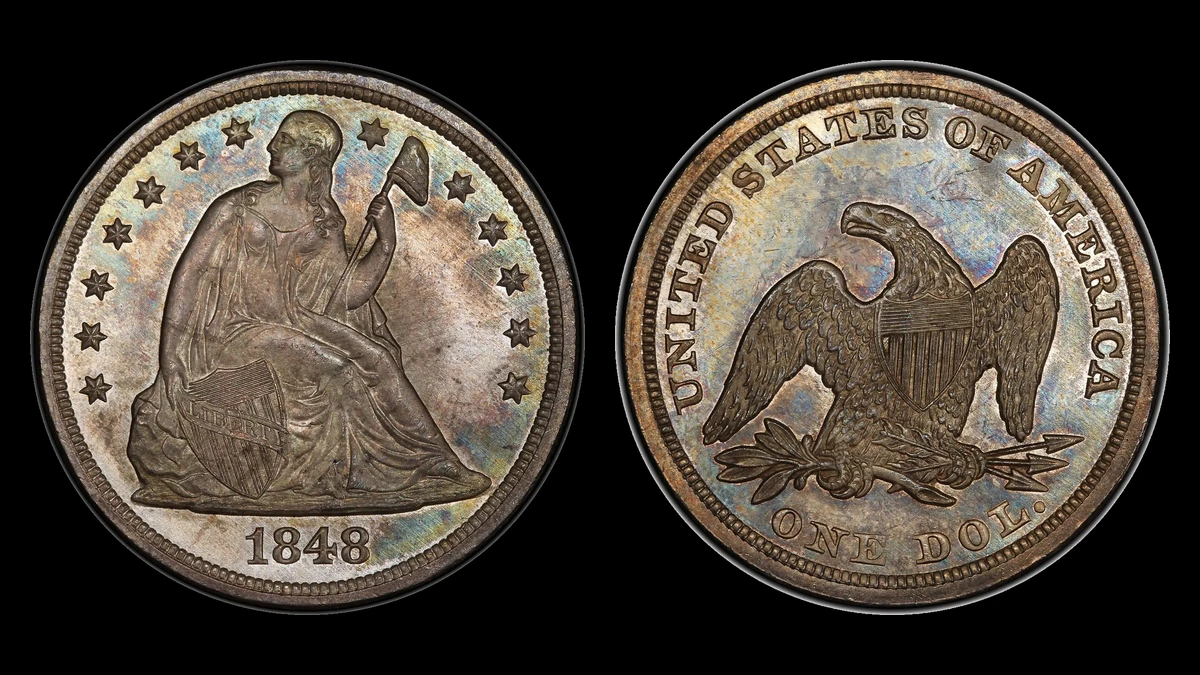
An exceptional 1848 Proof dollar brought $161,000 in July 2008. This 1848 Liberty Seated dollar error guide examines the small chest “badge” and reverse letter defects associated with rare Proofs.
Estimated whole-coin values span $15,000–$175,000. Compare the front spots and final A together, then judge the coin’s Proof identity and condition rather than pricing a raised mark alone.
1848 Dollar A chest badge and altered final A: Proof die defects Error
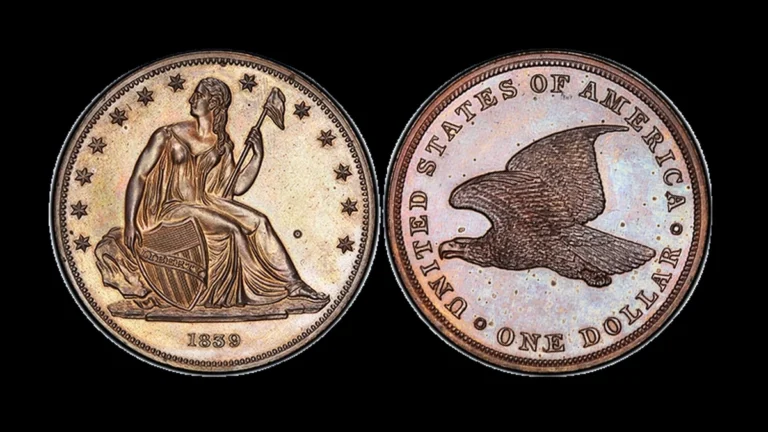
Below Liberty’s chest on the viewer’s right, small raised spots can resemble a badge or a large semicolon. This is the named feature of the Proof variety known as Breen-5440.
The reverse provides a second useful area to examine. The final A in AMERICA is partly filled at its lower right, with small spurs extending from its right sloping stroke.
These features were copied from defects in the steel stamping tools. Descriptions have attributed the damaged areas to chipping or rust, either of which can leave spaces that fill with metal during striking.
They help identify the particular Proof variety. An unrelated lump on an ordinary dollar does not turn that coin into a specially made collector issue.
How to Identify
Begin with the complete seated figure upright and retain the surrounding drapery in the photograph. Compare the chest spots as a group rather than isolating whichever one looks most badge-like.
Turn to AMERICA and locate its last A. Under magnification, compare both the partly filled lower-right opening and the small projections along the right diagonal.
The two areas should agree with an identified 1848 badge Proof. Dirt in a letter opening, an attached deposit, or a random die chip elsewhere cannot substitute for that combined pattern.
Use light from several directions to check how the raised features join the original surface. Do not pick at a spot or clean the letter to make the outline easier to see.
A Proof can have circulation wear or impaired surfaces and still retain its original method of manufacture. Conversely, polishing an ordinary strike cannot create a Proof.
Strong shine alone therefore cannot settle the identity. Both sides, their small variety markers, and the overall manufacture need to be compared with genuine Proof photographs.
What It’s Worth
The estimated whole-coin range is $15,000–$175,000, covering worn or impaired Proofs through exceptional examples. The rarity and preservation of the Proof account for much of that wide span.
PCGS records a PR67 auction result of $161,000 in July 2008. A separate PR64 badge example brought $28,000 before the buyer’s fee in March 2007.
The second amount excludes the buyer’s fee and should retain that qualification. Neither transaction is a standalone charge for a spot near Liberty’s chest.
Hairline scratches, cleaning, and wear remain important even when the badge and reverse letter match. A lower-grade Proof should be compared with similarly preserved complete coins.
Conclusion
The chest spots and final A provide two connected checks for the scarce 1848 badge Proof. Their locations and shapes matter more than whether a single raised mark looks unusual.
Establish the coin’s Proof identity and evaluate its surfaces before using the high auction comparisons. A worn or impaired Proof can retain the same die details as a superb example while carrying a very different whole-coin value.