Rare 1853 Dollar Errors (List & Pictures)
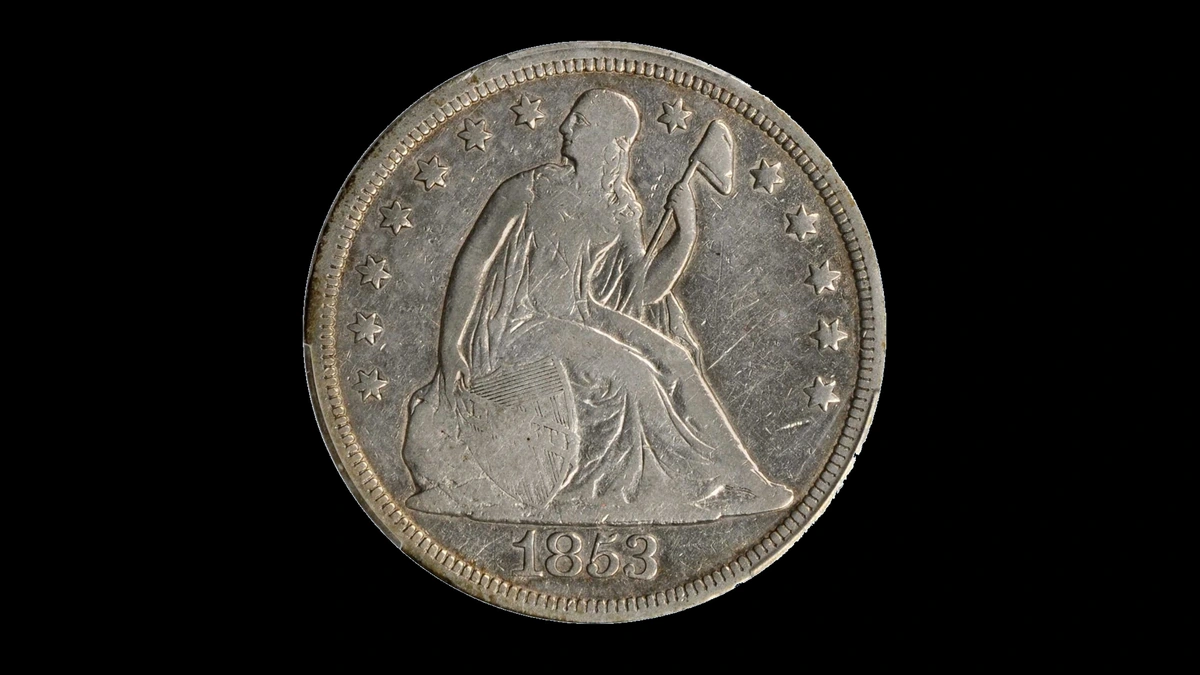
An 1853-dated Proof restrike reached $65,000 before buyer’s fees in October 2025. This 1853 Liberty Seated dollar errors guide covers estimated whole-coin values of $500–$150,000.
Compare shield lettering, chin lines, and date remnants separately, keeping reported ordinary-coin features distinct from the cataloged later Proof.
| Area | Reported feature | Estimated range |
|---|---|---|
| LIBERTY band and shield lines | Extra outlines needing attribution | $500–$15,000, conditional |
| Below Liberty’s chin | Die-finishing whiskers | $500–$20,000 |
| Ordinary 5 and 3 or Proof flag of 1 | Repunched date | $500–$150,000 by manufacture |
1. 1853 Dollar Extra outlines cross LIBERTY: lettering attribution under review Error
An indexed collector article mentions doubling in LIBERTY and extended shield lines on an 1853 dollar. The relevant area is the lettered band across Liberty’s shield.
The index identifies a feature for comparison without establishing its cause. A doubled design in the die, movement during striking, and tool reworking can leave different-looking evidence.
How to Identify
Frame the complete lettered band with the shield lines above and below it. Compare whether extra contours follow the letters or form flat shelves and unrelated cuts.
Light the area from more than one side to judge actual relief. A reflection in one enlarged photograph can imitate another letter edge.
A line extending beyond the band is not automatically another design impression. Match its route and nearby lettering with the reported specimen before assigning a mechanism.
What It’s Worth
The conditional whole-coin estimate for a confirmed original ordinary-strike lettering variety is $500–$15,000.
The index reference provides no completed sale. Thick-looking LIBERTY lettering alone cannot justify the range or a doubled-die attribution.
2. 1853 Dollar Fine lines descend from the chin: die-finishing whiskers Error
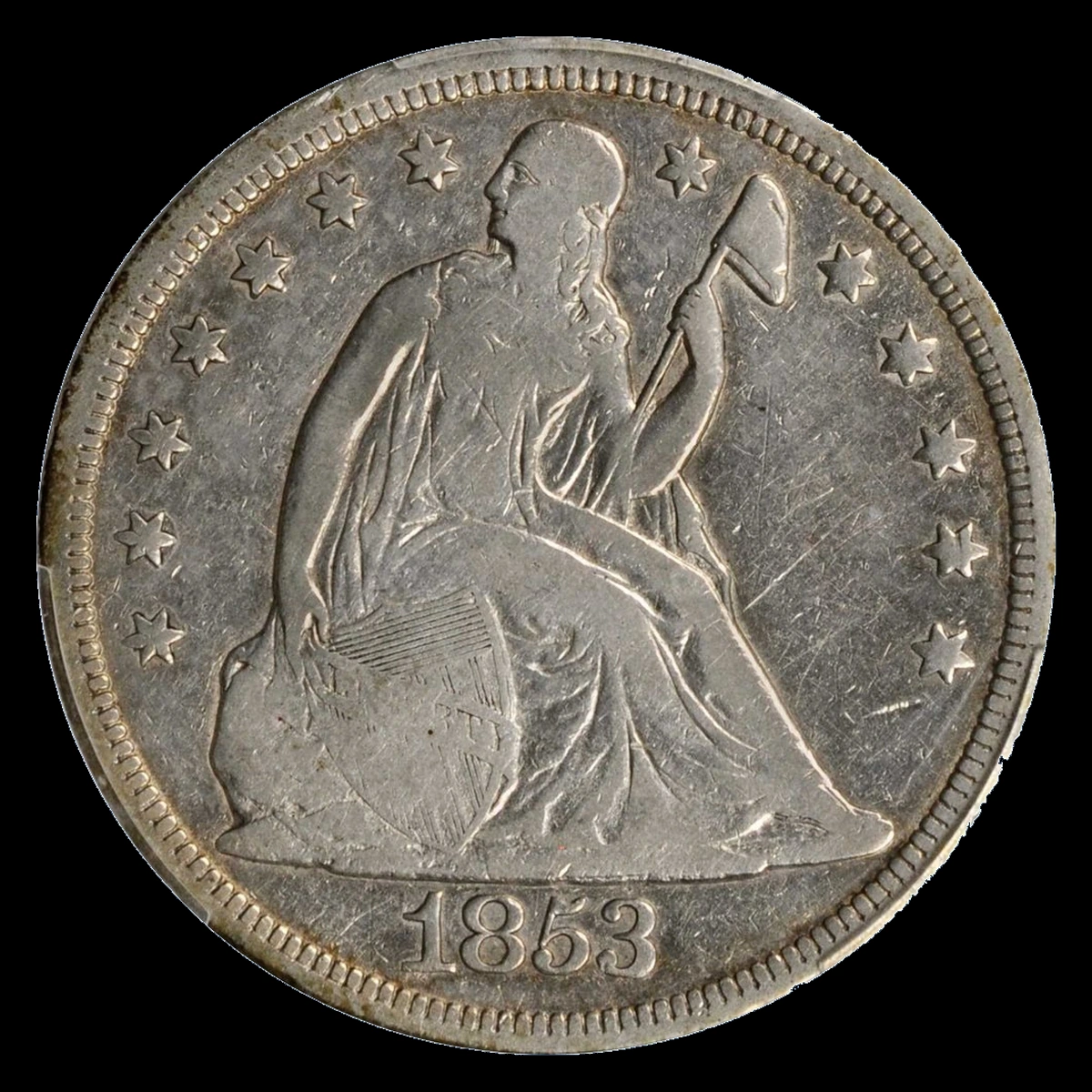
Short lines beneath Liberty’s chin can resemble whiskers. They are associated with finishing marks in the die that were copied onto ordinary 1853 dollars.
Early impressions may show the pattern more clearly than later coins. The lines are not proof that hair or wire remains on the dollar.
How to Identify
Locate each line’s starting point immediately beneath the chin. Compare the arrangement with a known early 1853 example at similar magnification.
Keep the date attached to the comparison because other years can also show chin lines. Look for cut edges or disturbed metal that might indicate handling scratches.
Move the light without wiping the surface. Wear and changes to the die can weaken the pattern, so absence alone does not establish a different coin type.
What It’s Worth
Matching ordinary examples have an estimated whole-coin range of $500–$20,000.
An ordinary 1849 MS65 sold for $41,400 in May 2003. That different-year preservation comparison does not price the 1853 chin lines.
The tiny pattern helps describe the tool. Condition and surface quality still account for much of the dollar’s value.
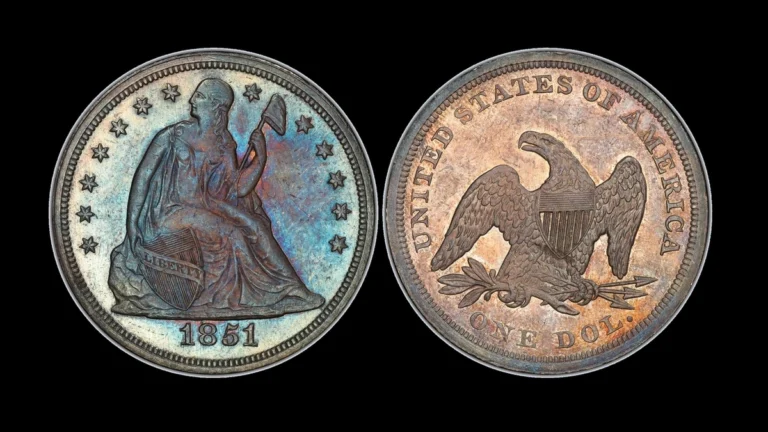
3. 1853 Dollar A numeral retains an earlier contour: repunched date Error
A year guide reports repetition at 5 and 3 without a precise die attribution. The documented Proof OC-P2 instead has slight repunching at the flag, or short top stroke, of 1.
Both descriptions concern repeated date-punch work in a die, but they are separate reports. They should not be combined into one required pattern across three digits.
The cataloged Proof was offered as a restrike, meaning a later coin carrying an earlier date. Its manufacture and value require a different comparison from an ordinary dollar.
How to Identify
For OC-P2, inspect the top of 1 against an identified Proof photograph. Keep the other digits and adjacent border teeth in view to preserve the complete date placement.
The reported 5-and-3 feature needs its own reference. The Proof image cannot supply missing directions or shapes for that ordinary-coin report.
Extra strokes should form raised remnants that relate to a numeral. Scratches and flat striking shelves require different explanations.
Assess the complete coin’s manufacture before applying a Proof price. Bright fields on an ordinary dollar are insufficient.
What It’s Worth
The combined estimate is $500–$150,000, including $500–$20,000 for confirmed ordinary examples and $25,000–$150,000 for identified Proofs.
The NGC PR65 OC-P2 reached $65,000 before buyer’s fees in Heritage’s October 2025 sale. That amount is not a fee-inclusive total.
The result prices a well-preserved scarce Proof restrike. Its small repeated 1 is part of the identification, not an independently priced error.
Conclusion
The shield band, chin, and date provide three distinct inspection areas. Retain uncertainty where the source identifies a topic without settling its mechanism, and use a matching photograph before naming the feature.
The ordinary reports should remain separate from Proof OC-P2. Its $65,000 result excludes buyer’s fees and reflects the complete restrike’s rarity and preservation, not the value of one small extra stroke on any 1853 dollar.