Rare 1877 Penny Errors (List & Pictures)
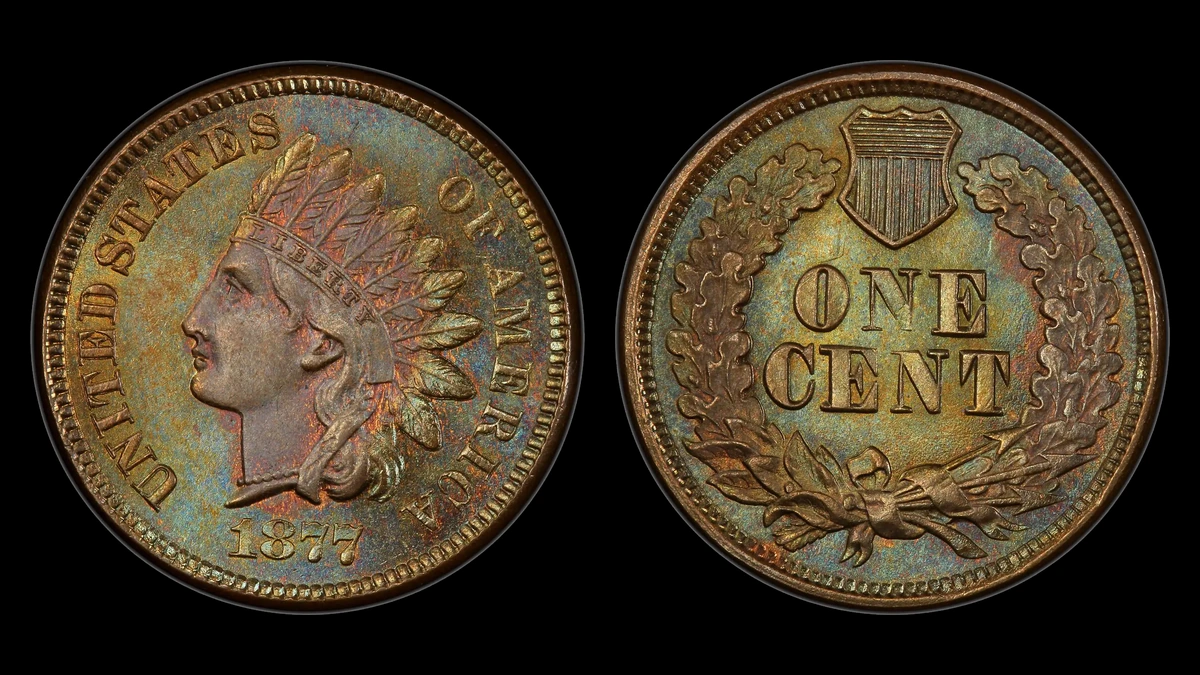
A superb cent carrying a tiny neck marker sold for $19,200 in February 2025. For 1877 penny errors, that is a whole-coin result reflecting the scarce date and condition, not the price of the marker alone.
Estimated ranges span $500–$35,000. Check altered or missing design first, then compare the neck, date, and reverse markers.
A normal bronze cent weighs 3.11 grams and measures about 19 mm, with a plain edge. No single marker or measurement authenticates the entire coin.
| Visible clue | Category | Estimated whole-coin value |
|---|---|---|
| Displaced design beside unused metal | Reported off-center strike | $1,000–$10,000, conditional |
| Local design fails to form | Reported struck-through material | $600–$6,000, conditional |
| Raised point above ribbon | Snow-2 neck die dot | $500–$25,000 |
| Raised lines at 1 and final 7 | Date die cracks | $500–$35,000 |
| Diagonal mark above O in ONE | Reverse die clash | $500–$35,000 |
1. 1877 Penny Unused Metal Borders a Displaced Design: Reported Off-Center Strike Error
An off-center strike requires a blank positioned so that some of the design misses it. Unstruck metal remains opposite the missing design.
A year guide reports this category for 1877 without supplying an authenticated specimen, strike percentage, or type of manufacture. The report therefore supports a category to investigate, not an exact visual pattern to assign to every candidate.
How to Identify
Read the surviving date before estimating the displacement. An absent final digit cannot simply be reconstructed as a 7 because 1877 is valuable.
Photograph both faces so their boundaries can be compared with one misplaced blank. A shift on only one face, a cut edge, or a surface ground blank calls for another explanation.
What It’s Worth
The conditional estimate is $1,000–$10,000 for authenticated ordinary-strike examples from worn through lightly worn condition. No supplied auction sale establishes that range for an 1877 off-center coin.
A 10% off-center 1897 cent graded AU58 sold for $280.60 in March 2026. Its very slight wear offers context, but the far scarcer 1877 date and any exceptional unworn grade need separate valuation.
2. 1877 Penny Part of the Design Never Forms: Reported Struck-Through Material Error
Material caught between a blank and a die can block the design or leave an impression of the obstruction. A die is the steel tool that stamps the coin.
The supplied 1877 year-guide report names the broad struck-through category without an exact location or object. It does not establish separate cloth, grease, or metal-fragment specimens.
How to Identify
Trace a neighboring letter or portrait detail into the affected area. Determine whether it failed to form during striking or was crushed by a later impact.
Preserve any material still attached and photograph it without removal. Establish the date and ordinary or Proof manufacture independently; a depression or low weight cannot identify the obstruction.
What It’s Worth
Confirmed ordinary-strike examples in worn through lightly worn condition have a conditional estimate of $600–$6,000. Much of that value already belongs to the scarce 1877 date.
A 1920 bronze cent struck through a metal fragment sold for $134 in March 2025. That later coin illustrates the mechanism, while exceptional unworn 1877 pieces require their own condition comparisons.
3. 1877 Penny A Raised Point Sits at the Neck and Hair: Snow-2 Die Dot Error
At the neck-and-hair junction just above the ribbon, a tiny dot helps identify the Snow-2 die variety. Auction descriptions use it as a marker rather than proof of a separate valuable striking mistake.
How to Identify
Enlarge the junction and compare the point with an identified Snow-2 photograph. Do not scrape a speck or deposit to test whether it hides a raised dot.
Assess the full date, both designs, and the edge along with the marker. Weaker portions of the N letters in ONE CENT are also noted for ordinary coinage, but their sharpness varies and cannot authenticate a coin alone.
What It’s Worth
The whole-coin estimate is $500–$25,000 across genuine worn pieces and suitable well-preserved unworn examples. The marker does not account for most of that range.
A PCGS MS65 Red Snow-2 cent sold for $19,200 in February 2025. Its high unworn grade and retained red color belong to the complete scarce-year coin, with no extra dot price to add.
4. 1877 Penny Raised Lines Cross the Date: Die Cracks Error
One documented Snow-2 coin has a thin raised line through the final 7 and a shorter line extending left from the lower-left foot of 1. Coin metal filled cracks in the die to form these ridges.
The example was graded NGC MS66 Red and Brown, indicating exceptional unworn preservation with some original red color. It also carries the reverse clash described next.
How to Identify
Keep the date upright while tracing both paths under changing light. Their centers should rise above the surface, rather than form the cut-in grooves of later scratches.
Compare the entire pattern and inspect the date area for alteration. A corresponding reverse clash may support the same die pair, but cannot create a missing date crack or establish the coin’s grade.
What It’s Worth
Estimated whole-coin values run $500–$35,000, from genuine worn cents to exceptional unworn pieces. The scarce date and preservation carry most of that value.
The described MS66 Red and Brown coin has a $32,900 January 2015 auction record explicitly marked as an owner buyback. It was not an independent buyer’s completed purchase, and the cracks do not guarantee a large surcharge on another coin.
5. 1877 Penny A Diagonal Mark Appears above ONE: Reverse Die Clash Error
The diagonal trace immediately above the O in ONE is described on the same MS66 coin as the date cracks. It belongs to a clash, caused when the dies meet without a blank and leave marks that later coins reproduce.
The supplied description does not identify which part of the front design produced that line. Its documented position and angle are the available starting points.
How to Identify
Compare the area above O without rotating an unrelated scratch until it appears similar. Changing the light helps distinguish the mark from a shadow cast by the letter.
Then compare the date-crack pattern on the other face. The paired evidence is more useful than either line alone, but neither replaces a complete authenticity assessment.
What It’s Worth
The estimated whole-coin range is $500–$35,000. A faint reverse clash does not independently explain the high end.
The $32,900 January 2015 owner-buyback record concerns the same MS66 coin discussed under date cracks. It must not be counted as another sale or added to a separate crack valuation.
Conclusion
For 1877, identifying the coin and its preservation matters before assigning value to an unusual feature. The neck dot, two date cracks, and reverse clash provide different details to compare, while the reported striking errors need their own confirmation.
Use the $19,200 result as a sale of a high-grade complete coin, and retain the owner-buyback qualification on the larger record. Small markers are not separate prices to stack onto an already scarce cent.