Rare 1900 Dollar Errors (List & Pictures)
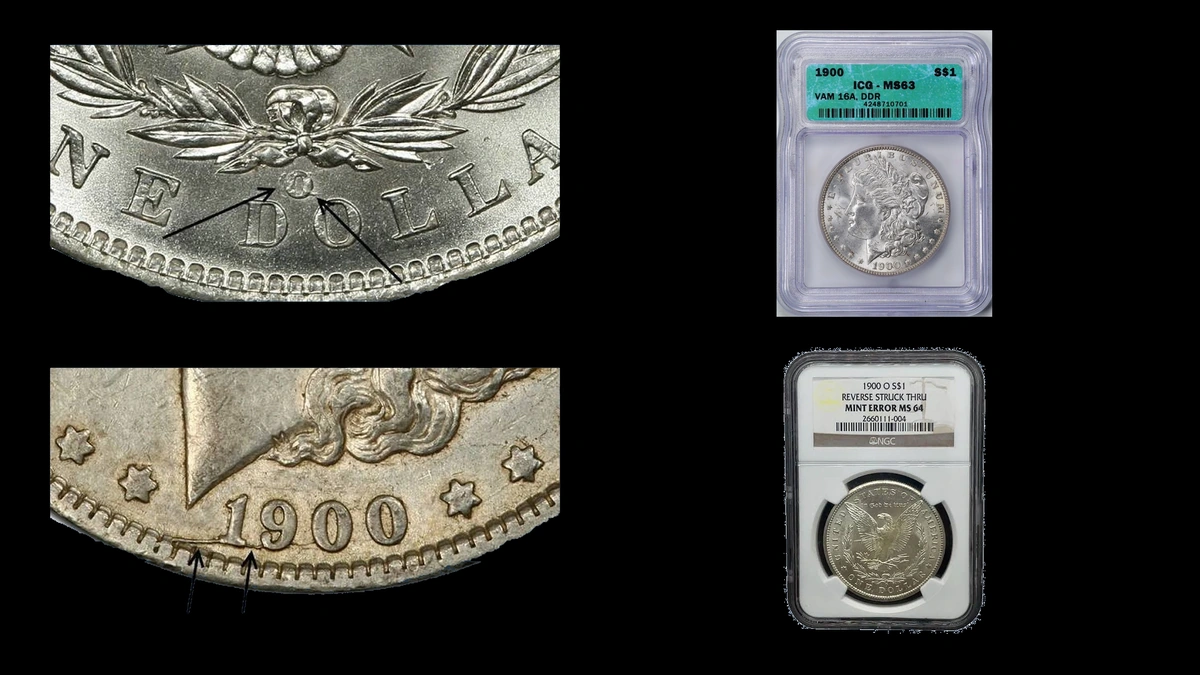
Three different mintmark questions arise among 1900 Morgan dollar errors: an O over earlier CC letters, overlapping S shapes, and ordinary letter styles that are not errors. An exceptional O/CC graded MS67+ sold for $52,875 in October 2015, the highest supplied completed result.
Whole-coin estimates span $60–$60,000. Start beneath the wreath, compare the nearby designs, and finish with both-face alignment and the edge.
| Look for | Category | Estimated value |
|---|---|---|
| CC remnants around O | Overmintmark | $75–$10,000 ordinarily; $25,000–$60,000 for exceptional coins |
| Two S outlines | Repunched mintmark | $100–$3,000 |
| Repeated olives, wings, or stars | Doubled die | $60–$3,500 |
| Raised line or interrupted patch | Die damage or struck through | $60–$2,500 |
| Shifted front or stepped edge | Misaligned die or partial collar | $75–$5,000 |
1. 1900 Dollar Curves of CC remain beside O: overmintmark Error
The 1900-O/CC records a change made to a reverse die. An O was punched over earlier CC letters, and surviving portions of those letters appeared on dollars subsequently made at New Orleans.
The coin is therefore a New Orleans issue. There was no regular 1900-CC Morgan dollar issue.
How to Identify
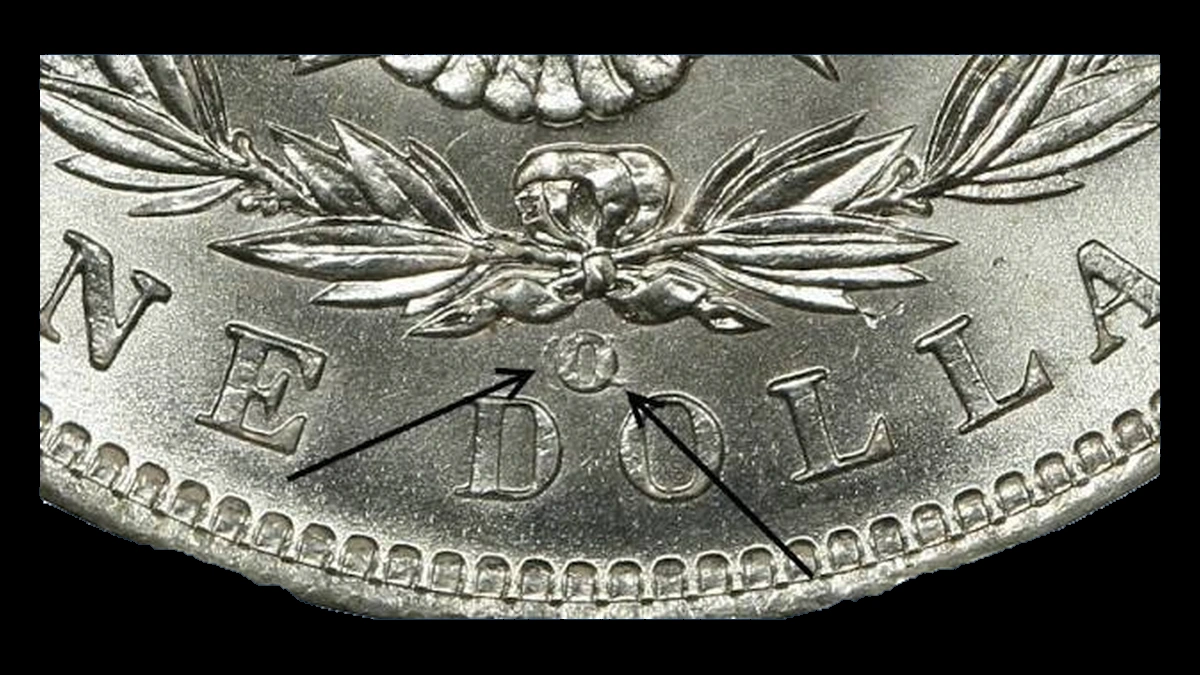
Find the O above DO in DOLLAR and inspect its entire outline under magnification. Look for remnants whose curves and positions agree with a documented O/CC die.
More than one die carried the feature, so the surviving CC detail varies. An O punched twice, a small O, or a curved dent is not interchangeable with this overmintmark.
Check for cuts or added metal around the letter, then match the other die details in the same reference. A lone extra curve is a starting clue rather than a complete attribution.
What It’s Worth
$75–$10,000 is the supplied range for ordinary circulated through attractive unworn examples, with $25,000–$60,000 reserved for exceptional top-condition coins. PCGS records an MS67+ O/CC at $52,875 in October 2015.
That result reflects an unusually clean unworn dollar. The same mintmark variety on a worn coin does not carry the record specimen’s complete value.
2. 1900 Dollar Narrow and wide S shapes overlap: repunched mintmark Error
A San Francisco variety preserves portions of two differently shaped S impressions in the same mintmark. The overlap originated in the die when the mintmark was punched.
Narrow and wide S styles are not inherently errors. The surviving second outline distinguishes the repunched variety from a normal single letter.
How to Identify
Locate the S above DO in DOLLAR and follow its upper curve, middle, and lower curve. Compare that main letter with normal narrow and wide forms before interpreting the additional metal.
The remnants should fit a coherent second S. Flat shelves, wear, scratches, and isolated lumps do not establish the same overlap.
A high mintmark or front die cracks do not automatically identify this variety. Those clues belong to separate comparisons unless the complete die match supports a connection.
What It’s Worth
$100–$3,000 is the estimated range for authenticated examples from circulated through moderately unworn condition. It includes the underlying San Francisco dollar.
Clear surviving outlines help show the feature, while heavy marks or wear can obscure it. No completed sale for a specifically graded overlapping-S specimen is supplied here.
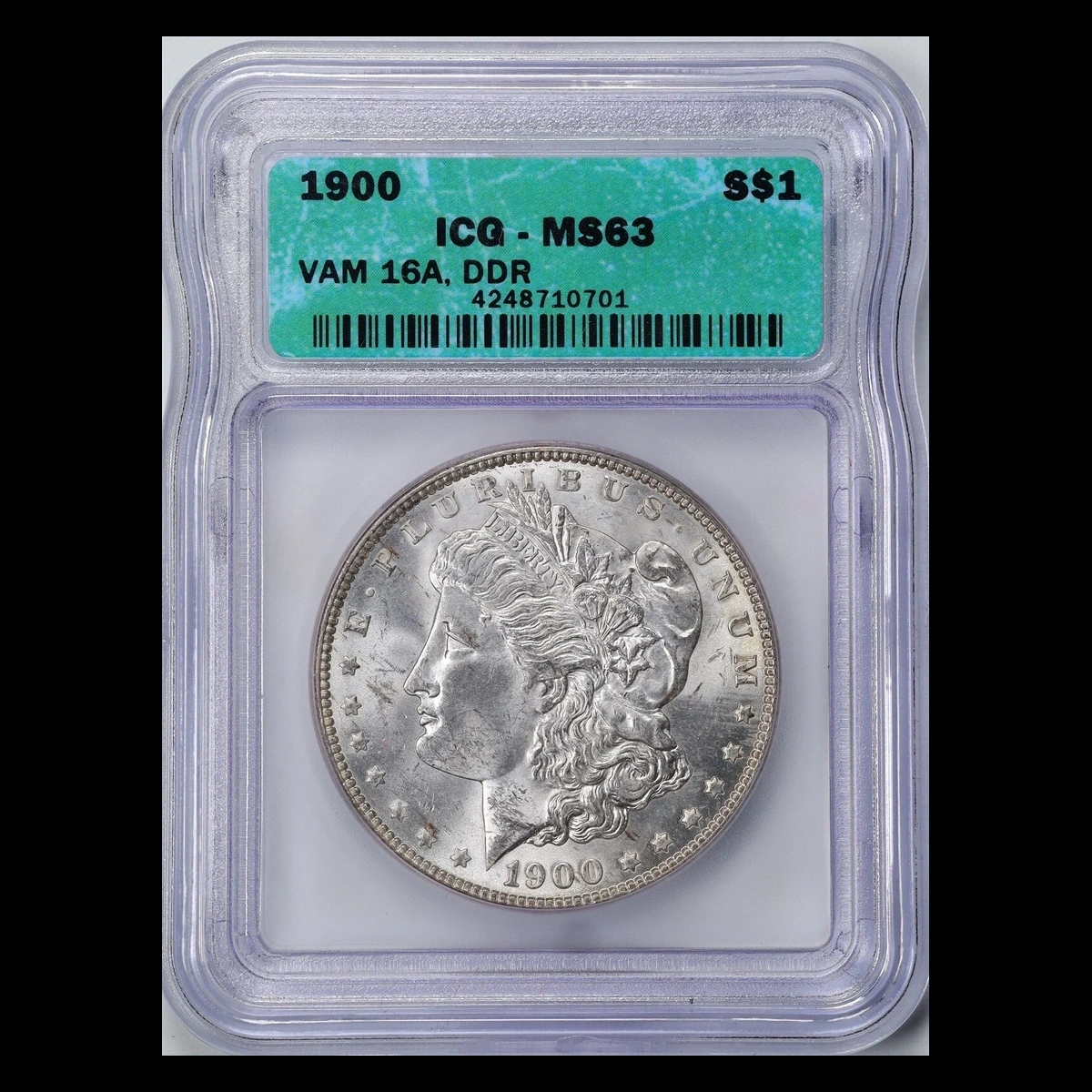
3. 1900 Dollar Olives, feathers, or star points repeat: doubled die Error
Some Philadelphia reverse dies received impressions from two versions of the master design. Their overlapping features can create the Two Olive appearance beneath the eagle.
Separate Philadelphia patterns involve wing doubling, while a New Orleans variety affects front stars. These locations describe different varieties rather than one combined checklist.
How to Identify
For Two Olive, compare the extra raised contour beneath the eagle with an identified example. Include nearby wings and arrows so the design combination remains clear.
Normal differences between reverse designs do not alone prove doubling. A wing-only Philadelphia pattern needs its own comparison, as does the star-tip separation on an O-mint dollar.
Reflections can resemble another olive in a dark photograph. Look for actual raised duplicated shape rather than counting spots or accepting flat strike-related shelves.
What It’s Worth
$60–$3,500 is the supplied estimate across identified varieties in ordinary collectible condition. A Two Olive example graded PCGS MS66+ sold for $911 in December 2019.
Greysheet’s supplied auction index also lists an MS64 example at $149 in March 2022. Both are unworn grades, but the difference in preservation makes them distinct whole-coin comparisons.
4. 1900 Dollar Ridges or a raised patch cross the design: die cracks and breaks Error
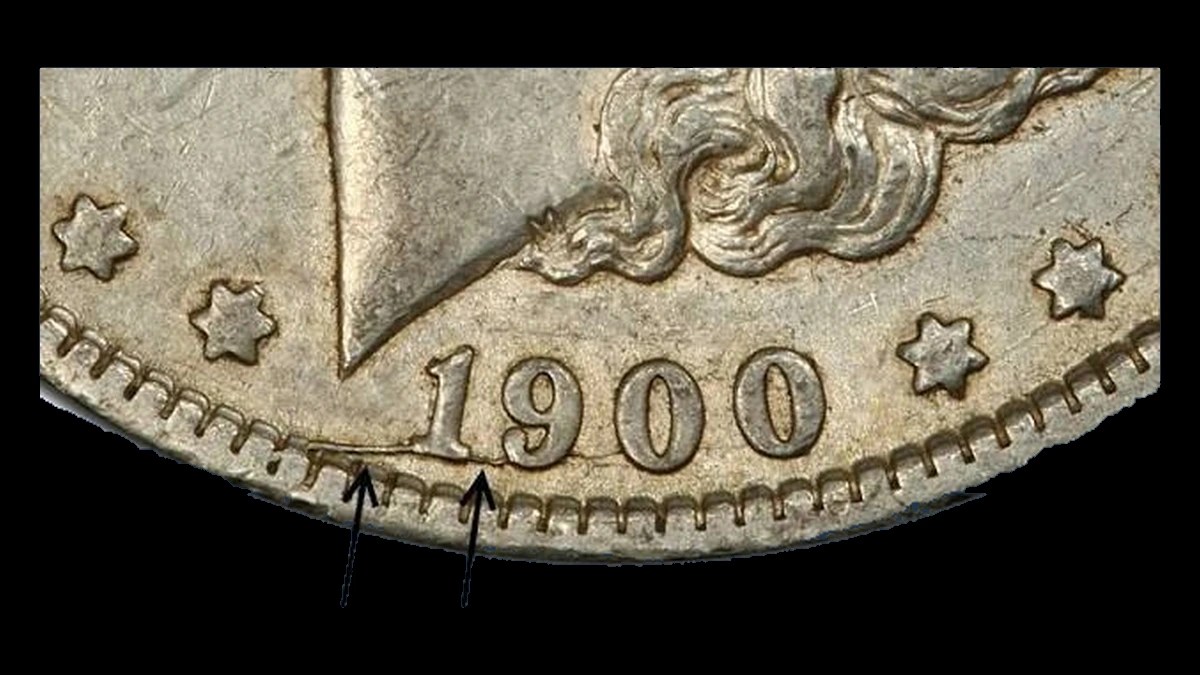
A damaged die can add metal to the struck image: silver fills a crack or a larger missing portion of the tool. The result appears raised on the dollar.
The New Orleans VAM-29A has a front die break. A separate San Francisco report describes cracks above the date and around the stars at the right.
How to Identify
Use changing light to establish whether a line rises from the surface or cuts into it. Then follow the entire route and compare it with the correct mint’s documented pattern.
The New Orleans break does not inherit the San Francisco crack locations. On the reported S coin, its high mintmark is a supporting marker, not itself a crack or proof of repunching.
Inspect a larger bump for dents, added material, or crushed adjacent letters. A genuine die break must fit the surrounding struck surface.
What It’s Worth
$60–$2,000 is the estimate for authenticated cracks and breaks in ordinary collectible grades. An obvious raised break generally offers stronger visual interest than a thin incidental line.
A 1904-O Fishhook variety sold for $999 in July 2023. That different-date, clash-related feature illustrates interest in named varieties but is not a matched sale of a 1900 die break.
5. 1900 Dollar A depression interrupts the picture: struck through Error
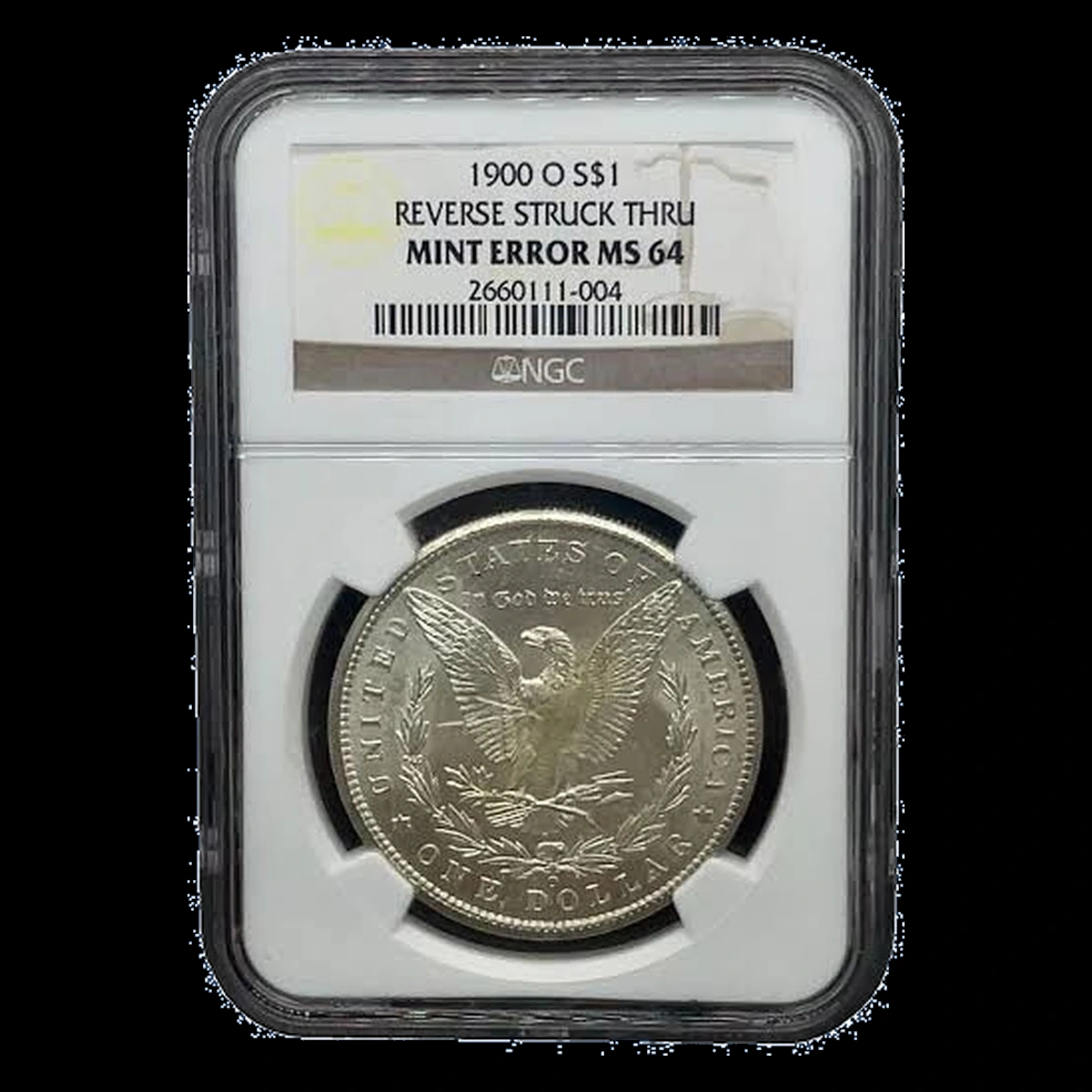
Material between the blank and die can leave a hollow or weak patch where it blocks the design. The supplied year list includes this category without fixing a mint, location, or object.
It does not establish a separate known specimen for every possible substance. The actual surface must support any more specific description.
How to Identify
Examine where a normal letter or portrait detail meets the patch. Its interruption should relate to the shape or coverage of the obstruction.
Texture inside the hollow can help, but it may not identify the material. A later impact can crush completed detail and push metal around the boundary.
Record both faces and the mintmark before choosing a comparison. Do not label a generic depression cloth, wire, or retained material without specimen-specific evidence.
What It’s Worth
$100–$2,500 is the estimated range for authenticated struck-through examples. Clear impressions on original surfaces generally provide more useful comparisons than vague weak areas.
A 1923 Peace dollar with a front strike-through sold for $134 in March 2023. It is a later silver-dollar comparison for the mechanism, not a confirmed 1900 transaction.
6. 1900 Dollar The front border is uneven but the back is centered: misaligned die Error
A front die out of position can move the portrait design relative to the rim while leaving the reverse centered. The supplied year report describes a Fine 15 example, but its mint must be checked on the actual coin.
A misplaced blank can instead shift both faces. That distinction makes a complete pair of straight-on views essential.
How to Identify
Compare the spaces between outer letters or stars and the rim on opposite sides of the front. Repeat the examination on the reverse without changing the image scale or cropping the edge.
Check crowded front details against the actual outline to distinguish shifted design from removed metal. Read the mintmark area above DO in DOLLAR before assigning a mint-specific comparison.
What It’s Worth
$75–$1,500 is the estimated range from worn minor misalignments to stronger shifts on attractive unworn dollars. The year guide reports $94 for the Fine 15 example without a sale date.
The reported amount is a limited comparison. A clearly displaced front paired with a centered reverse is more convincing than a merely wide border in a tilted photograph.
7. 1900 Dollar A step interrupts the edge grooves: partial collar Error
When only part of the blank sits inside the collar, the confined and unconfined metal spread differently. The finished dollar can have two edge levels.
The supplied reports do not establish one mint or a fixed location for the step. Its relationship with the grooves and nearby rim carries the useful evidence.
How to Identify
Inspect several views around the edge, keeping a certified holder closed. Trace where grooves change or meet the expanded portion and compare the adjoining rims on both faces.
A normal Morgan measures about 38.1 millimeters and weighs 26.73 grams. Collar errors can spread metal without losing it, so near-normal weight does not rule one out.
Hammering or grinding can flatten grooves and distort a finished edge. Those altered surfaces should not be mistaken for the original transition produced during striking.
What It’s Worth
$150–$5,000 is the supplied estimate for authenticated partial-collar examples. Strong visible edge structure and preservation distinguish the more compelling coins.
A 1971-D Eisenhower dollar with both an indent and partial collar contact sold for $408 in August 2020. Its different series and combined features make it a broader comparison rather than a direct 1900 price.
Conclusion
Read the mintmark as a whole before assigning a variety, and keep normal letter styles separate from overlapping impressions. The same care applies to ordinary reverse-design differences and genuine doubled features.
For larger striking errors, both faces and the edge explain more than a cropped close-up. Match the specific mechanism, mint, and condition before choosing a value, especially when comparing a worn dollar with the exceptional O/CC record.