Rare 1899 Half Dollar Errors (List & Pictures)
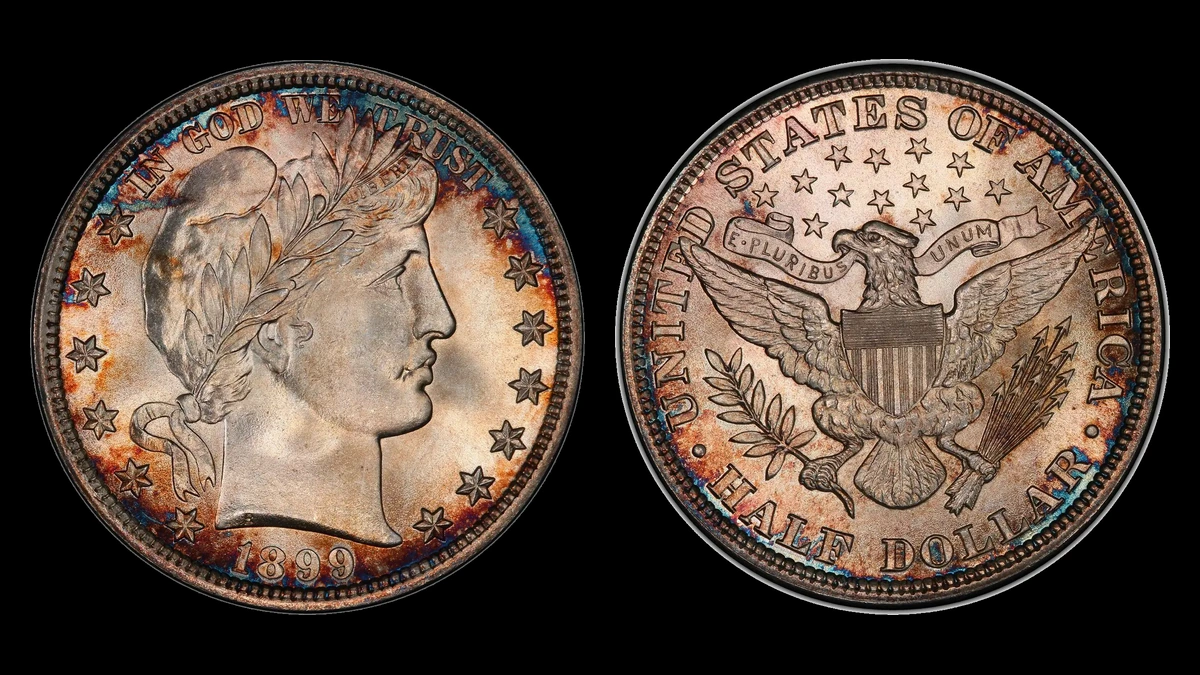
An extra edge on a letter does not always reveal how it formed. The 1899 half dollar errors covered here include a reverse-doubling report whose cause remains unsettled, as well as date, mintmark, and off-center features.
Estimated values run from $200–$4,000. A regular MS65 1899 sold for $1,560 in January 2025, providing condition context; begin with the outline, then examine the date and reverse details.
| Visible clue | Area to compare | Feature | Estimated value |
|---|---|---|---|
| Design displaced onto the edge | Both faces and blank margin | Off-center strike | $1,000–$4,000 |
| Extra pieces of a digit | Philadelphia date | Repunched date | $1,500–$2,200 at MS65 |
| Extra letter outlines | UNITED and DOLLAR on an S coin | Unresolved reverse doubling | $200–$400 |
| A remnant of another S | Below the eagle | Repunched mintmark | $250–$600 |
Normal unworn specifications are approximately 12.50 grams and 30.6 mm, with a grooved edge. Use weight and size as supporting checks for a loose coin, allowing for metal lost through wear.
1. 1899 Half Dollar The Design Shifted Toward the Lower Left: Off-Center Strike Error
A historic listing describes an 1899 half dollar struck about ten percent off center toward seven o’clock. It had light wear and a scratch on the front, and the listing did not specify its mint.
In an off-center strike, the blank’s position determines which metal remains unstamped and which design falls beyond the edge. The later scratch is a separate condition issue.
How to Identify
Hold the front upright before judging the seven-o’clock direction in the historic catalog description. That direction describes the listed specimen rather than every possible 1899 off-center strike.
Inspect the complete back for displacement consistent with the front. A narrow front border paired with a centered reverse can point to a misplaced die instead of the blank having shifted.
Find the surviving blank metal and examine its boundary with the struck area. Cutting away part of a coin may remove design but does not leave the original blank crescent.
Read the date and check any surviving mintmark before making price comparisons. Keep scratches and filing separate from the mint-made displacement when judging the surfaces.
What It’s Worth
Estimated range: $1,000–$4,000 for a lightly worn 1899 with about ten-percent displacement. The unspecified mint and the scratch in the old listing limit how precisely that report can be valued.
A ten-percent off-center 1896-S Barber graded AU Details was offered at $4,820.40. It is an asking price for a different, scarcer date and mint, rather than a completed 1899 sale.
A fifteen-percent off-center 1976 Kennedy graded NGC MS64 sold for $480 in December 2025. Its modern date and different series make it broader category context only.
2. 1899 Half Dollar A Digit With an Extra Piece: Repunched Date Error
The Barber society survey records a Philadelphia 1899 repunched-date example without naming the affected digit or the direction of its remnant. A full date comparison is therefore necessary.
Date digits were punched into the die that would later stamp the coins. If a changed punch position left part of an earlier impression uncovered, that fragment could appear beside the final numeral.
How to Identify
Place a normal Philadelphia date beside the candidate before enlarging any particular number. The two ordinary 9s are part of the intended date, so their repetition has no error significance.
Search for a small raised stroke that fits an additional position of one digit. Thickness by itself may reflect the normal design, wear, or a flat shelf produced during striking.
Check the absence of a reverse mintmark and seek an identified 1899 reference. Another date can illustrate repunching as a process but cannot supply the missing diagnostic for this report.
One survey response is a record of an example, not a census proving only one coin exists. The report’s limited detail also means a suspicious mark may remain unconfirmed until a proper comparison is available.
What It’s Worth
Estimated range: $1,500–$2,200 for a genuine Philadelphia example at MS65, a well-preserved grade with no circulation wear. A regular PCGS MS65 1899 brought $1,560 in January 2025.
The auction supplies a date-and-condition baseline without a repunched-date attribution. Any allowance above it depends on clear variety identification, since the survey provides no sale price for its reported coin.
3. 1899 Half Dollar Extra Outlines on UNITED and DOLLAR: Unresolved Reverse Doubling Error
These two words are the locations recorded for doubling on a worn 1899-S. The society report preserves the observation without deciding whether a doubled die or movement during striking produced it.
A doubled die carries repeated detail in the steel tool itself. Striking movement can instead create a lower, flatter shelf along the edge of otherwise normal lettering.
How to Identify
View UNITED and DOLLAR at the same magnification and light angle. Comparing both prevents one unusually strong shadow from dominating the diagnosis.
Study the height of the extra edge: is there rounded duplicate detail, or a flat step below the main letter? A photograph may not resolve that distinction clearly enough to identify the cause.
Move the lamp while retaining some surrounding field in view. Then verify the S and the date, so the observed words are being compared within the reported year and mint.
What It’s Worth
Estimated range: $200–$400 for a worn example around Extremely Fine condition with the reported appearance. No established doubled-die premium is built into that range.
The $210 paid in March 2018 was for a regular 1899-S with a PCGS XF45 grade. That same-mint comparison supports the underlying value of a circulated coin, not a confirmed sale of the unresolved doubling.
Until the cause is established, original surfaces and remaining detail are the firmer basis for valuation. The descriptive word “doubling” alone does not settle the premium.
4. 1899 Half Dollar A Curved Fragment Beside the S: Repunched Mintmark Error
Below the eagle’s tail, an extra piece of an S may remain beside the final mintmark. The society survey records two reported examples, with no fixed direction for the extra stroke.
The S was added to the die using a separate punch. A slight change between impressions could leave a remnant, which is the meaning of the collector shorthand S/S.
How to Identify
Concentrate on whether the fragment fits the curves of another S. A scrape can push silver next to the mintmark without preserving a second letter shape.
Check for a recessed cut alongside any raised lip and distinguish a flat shelf from a curved punch remnant. The doubling in UNITED and DOLLAR needs its own analysis and cannot confirm the mintmark feature.
Use a documented 1899-S comparison rather than assigning an overlap direction from another year. The survey’s two reports do not establish the total number surviving.
What It’s Worth
Estimated range: $250–$600 for a clearly identified S/S around Extremely Fine. The range allows for visible repunching while keeping the circulated coin’s basic value in view.
The regular XF45 sale at $210 in March 2018 is the same comparison used above. It is not a sale of either surveyed S/S example.
Conclusion
A full outline settles questions that a date close-up cannot, while the reverse words and mintmark each need their own diagnosis. In particular, the reported UNITED and DOLLAR effect should remain unresolved unless its cause can be shown.
Across the $200–$4,000 estimates, match mint, condition, and the actual feature. Ordinary-coin sales and other-date asking prices provide context without becoming confirmed 1899 error transactions.