Rare 1968 Half Dollar Errors (List & Pictures)
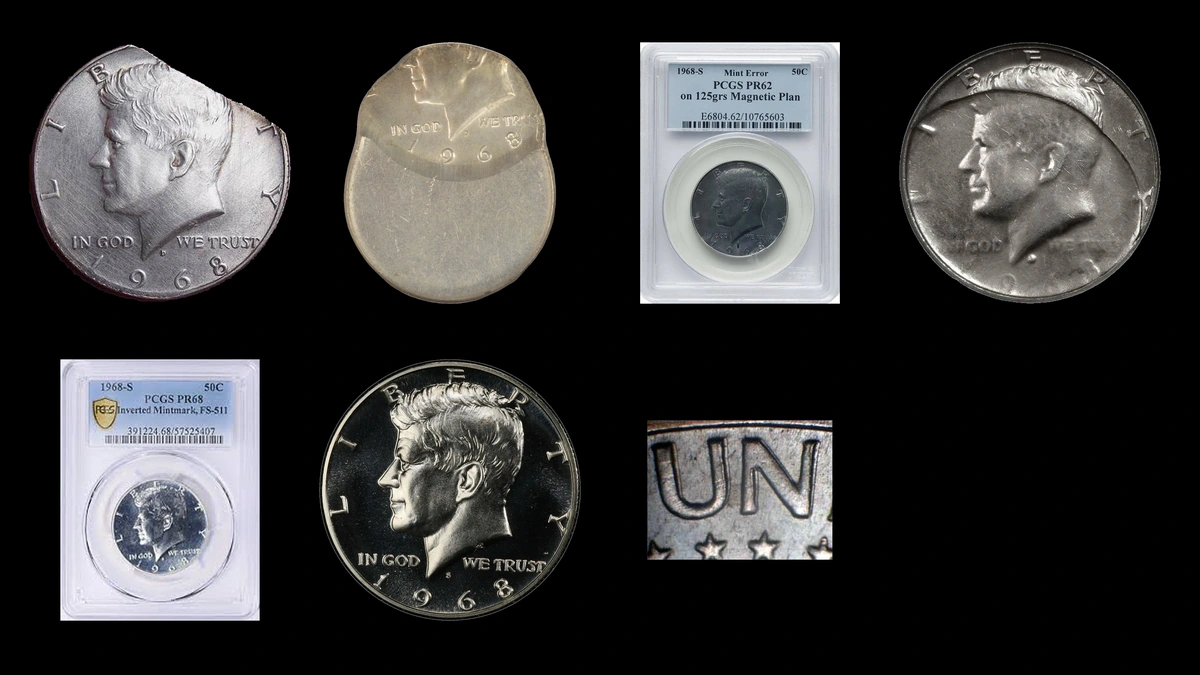
A magnetic 1968-S proof weighing about 8.1 grams sold for $9,000 in August 2025. It represents the dramatic end of 1968 half dollar errors, which have supplied estimates from $10 to $10,000.
Some varieties require only a tiny letter comparison, while others alter the blank, layers, or entire strike. Inspect the outline and metal first, then follow the mintmark and repeated design details.
| Clue | Category | Estimated range |
|---|---|---|
| Missing curved section | Clip | $50–$350 |
| Thin-looking body | Thin-planchet candidate | $75–$250 if established |
| Unstruck crescent | Off-center strike | $150–$1,500 |
| Small second design | Double strike with uniface reverse | $400–$1,800 |
| Small blank, cropped design | Denver wrong planchet | $800–$4,500 |
| Unusual proof metal | Proof wrong planchet | $2,500–$10,000 by type |
| Opening or missing metal layer | Clad-layer failure | $75–$750 |
| Foreign-object impression | Strike-through | $75–$800 |
| Additional mintmark fragment | Repunched mintmark | $25–$675 |
| S loops reversed | Inverted S | $150–$1,250 |
| Slight repeated thickness | Inherited doubling | $10–$35 |
| Extra front contours | Doubled or tripled obverse | $25–$1,000 |
| Extra reverse letters or star points | Doubled or tripled reverse | $25–$4,000 |
The normal 1968 half weighs 11.50 grams and measures 30.61 millimeters, with a grooved edge and 40% silver overall. Its bonded outer layers contain 80% silver and its core about 20.9% silver, so an exposed center differs from the copper core of later ordinary halves.
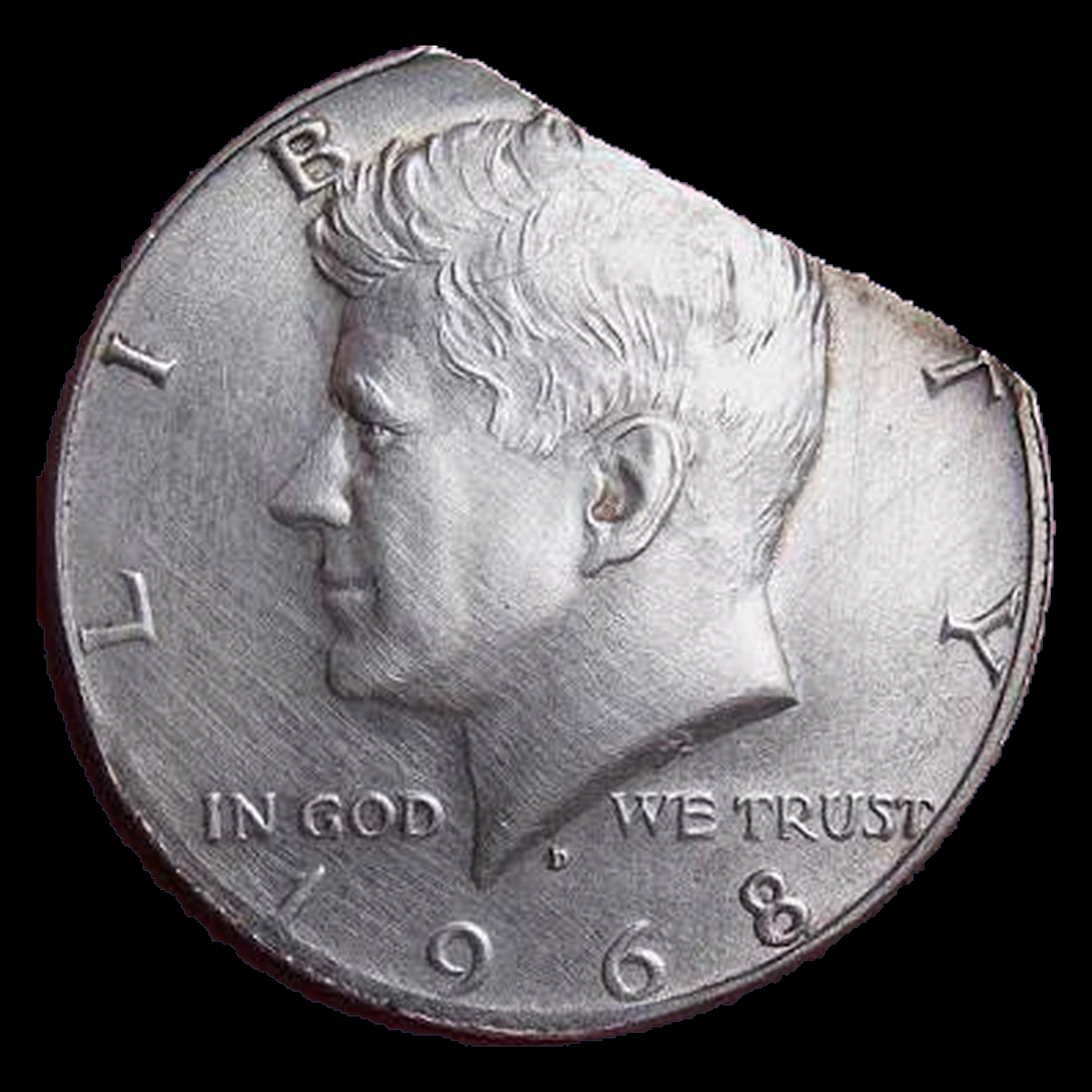
1. 1968 Half Dollar A curved bite out of the rim: Clipped planchet Error
A documented 1968-D PCGS MS61 has about 28% of its blank missing. A separate ANACS AU50 with a much smaller shortage weighs 11.25 grams; that measurement does not belong to the large clip.
How to Identify
Examine both ends of the curved gap for rim and design shaped around metal already missing when struck. Later cutting can slice through completed letters and leave sharp tool marks.
Compare the remaining weight with the absent area and inspect the opposite rim for possible weakness. This supporting feature varies and need not appear equally on every genuine clip.
What It’s Worth
Genuine examples are estimated at $50–$350. The 28% PCGS MS61 clip brought about $84 in July 2021, showing that a large gap alone does not guarantee a large price.
Condition and how much of the portrait, date, and mintmark survives influence demand. The smaller AU50’s weight describes that separate coin and supplies no price for the large clip.
2. 1968 Half Dollar An unusually thin edge at normal weight: Thin-planchet candidate Error
An auction listing describes a 1968-D as a thin-planchet error but gives its weight as 11.5 grams, the normal standard. That combination requires more measurement before the proposed diagnosis can be accepted.
How to Identify
Compare thickness at several undamaged points with diameter and weight. A blank made from stock rolled too thin is different from normal-weight metal spread into a wider, thinner shape during striking.
Inspect the bonded edge for intact layers, filing, peeling, or crushed designs. A thin appearance alone cannot show that too little metal entered the press.
What It’s Worth
A properly identified original thin-blank error of this general kind is estimated at $75–$250. The listed coin brought about $94 in June 2010.
That sale does not resolve the normal-weight contradiction. A filed or flattened half instead requires a damaged-coin comparison.
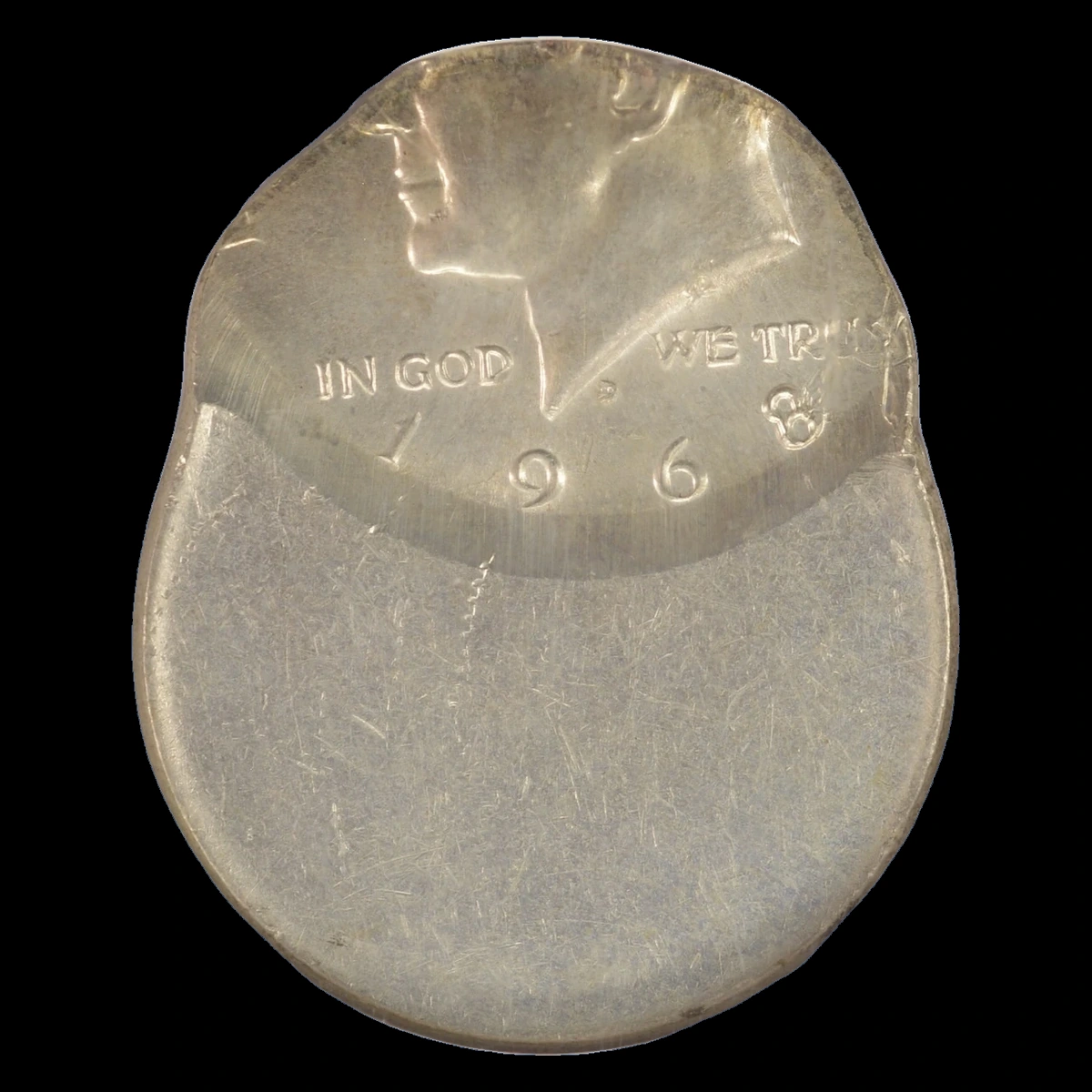
3. 1968 Half Dollar A large plain crescent beside the strike: Off-center Error
A documented Denver half graded NGC MS63 was struck 40% off center. Its label reads (1968)-D, with parentheses indicating an attributed year rather than promising a fully visible date.
How to Identify
Compare both faces for a compatible shift relative to the blank and inspect the bare area for untouched metal. Ground-away design leaves altered texture rather than an original unstruck crescent.
A normal weight can remain because offset alone removes no metal. Silver-clad construction cannot establish the year by itself, since other dates used the same metal.
What It’s Worth
The supplied estimate is $150–$1,500 from smaller shifts through dramatic examples with strong remaining design. No recorded sale is assigned to the 40% MS63 specimen.
Preservation and a readable or well-supported attributed date improve comparability. An undated silver-clad half cannot receive a 1968 identity simply because its composition fits.
4. 1968 Half Dollar A small second design with a plain opposite area: Double strike Error
The documented 1968-D NGC MS62 received a second strike about 85% off center after its initial normal strike. At that second contact, the reverse was blocked and did not receive a normal reverse design, producing a uniface area.
How to Identify
Locate the primary design, then trace genuine struck details in the much smaller extra impression. Look for parts of the first design flattened by the later blow.
The plain reverse area should correspond to the second obverse contact. Inspect the edge for seams or added pieces before accepting the two areas as one minting sequence.
What It’s Worth
Comparable examples are estimated at $400–$1,800. The NGC MS62 sold for $600 in December 2024.
Remaining identity, marks, and clarity of the extra impression influence the whole-coin price. The off-center second strike and uniface reverse are linked features, not separate premiums to add together.
5. 1968 Half Dollar Half-dollar details on smaller denomination blanks: Denver wrong planchets Error
A Denver half on a quarter blank weighs 5.67 grams and was graded NGC MS68. Separate examples use nickel blanks, while another quarter-blank coin graded NGC MS63 also has an approximately 80% off-center strike.
How to Identify
A quarter blank has copper-nickel faces over copper, while a nickel blank is solid copper-nickel and starts near five grams. Neither uses the half dollar’s normal 40% silver construction.
Check the metal structure, weight, and natural design flow at the original edge. A normal half trimmed down later may be small and light but should show altered borders or cut lettering.
Allow for a small blank spreading during striking. The separate MS63’s large plain area also reflects its offset, not just the wrong blank’s size.
What It’s Worth
Denver examples on these smaller blanks are estimated at $800–$4,500. An auction index records $1,495 for the quarter-blank MS68 in June 2006.
Nickel-blank specimens brought $2,160 in MS63 and $3,720 in MS64 during 2024. The quarter-blank MS63 with 80% off-centering requires a whole-coin comparison rather than adding two independent error values.
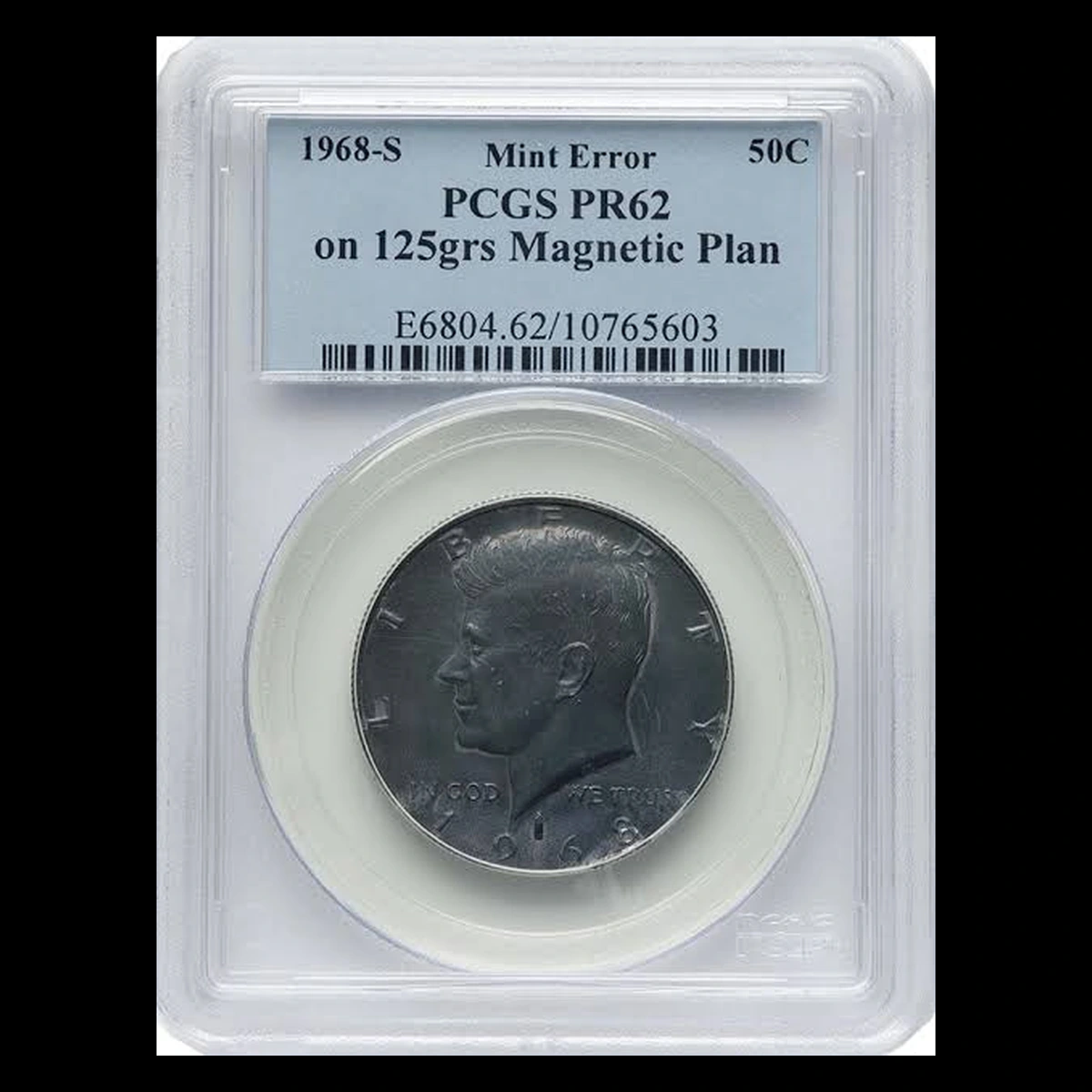
6. 1968 Half Dollar A proof with unusual metal or weight: San Francisco wrong planchets Error
The magnetic 1968-S PCGS PR62 weighs about 8.1 grams despite expanding to normal half-dollar width and lacks ordinary proof reflectivity. Its listed 125 grains is a weight unit, not 125 grams.
A separate PR67 Cameo on a quarter blank has two slightly displaced impressions. A third report identifies an ANACS-certified proof on a Philippine 50-centavos blank.
How to Identify
Compare each coin with its own certification and measurements. The magnetic coin’s weight and diameter do not describe the Philippine specimen.
Magnetic attraction cannot name an alloy by itself, so professional composition testing may be needed. Test without dragging a magnet over the surface.
On the quarter-blank proof, verify the displaced second impression. Ordinary repeated proof blows should align and do not explain that particular doubling of strikes.
What It’s Worth
The magnetic proof is estimated at $4,000–$10,000, supported by its $9,000 Heritage sale in August 2025. The double-struck quarter-blank proof brought $2,760 in May 2022 and has a $2,500–$5,000 comparison range.
The Philippine-blank report has an estimated $3,000–$8,000 range based on other major proof errors, without an assigned sale. The three specimens require distinct blank and condition comparisons.
7. 1968 Half Dollar A layer opens or disappears: Clad-layer separation and loss Error
Denver examples include layers opening on either face as well as complete and partial obverse loss. The separation follows the bonded structure of silver-clad metal, rather than exposing the pure copper core typical of later halves.
How to Identify
Follow an actual layer boundary into the edge and photograph any attached flap without moving it. Cuts and prying can leave gouges or pushed metal that distort the original separation.
A retained layer may preserve almost all the original weight. Complete-loss AU58 and partial-loss MS62 examples weigh 9.52 and 9.93 grams respectively, but those readings belong to different coins.
What It’s Worth
Layer failures are estimated at $75–$750, according to extent, originality, and condition. The 9.52-gram AU58 sold for $129 in December 2024, while the 9.93-gram partial-loss coin brought $174 in March 2022.
A cleaned example with an opening attached layer sold for $69. Its lower result shows why a dramatic flap does not necessarily overcome impaired surfaces.
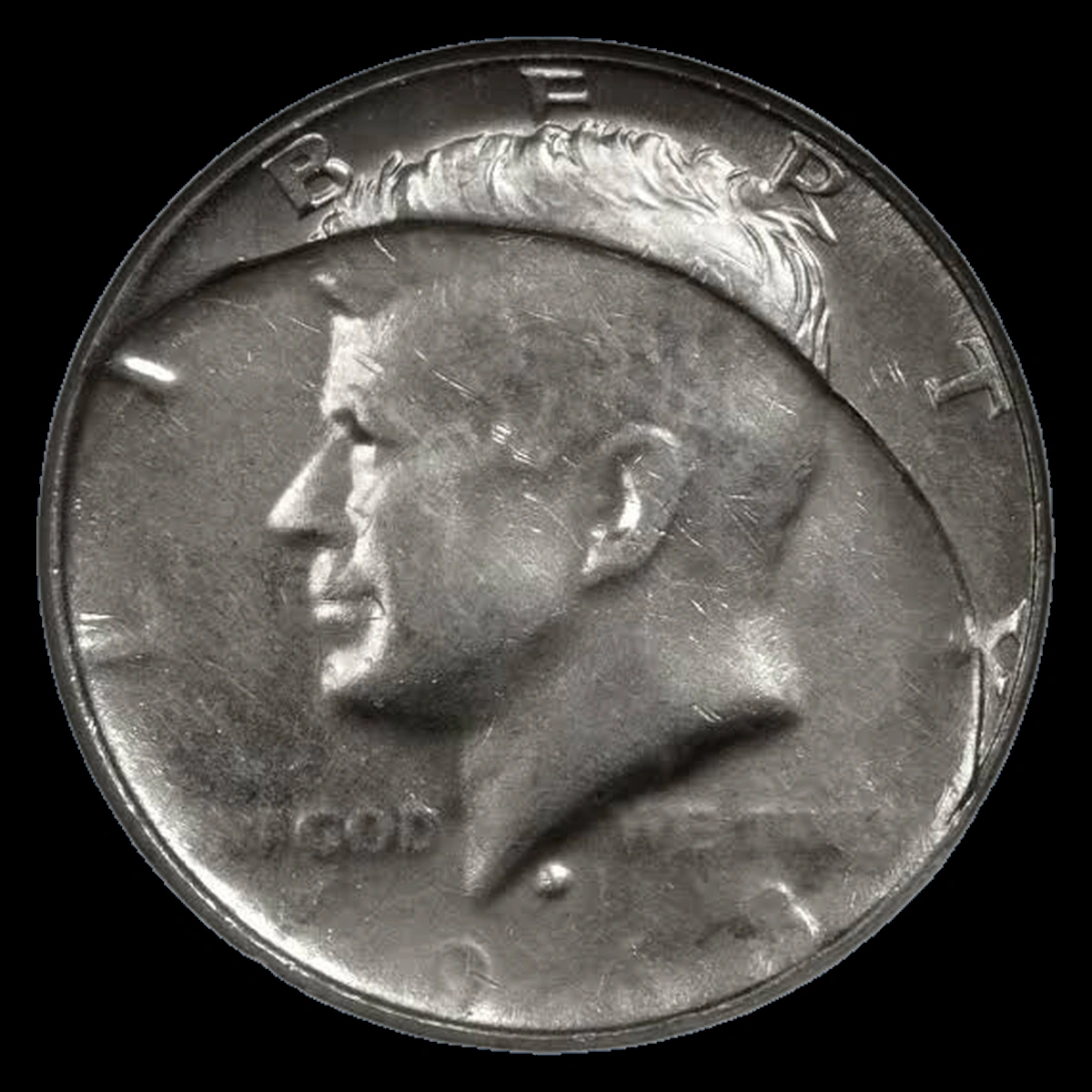
8. 1968 Half Dollar A depression carrying foreign texture: Strike-through Error
Reported Denver obverse examples were struck through fragments of an outer coin layer. The AU58 and MS64 are separate specimens, and the large affected area belongs to the MS64.
Another reverse example preserves an impression of a ridged edge fragment. These are interruptions caused by material between die and blank, not missing layers from the struck coin itself.
How to Identify
Examine the depressed area for the object’s texture and for surrounding design formed alongside it. Orderly parallel grooves within the reverse impression can support the edge-fragment explanation.
Those grooves are separate from the coin’s own peripheral edge. A later gouge may have rough borders and displaced metal instead of an original object impression.
What It’s Worth
Examples across this group are estimated at $75–$800. A Denver AU55 reverse edge-fragment strike-through sold for $134 in June 2023.
A large recognizable impression on clean surfaces may attract more interest than a small plain mark. The upper estimate is not a recorded sale for the MS64 layer-fragment specimen.
9. 1968 Half Dollar An earlier curve beside S or D: Repunched mintmarks Error
One San Francisco variety preserves an S curve below the main letter. The separate FS-512 shows a pointed-tip Serif S over remnants of a rounded-tip Knob S.
How to Identify
Find the mintmark below Kennedy’s neck and compare the complete letter and extra fragment. FS-512 requires the particular overlapping tip shapes, not merely any mark beneath an S.
Other Denver and San Francisco repunching reports lack clearly specified outlines here. Keep those reports separate from the recognized pattern and exclude flat striking shelves or scratches.
What It’s Worth
Minor matched repunched mintmarks are estimated at $25–$150, while recognized FS-512 proofs are estimated at $275–$675. These are supplied estimates rather than specified completed sales.
Cameo or Deep Cameo contrast can enhance proof value through frosted designs against reflective fields. An ordinary extra S curve does not receive the FS-512 range without matching its punch shapes.
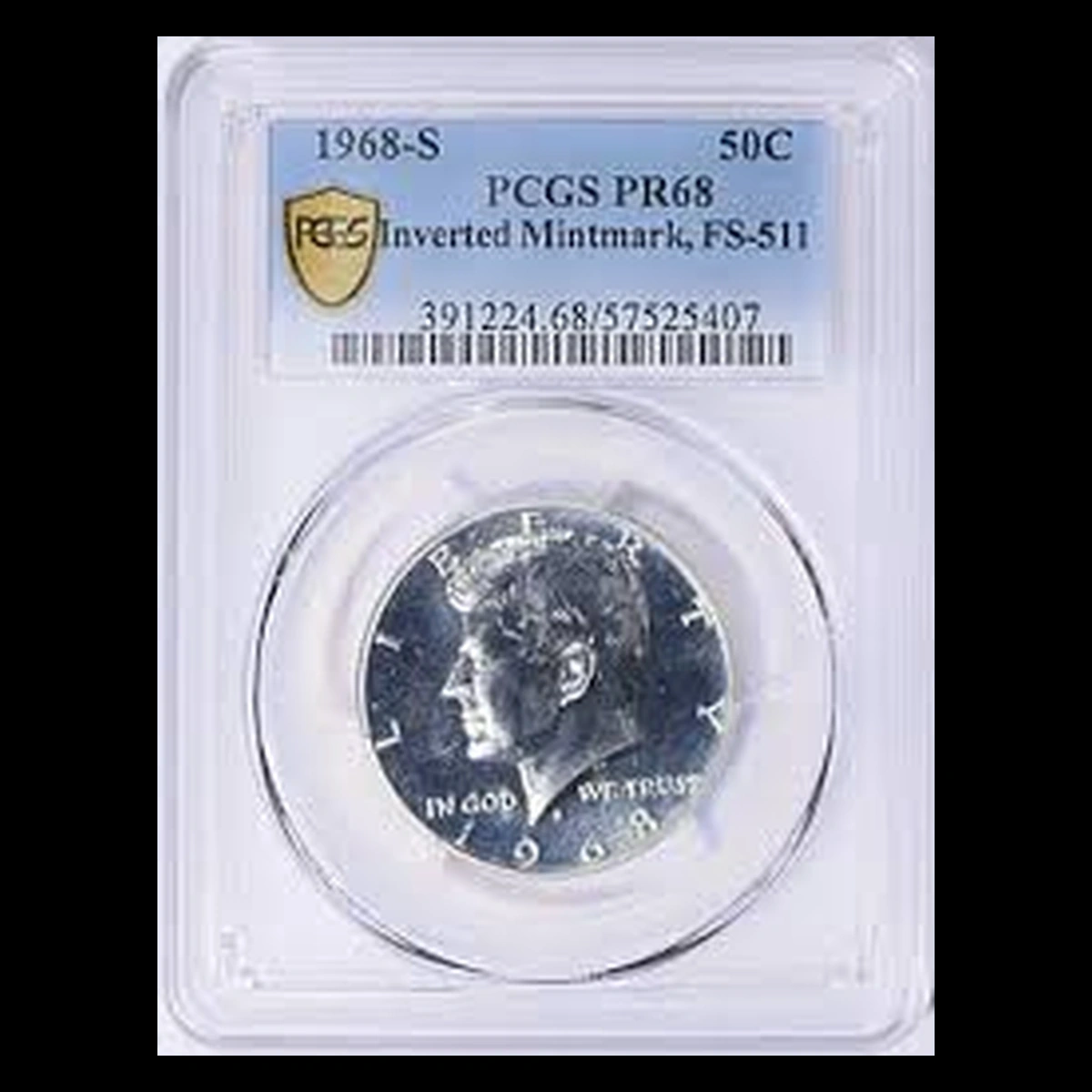
10. 1968 Half Dollar The S loops trade places: Inverted mintmark Error
On FS-511, only the S punch was used upside down; the date and portrait retain their normal orientation. The unequal loops and tips reveal the reversal even though the letter can initially look normal.
How to Identify
Keep both candidate and normal comparison portraits upright, then compare the upper and lower loops and terminal shapes. A tilted photograph or an impact inside the letter can mislead the eye.
FS-511 differs from the overlapping S punches of FS-512. Another catalog’s inverted-S listing alone does not prove an additional distinct die variety.
What It’s Worth
Correctly identified FS-511 examples are estimated at $150–$1,250. One PCGS PR66 sold for $456 in May 2022, while a different PR66 brought $705 in January 2016.
Equal numerical grades can still differ in surface quality, contrast, and demand. These transactions concern the inverted S rather than the repunched FS-512.
11. 1968 Half Dollar Slight inward thickening shared across dies: Inherited doubling Error
Some Denver halves show subtle inward-spreading thickness, with an even slighter reverse effect. The feature originated in a tool used to make multiple dies, allowing coins from different dies to inherit similar doubling.
How to Identify
Compare the actual raised contours with known Denver examples under changing light. Individual die scratches can differ even while the inherited design feature matches.
A separate San Francisco report lacks clear diagnostic photographs in the supplied material. Denver’s pattern should not automatically be applied to that report.
What It’s Worth
Collectible examples with this slight doubling are estimated at $10–$35. The range reflects a small design difference, with silver content and condition also contributing to total value.
Exceptional preservation needs a closer condition comparison. The San Francisco report by itself does not establish an added premium.
12. 1968 Half Dollar Repeated motto, portrait, or date contours: Doubled and tripled obverses Error
Denver FS-101 shows multiple outlines around TRUST, supported by notches in IN, a split at the top of Y, and extra date detail. The die contained these shapes before striking, rather than the coin receiving three displaced blows.
San Francisco FS-101 is a different proof variety, with clockwise-spreading doubling through parts of the motto, date, and portrait. A shared catalog number does not make the two mint varieties identical.
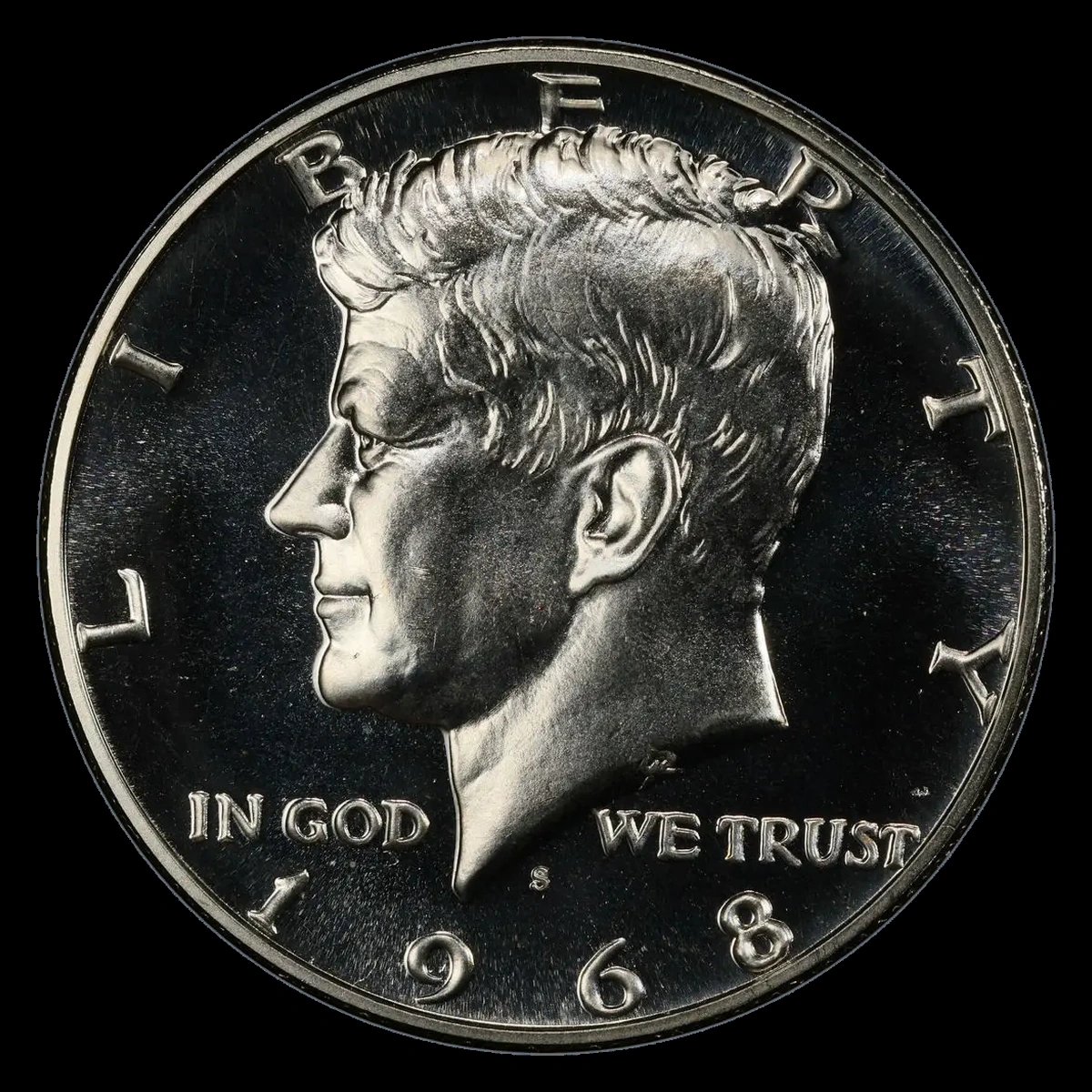
How to Identify
Read the mintmark first and use the corresponding reference. On Denver coins, linked TRUST, IN, Y, and date features are stronger evidence than a single thick letter.
For the S proof, match its clockwise contours instead. Flat shelves from striking movement and less clearly documented minor reports should not be assigned either FS-101 name without their own match.
What It’s Worth
Smaller identified obverse varieties are estimated at $25–$150; stronger Denver and San Francisco examples are estimated at $100–$1,000. A Denver PCGS MS65 FS-101 sold for $288 in August 2025.
A San Francisco PR68 FS-101 brought $325 in May 2022. These are separate varieties with different finishes, not interchangeable prices for thick-looking letters.
13. 1968 Half Dollar Repeated star points below OF AMERICA: Doubled and tripled reverses Error
The strong 1968-S FS-801 has repeated star points beneath OF AMERICA and counterclockwise-spreading extra contours. Denver reports include inward tripling and smaller letter separations, while other S proofs have their own patterns.
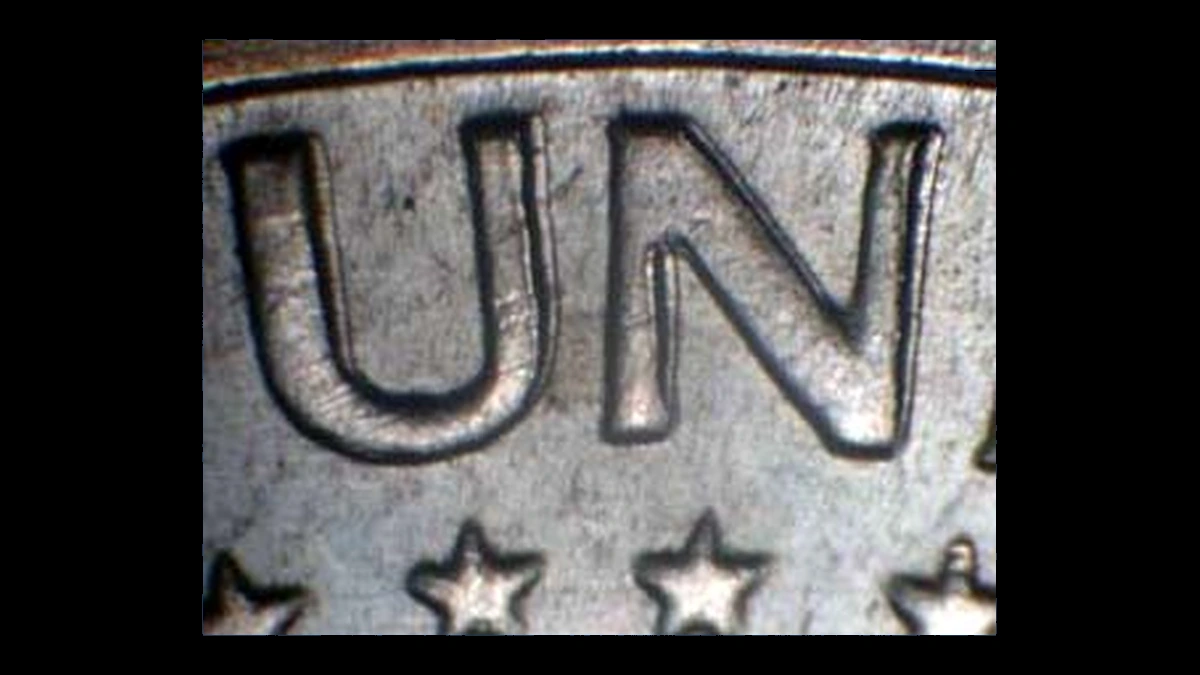
How to Identify
For FS-801, start with the repeated star points and follow the same direction through nearby lettering. Mere blur is insufficient, and Denver coins require Denver references.
The designer’s G can vary with normal design differences. Its shape alone does not establish doubling or replace a consistent match across the affected reverse features.
What It’s Worth
Smaller reverse varieties are estimated at $25–$200, while strong matched proof varieties range around $300–$4,000. PCGS records an FS-801 PR68 Deep Cameo at $3,833 in June 2022.
That result includes high preservation and strong contrast. It is not a general price for any doubled-looking reverse letter.
Conclusion
The 1968 half’s silver-clad construction is essential to interpreting layer loss and wrong metal. Record the actual weight and edge structure rather than expecting the copper core of a later coin.
For small varieties, distinguish inherited doubling, repeated mintmark punches, and an inverted S before choosing a reference. Compound errors and high-grade proofs need whole-coin comparisons, with each measurement, grade, and sale kept attached to the correct specimen.