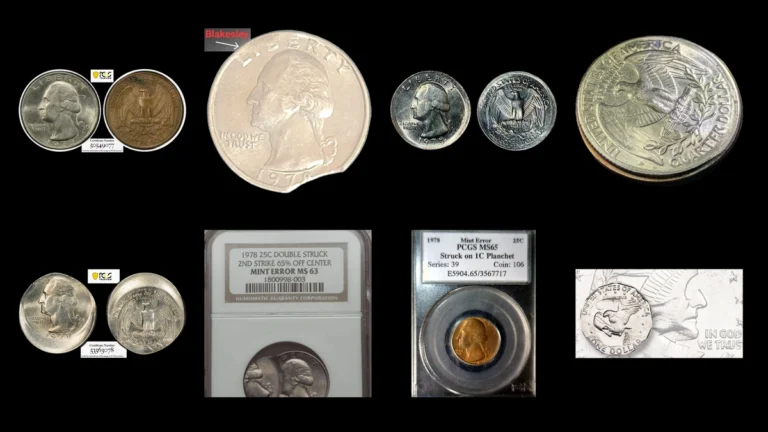
Rare 1968 Quarter Errors (List & Pictures)
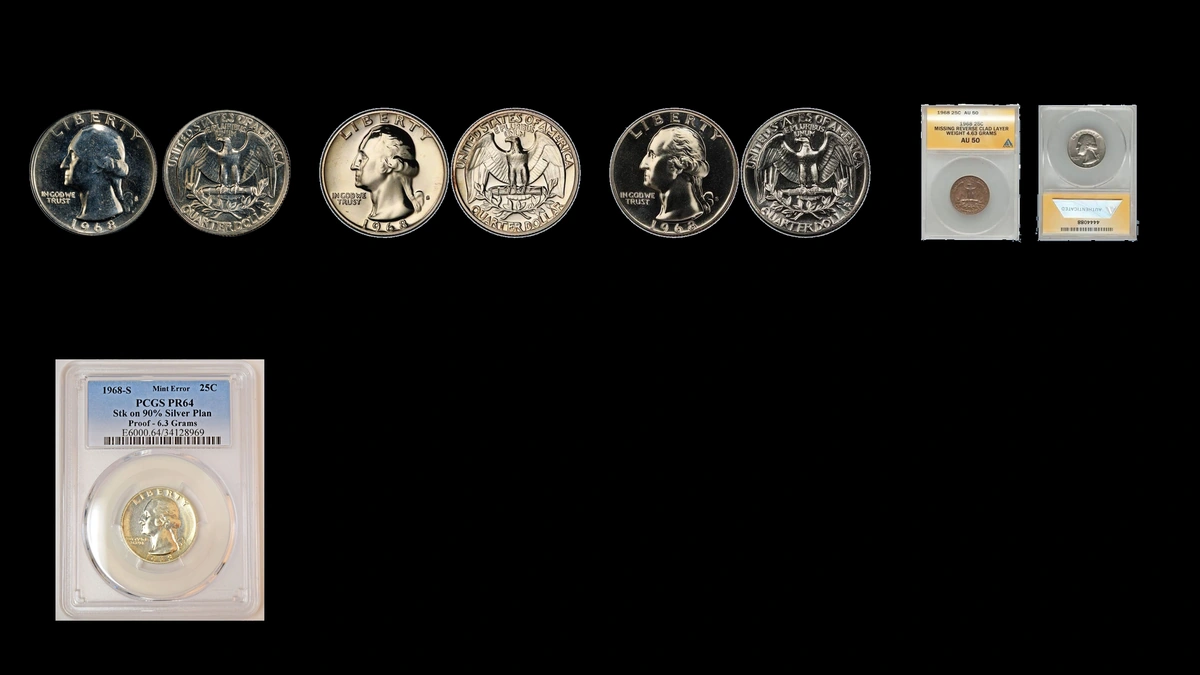
A 1968-S Proof on a 90% silver blank sold for $11,700 in May 2022. The 1968 quarter errors and comparison varieties below span estimated values of $5–$20,000.
Identify the mint and finish first, then compare the lettering, edge, and metal to distinguish ordinary design differences from genuine production mistakes.
| Visible clue | Category | Guide range |
|---|---|---|
| Extra mintmark or design contours | Repunched mintmark or doubled die | $5–$3,000 |
| Different lower wing outline | Normal Proof design variety | $5–$1,500 |
| Raised patch or missing edge | Die break or clip | $5–$1,000 |
| Copper face or thin separate piece | Layer loss or outer-layer strike | $50–$12,000 |
| Displaced artwork, irregular shape, or cup | Strike error, scrap blank, or die cap | $25–$7,500 |
| Wrong size or alloy | Wrong planchet, including silver Proof | $150–$20,000 |
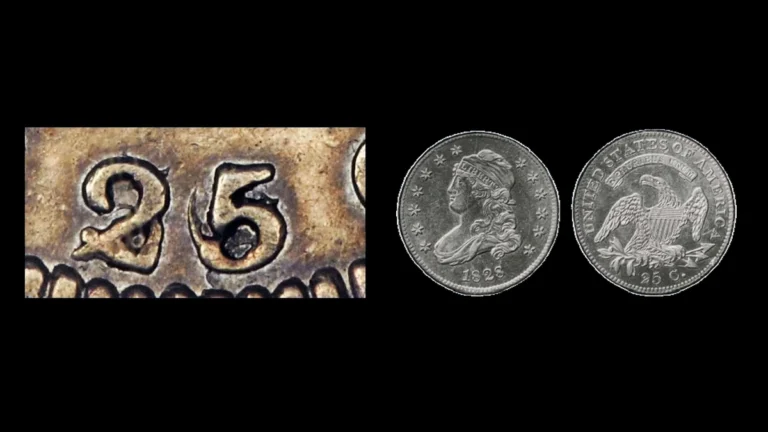
1. 1968 Quarter Another D or S contour: repunched mintmark Error
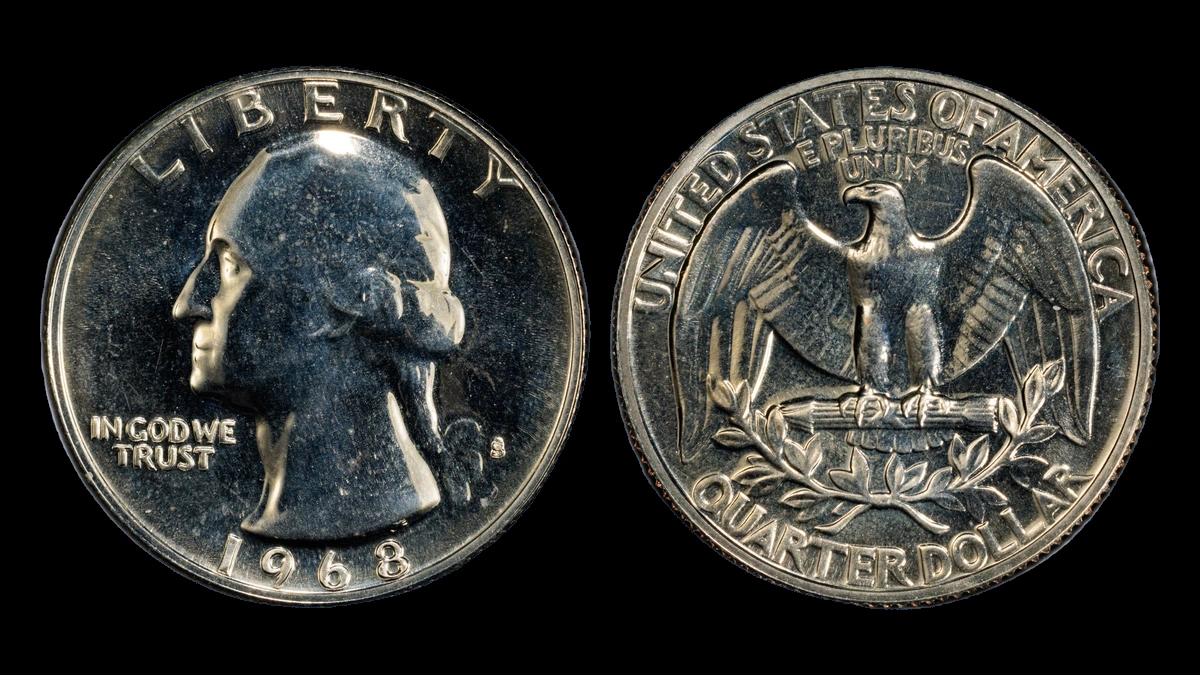
Denver WRPM-001 shows an earlier D to the left of the main mintmark. San Francisco Proof reports include extra S outlines left, above, or below the final letter.
These came from repeated applications of the mintmark punch to the die, not from another strike on the finished coin. Proof catalog numbering does not agree in every cross-reference.
How to Identify
For Denver WRPM-001, compare the leftward D and supporting vertical lines near the eyebrow, below the eagle’s left wing, and left of its beak.
CONECA places Proof RPM-001 left, RPM-002 below, and RPM-003 and RPM-004 above S. Wexler’s WRPM-002 points left and WRPM-003 below, so match each catalog’s photographs rather than treating shared numbers as equivalent.
A rounded remnant belonging to another letter differs from a flat shelf or random bump. Preserve the mint and finish with each close-up.
What It’s Worth
Authenticated repunched mintmarks have an estimated range of $10–$500.
No individual auction price is supplied for these patterns. Clear outlines and well-preserved surfaces support stronger comparisons than faint remnants on worn coins.
2. 1968 Quarter Repeated letters, feathers, or leaves: doubled die Error
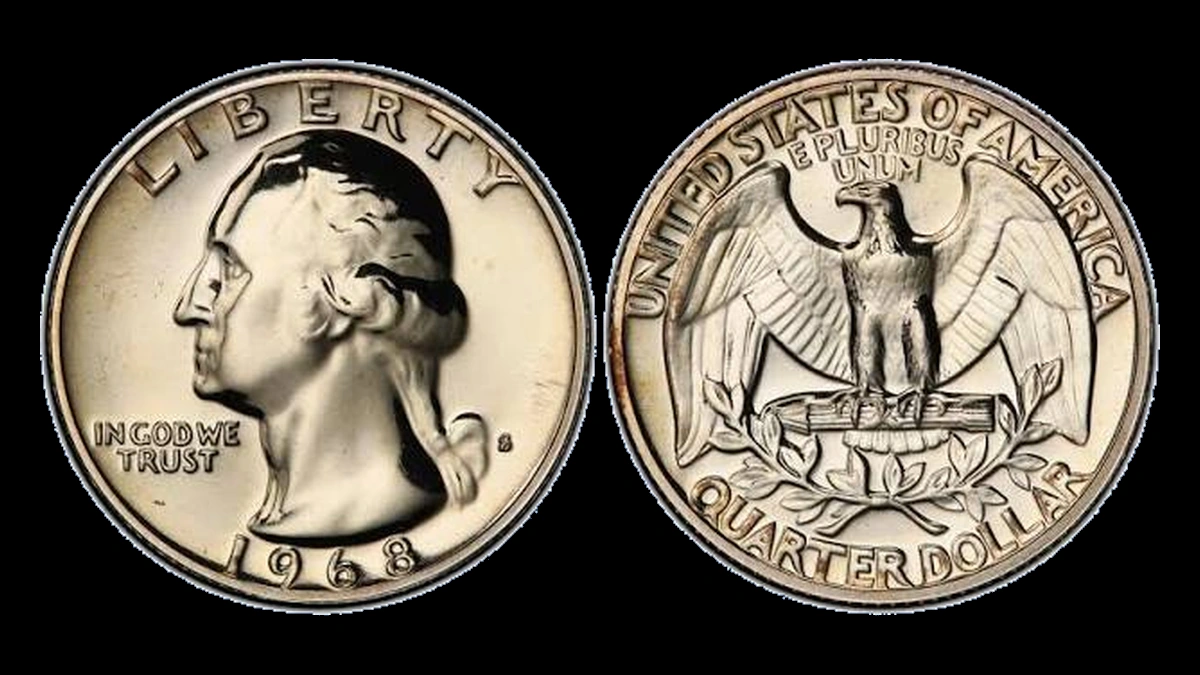
Denver has two cataloged reverse patterns, while San Francisco Proofs have four front patterns and a separate doubled reverse. Ordinary front-doubling reports lack a matched catalog identity.
The repetition was in the die before striking. Common inward doubling around QUARTER DOLLAR and the lower wreath instead derives from a shared master design and is not automatically scarce.
How to Identify
Denver WDDR-001 affects both wing tips, the wreath, and inscriptions. WDDR-002 involves UNITED STATES OF AMERICA, with supporting dots beside D in UNITED and near the arrow shaft.
Proof DDO-001 affects the motto, date, eyelid, and LIBERTY; DDO-002 repeats TR in TRUST and G in GOD. DDO-003 affects LIBERTY and the date with two fine forehead lines, while DDO-004 has slight repetition at ERTY.
Proof DDR-001 shows separation around the outer reverse lettering and lower leaves. Denver FS-801 and Proof FS-801 are different varieties despite sharing the number.
Use the correct mint and finish to select one complete pattern. Flat shelves from strike movement and widespread master-design repetition need separate treatment.
What It’s Worth
The estimated whole-coin range is $5–$3,000 across identified ordinary and Proof varieties.
No separate auction result is supplied for each pattern. Common master-design repetition alone adds no special error premium.
3. 1968 Quarter Two lower wing outlines: Type E and Type F Proof designs Error
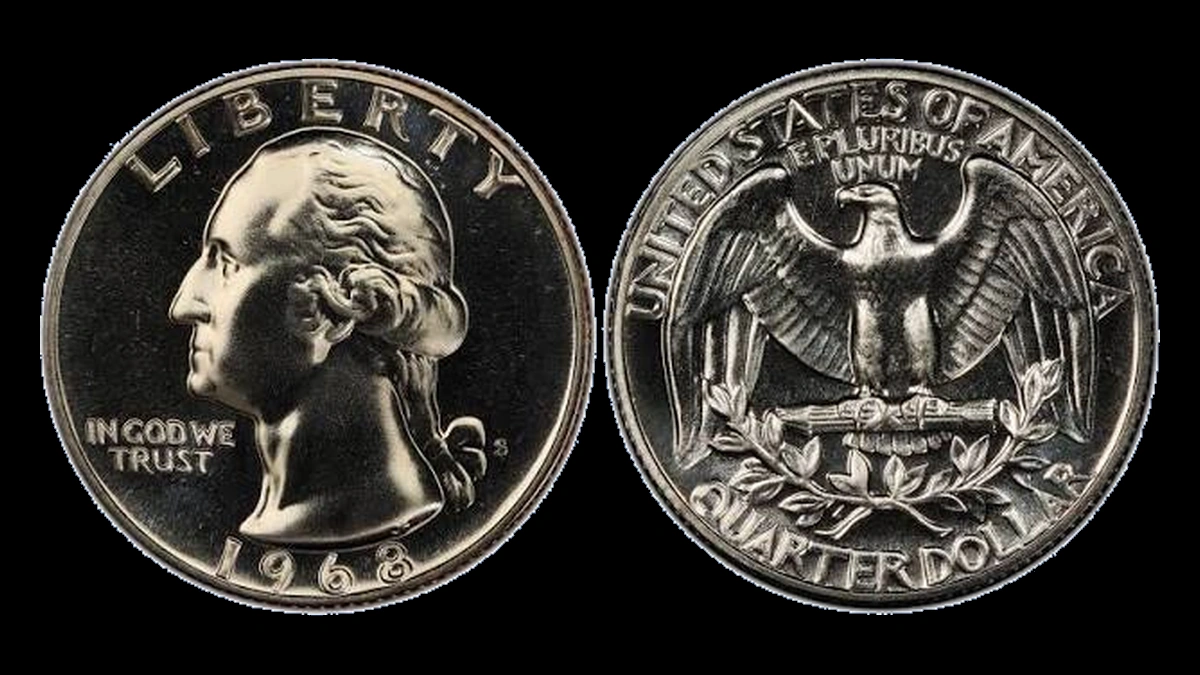
On Type E, part of the eagle’s lower-left wing boundary fades near the leg. Type F keeps a clearer boundary into that area.
Both are design varieties of 1968-S Proof quarters. Type F also carries inherited repeated detail at Q in QUARTER, rather than automatically representing a rare individual doubled die.
How to Identify
Follow the wing’s lower edge toward the leg under changing light. On Type E it fades around roughly four feathers approaching the leg, whereas Type F remains more distinct.
Check neighboring feathers so poor lighting or surface wear does not make a clearer boundary appear absent. Use the same-design Q as supporting context, not as an automatic error claim.
What It’s Worth
Estimated whole-coin values range from $5–$1,500, with ordinary Proof examples far below the exceptional end.
A published PCGS record lists a Type F PR68 coin at $1,200 in February 2021. The result concerns a well-preserved design variety, not proof that a clear wing outline is a minting mistake.
4. 1968 Quarter Raised metal beside the rim: die breaks Error
Denver reports include small die breaks and retained rim breaks. A retained break occurs when a cracked piece remains in place and can still transfer some design within the affected area.
A raised patch connected to the rim is commonly called a cud. The general report establishes no fixed position or catalog number for all examples.
How to Identify
Trace the raised boundary and determine whether it reaches the rim. An interior chip belongs to a different shape than a rim-connected break.
Surviving letters within a raised patch can help explain a retained die piece. Check the edge and nearby lettering for a later impact that crushed or dragged metal onto the face.
What It’s Worth
Genuine small breaks and retained rim breaks have an estimated range of $5–$600.
No individual sale is supplied for the reported Denver group. A developed, clearly bounded feature is easier to compare than a tiny lump with an uncertain cause.
5. 1968 Quarter A straight or curved missing section: clipped blank Error
A Denver straight-clip coin is reported in NGC MS65, alongside general curved-clip reports without a particular mint or percentage. These gaps began in the blank before striking.
A separate Philadelphia PCGS MS65 coin combines a 15% straight clip with a broadstrike. It used a Type 1 blank, meaning its edge had not received the normal raised rim before the strike.
How to Identify
Examine where the rim and design meet both ends of the gap. Fresh saw marks, burrs, or filing suggest metal removed from a finished coin.
The Philadelphia coin’s broadstrike leaves outward spreading around a complete design away from the gap. Its 15% straight clip should not be transferred to other curved or Denver examples.
A weak opposite rim may support an original clip but is not always strong. Both the missing edge and the remaining struck surface need to fit the explanation.
What It’s Worth
Genuine clips have an estimated range of $10–$1,000, including dramatic shapes and combinations.
No realized price is supplied for the Philadelphia combined coin. Its clip and broadstrike contribute to one complete value rather than separate amounts to add.
6. 1968 Quarter Missing outer metal, sometimes with its loose fragment Error
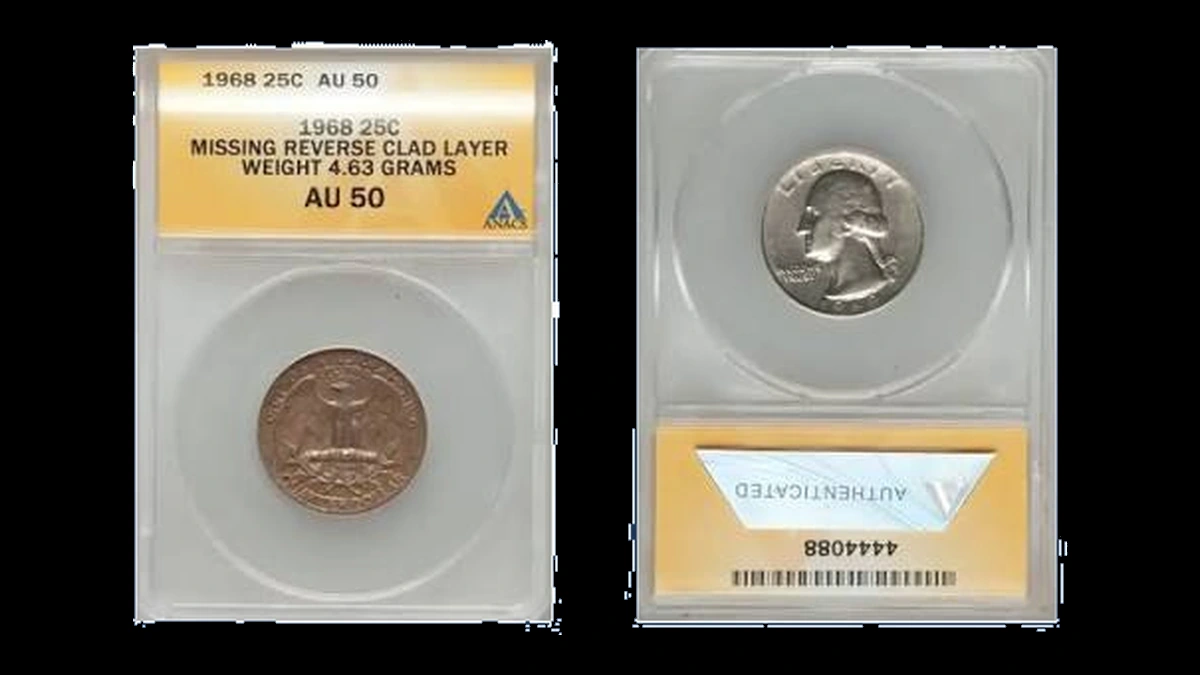
A Philadelphia reverse-layer coin graded NGC AU58 weighs 4.6 grams. A separate Denver NGC MS62 example has front-layer loss and the same recorded weight.
Another Denver record pairs a quarter with partial reverse-layer loss and its matching detached piece, described as NGC XF45. Those are a coin and fragment, not two complete quarters.
How to Identify
Compare the exposed copper, remaining pale layer, and edge together. A normal clad quarter weighs 5.67 grams; the two 4.6-gram readings are specimen measurements, not required weights for every partial loss.
If a fragment survives, compare its outline and design in photographs without pressing it back into place. Preserve both pieces without gluing or flattening them.
Scraping and chemical damage can change a face after minting. The metal boundary needs to support actual original layer separation.
What It’s Worth
Authenticated layer-loss examples have an estimated range of $50–$1,500, including a properly matched coin-and-fragment pair.
No individual sale is supplied for the three records. A surviving fragment can clarify the event but should not be valued as another full quarter.
7. 1968 Quarter An unstruck crescent on a normal blank: off-center strike Error
Ordinary Philadelphia and Denver off-center quarters are reported without a fixed specimen’s direction or percentage. Their blanks were misplaced, leaving some metal unstruck and some intended design outside the available surface.
How to Identify
Compare both faces for displacement explained by the same blank position. A shift limited to one face can indicate a misaligned die, while full designs inside expanded metal suggest a broadstrike.
Inspect the plain crescent and edge for hammering, cutting, or filing. Read surviving identity directly instead of completing missing digits or mintmarks from expectation.
What It’s Worth
Authenticated ordinary examples have an estimated range of $25–$2,000.
No individual sale establishes a price for the general report. The independently struck thin outer layer described later is a different starting object and requires its own comparison.
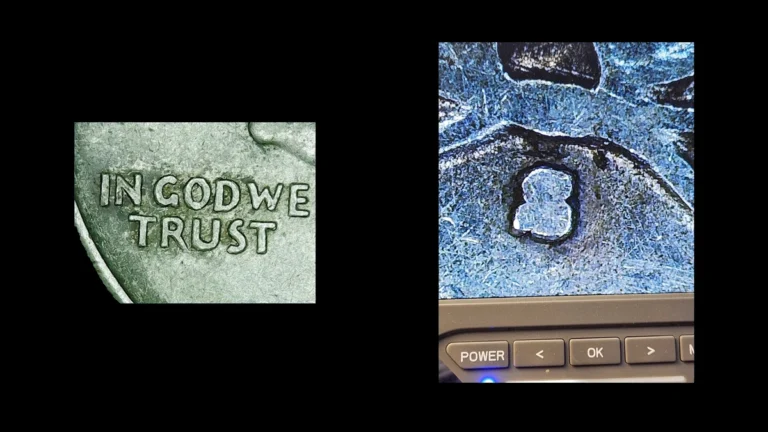
8. 1968 Quarter GOD WE TRUST across the neck: displaced double-struck Proof Error
A recorded 1968-S Proof has earlier motto letters across Washington’s neck. The turned design survives beneath a later impression in a different position.
NGC graded the coin PR68 Ultra Cameo, indicating strong preservation and contrast between frosted design and reflective background. Normal repeated Proof blows are not the error; the displaced artwork is.
How to Identify
Follow GOD WE TRUST as a group across the neck and compare its spacing with the normal motto. Several connected letters should fit the earlier design position.
Include the portrait, date, and rim to show the overlap beyond one bright line. Raised surviving letters differ from scratches in the reflective field or small flat strike-doubling shelves.
What It’s Worth
Genuine displaced double-struck Proofs have an estimated range of $300–$5,000.
A different-year 1972-S PR65 Cameo double strike was recorded at $805 in 2010. That is not a sale of the 1968 PR68 Ultra Cameo specimen.
9. 1968 Quarter Quarter artwork on irregular metal: scrap planchet Error
A Denver PCGS MS63 example was cataloged as struck on a 52% scrap planchet. Scrap from blank production can enter the press without the ordinary round starting outline.
The catalog percentage describes its scrap-blank identity. It does not automatically mean that the strike was 52% off center.
How to Identify
Keep the entire outline visible while reading the date and D. Follow how the design approaches each irregular edge and compare with the certified example.
Fresh saw cuts or filing may show that a finished quarter was reduced later. Actual weight can document a loose specimen, but normal quarter weight cannot by itself identify an irregular scrap blank.
What It’s Worth
An authenticated scrap-blank quarter of this type has an estimated range of $300–$5,000.
This is a comparison-based estimate, not a documented sale price for the PCGS MS63 example. Readable identity and original struck edges are central to its assessment.
10. 1968 Quarter A cup formed around a die: reported die cap Error
A quarter that fails to leave a die may spread and rise around the tool as new blanks arrive. The stuck coin becomes a die cap.
The 1968 report identifies no mint, finish, or certified specimen. A bowl-shaped coin must still be distinguished from a finished quarter bent afterward.
How to Identify
Use side views to examine the wall and central design, looking for stretched artwork consistent with the metal rising during striking. A sharp fold or gripping marks may indicate later force.
Read the surviving date and mintmark without flattening the object. The shape and design must support a mint-made cap, not merely an unusual silhouette.
What It’s Worth
An authenticated 1968 die cap has a conditional estimated range of $500–$7,500.
No identified 1968 specimen sale is supplied. A confirmed Proof would need a separate Proof-error comparison rather than an assumed ordinary-strike value.
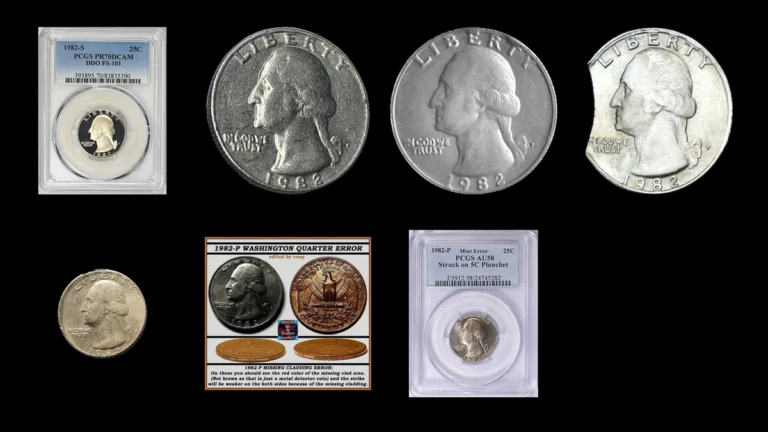
11. 1968 Quarter Quarter design on nickel, dime, or cent blanks Error
A Denver nickel-blank example is recorded as PCGS AU58. A separate San Francisco Proof on a nickel blank weighs 4.9 grams and is described as double-struck.
Another Proof on a clad dime blank has close overlapping strikes and an expanded outline. A Proof cent-blank type is reported without an identified certified specimen.
How to Identify
Compare actual composition and cropped design with the proposed blank. Standard weights are 5 grams for a nickel blank, about 2.27 grams for a clad dime, and 3.11 grams for a copper cent.
The 4.9-gram nickel Proof has its own additional-strike evidence. The dime Proof’s close overlap and spreading are a different combination.
Look for remnants of an older coin design. Such artwork would indicate a finished-coin overstrike instead of the unused blanks described here.
What It’s Worth
The combined range is $150–$10,000, including ordinary nickel-blank coins around $150–$2,500 and authenticated Proof wrong-blank combinations around $1,500–$10,000.
The PR65 Cameo nickel-blank Proof sold for $2,185 in January 2008. Published offers for a dime-blank Proof asked $4,250 and $4,700, which are not completed sales.
The cent-blank report needs its own authentication and cannot inherit either specimen’s identity.
12. 1968 Quarter A 0.9-gram layer with its own off-center strike Error
The documented Philadelphia NGC MS64 piece consists of an outer metal layer rather than a complete clad blank. It weighs 0.9 gram and received its own strike 50% off center.
Its metal structure was already incomplete when that strike occurred. This differs from a normal finished quarter later shedding a fragment.
How to Identify
Inspect the very thin edge for the absence of the copper center and opposite outer layer. Support the piece carefully without bending or pressing it flat.
Relate its plain area to design cut off at the opposite edge. A peeled fragment retaining an old normal design needs an independent displaced strike to match this example.
What It’s Worth
A comparable authenticated thin-layer off-center strike has an estimated range of $1,000–$12,000.
No realized sale is supplied for the 0.9-gram specimen. Its independent strike and readable identity, not low weight alone, support the unusual comparison.
13. 1968 Quarter A silver edge on a clad-era Proof: wrong silver blank Error
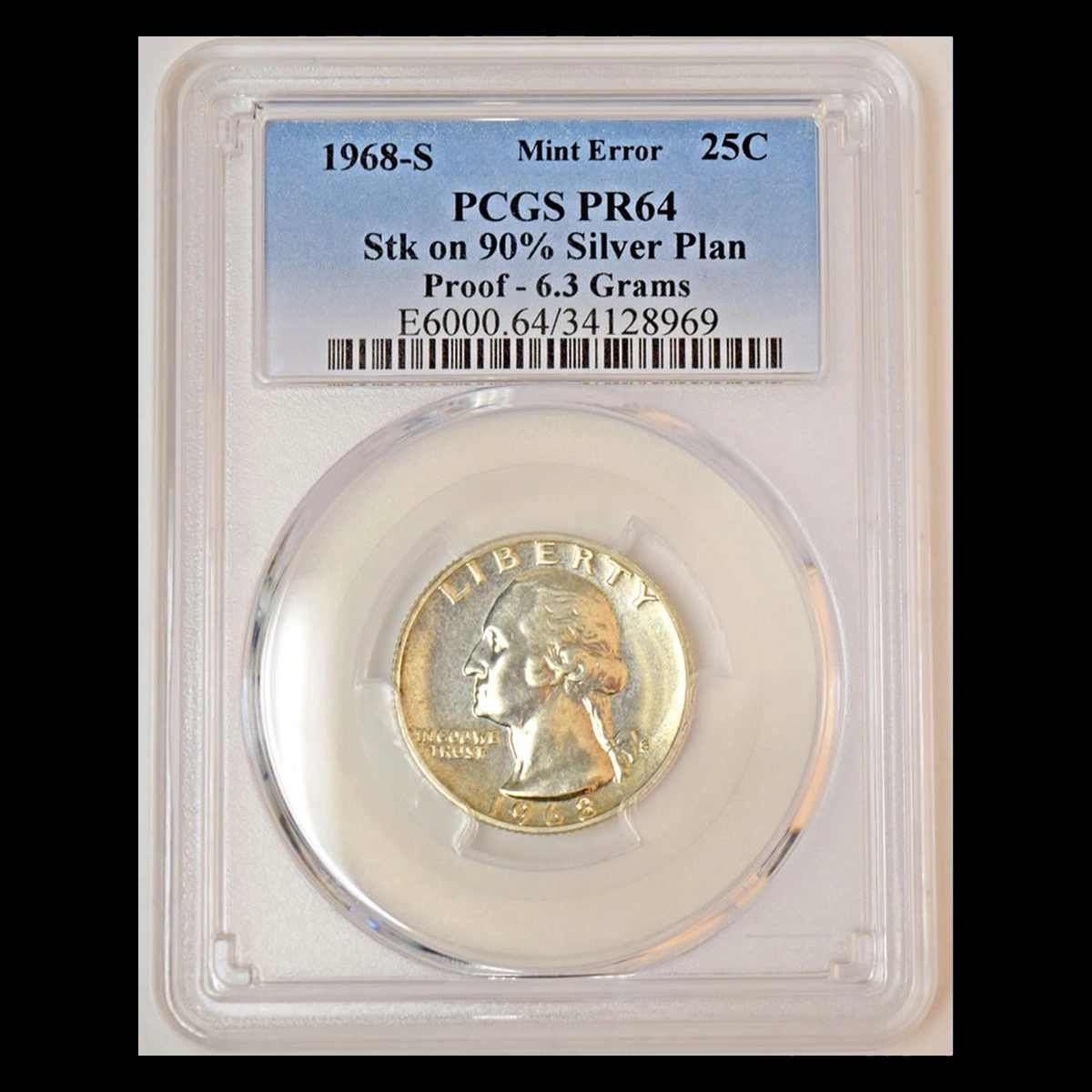
The recorded 1968-S Proof was struck on a 90% silver blank even though the issue normally used copper-nickel clad metal. PCGS graded it PR64, and its measured weight is 6.3 grams.
The description notes sharp design, reflective fields, and a pale edge visible through the holder. An S or a bright surface alone cannot establish the wrong alloy.
How to Identify
Compare the full edge and both faces under neutral light. Plating can hide a normal copper band, while polishing can create shine without original Proof surfaces.
Confirm 1968 and S, then use recorded weight and nondestructive composition testing. The correct alloy throughout the coin must be distinguished from a silver-colored coating.
What It’s Worth
A comparable authenticated silver-blank Proof has an estimated whole-coin range of $7,000–$20,000.
The PCGS PR64 example sold for $11,700 at Heritage in May 2022. Its value reflects the rare wrong-metal strike rather than the silver content alone.
Conclusion
The mint, finish, and starting metal are essential to sorting 1968 quarter features. A normal Proof reverse variety, a missing layer, and an independently struck thin layer should never share one diagnosis.
For small varieties, match the exact catalog photographs; for major errors, compare both faces and the edge. Retain specimen-specific weights and asking-price labels so that an attractive example is measured against the right evidence.