Rare 1985 Quarter Errors (List & Pictures)
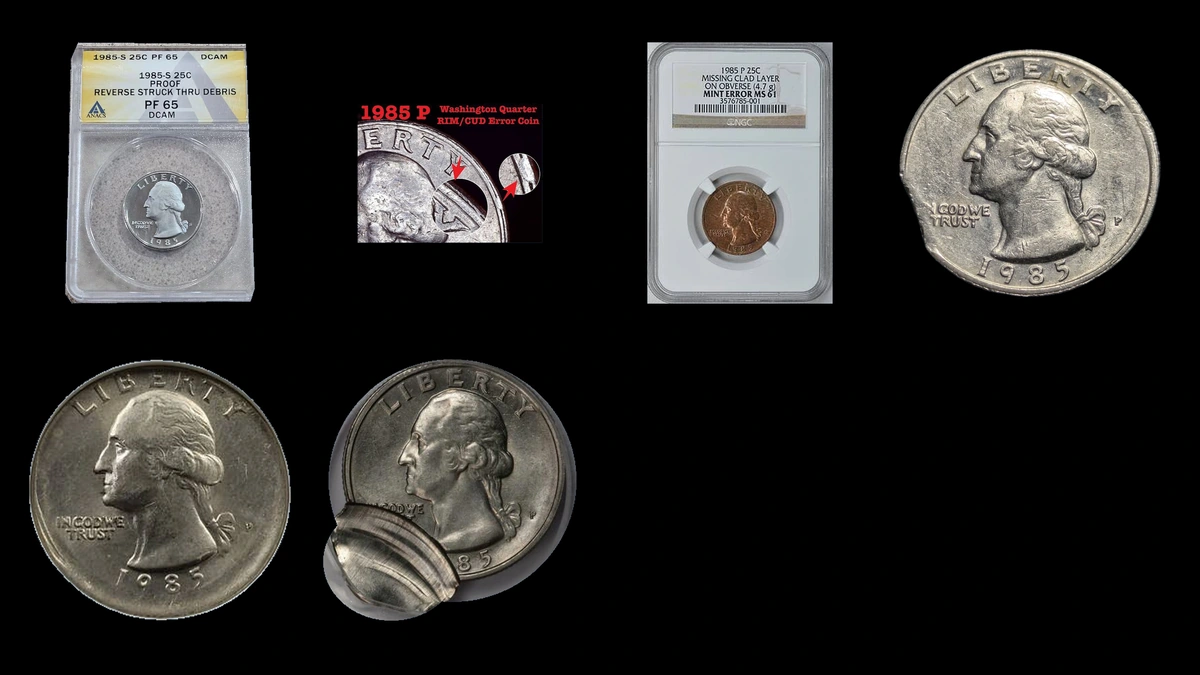
Some 1985 quarter errors are easiest to understand as combinations: a clip beside a displaced strike, an impression beside an uneven edge, or two coins preserving one collision. Supplied whole-coin estimates span $5–$15,000, with the highest wrong-metal claim requiring authentication.
A documented matching pair realized $1,725 for both coins on April 19, 2008. Work from raised and weak design details to metal defects and strike geometry, keeping each specimen’s measurements, grade, and sale together.
1. 1985 Quarter Small Repeated Letter or Feather Contours: Doubled-Die Reports Error
Front reports mainly concern Philadelphia, with Denver also mentioned, around LIBERTY, the motto, and Washington’s hairline. Reverse reports name the eagle’s neck, wing tips, country name, and motto without establishing a mint.
No fixed catalog pattern is supplied. A true doubled die carries its extra design before striking and can reproduce that pattern on many coins.
How to Identify
Keep the year, mint, and whole affected face in the photographic record. Compare several neighboring details for consistent raised contours or split corners rather than one thick shiny edge.
Normal feathers already contain lines, and a flat mechanical shelf can imitate an extra outline. Match the actual shape with a documented variety before assigning a doubled-die identity.
What It’s Worth
$5–$300 is conditional on confirming a genuine doubled-tool pattern. Clear original detail supports attribution, while vague thickness or reflection does not justify a variety premium.
2. 1985 Quarter Weak Words beside Sharp Detail: Blocked Design Error
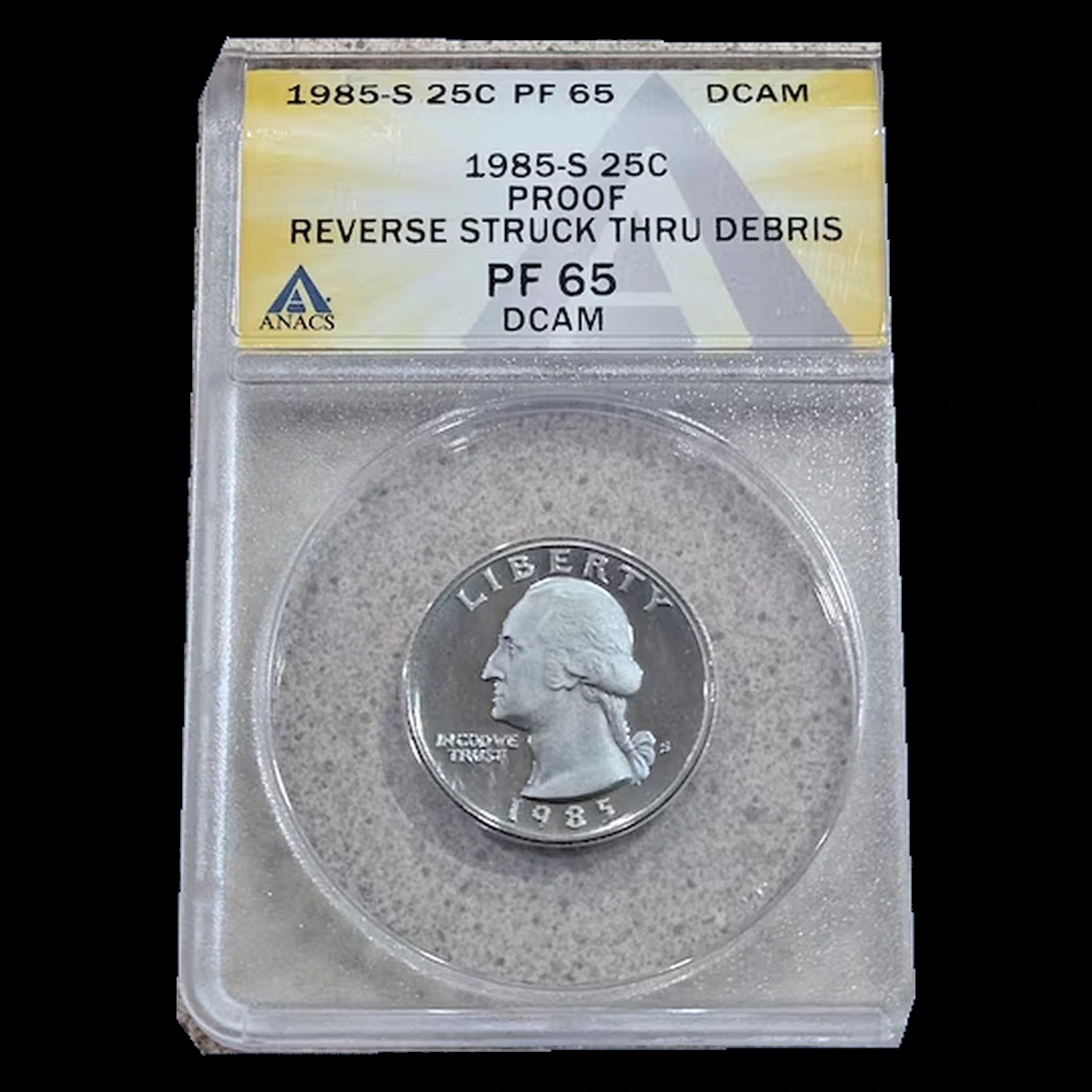
Philadelphia and Denver reports describe grease-related weakness in the front motto and hair or the eagle’s breast. Material blocking recesses in the die can prevent local details from forming.
Weakness alone cannot identify grease. Wear, low pressure, and die polishing can also soften the picture.
How to Identify
Compare the weak area with immediately adjacent sharp detail and the portrait’s high points. Broadly worn hair and letters need a different explanation from a sharply bounded interruption.
On the reverse, assess the breast against the wings and surrounding words. Inspect for abrasion or polishing that removed finished detail, leaving the surface untouched for examination.
What It’s Worth
$5–$500 is estimated for genuine blocked-design errors. A small weak letter occupies a different part of that range from a large original interruption beside sharp artwork.
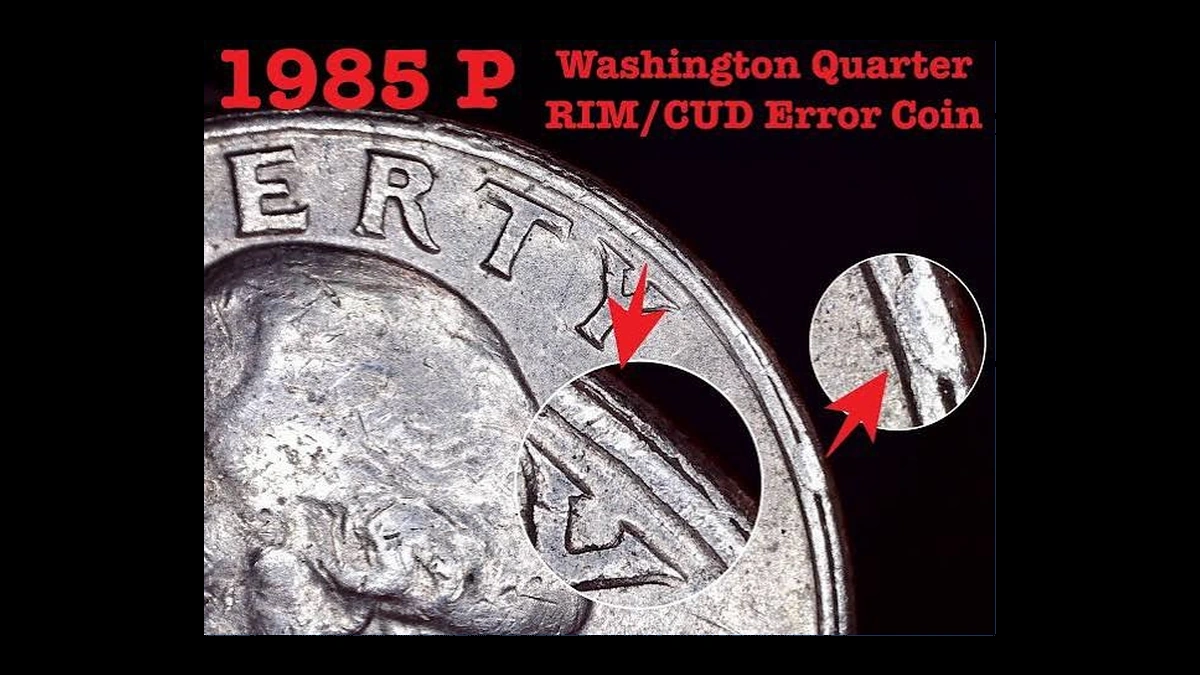
3. 1985 Quarter A Raised Patch Replaces Design: Die Breaks and Cuds Error
A cataloged Philadelphia front die break was graded NGC MS64. A separate Philadelphia cud is also reported, but the first description does not establish a rim connection or clock position.
A broken area of die leaves space for additional coin metal. A substantial break connected to the rim is a cud, while an enclosed patch must not automatically receive that label.
How to Identify
Follow the raised feature into surrounding design and, for a claimed cud, all the way to the rim. Compare the MS64 front break only with its own documented shape.
Check the edge for a blow that pushed rim metal inward, and the opposite face for related pressure damage. Solid raised metal from a die cavity differs from a dent’s displaced lips.
What It’s Worth
$5–$500 is estimated across minor through substantial genuine breaks. MS64 describes preservation, not the size of the missing tool area, so grade and the feature itself need separate assessment.
4. 1985 Quarter A Thin Flap or Local Split: Lamination Error
The year report calls local peeling or splitting lamination without establishing a mint, face, or particular shape. An internal weakness or separation associated with the layered metal requires examination of the actual boundary.
A small peel is not automatically the same condition as loss of a complete outer face. The attachment and surviving design can help explain the difference.
How to Identify
Leave loose metal attached and illuminate its connection from opposite directions. Trace any original letter or portrait detail across the flap and surrounding surface.
Inspect for scrape marks, sharp folds, dents, or chemical disturbance. Preserve loose fragments with the coin instead of prying into the opening.
What It’s Worth
$10–$350 is estimated for authenticated local separation. An intact original boundary provides more useful evidence than a large brown patch whose cause cannot be established.
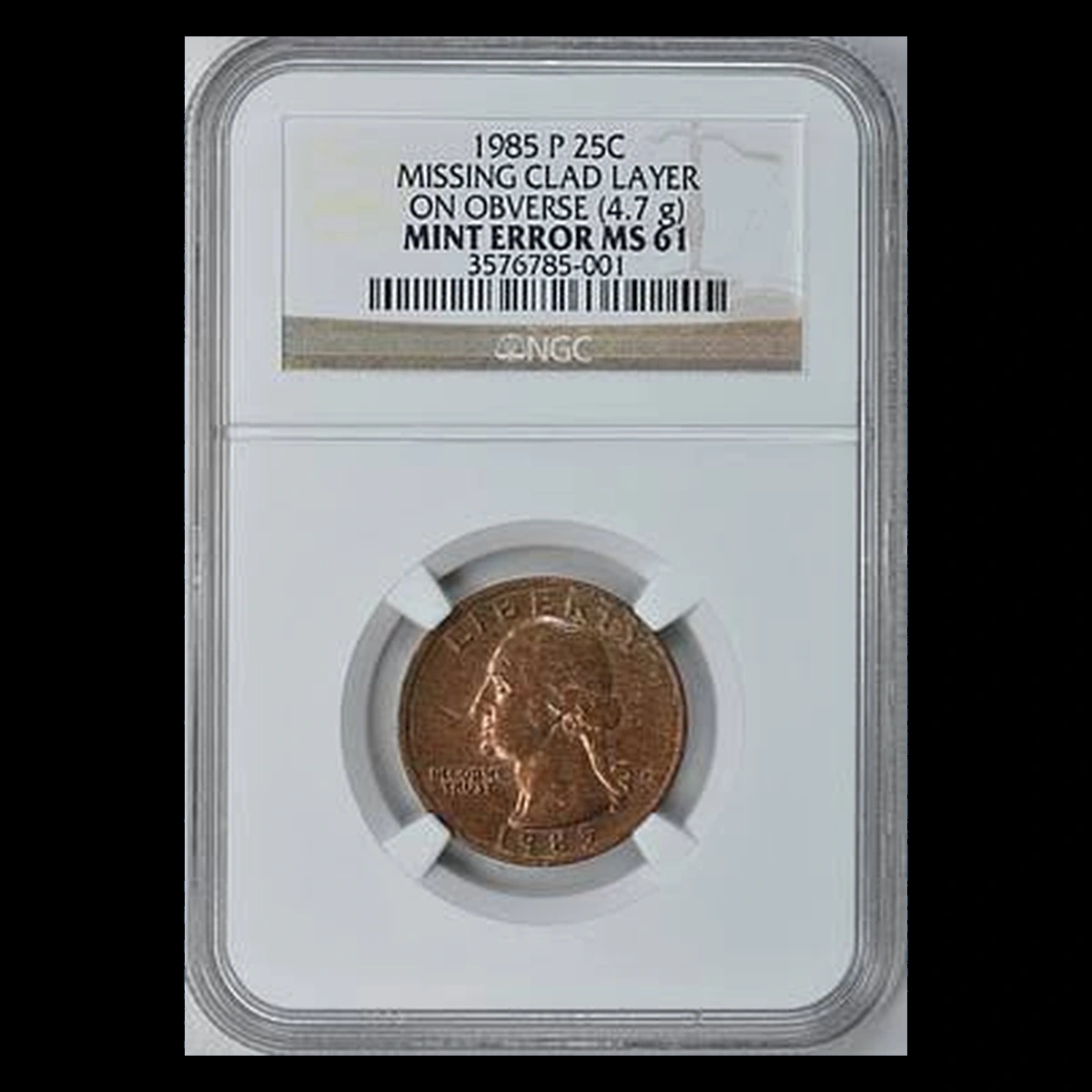
5. 1985 Quarter A Copper-Colored Front with Reduced Weight: Missing Clad Layer Error
The documented Philadelphia front-layer loss weighs 4.68 grams and was graded ANACS MS63 Red-Brown. The reverse retains a normal pale surface for comparison with the exposed copper center.
A clad quarter is assembled from bonded metal layers. Its normal weight is about 5.67 grams, but reduced weight alone does not establish how or when metal was removed.
How to Identify
Follow the missing layer into the edge while comparing both faces under neutral light. The copper-colored front should retain struck detail consistent with the attributed loss.
Look for scraping, corrosion, or staining that offers a later explanation. Use the recorded weight for a holdered specimen and let specialist examination address the timing of separation.
What It’s Worth
$50–$1,000 is estimated for genuine 1985 layer loss. The 4.68-gram front-loss coin supplies a concrete specimen, but no individual realized price accompanies it here.
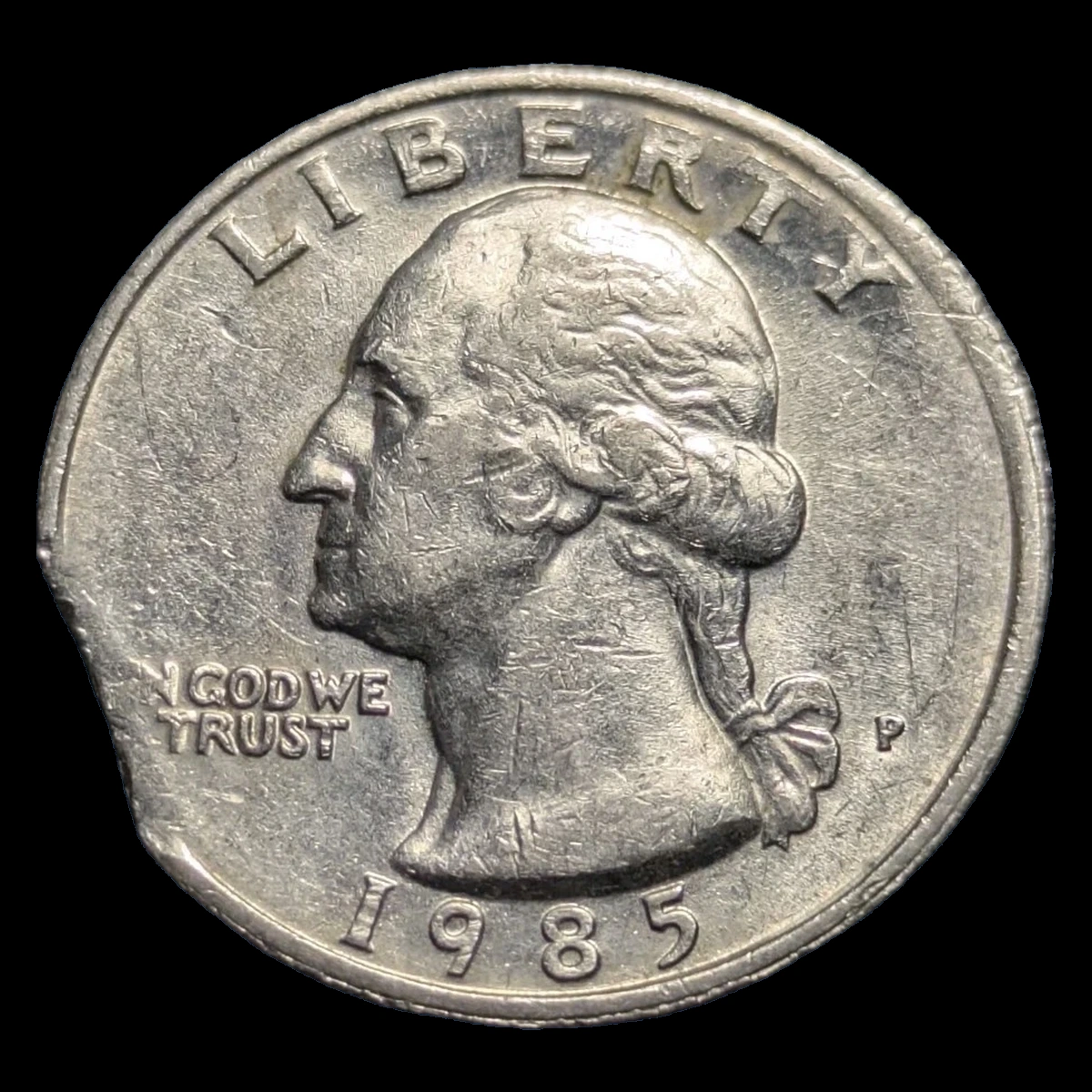
6. 1985 Quarter Curved or Straight Missing Segments: Clipped Planchet Error
A Philadelphia NGC MS63 has a 10% curved clip, while a separate AU58 coin has a 23% clip whose precise shape needs its own photograph. Straight clips are also reported without a fixed mint for an individual example.
Blanking across an earlier hole can create a curve, while cutting across the strip’s boundary can create a straight shortage. The incomplete disk receives its design afterward.
How to Identify
Examine where each opening meets the surviving rim and lettering. Original metal flow or weakness differs from finished details sliced off by later cutting.
Check for burrs and file marks, using opposite-rim weakness only as supporting evidence. Do not transfer the 10% example’s curved shape to the 23% specimen.
What It’s Worth
$10–$600 is estimated for authenticated curved or straight clips. The MS63 unworn example and AU58 lightly worn example are distinct coins, and their percentages are not interchangeable measurements.
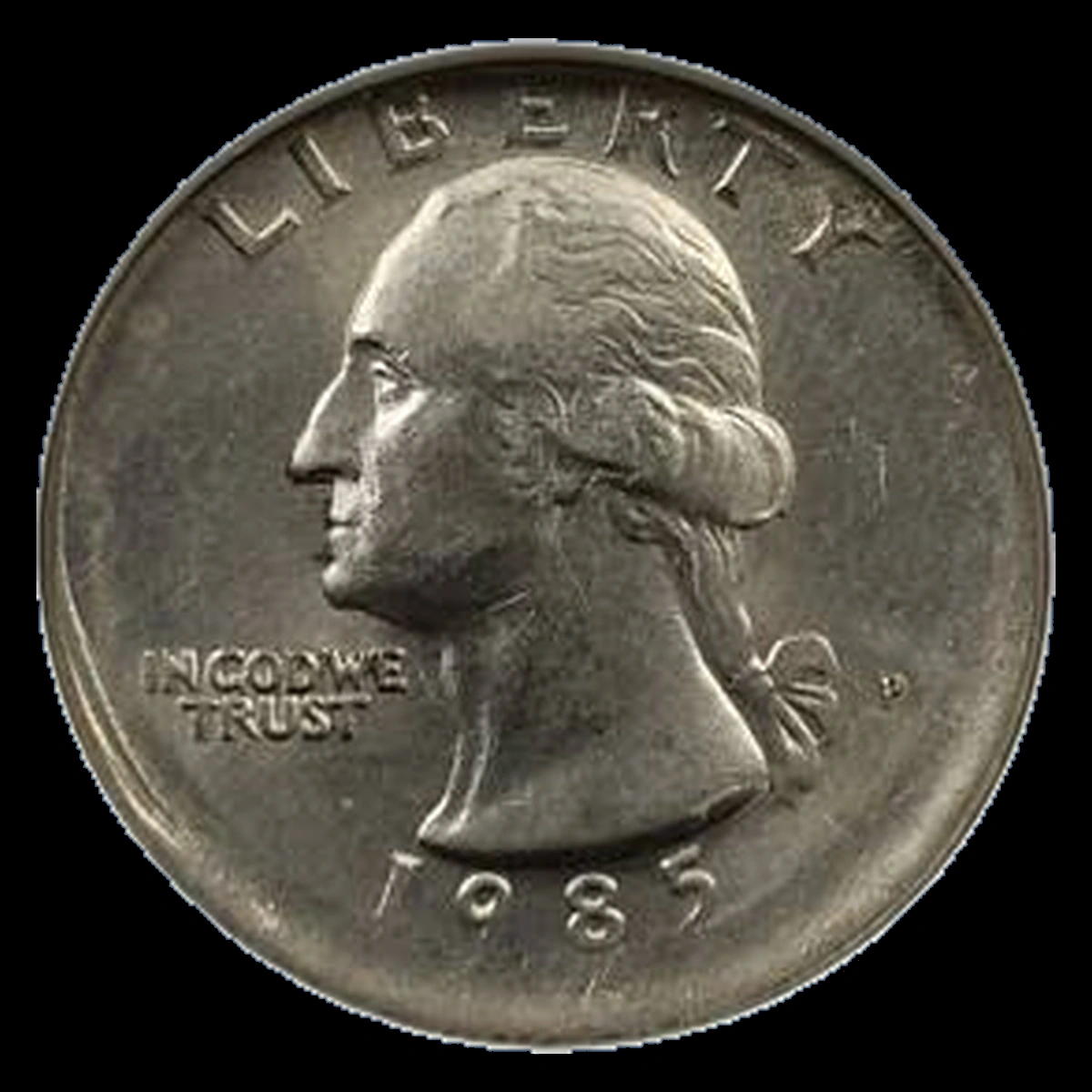
7. 1985 Quarter Expanded Metal around the Complete Picture: Broadstrike Error
Reported Philadelphia and Denver broadstrikes spread beyond the normal outline because the retaining collar did not contain the blank properly. The intended picture remains on the metal even if its surrounding margin is uneven.
How to Identify
Trace all outer lettering on both sides before interpreting the wide border. Compare several widths of a loose coin with the normal diameter of about 24.3 millimeters.
Inspect original edge flow and raised detail for grinding, hammering, or crushing. Missing grooves alone can have a later cause and do not establish collar failure.
What It’s Worth
$25–$800 is estimated for genuine ordinary broadstrikes. Strong expansion with an intact original design provides a more useful comparison than slight widening or a damaged edge.
8. 1985 Quarter An Inverted Eagle after a Vertical Flip: Rotated Dies Error
A collector reported a 1985-P quarter with 180-degree alignment, and error specialist Mike Diamond stated that he owned another. These accounts describe a half-turn difference between the two designs.
The relationship is observable even though it does not reveal which die moved or when. Independently straightened face photographs conceal it.
How to Identify
Hold Washington upright and flip top to bottom without twisting sideways. A normal eagle finishes upright, while the reported half-turn example remains inverted.
Repeat the movement against a fixed reference and retain the year and P in the record. Inspect for an edge seam or other evidence of a novelty assembled from two coins before accepting a mint-made rotation.
What It’s Worth
$20–$300 is estimated for a confirmed 180-degree rotation. The collector accounts provide no completed-sale amount, and the actual fixed alignment must be distinguished from movement inside a holder.
9. 1985 Quarter A Depression beside a Stepped Edge: Indent and Partial Collar Error
A fully dated Philadelphia quarter in a 2014 Stack’s Bowers lot was described as an indent with a partial collar and graded PCGS AU58. An obstruction covered part of the blank while the collar constrained only part of its edge.
The lot also contained a different coin with an incomplete date. Its details and any shared lot price must remain separate from the 1985 example.
How to Identify
Inspect the transition from normally formed edge to an uneven step, then locate the depression on the face. Its boundary should explain where the overlap interrupted the design.
A plain indent does not require backward letters. Check both faces for later squeeze marks and keep the complete date visible when comparing the two-coin auction material.
What It’s Worth
$50–$1,000 is estimated for a genuine indent and partial-collar combination. Both effects belong to one coin, and the auction lot total would not be its individual realized price.
10. 1985 Quarter Backward Sunken Detail with an Edge Step: Partial Brockage Error
The documented 1985-P NGC MS63 combines a transferred front-design impression with partial collar restraint. An already struck coin impressed its design into another blank, producing the recessed, reversed detail called brockage.
The description supplies no precise transfer percentage. The coin that made the impression was not included and should not be presented as an available matching partner.
How to Identify
Use side lighting to establish that the transferred shapes sink into the surface, and compare any backward letters with normal quarter detail. Then examine the partial-collar edge step independently.
Later pressing of finished coins can also copy shapes. A specialist must assess original strike flow and the relationship between normal and transferred design before confirming the minting explanation.
What It’s Worth
$50–$1,500 is estimated for the broader type. The documented partial-brockage MS63 sold for $71 on January 2, 2023, a result that should not be applied to a full-face brockage.
11. 1985 Quarter Untouched Metal beside a Displaced Image: Off-Center Strike Error
Examples range from a Philadelphia 10% displacement to a Denver coin struck 80% off center toward 11 o’clock. Those descriptions belong to different specimens.
One Philadelphia combination is 15% off center with a 2% clip. Another curved-clip example weighs 5.2 grams but has no established off-center percentage in the supplied description.
How to Identify
Find where design ends beside original blank metal and confirm that intended artwork misses the disk. Both faces should fit the same displacement, with any claimed direction measured against an upright front.
Inspect a clip separately: its metal is absent, while the off-center crescent still exists but was not struck. Keep the 15%-plus-2% coin separate from the 5.2-gram specimen.
If the date is incomplete, preserve a reliable assigned attribution rather than claiming hidden digits are readable. A dramatic crescent alone does not establish year or mint.
What It’s Worth
$50–$2,000 is estimated for genuine 1985 off-center quarters. The Philadelphia 10% coin appeared in a lot with a 1972 dime, so neither the dime’s 15% description nor the group total belongs to that quarter.
12. 1985 Quarter Widely Shifted Portraits and Borders: Multiple Strikes Error
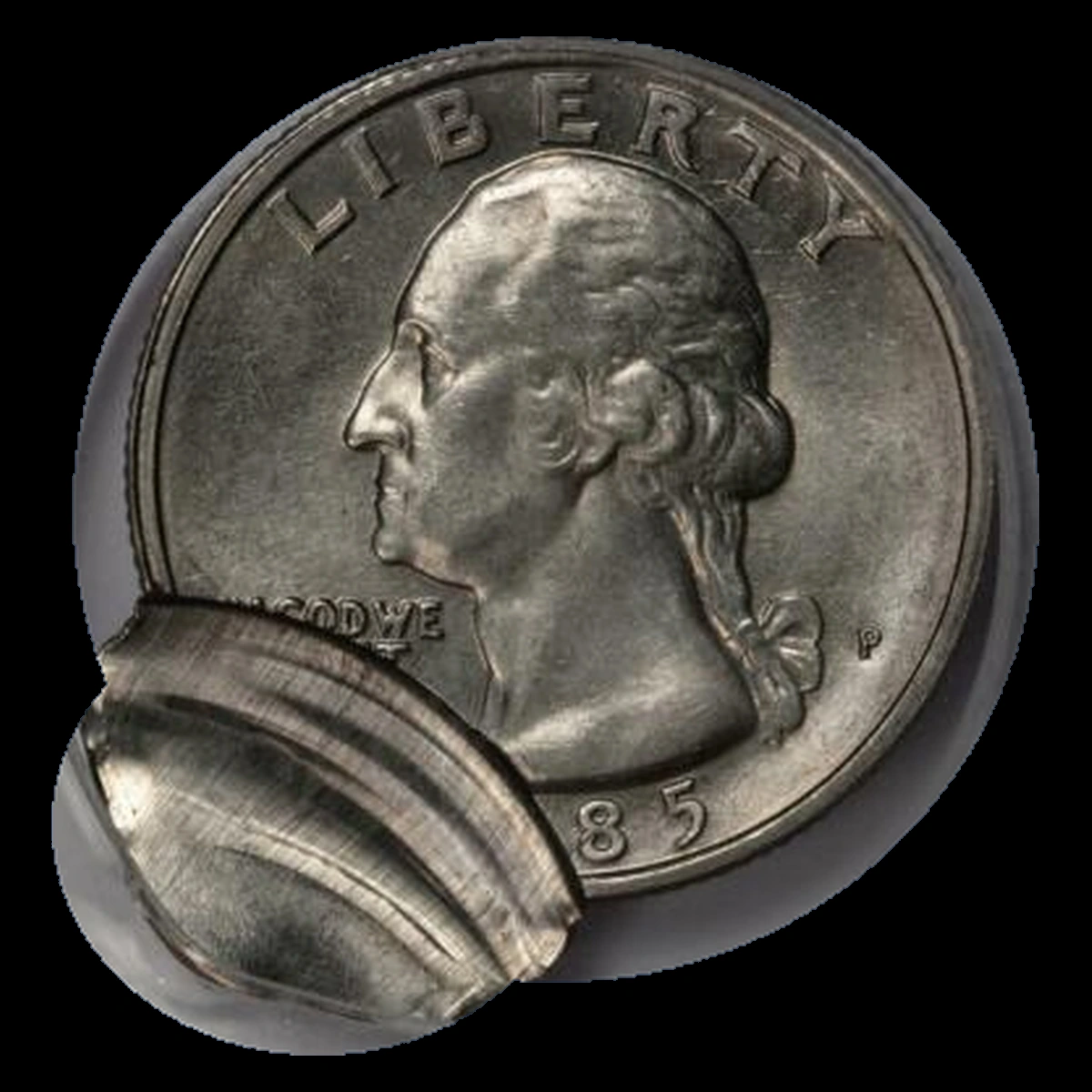
The documented group includes double, triple, and other repeated strikes. A retained coin can move between blows, leaving overlapping designs in separate positions.
One Philadelphia triple strike has its third impression 75% off center, while another triple-struck example has all three impressions off center. An attributed “(1985)” double strike has both impressions off center and does not display a fully readable year.
How to Identify
Follow one portrait or border at a time in full-face photographs, checking where later strikes flattened earlier detail. Avoid counting disconnected fragments of a single impression as additional blows.
The 75% figure describes the third blow on its specimen, not all three. Preserve separate damage information on the AU Details–Damaged triple strike, and retain parentheses for the assigned-year double strike.
What It’s Worth
$100–$2,500 is estimated across these arrangements. A Philadelphia double strike with its second impression 70% off center sold for $480 in January 2023.
The triple strike with the third blow 75% off center realized $264 in September 2024. The assigned “(1985)” double strike separately brought $1,080 that September.
13. 1985 Quarter Two Coins Preserve One Collision: Mated Error Pair Error
In the documented Philadelphia pair, an incoming blank slid partly beneath a previously struck coin. Their contact left complementary evidence that explains why the two belong together.
One has an off-center strike and upper indent, while the other has a second design on the left turned about 90 degrees. PCGS graded the individual pieces MS65 and MS64.
How to Identify
Photograph each face with its own certification record before comparing the pair. Match the upper contact area with the relevant opposing design by scale, curvature, and position.
Trace the retained coin’s left-side second image separately from the contact area. Do not press the coins together to demonstrate a fit; enlarged views preserve the surfaces while showing their relationship.
What It’s Worth
$800–$4,000 is estimated for a comparable authenticated pair. These two quarters sold together for $1,725 on April 19, 2008.
The price includes their shared history and physical match. Dividing it mechanically would not price an unrelated single quarter, and separating the pair removes part of its explanatory value.
14. 1985 Quarter A High Wall beside Expanded Design: Obverse Die Cap Error
The Philadelphia NGC MS68 cap has a high lip on the right, with its front having remained against the die during repeated contacts. At least four strikes were reported.
The reverse carries an expanded transferred design described as counterbrockage. That term concerns further contact with struck surfaces and need not look like a simple incuse mirror image.
How to Identify
Use a side view to compare the right-hand wall with the lower perimeter and follow stretched design into the expanded metal. The front view alone can hide the cap’s depth.
Inspect for sharp folds or crushed surfaces from later bending and preserve storage clearance around the wall. Its shiny surface does not establish Proof manufacture, and the strike sequence needs its own evidence.
What It’s Worth
$800–$6,000 is the broader estimate for comparable caps. The documented MS68 sold for $1,495 on January 15, 2005, reflecting a particular deepened shape, transferred design, and high preservation.
15. 1985 Quarter Quarter Designs on a Smaller Disk: Wrong Planchet Error
Confirmed Philadelphia quarters on nickel blanks include an NGC MS66 at 5.0 grams and a separate PCGS AU58 with part of QUARTER DOLLAR beyond the metal. Those are distinct specimens of the same general blank error.
The Denver silver-dime-blank claim in year guides has no established authenticated specimen or original auction lot in the supplied reports. It remains a separate, unconfirmed proposition.
How to Identify
Record actual loose-coin dimensions and weight, and examine how the smaller edge truncates the design. Lack of a copper stripe can prompt investigation but cannot identify the blank by color alone.
A silver dime blank has a normal reference weight around 2.5 grams, while a clad dime blank is about 2.27 grams. Neither figure belongs to the documented 5.0-gram nickel-blank quarter.
Professional metal testing and a matching certification record are needed to resolve the proposed Denver silver example. A light coin or a repeated extraordinary price claim cannot supply that missing evidence.
What It’s Worth
$200–$15,000 spans the confirmed nickel group and the separate conditional silver claim. Nickel-blank quarters are estimated at $200–$1,500, with the 5.0-gram MS66 selling for $288 in January 2023 and another MS67 realizing $305.50 in October 2012.
The Denver silver-dime-blank estimate is $1,000–$15,000 only after authentication. Repeated six-figure claims without an original matching auction record are not evidence of completed sales.
Conclusion
A combination error needs more than one diagnostic check, but still represents one complete coin. Matching pairs are different because two preserved objects help reconstruct the same event.
Keep individual weights, percentages, grades, and sale amounts with their proper specimens. For unusual blanks, establish the metal and original strike before choosing the price range; the unconfirmed Denver silver claim cannot borrow the evidence supporting Philadelphia nickel-blank quarters.