Rare 1989 Half Dollar Errors (List & Pictures)
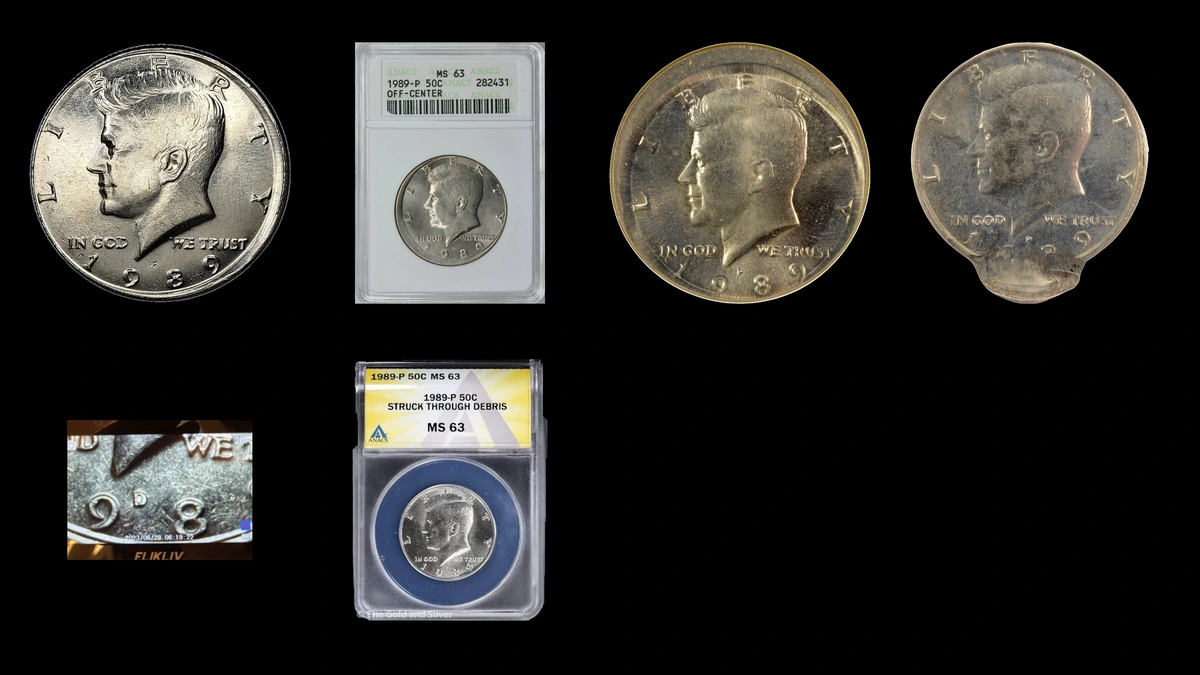
A 1989-P struck a second time 65% off center sold for $2,400 in July 2022. Smaller 1989 half dollar errors include a repeated D and a blocked reverse star, with supplied estimates spanning $1–$3,500.
Begin by comparing both faces against the outline, then check alignment, the mintmark, and local marks. This helps distinguish an extra strike from a moved die or a small feature already present in a tool.
| Visible clue | Category | Estimated range |
|---|---|---|
| Only the front is shifted | Misaligned obverse die | $10–$150 |
| Both designs displaced | Off-center strike | $75–$850 |
| Complete designs with wide border | Broadstrike | $75–$500 |
| Overlapping design positions | Double or multiple strikes | $250–$3,500 |
| Small backward impression and edge step | Brockage with partial collar | $100–$650 |
| Curved missing section | Clipped planchet | $25–$350 |
| Eagle tilted after a straight flip | Rotated dies | $30–$300 |
| Extra D contour | RPM-001 | $20–$125 |
| Raised portrait or wing line | Die crack | $5–$200 |
| Absent star or object texture | Filled die or strike-through | $1–$1,200 by type |
| Split front-letter outlines | Disputed doubled-die report | $25–$400 if identified |
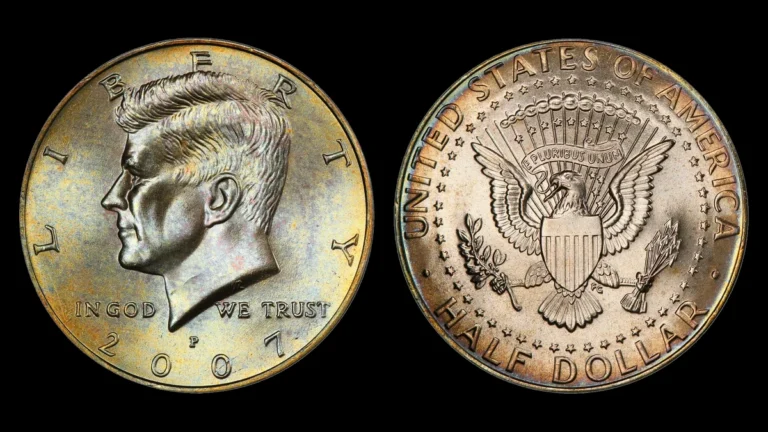
All normal 1989 halves, including proofs, use clad metal and weigh 11.34 grams at a diameter of 30.61 millimeters. Measurements and the grooved edge help assess altered outlines, while small die varieties require direct comparison of their raised details.
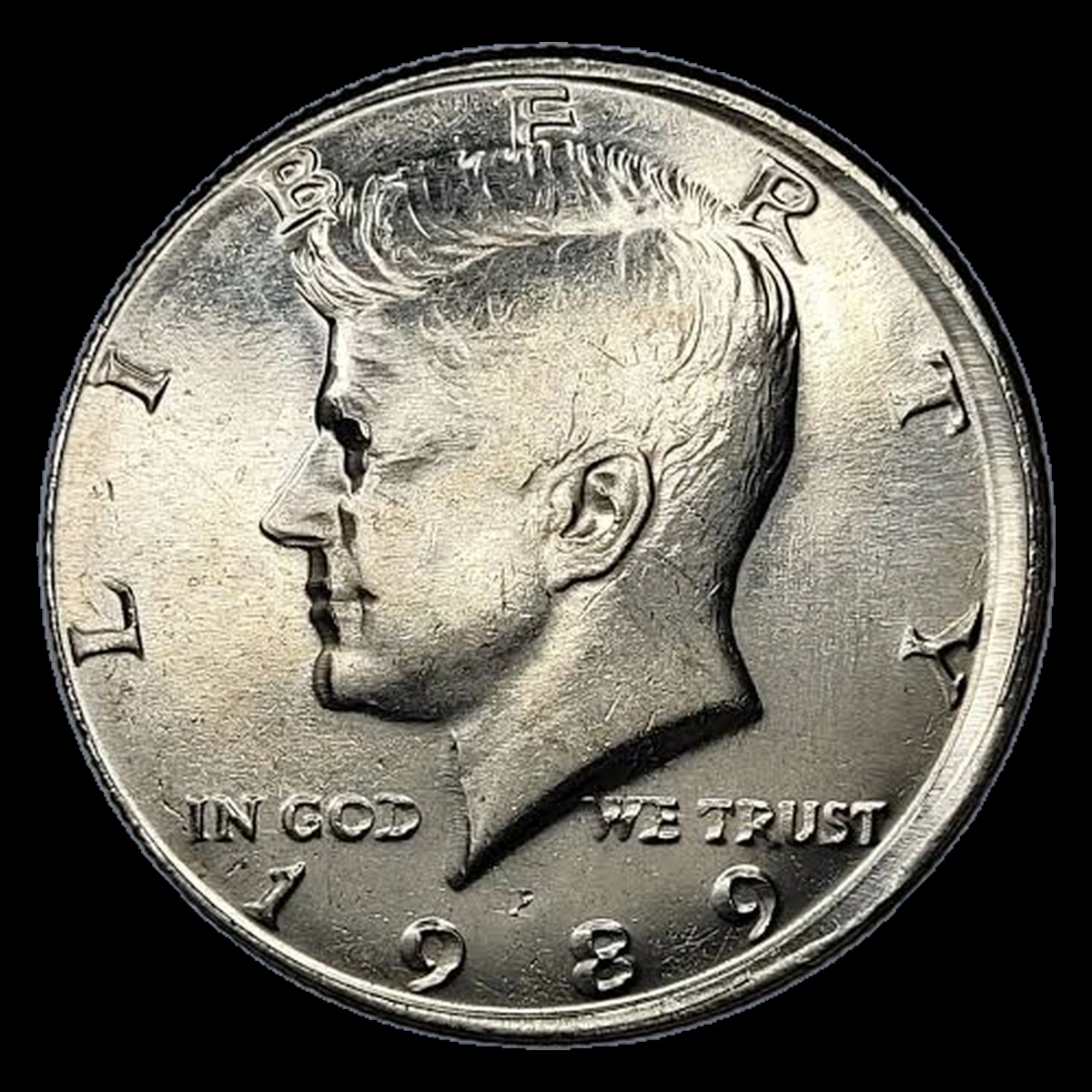
1. 1989 Half Dollar An uneven front border with a centered reverse: Misaligned obverse die Error
The reported Denver coin has a shifted portrait-side design while its reverse remains centered. Although presented with an off-center label, that description fits an obverse die positioned away from its proper alignment.
How to Identify
Take straight-on full-face photographs and compare border widths around both designs. Tilted camera angles can make a centered coin appear uneven.
One shifted face differs from a displaced blank, which generally affects both faces and leaves original plain metal. Inspect the edge for squeezing, filing, or seams that could offer another explanation.
What It’s Worth
Visible front-die misalignment is estimated at $10–$150, with slight border differences toward the lower end. Stronger clear displacement may attract more interest.
The $240 sale of a genuine 15% off-center 1989-P in October 2021 concerns a different error. Its NGC MS65 grade and two-sided displacement should not be assigned to the Denver report.
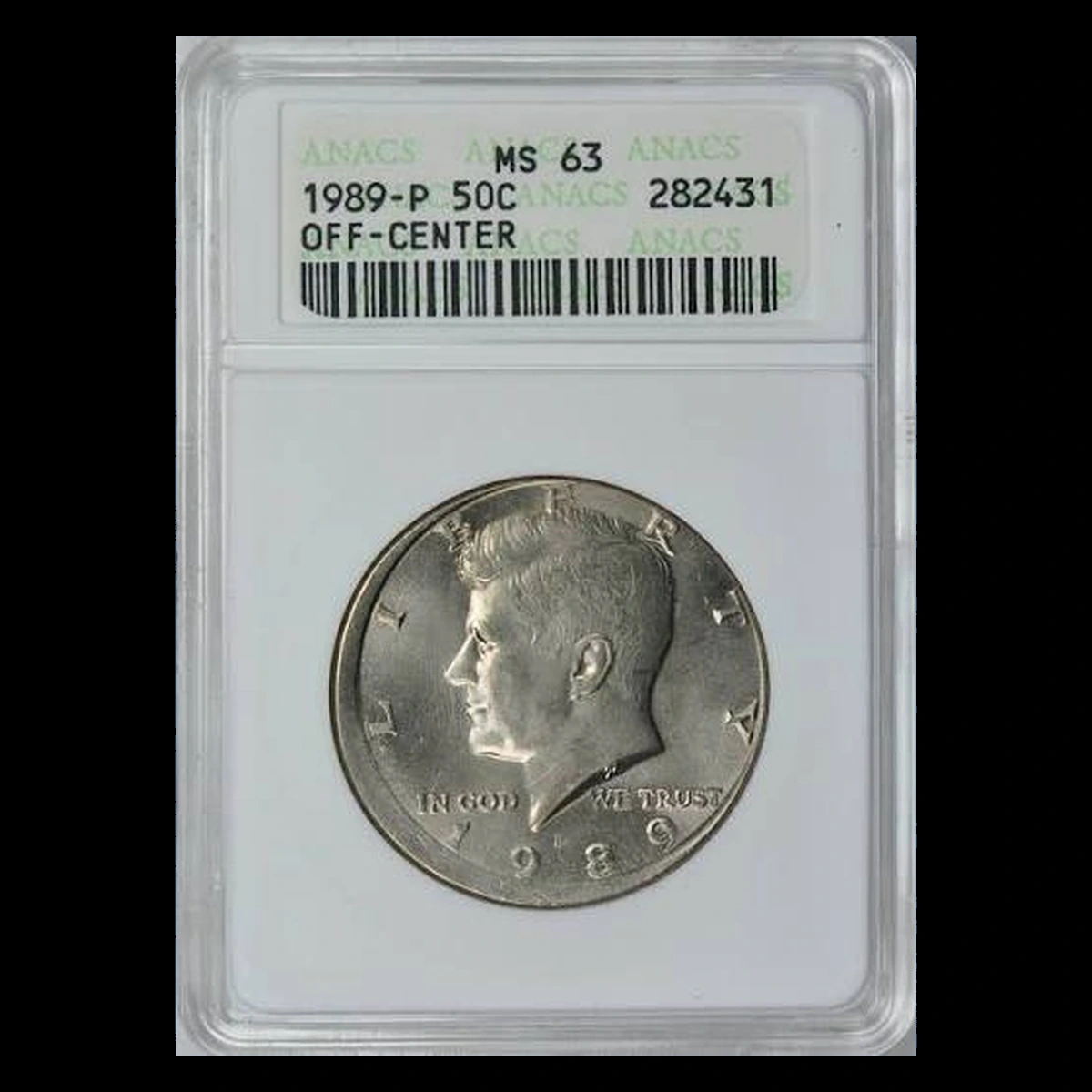
2. 1989 Half Dollar Incomplete designs beside a blank crescent: Off-center strike Error
Recorded Philadelphia examples include an NGC MS63, an NGC MS65 struck 15% off center, and a PCGS MS64 with a 10% offset toward about 4:30. The direction belongs to the last coin rather than the entire group.
How to Identify
Compare the plain areas and incomplete designs on both faces. Original blank texture should meet the strike without grinding marks from later removal.
Keep the date and P within uncropped photographs of the outline. Off-centering changes where the design lands, so weight can remain near normal when the original metal is intact.
What It’s Worth
Genuine examples are estimated at $75–$850. The 15% MS65 sold for $240 in October 2021, the 10% MS64 for $115 in June 2005, and the separate MS63 for $69 in October 2010.
A 1990-P 10% offset graded NGC MS66 sold for $198 in September 2025. These records show the need to compare surfaces, retained design, and each specimen’s actual displacement.
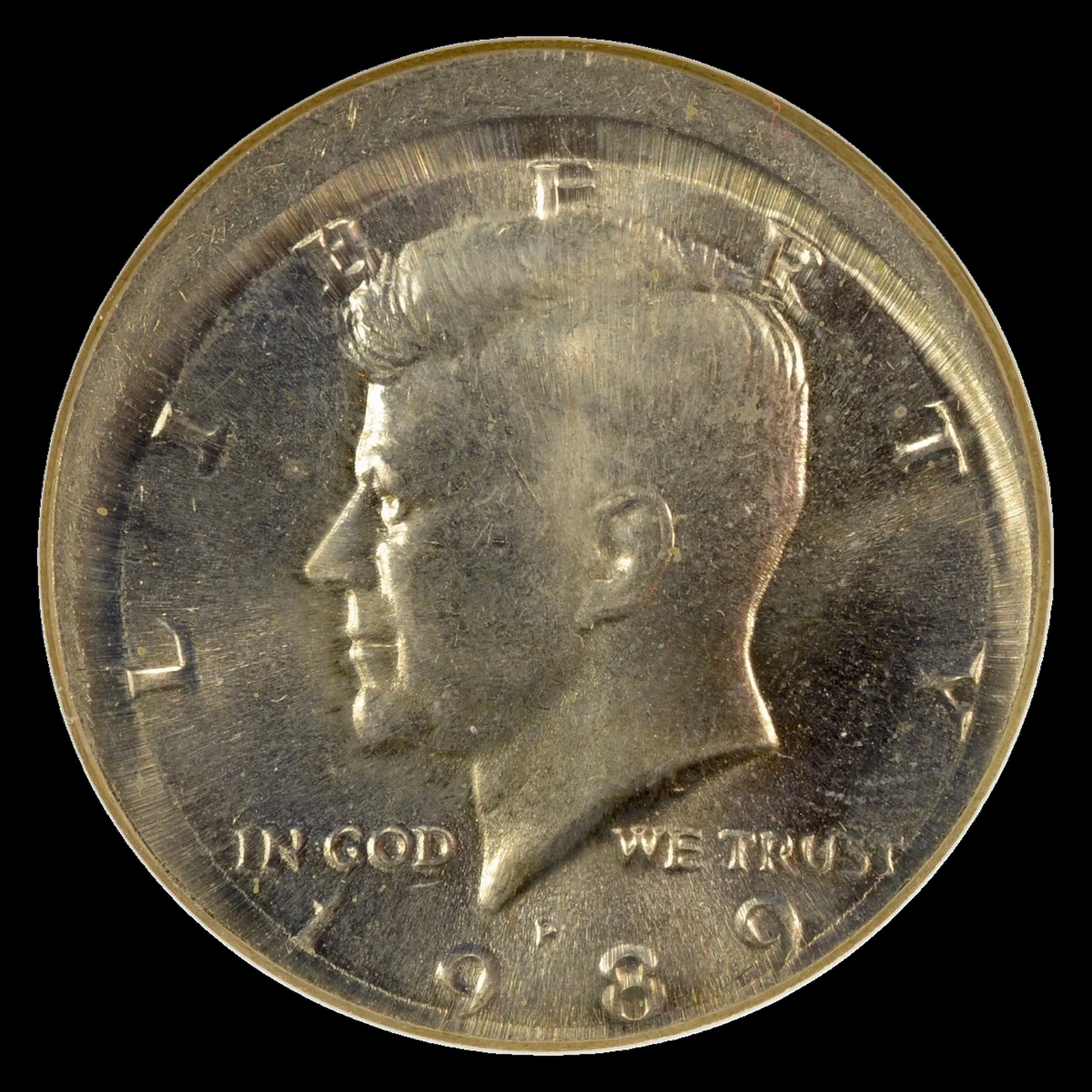
3. 1989 Half Dollar A broad margin surrounding complete designs: Broadstrike Error
A 1989-P NGC MS66 retained its full design while metal spread beyond the normal outline. The collar ring failed to contain the blank during striking, allowing width to increase without adding metal.
How to Identify
Read every outer word on both sides before judging the border’s size. Check the expanded edge for missing or incomplete grooves and original metal flow.
Later pressure can enlarge a normal half but often crushes lettering and changes surface texture. This plain broadstrike is a different specimen from the complex multiple-strike coin below.
What It’s Worth
Comparable broadstrikes are estimated at $75–$500. The 1989-P MS66 sold for $69 in December 2009, a historical completed sale.
A 1990-P ANACS MS61 brought $192 in March 2025. The contrast shows why numerical grade alone does not determine an error’s price.
4. 1989 Half Dollar Two or more displaced design positions: Double and multiple strikes Error
Known 1989-P coins include second strikes 65% and 60% off center, plus a flipover example whose second strike is 95% off center. The 60% coin turned about a quarter revolution and shows two P mintmarks, a complete date, and part of another.
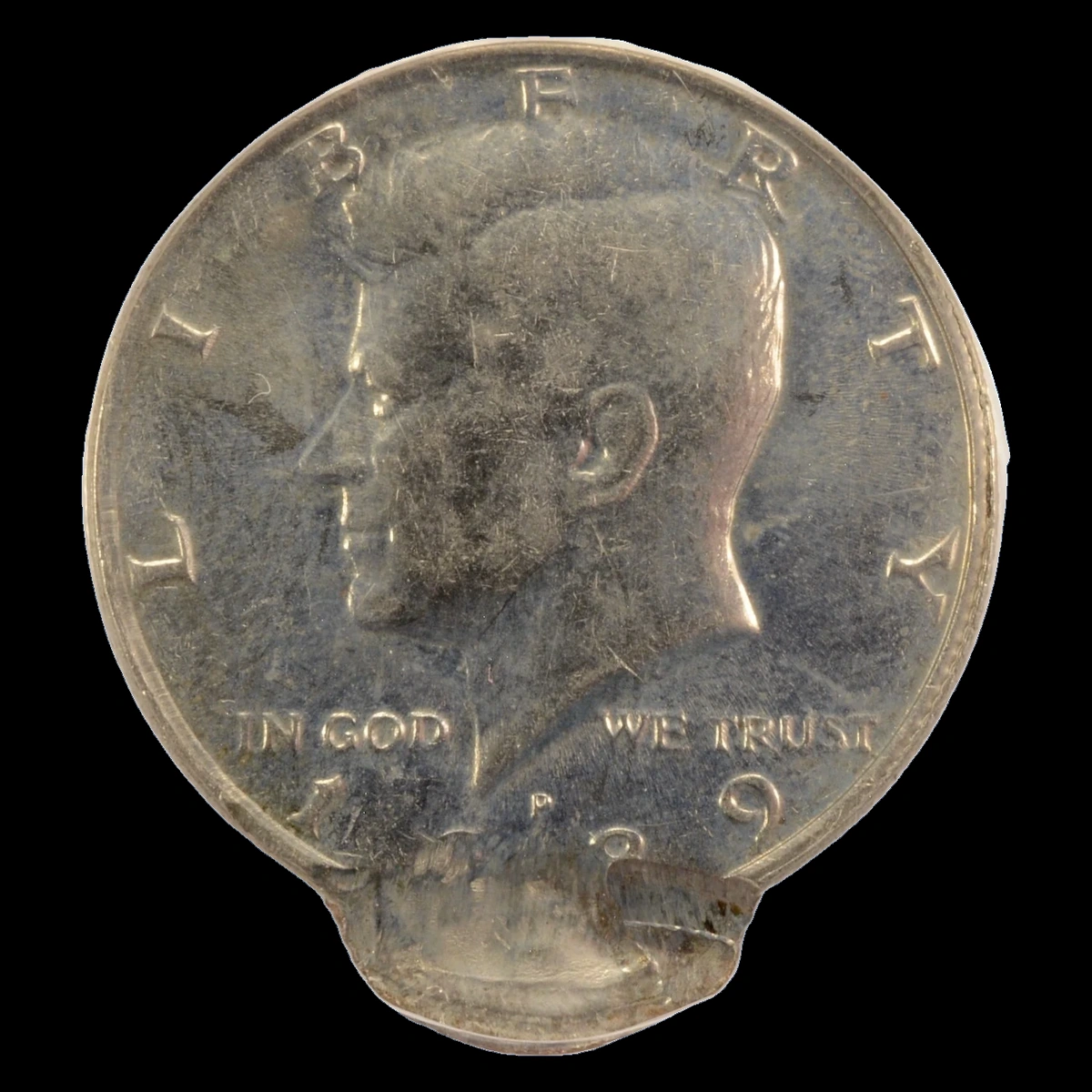
A separate PCGS MS65 combines several strikes, a broad outline, backward eagle detail, and a small split. Heritage proposed that another coin had adhered to a die during the sequence; that is a reconstruction rather than a witnessed event.
How to Identify
Trace one coherent design position at a time, looking for where a later blow flattened earlier detail. The 60% example’s second strike points toward three o’clock, while the flipover coin requires remnants of the opposite design.
On the complex MS65, inspect the backward eagle from nine to 1:30, incuse reverse details near three, and the split near nine. The surviving 89 and P belong to that specimen’s identification.
Several lines can come from one impression. Do not count every isolated contour as an additional strike.
What It’s Worth
The supplied range is $250–$3,500. The 65% second-strike MS62 sold for $2,400 in July 2022, the 95% flipover MS62 for $252 in July 2021, and the 60% MS64 for $1,610 in January 2008.
The complex MS65 realized $2,012.50 in August 2007. Its brockage, spread, and split share one whole-coin price, and a larger offset clearly did not guarantee the largest result among these records.
5. 1989 Half Dollar A backward impression with a stepped edge: Partial brockage and partial collar Error
The PCGS MS62 1989-P combines a 4% brockage with a partial collar strike. Another struck coin produced a small reversed, sunken design, while incomplete collar support allowed one edge portion to spread beyond the other.
How to Identify
Find recognizable backward detail depressed into the face; a plain dent is not enough. The supplied listing does not establish the exact affected face or clock position.
Then view the edge sideways to locate the original junction between contained and expanded metal. Both the copied design and the edge step need evidence, rather than inferring one from the other.
What It’s Worth
Comparable genuine combinations are estimated at $100–$650. The PCGS MS62 sold for $119 on March 31, 2025.
That price covers both features on one coin. A 4% brockage should not be compared directly with a large complete backward design solely because they share the same error term.
6. 1989 Half Dollar A curved shortage in the blank: Clipped planchet Error
A curved clip can form when the blanking punch overlaps an earlier hole in the metal strip. The 1989 report gives no established mint, percentage, or position tied to a specific auction specimen.
How to Identify
Examine the two ends of the arc for rim weakness or flow toward the gap. Burrs, filing, and saw marks can instead show that a finished coin was cut later.
Opposite-rim weakness can be useful but may not be evident on every clip. A low weight confirms absent metal without proving when it disappeared.
What It’s Worth
A genuine 1989 curved clip is estimated at $25–$350. A small 1993-D ANACS MS64 clip sold for $34.74 including fees in August 2025.
The higher estimate allows for more conspicuous attractive examples, not a known 1989 auction or specified loss percentage. A clear date and original gap boundaries make comparison more reliable.
7. 1989 Half Dollar A consistently tilted eagle after a straight flip: Rotated dies Error
The 1989 rotation report names neither a mint nor a measured angle. A turned die changes the relationship between complete front and reverse designs even though each face can look normal by itself.
How to Identify
Flip an upright portrait top to bottom without letting the coin swivel, then repeat beside a normal half. A short continuous video can document the same reverse tilt each time.
Separately straightened photographs conceal the relationship. Examine the edge for seams or tool marks from joined pieces, since correct dimensions alone do not rule out alteration.
What It’s Worth
Genuine rotation is estimated at $30–$300, with degree and surface appeal affecting demand. A 2000-P PCGS MS61 with 75-degree rotation brought $79 in March 2025.
Two 1988-P NGC MS65 halves rotated 180 degrees sold together for $288 in July 2021. That total belongs to a pair and provides no angle or sale result for the general 1989 report.
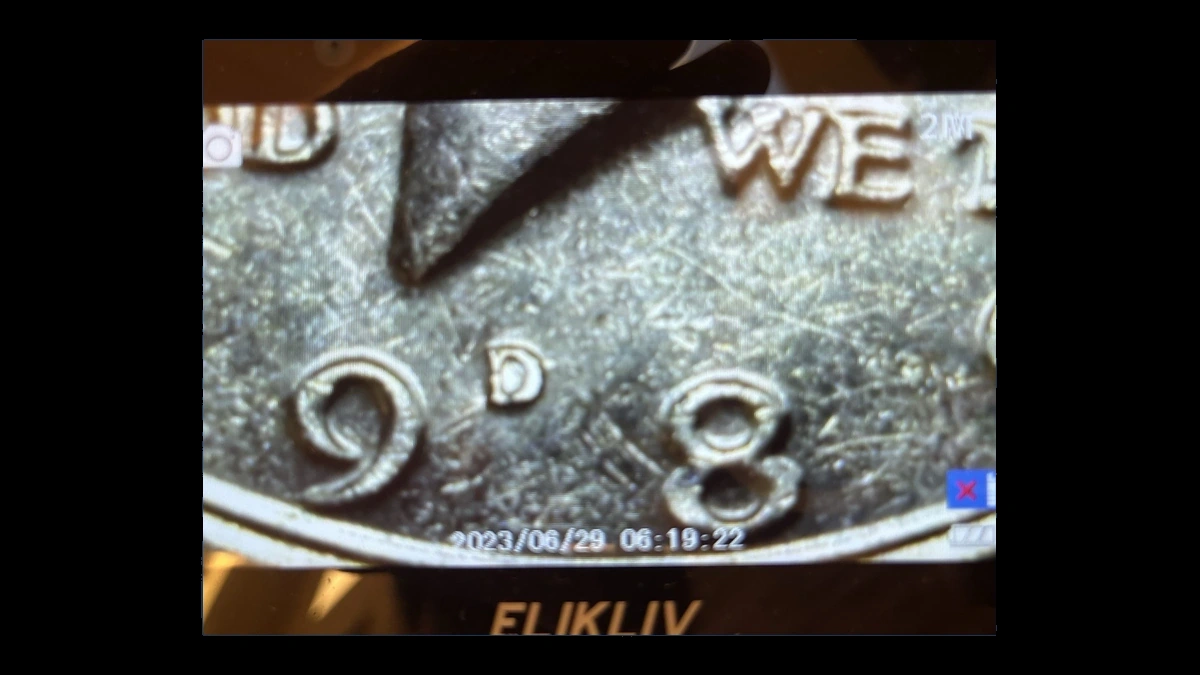
8. 1989 Half Dollar A slightly turned earlier D: Repunched mintmark RPM-001 Error
On 1989-D RPM-001, an earlier D punch sits slightly counterclockwise from the final letter. CONECA records the overlapping pattern, including examples found in ordinary uncirculated mint sets.
How to Identify
Follow the earlier letter around the principal D using the CONECA reference photographs. A flat shelf or corroded lump does not reproduce the same rotated D shape.
Minor markers can change as a die wears, while the underlying overlap remains the identifying feature. Mint-set packaging is neither proof of the variety nor evidence of a specially manufactured proof coin.
What It’s Worth
A clearly matched RPM-001 is estimated at $20–$125. Sharp mintmark remnants and attractive surfaces support the stronger end.
A guide’s $15–$60 range for minor ungraded 1986-D repunched mintmarks offers only a different-year comparison. The catalog establishes the 1989 pattern but supplies no sale price here.
9. 1989 Half Dollar A narrow raised seam across portrait or wing: Die crack Error
The guide suggests Kennedy’s portrait and the eagle’s wing as inspection areas without mapping a particular specimen. Metal entering a fracture in the die can form a ridge on the finished coin.
How to Identify
Use low side light to distinguish a continuous raised seam from a cut with displaced borders. Follow only the actual added line rather than extending it along a normal feather edge.
Deposits can also resemble ridges, so preserve the surface rather than cleaning or scraping it. The location alone cannot establish a cracked-die origin.
What It’s Worth
Genuine examples are estimated at $5–$200, with faint lines generally modest in value. A larger clear ridge on clean surfaces may draw more attention.
A stronger 1976-D reverse die break graded NGC MS65 sold for $256 in June 2026. It is a different-year, more substantial defect and does not establish a result for any reported 1989 crack.
10. 1989 Half Dollar A missing star or recognizable object texture: Filled die and strike-throughs Error
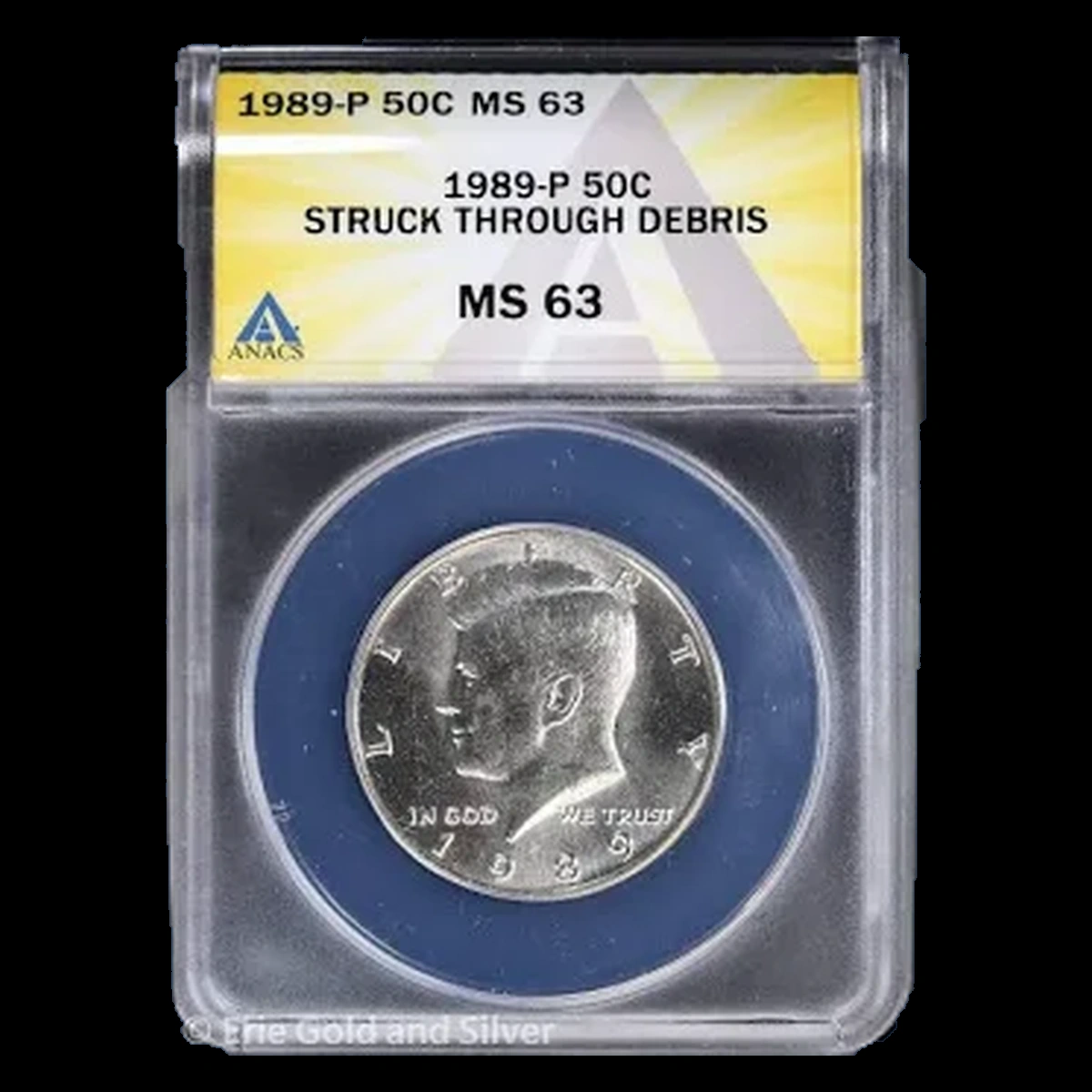
A collector’s 1989-D lacks a star below the eagle’s tail, and Fred Weinberg assessed the photographs as showing a small filled-die area. Material blocking a die recess can prevent that star from forming without changing the reverse design itself.
Separate cloth and metal-layer-fragment reports lack matched grading records. Those possible obstructions need evidence distinct from the missing-star example.
How to Identify
Compare the star’s location with a normal reverse and examine neighboring stars and feathers for sharpness. Scratches at the empty spot could indicate later removal, and the supplied specialist assessment was made from photographs.
A cloth claim needs a recognizable woven texture; a metal-fragment claim needs a convincing impression or surviving material. An untextured hollow identifies neither.
What It’s Worth
Minor filling is estimated at $1–$20, clear ordinary strike-throughs at $25–$300, and strongly supported cloth or metal-fragment impressions at $200–$1,200. The upper category requires evidence of the claimed object type.
A 1988-D obverse strike-through graded NGC MS67 brought $59 in July 2021, while a 1976-D affected on both faces sold for $114 in March 2025. These are different-year comparisons rather than sale records for the 1989 reports.
11. 1989 Half Dollar Split contours in the front lettering: Disputed doubled-die report Error
One report points to LIBERTY and IN GOD WE TRUST, while other year references dispute an established cataloged 1989 doubled obverse. No specific mint or recognized variety number is established by the supplied account.
How to Identify
Look for rounded second outlines or split letter tips that remain in the metal under changing light. Overall thickness and bright reflections are insufficient.
A flat shelf narrowing the main letter often comes from movement during striking instead. A reliable same-variety comparison is needed before assigning a catalog identity to a candidate.
What It’s Worth
The $25–$400 estimate applies only to genuine clearly identified doubled-die detail. It does not apply automatically to mechanical shelves or unresolved thick letters.
A recognized 1974-D doubled die graded ANACS MS64 sold for $49 in May 2026. That modest different-year result cannot confirm the disputed 1989 claim.
Conclusion
For a 1989 half, comparing both faces resolves several common mix-ups before magnification is needed. A single shifted face, a displaced blank, and a broadstrike have different relationships between design and outline.
Trace recognizable designs on multiple-struck coins and keep compound features attached to one specimen’s price. For tiny marks, a matching raised D or a documented missing star is more informative than a dramatic error name alone.