Rare 1864 Half Dollar Errors (List & Pictures)
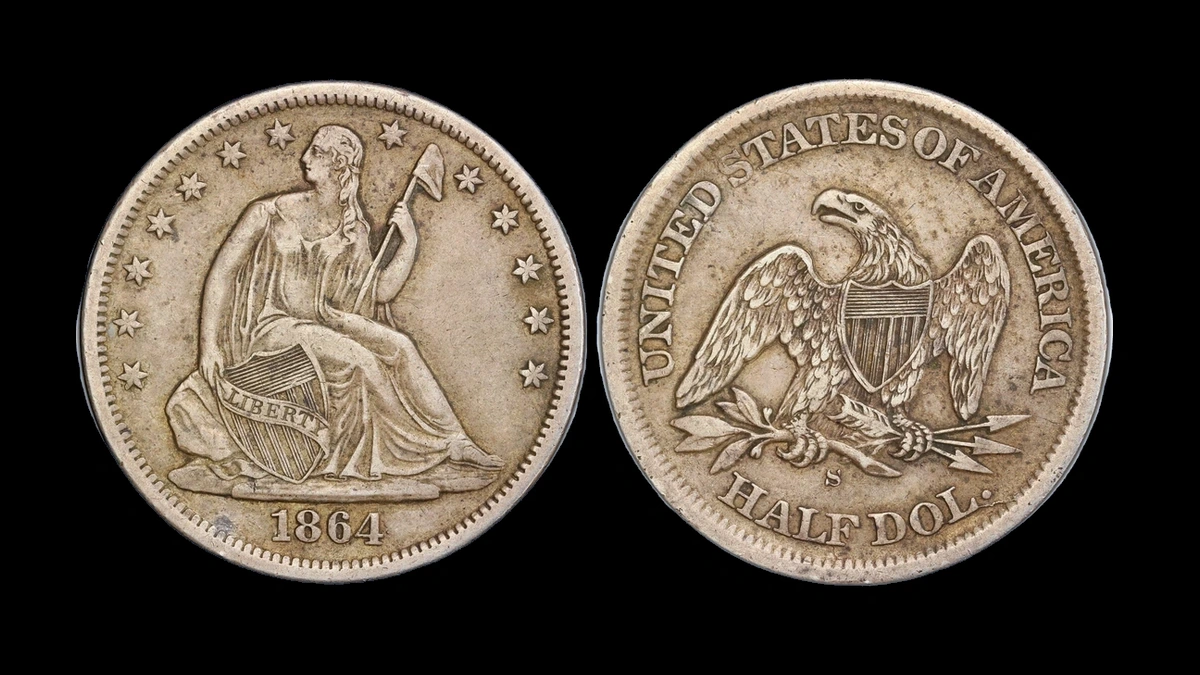
A missing part of an S and extra strokes in a date belong to two different searches for 1864 half dollar errors. Estimated values span $200–$40,000 across the mints and conditions discussed here.
The documented high sale is $38,400 for an exceptional San Francisco MS67 in May 2025. Read the mintmark first, then follow the relevant letter, date, and raised-line checks below.
| Look here | Clue | Category | Estimated value |
|---|---|---|---|
| S below the eagle | Gap in the upper curve | Small Wide Broken S | $200–$1,000 circulated; $30,000–$40,000 exceptional MS67 |
| 1 and 4 in the date | Extra raised numeral strokes | Repunched date | $2,000–$3,500 for similar unworn coins |
| Surfaces of a Philadelphia WB-102 | Fine raised threads | Die cracks | $2,000–$3,500 for similar unworn coins |
Philadelphia used no mintmark, while S identifies San Francisco. A normal 1864 half dollar weighs 12.44 grams before wear, measures roughly 30.6 mm across, and has grooves around the edge.
1. 1864 Half Dollar A Gap in the Top of the S: Broken Mintmark Error
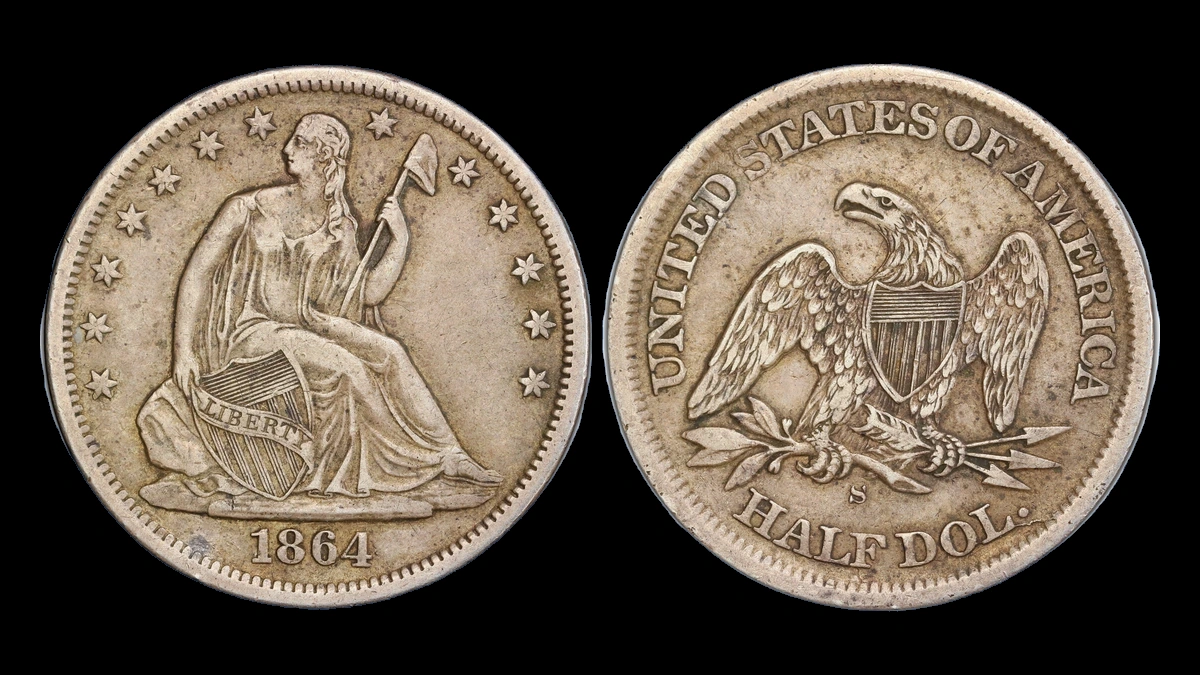
The back offers a useful first division between coins in this guide. If an S appears below the eagle, inspect its upper curve for the gap called Small Wide Broken S.
The incomplete shape was carried by a damaged punch used to put the mintmark into a die. A die is the steel tool that stamps the coin, so the missing section was absent from the design before striking.
Bill Bugert’s San Francisco reference records the shape on more than one 1864-S die pair. It is not evidence that silver broke off each finished coin.
How to Identify
View the full S under a magnifier before enlarging its top. The letter’s width and overall outline matter alongside the small missing section.
Compare the upper-curve gap with a documented Small Wide Broken S. General weakness across several parts of the letter may reflect a soft strike or wear rather than this specific punch shape.
Inspect the silver just outside the mintmark too. A cut extending beyond the S or a disturbed surface can point to damage after manufacture.
A full reverse photograph preserves the mintmark’s placement and size. Pair it with a close detail instead of relying on a cropped gap alone.
What It’s Worth
Estimated range: $200–$1,000 for circulated examples. A PCGS EF Details–Cleaned WB-4 sold for $312 at Stack’s Bowers in November 2025.
“Details–Cleaned” means the coin has a surface problem, although its remaining design can still be assessed. That result is a more useful comparison for an impaired worn coin than a top-grade auction record.
Exceptional MS67 examples are estimated at $30,000–$40,000. PCGS records a $38,400 Heritage sale in May 2025 for this superb unworn grade.
The huge difference reflects preservation. Recognizing the same incomplete S on a worn coin does not place it in the MS67 price range.
2. 1864 Half Dollar Extra Strokes Above the 4: Repunched Date Error
On the Philadelphia WB-102, examine the area above the 4’s crossbar and right foot. Small added outlines also occur at the 1.
These fragments reproduce earlier impressions made while the date was punched into the die. The final punch placement did not cover every part of the previous impression.
How to Identify
First confirm there is no S below the eagle. This date description concerns the Philadelphia variety, whose catalog number is WB-102.
Bring the entire date into focus and use the two described locations at the 4 as starting points. After matching them, compare the 1 with a clear reference image of the same variety.
The surviving numeral edges should be raised and recognizable in shape. A dent through a number or a flat shelf beside it is not enough to identify repeated date punching.
Wear can reduce the visibility of small extra strokes. Match what remains at several points rather than assuming that an indistinct 1 proves or rules out the variety.
What It’s Worth
Estimated range: $2,000–$3,500 for similarly preserved unworn examples. The reference coin also has the fine die cracks covered next.
The PCGS MS63 WB-102 sold for $2,640 at Heritage on January 14, 2025. MS63 means no circulation wear, with surface marks still possible.
That one sale values the complete coin with both features. It cannot be divided into a full repunched-date price plus an additional full die-crack price.
3. 1864 Half Dollar Fine Threads Above the Surface: Die Cracks Error
After checking the Philadelphia coin’s date, inspect its surfaces for fine raised lines. The WB-102 auction description mentions die cracks without giving their complete routes.
The extra height comes from silver filling narrow splits in the die under pressure. The coin preserves those openings as ridges.
How to Identify
Move the lamp around the coin and determine whether each candidate line rises above the surrounding silver. Compare the locations with clear photographs of the auctioned WB-102 rather than guessing a path from the catalog’s brief wording.
The source also mentions a gray surface line near STATES. Color alone cannot establish a die crack, so that line needs a separate check for height.
Scratches leave grooves, often with displaced metal at their sides. Following the whole mark helps distinguish that damage from a thin ridge produced by the die.
An S-marked half dollar needs its own die-crack reference. A crack on the same date from a different mint does not automatically match the Philadelphia example.
What It’s Worth
Estimated range: $2,000–$3,500 for an unworn Philadelphia coin comparable to the MS63 reference. The supporting result is the same $2,640 January 2025 sale used for the repunched date.
Original surfaces and remaining detail help determine where a comparable coin fits. A faint ridge on a heavily worn half is insufficient reason to use an unworn-coin estimate.
Conclusion
Reading the mintmark divides the search: San Francisco offers the incomplete S, while the Philadelphia reference combines repunched digits and fine cracks. Check each feature where the evidence places it.
The $200–$40,000 estimates cover very different preservation levels. The $2,640 Philadelphia record is one coin with two features, and the $38,400 San Francisco record belongs to an exceptional MS67.