Rare 1889 Half Dollar Errors (List & Pictures)
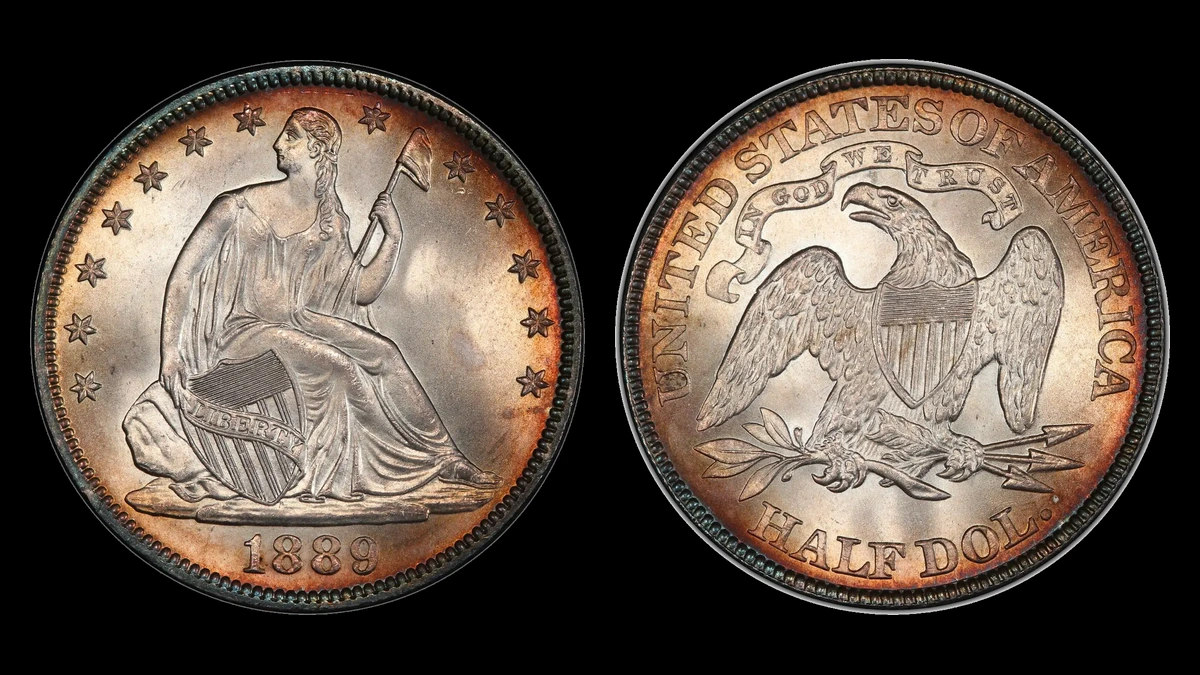
On an 1889 half dollar, a line between the stars can be a normal clue to how the coin was made. It need not mean someone scratched it.
This guide to 1889 half dollar errors covers that raised star-to-star line, with an estimated $500–$3,500 whole-coin range for the conditions discussed below. A much finer MS67 example reached $11,163 in February 2016.
Start by finding the correct stars, then compare the coin’s condition before judging its value.
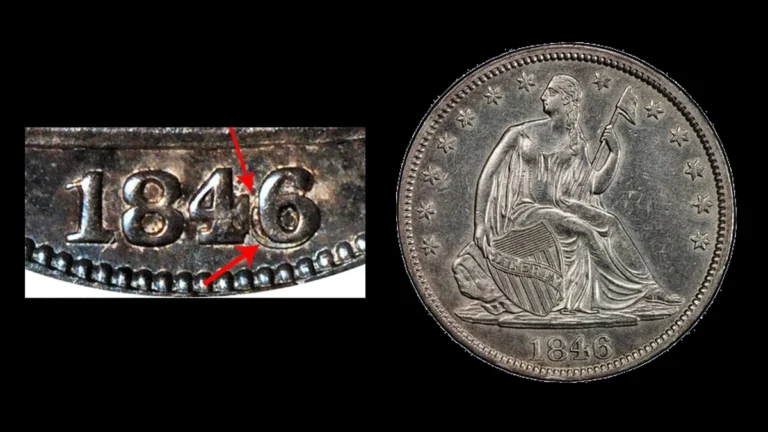
1889 Half Dollar A Line Joining Four Stars: Die Crack Error
The stars act like a map for this feature. Number them from the lower left, moving upward and then across the top of Liberty.
Between stars 6 and 9, many 1889 regular-issue halves show a connecting ridge. These are the coins made for everyday use, rather than Proofs specially made for collectors.
The ridge is a copy of a narrow break in the stamping tool, or die. Pressure pushed silver into that break, leaving a line above the surrounding surface.
A reference on Seated Liberty half dollars describes this star crack as usual for the year. Finding it can confirm an interesting mint-made feature, but does not by itself establish rarity.
How to Identify
First make sure you are studying an 1889 Philadelphia coin, which has no mintmark. The familiar crack discussed here is a feature of regular coins.
Bring stars 6 through 9 into view together under a 10× magnifier. Trace the connecting line across the spaces rather than checking one isolated mark beside a star.
Use a reference photo that includes the surrounding stars. A tightly cropped line loses the landmarks needed to tell whether you are looking in the right place.
Move the light across the surface from the side. The crack’s ridge stands up; a scratch normally leaves a cut, sometimes with rough displaced metal along it.
Do not try to rub away the line to test it. Cleaning would alter the surface you need to examine and can reduce the coin’s appeal.
If the coin is loose, its basic measurements provide another check: about 30.6 millimeters across and 12.50 grams when unworn. The edge has grooves, and wear may reduce the weight slightly.
What It’s Worth
Estimated range: $500–$3,500 for whole coins comparable to the worn and lower uncirculated examples here. This is not a separate price to add for the crack.
Two 2025 auction results listed by Greysheet help explain that range: $528 for a PCGS VG10 and $3,120 for a PCGS MS64 CAC. VG10 means substantial wear, while MS64 describes a coin without circulation wear but with some visible imperfections.
Those prices show how strongly condition can matter within the same year. Neither result establishes a special premium for the common star crack.
Far above those comparisons, a PCGS-listed MS67 example brought $11,163 in February 2016. That much higher grade represents unusually fine preservation.
Keep the record apart from the everyday estimate. A heavily worn coin with the right line does not have the surfaces of that exceptional MS67 example.
Conclusion
Finding this 1889 feature is a small mapping exercise: count the stars, follow the raised connection, and compare it with a clear reference. The line records damage to the Mint’s tool rather than a split in the coin.
For value, move your attention back to the whole coin. The $500–$3,500 estimate reflects comparable conditions, while $11,163 belongs to a much finer example.