Rare 1802 Half Dollar Errors (List & Pictures)
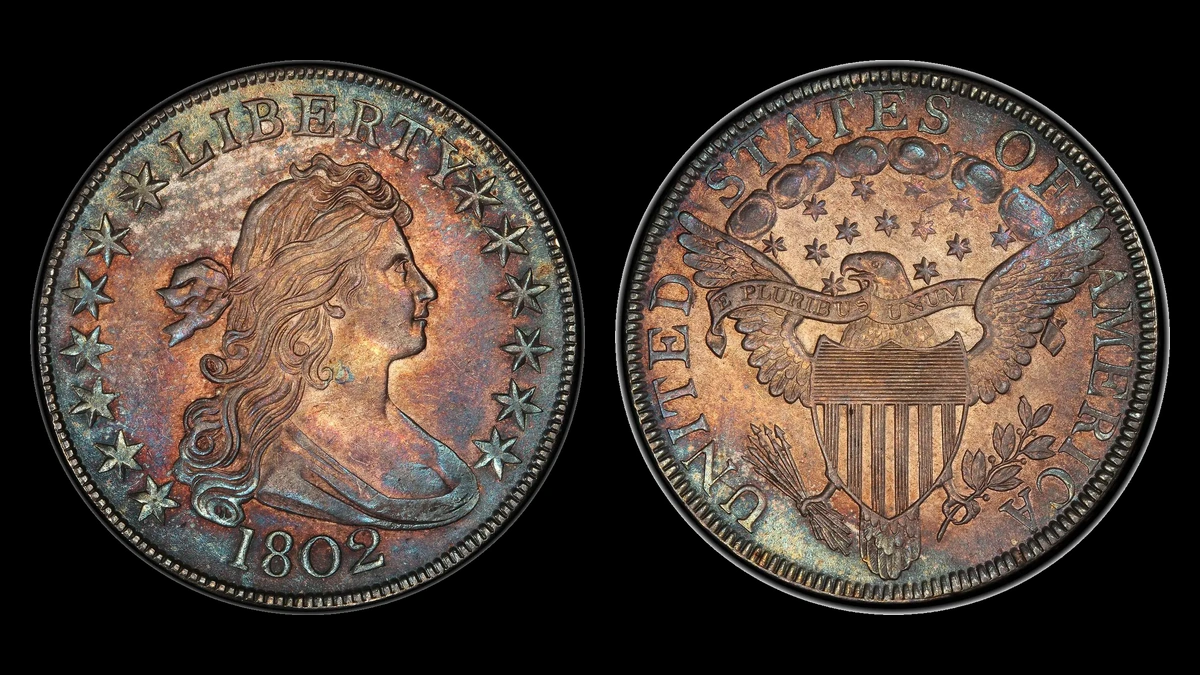
Several 1802 half dollar errors can appear on one coin, so their prices need careful grouping. The estimated $1,200–$120,000 span below runs from worn examples to exceptional survivors.
The documented $114,000 sale in August 2023 belongs to an unworn MS62 with an early reverse crack. Begin with surface texture, test the alignment, and then distinguish repeated designs from marks left by the dies.
| Clue | Useful view | Category | Estimated value |
|---|---|---|---|
| Shallow original pits | Surfaces beside intact design | Planchet flaw | $1,200–$2,500 for comparable Fine coins |
| Eagle tilts after a controlled flip | Relationship between both faces | Rotated dies | $1,200–$2,500 for similar worn examples |
| Parts of two design positions | Both complete faces | Reported double strike | $3,500–$8,000 |
| Raised routes near reverse lettering | First S in STATES and ED in UNITED | Die cracks | $1,200–$120,000 across grades |
| Faint traces of the front design | Back of the documented AU58 | Die clash | $50,000–$80,000 for comparable AU58 quality |
The normal 1802 half dollar weighs about 13.48 grams before wear, measures approximately 32.5 mm across, and carries lettering on its edge. Photograph both complete faces before enlarging small defects.
1. 1802 Half Dollar Small Pits Beside the Struck Design: Planchet Flaws Error
Heritage described scattered shallow pits on an ANACS Fine 12 as flaws in the original blank. A planchet is that prepared metal disc before the coin receives its design.
The same specimen also has a thin later scratch across the eagle’s head and shield. Keeping the scratch separate helps explain why not every surface mark shares a manufacturing cause.
How to Identify
Inspect the boundary of each hollow with light from several directions. The design should meet an original flaw naturally, rather than appearing cut away or pushed aside after striking.
Compare roughness and dark areas with the nearby intact surface. Color alone does not distinguish an original pit from later corrosion.
Use the described eagle-and-shield scratch as a separate observation when matching the cataloged example. A full reverse view keeps each mark connected to its actual location.
What It’s Worth
Estimated range: $1,200–$2,500 for similarly worn coins with modest original flaws. Fine 12 describes substantial wear with the coin still clearly identifiable.
The reference sold for $1,265 at Heritage on June 3, 2005. That same coin also has the approximately thirty-degree rotation described next.
The price includes both features and the scarce 1802 date. It cannot isolate an amount paid for the shallow pits, and heavier later damage needs a different comparison.
2. 1802 Half Dollar An Eagle That Sits at an Angle: Rotated Dies Error
The pitted Fine 12 also shows the reverse about thirty degrees clockwise from its normal relationship to the front. This is a difference in alignment, even though no design needs to be missing.
Dies are the steel tools that stamp the two faces. Their relative positions control how the designs line up on the finished coin.
How to Identify
Hold Liberty upright and flip the coin top to bottom without twisting it sideways. The eagle should finish upright under normal U.S. coin alignment.
Repeat the flip and record it continuously. For this comparison, the reverse should repeatedly settle about thirty degrees clockwise from upright.
Separate face photographs often conceal rotation because each has been turned upright for display. Inspect the lettered edge for seams or solder that might instead indicate joined pieces.
What It’s Worth
Estimated range: $1,200–$2,500 for a similarly worn example with comparable rotation. The historical reference remains the $1,265 June 2005 sale of the Fine 12.
That is the same transaction used for the original pits. Adding both full estimates together would value one coin twice.
3. 1802 Half Dollar Related Remnants of a Second Design: Reported Double Strike Error
A November 1998 auction table records an 1802 O-101 as double struck, with a listed grade of 40. The O-101 number identifies a particular die pairing.
The brief record does not state which details show the second impression most clearly. Exact locations and movement must therefore come from the coin or its photographs.
How to Identify
Survey the portrait, stars, date, outer lettering, and eagle for repeated design pieces. Several details should fit a consistent movement between two blows.
Distinguish raised impressions from scratches and flat shelves created during a strike. A single unexplained extra curve is not enough to demonstrate another full design position.
Keep the complete 1802 date and both face designs visible when matching O-101. The supplied historical description cannot justify assigning the strongest doubling to a particular letter or star.
What It’s Worth
Estimated range: $3,500–$8,000 for a comparable lightly worn coin with clear separate impressions. The estimate uses an old record rather than a recent transaction.
The published auction table gives $3,910 including the buyer’s fee in the November 1998 Bowers and Merena Morgan-Leckar sale. Visibility of the shift and surface condition affect how another example compares.
4. 1802 Half Dollar Short Raised Lines Near STATES and UNITED: Die Cracks Error
Locate the first S in STATES on the back. A short crack reaches its upper-right tip on a reverse die that had already served for 1801 coins.
During later use, another route developed from ED in UNITED toward the nearby fifth wing feather. That later route does not appear on every 1802.
Pressure forced silver into the tool’s openings, leaving raised lines. Their extent records the stage of die damage rather than a cut through the finished coin.
How to Identify
Match the first-S route before moving to ED and the wing. Record the two areas separately so the later crack is not assumed present from the earlier one alone.
Check their height under low lighting. A recessed line crossing the design is more consistent with a later scratch than the ridge expected from a die opening.
The reused die also makes the visible date important. A familiar reverse line is insufficient without confirming the 1802 obverse belongs to the same physical coin.
What It’s Worth
Estimated range: $1,200–$120,000 across worn coins and exceptional unworn survivors. Condition is the main reason this bracket is so wide.
A PCGS MS62 brought $114,000 at Heritage on August 15, 2023. It shows the earlier die state, without establishing a sale for the later ED-to-wing crack.
The sale is not a price assigned to the short line itself. Finding a longer crack does not substitute for the auction coin’s unworn preservation.
5. 1802 Half Dollar Faint Front-Design Traces on the Back: Die Clash Error
The Link collection describes transferred traces on the reverse of an 1802 graded PCGS AU58. The supplied wording does not specify an exact feather or letter for the strongest mark.
When the dies touched with no blank between them, one could receive traces from the other’s design. Later coins then reproduced those faint shapes beside the normal reverse.
How to Identify
Use the Link collection’s 1802 photographs to establish the locations. Do not import a familiar clash position from a different date.
Compare the faint reverse traces with the front design under angled light. A recognizable transferred fragment offers stronger evidence than an unexplained line or change of color.
Separate any clash shapes from raised cracks and later scratches. Wear or work on the die can weaken transferred traces, making full-side context especially useful.
What It’s Worth
Estimated range: $50,000–$80,000 for an attractive coin comparable to the documented AU58. AU58 is almost unworn, a demanding condition for this scarce date.
Heritage sold that PCGS AU58 for $70,500 in August 2013. The high value belongs to the rare date at this preservation level, with its documented traces.
A heavily worn coin needs other worn examples for comparison. The faint clash does not independently create a five-figure premium.
Conclusion
Record each feature while keeping its coin identity intact. The Fine 12’s pits and rotation share one $1,265 sale, while the major AU58 and MS62 prices belong to much better-preserved examples.
The $1,200–$120,000 estimates therefore demand careful condition matching. Controlled flipping, complete face views, and precise raised-line comparisons help distinguish features without turning each one into a separate price.