Rare 1835 Half Dollar Errors (List & Pictures)
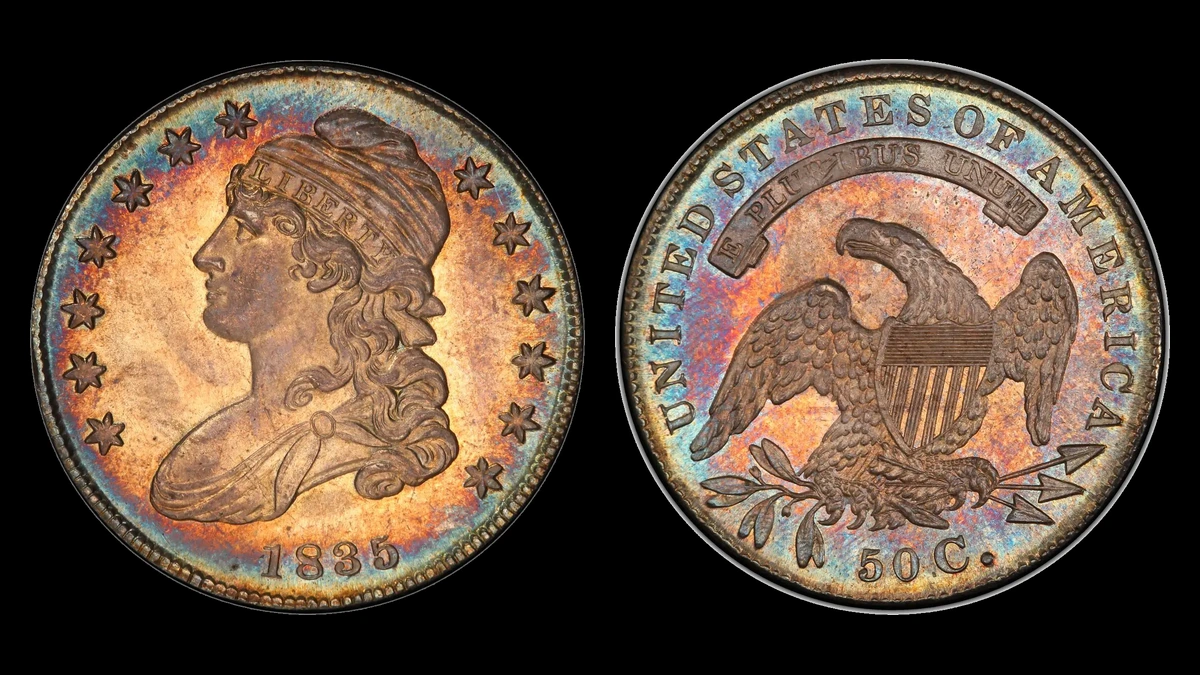
A surface line, an opening in the metal, and a loose silver layer require different checks when identifying 1835 half dollar errors. The estimated values here span $80–$2,600.
A documented O-108 graded MS63 brought $2,400 in August 2024, valuing an unworn coin with die-crack features. Start with the edge and alignment, then use the surface checks to distinguish raised ridges from damaged or separating metal.
| Visible clue | Inspection area | Category | Estimated value |
|---|---|---|---|
| Missing or crowded words | Edge near HALF | Incomplete or overlapped edge lettering | $150–$600 |
| Eagle tilted after a flip | Relationship between faces | Reported rotation | $150–$850 |
| Small toothlike tracks | Below Liberty’s bust | Reported double strike | $400–$1,600 |
| Raised arc and date-base line | Front stars and date | Die cracks | $125–$2,600 |
| Opening into the coin | Edge and both faces | Cracked planchet | $150–$450 |
| Thin lifting layer | Actual affected area, not specified in report | Lamination | $80–$250 |
The usual edge inscription is FIFTY CENTS OR HALF A DOLLAR. Original specifications are about 13.48 grams and 32.5 mm across, although wear and missing metal can affect measurements.
1. 1835 Half Dollar Interrupted Words Around the Edge: Incomplete or Overlapped Lettering Error
One reported edge reads OR LF DOLLAR, while another report describes ALF without its H. These accounts concern missing or crowded portions of the normal wording, not a completely plain edge.
The edge words were applied before the faces received their designs. An interruption at that step could affect the inscription while leaving the portrait and eagle normal.
How to Identify
Photograph consecutive sections and transcribe the complete edge in order. A stroke thought missing may be crowded into its neighbor or hidden by the viewing angle.
Compare the affected area with the rest of the edge for filing, dents, and wear. Words upside down relative to Liberty are normal, and specially produced Proofs with crushed lettering present a separate question.
What It’s Worth
Estimated range: $150–$600 for worn coins with clearly identified missing or overlapped strokes. Neither supplied collector report includes a completed 1835 sale.
A cleaned, worn 1834 with doubled edge lettering sold for $220 at Heritage in July 2026. Its repeated words provide related context, although the 1835 accounts describe interruptions around HALF.
2. 1835 Half Dollar A Repeatable Tilt of the Eagle: Reported Rotated Dies Error
The year guide reports a noticeably rotated reverse on an O-101. That catalog label identifies the face designs, but does not imply every coin from the pairing has the same alignment.
The dies, or steel stamping tools, can turn relative to one another while each design remains centered. No measured angle is given for the reported coin.
How to Identify
Set Liberty upright against a fixed reference and flip top to bottom without a sideways twist. Repeat the movement to establish whether the eagle returns to the same unexpected angle.
Measure that angle rather than inventing one from the description. Separately straightened photographs cannot show it, and seams along the edge may reveal an altered or joined coin.
What It’s Worth
Estimated range: $150–$850 from moderate wear through nearly unworn condition with a clear rotation. The amount of tilt still needs measurement.
Ordinary O-108 comparisons brought $149 in PCGS VF30 in December 2025 and $576 in AU55 in January 2025. They concern a different variety and supply underlying condition context rather than recorded prices for the rotated O-101.
3. 1835 Half Dollar Border Teeth Below the Portrait: Reported Double Strike Error
A collector interpreted toothlike tracks along the lower bust as remnants of an earlier border impression. Under that explanation, a later blow placed the portrait over part of the first design.
The account is a collector’s report rather than stated grading-service confirmation. A later impact from another coin can also leave a row of tooth-shaped dents.
How to Identify
Compare the tracks’ spacing with the normal border teeth in the illustrated report. Preserve enough surrounding design to follow the arc’s direction.
Search both sides for other remnants consistent with the same movement. Sharp impact dents or an isolated row without supporting design evidence cannot settle the proposed sequence.
What It’s Worth
Estimated range: $400–$1,600 for a worn coin with convincing original tracks and supporting second-strike evidence. No sale of the reported 1835 is supplied.
A certified 1812 obverse double strike graded PCGS VF30 brought $1,200 at Heritage in February 2018. That different-year result is more useful for an authenticated second impression than for unexplained tooth marks alone.
4. 1835 Half Dollar A Raised Arc Above Liberty: Die Cracks Error
On O-108, an upper arc runs from around star five toward star ten. A separate line occurs along the bottom of the date.
Silver entering splits in the die formed these added ridges. The coin remains solid beneath them, unlike a physical crack through its own metal.
How to Identify
Trace the upper route using the stars as landmarks, then inspect the date-base line separately. Compare both positions with a confirmed O-108.
Move low light across each line to establish its height. A cut or physical split has depth into the coin instead of the raised center expected here.
What It’s Worth
Estimated range: $125–$2,600 across worn through selected unworn O-108 examples. Preservation accounts for most of that spread.
Recorded O-108 sales include $2,400 for PCGS MS63 in August 2024, $149 for VF30 in December 2025, and $576 for AU55 in January 2025. These are whole-coin prices, not separate payments for either crack.
5. 1835 Half Dollar An Opening Into the Metal: Cracked Planchet Error
The historical Bolt Collection list describes an XF 1835 with a cracked blank near two o’clock. A separate guide mentions a reverse crack near eight o’clock, without establishing that it is the same coin.
A planchet is the metal blank used to make a coin. Here the reported defect is an opening in that metal, rather than a ridge copied from a split die.
How to Identify
Inspect the line from the edge and both faces without bending the coin. Follow its depth into the thickness of the metal.
Look for a later notch, saw marks, or evidence of bending and displaced silver. A dark photographed line with no visible depth cannot distinguish an original opening from damage or a surface mark.
What It’s Worth
Estimated range: $150–$450 for a worn coin with a limited, identified crack. The separate eight-o’clock example was offered at $150, rather than recorded sold.
An 1832 with a minor rim-metal defect brought $263.25 in July 2025, graded ANACS XF45. That is a related different-year comparison, not an exact match for either 1835 account.
6. 1835 Half Dollar A Thin Layer Lifting Away: Reported Lamination Error
A separating sheet of silver indicates a different metal problem. Lamination develops where layers do not hold together, sometimes leaving a shallow uneven area after a flake detaches.
The Coins Value guide reports a worn 1835 without specifying its affected face or location. Those details require photographs of the actual piece.
How to Identify
Use side lighting to find a thin sheet, curled margin, or clear boundary between layers. Keep any attached metal undisturbed rather than pressing or lifting it.
Inspect the exposed area for corrosion pits or parallel scraping cuts. Rough texture alone is weaker evidence than an actual separated layer and its surrounding original surface.
What It’s Worth
Estimated range: $80–$250 for a small identifiable peel on a circulated example. The guide’s $85 figure is an asking price, with no confirmed numerical grade.
The amount of remaining design and extent of the separation matter. A large attached flap with strong visual interest would need different comparisons from the minor flaw covered here.
Conclusion
Check whether a suspected line rises above the surface, opens into the coin, or follows a separating layer. Then examine edge wording and face alignment on their own terms.
The $80–$2,600 estimates reflect different conditions and evidence. Preserve reported status where authentication is absent, distinguish asking prices from completed sales, and leave loose metal or a weakened crack undisturbed during examination.