Rare 1955 Half Dollar Errors (List & Pictures)
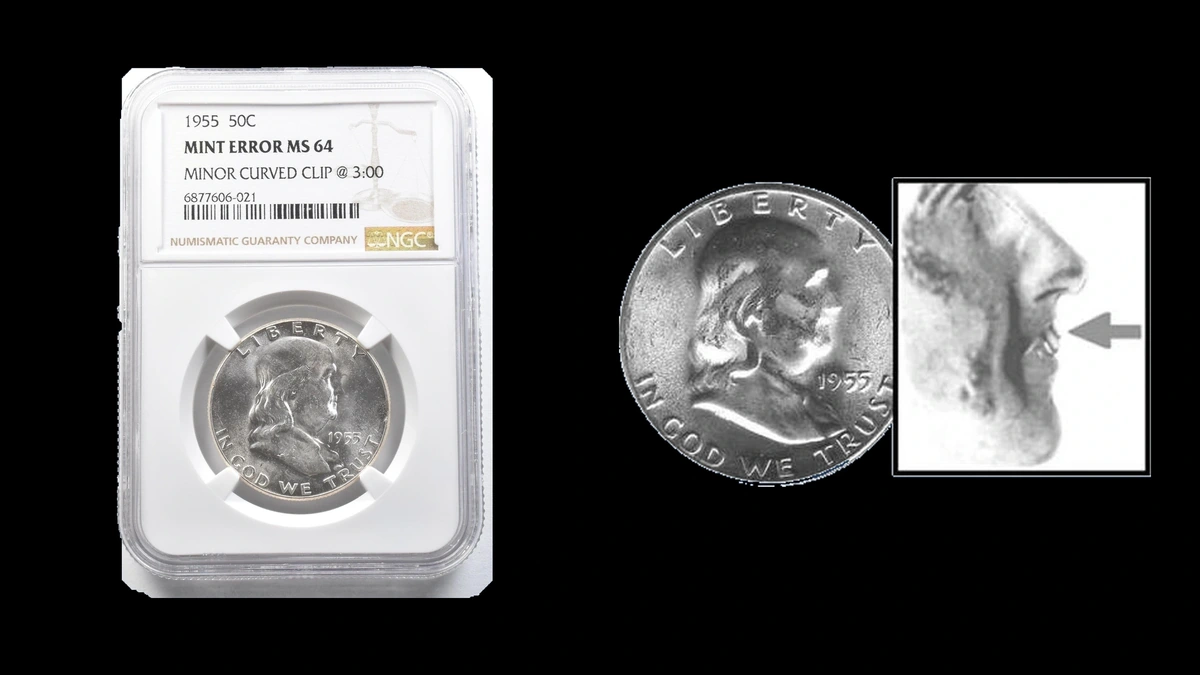
A Franklin half dollar struck twice brought $11,400 in November 2022, but that auction coin was dated 1962-D. The supplied evidence for a double-struck 1955 instead includes a historical $3,800 offer.
1955 half dollar errors have working estimates of $40–$12,000 across the categories below. Start with the coin’s outline, then inspect its surface and Franklin’s mouth to see which explanation fits.
An intact 1955 Franklin half weighs 12.50 grams and measures 30.6 millimeters across. It is a silver-copper alloy coin with a reeded, or grooved, edge; a scale, magnifier, and views of both faces are useful starting tools.
| First clue | Possible explanation | Estimated whole-coin value |
|---|---|---|
| Much smaller disc | Nickel planchet | $2,500–$6,000 |
| Curved missing piece | Clipped planchet | $75–$400 |
| Design beside blank metal | Off-center strike | $150–$1,500 |
| Additional impression at bottom | Double strike | $3,000–$12,000 |
| Lifted surface layer | Lamination | $40–$175 |
| Extra line or rim lump | Die crack or cud | $40–$300 |
| Toothlike mouth projection | Bugs Bunny clash | $50–$3,500 |
1. 1955 Half Dollar A Small Disc Cuts Off the Design: Nickel Planchet Error
Begin with the size of the entire coin if Franklin looks crowded against its edges. A planchet is the prepared metal blank, and a nickel planchet cannot hold all the design intended for a half dollar.
The 1955 account reports an NGC example struck on this wrong blank. Its copper-nickel metal would also differ from the normal silver alloy.
How to Identify
Record weight, diameter, and thickness before interpreting the missing letters. A nickel blank begins at about 5.00 grams and 21.2 millimeters, although the force of striking may widen it.
The source does not give exact measurements for its reported coin. Use the starting specifications as a comparison, not as measurements supposedly taken from that specimen.
Check the entire edge for file marks or cutting, and seek nondestructive metal testing if the size and weight look promising. A reduced silver half may be small and light without having started as a nickel blank.
What It’s Worth
A genuine, identifiable nickel-planchet strike has an estimated $2,500–$6,000 range. Surviving date details, surface condition, and confirmation of the metal matter to the price.
The 1955 account reports $3,600 for an NGC example. That is a published auction report; the supplied material does not independently match an original auction lot.
2. 1955 Half Dollar A Crescent Is Missing from the Edge: Curved Clip Error
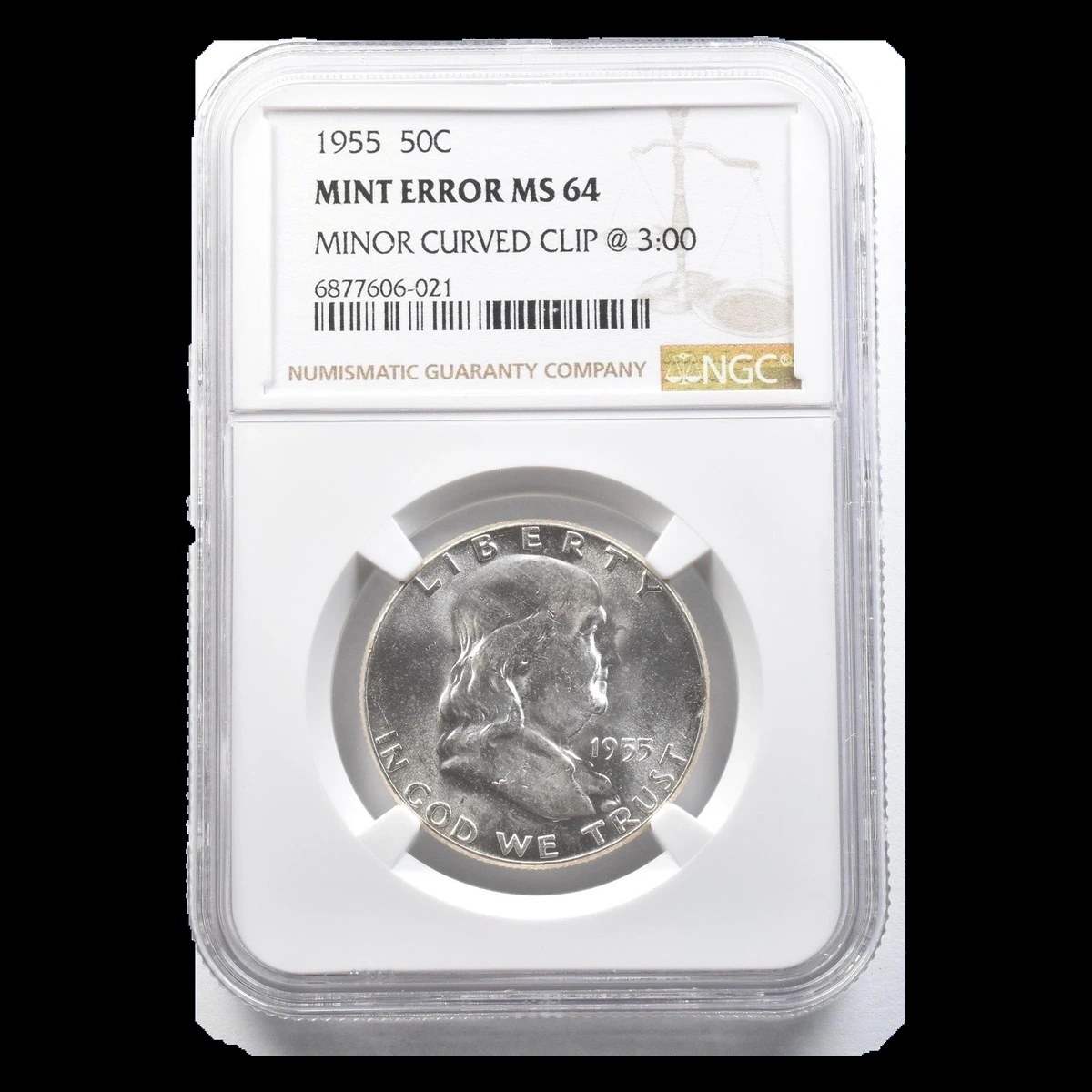
A normal-sized half with one curved section absent presents a different question from a small blank. During blank cutting, an overlapping punch can enter a hole already left in the metal strip and produce an incomplete disc.
The rim and design then form around that existing gap. This sequence leaves more useful evidence than the crescent shape by itself.
How to Identify
Examine the lettering and rim as they approach both ends of the gap. They should be compatible with striking an incomplete blank, rather than show finished details abruptly removed by a saw or file.
Include the opposite rim in a photograph: weakness there can support a clip diagnosis. It is a supporting clue, not a requirement that can authenticate the coin on its own.
Weight should be lower than the intact standard in a way consistent with missing metal and wear. No particular clock position is mandatory for this category.
What It’s Worth
A clear genuine curved clip with a readable date has an estimated $75–$400 value. The year guide allows more for particularly impressive or well-preserved pieces.
For historical context, a 1962-D with a four-percent clip and PCGS MS61 grade sold for $84 in March 2011. That comparison establishes neither the clip percentage nor the grade of a 1955 coin.
3. 1955 Half Dollar One Side of the Design Runs Off the Disc: Off-Center Strike Error
Check whether a complete round blank remains despite missing design. If it entered the press partly outside the dies—the steel tools carrying the design—one blow could leave an untouched crescent and cut off details elsewhere.
This is a single off-center strike. The amount of blank metal should be understood together with the displaced design on both faces.
How to Identify
View the front and back at the same scale and compare where the design ends. A broad border on only one face does not establish an off-center strike.
Inspect the transition from struck detail to blank metal for abrasion or grinding. Also check whether a second, overlapping impression is present, which would change the diagnosis to multiple striking.
The supplied year guide gives no certified 1955 specimen with a fixed percentage or angle. Avoid assigning either measurement from a general illustration.
What It’s Worth
Estimated values are $150–$500 for modest shifts with legible dates and $500–$1,500 for more dramatic attractive examples. These are guide estimates for genuine single strikes.
Size alone does not set the premium. A clear date and undamaged blank area may make a less extreme shift easier to identify and more appealing.
4. 1955 Half Dollar Extra Detail Appears at Six O’Clock: Double Strike Error
On the specifically described 1955 double strike, the main image remains because the first blow was followed by another that barely caught the bottom of the coin. The second strike was described as 95 percent off center at six o’clock.
That percentage belongs to the later blow. It does not mean the original portrait occupies only five percent of an otherwise blank coin.
How to Identify
Keep the whole portrait in view while enlarging the bottom edge. Look for an additional recognizable design impression that overlaps or interrupts the first one.
Map the altered outline and inspect its edge for later squeezing. A dent or recessed mirror-image impression made after minting cannot substitute for evidence of another strike by the dies.
The cataloged coin was graded PCGS MS64, an unworn grade that allows some marks. Repeated appearances of that same coin in catalogs are not evidence of multiple specimens.
What It’s Worth
A broad working estimate for substantial genuine Franklin double strikes is $3,000–$12,000. The 1955’s specific evidence is a $3,800 catalog asking price in 2016, not a completed sale.
The $11,400 November 2022 sale was a 1962-D graded NGC MS60 with a second strike 70 percent off center. Its date, grade, and strike arrangement differ, so it serves as a comparison rather than a 1955 price record.
5. 1955 Half Dollar A Thin Layer Opens in the Silver: Lamination Error
Move from the outline to any peeling or splitting on the faces. Lamination occurs when a weakness within the alloy lets a layer separate, sometimes leaving a flap attached and sometimes leaving a shallow missing patch.
The supplied 1955 listing names the category without locating a particular separation. Neither a stained area nor a photograph from another date establishes a 1955 lamination.
How to Identify
Use low-angle light to find an actual opening and follow its boundary into the surrounding metal. Leave a loose layer untouched; lifting it destroys evidence and may break it off.
A cut crosses a finished surface, while corrosion tends to leave eaten cavities. Look for a separation along a layer rather than relying on roughness alone.
An attached flap may produce little weight loss. Missing material can lower the reading, but weight cannot explain the surface feature by itself.
What It’s Worth
Visible original lamination on a worn or lower-grade unworn 1955 has an estimated $40–$175 whole-coin value. The estimate draws on the year guide and comparable Franklin surface errors.
No particular 1955 flap has a documented sale attached to this range. An attractive attached layer may draw interest, while cleaning or an unattractive void may reduce it.
6. 1955 Half Dollar Raised Metal Interrupts the Design: Die Crack or Cud Error
The bell’s familiar engraved crack belongs to the intended design. For this category, seek an additional raised line or a raised patch that connects to the rim.
A fracture in a die can receive metal during striking and leave a raised line on the coin. If a piece at the die’s edge breaks away, the resulting rim-connected area of raised metal is called a cud.
How to Identify
Compare the bell with a normal example first, then follow any extra feature across the design or surrounding flat area. A scratch is usually incuse—cut into the surface—rather than a raised product of a die opening.
For a cud, establish a connection to the rim and missing normal detail beneath the raised patch. An isolated interior lump, added solder, or an impact bulge needs a different explanation.
No exact crack route or cud size is supplied for 1955. The illustration must therefore be treated as an example of the category unless a specific match is available.
What It’s Worth
Modest genuine cracks have estimated $40–$100 whole-coin values, while clear cuds are estimated at $100–$300. These are not prices from a named 1955 cud auction.
The feature’s visibility and the condition of the coin determine whether it merits a premium. Several lines from one damaged die do not create separate prices to add together.
7. 1955 Half Dollar Franklin Seems to Have an Extra Tooth: Bugs Bunny Die Clash Error
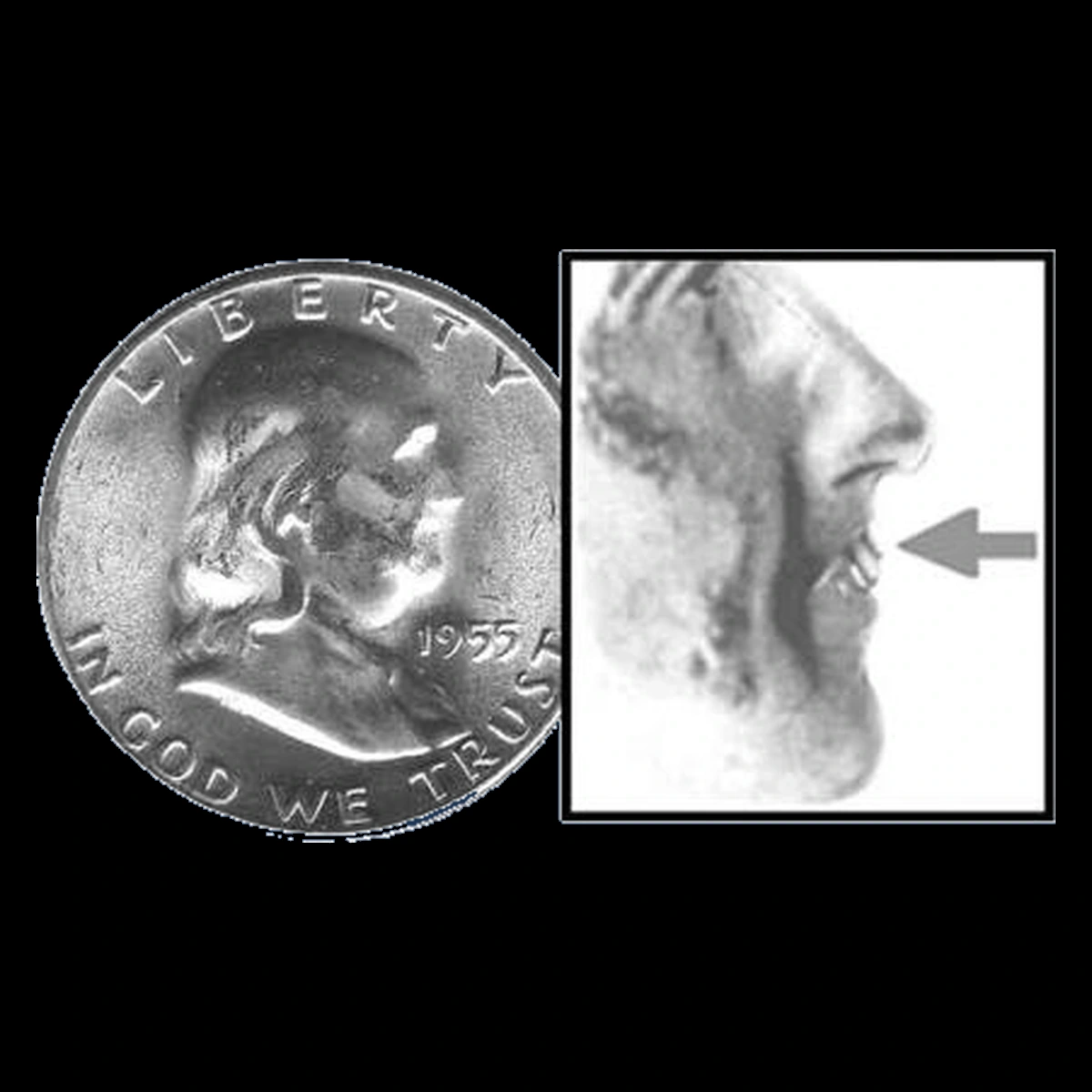
Finish the inspection at Franklin’s mouth, where a small raised projection identifies the familiar Bugs Bunny variety, FS-401. Its origin is a collision between the dies with no blank between them.
Part of the reverse eagle’s wing marked the obverse die during that collision. Later strikes carried the unwanted mouth detail, without receiving a second portrait or becoming related to the famous doubled 1955 cent.
How to Identify
Compare the projection’s position and outline with the illustrated Bugs Bunny example. A swollen lip or random facial mark is not enough.
Inspect nearby metal for a cut, pushed-up impact ridge, or added material. Other clash traces require their own comparisons and do not all receive this nickname.
Evaluate the bell lines separately from the mouth. Full Bell Lines, abbreviated FBL, describes clearly defined lines on the reverse and can affect value without causing the clash.
What It’s Worth
Many identified lower-grade unworn examples are estimated at $50–$250. Exceptional certified pieces occupy a separate $250–$3,500 range.
The year account reports $3,360 for an MS67 FBL in April 2024. That price reflects exceptional preservation and bell detail as well as the variety; it is not a routine value for every coin with a toothlike mark.
Conclusion
For a 1955 Franklin half, first establish whether metal is missing, the design is displaced, or an extra feature is raised on an otherwise normal coin. That choice leads to more useful comparisons than starting with the highest price.
Preserve loose layers and original surfaces, photograph the edge as well as both faces, and keep offers separate from sales. A specific diagnosis and condition assessment should come before applying any estimate.