Rare 1960 Half Dollar Errors (List & Pictures)
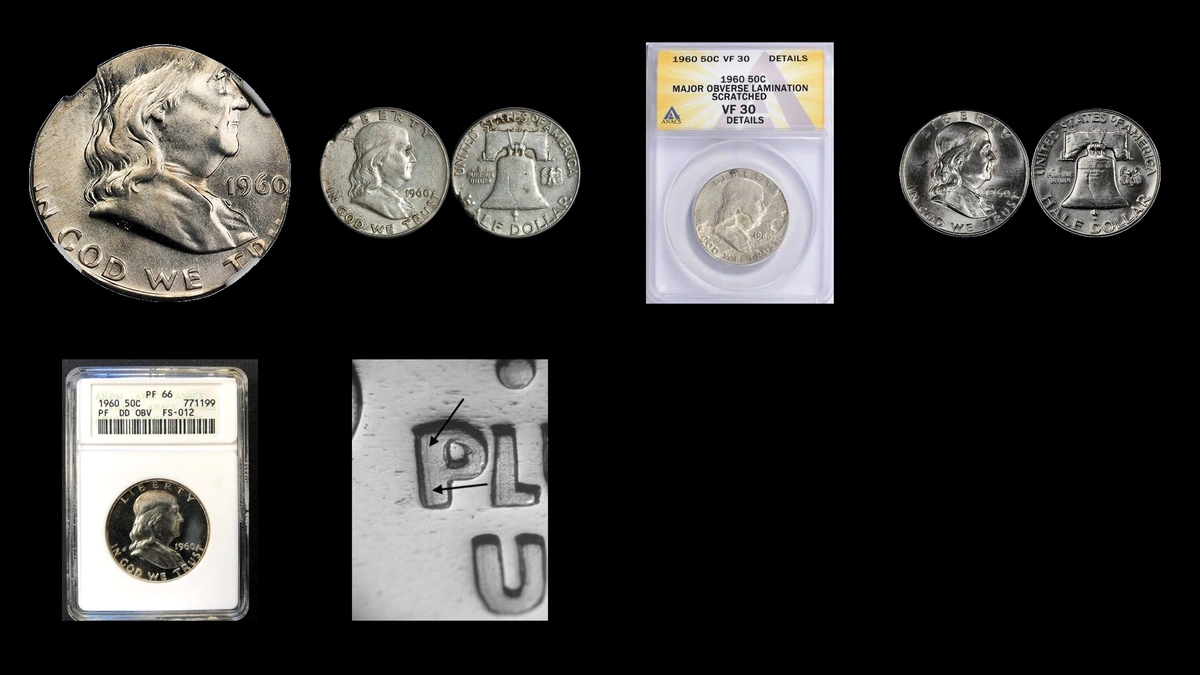
A light Franklin half might have lost a small layer, been struck on a thin split fragment, or started on the wrong denomination’s blank. The surviving design helps distinguish these possibilities.
Estimated values for 1960 half dollar errors range from $40 to $7,500. A dated split-planchet example sold for $630 in 2023; the larger supplied result, $4,312.50, belongs to a 1962-D nickel-blank comparison.
Begin with the metal and outline, then inspect local impressions, clash marks, and Proof doubling.
| Visible clue | Error | Estimated value |
|---|---|---|
| Half-dollar design on small metal | Nickel planchet | $3,000–$7,500 |
| Very thin body with struck rough face | Split before striking | $400–$1,200 |
| Uneven missing edge | Ragged clip | $75–$400 |
| Small separating layer | Localized lamination | $40–$200 |
| Impression or attached fragment | Struck through | $50–$1,000 |
| Toothlike or other transferred shape | Die clash | $50–$500 |
| Extra front lettering | Proof doubled die obverse | $50–$750 |
| Extra back lettering | Proof doubled die reverse | $40–$250 |
An ordinary silver Franklin half has a standard weight of 12.50 grams, diameter around 30.6 millimeters, and a grooved edge. Measure accessible coins without disturbing surfaces or opening sealed grading holders.
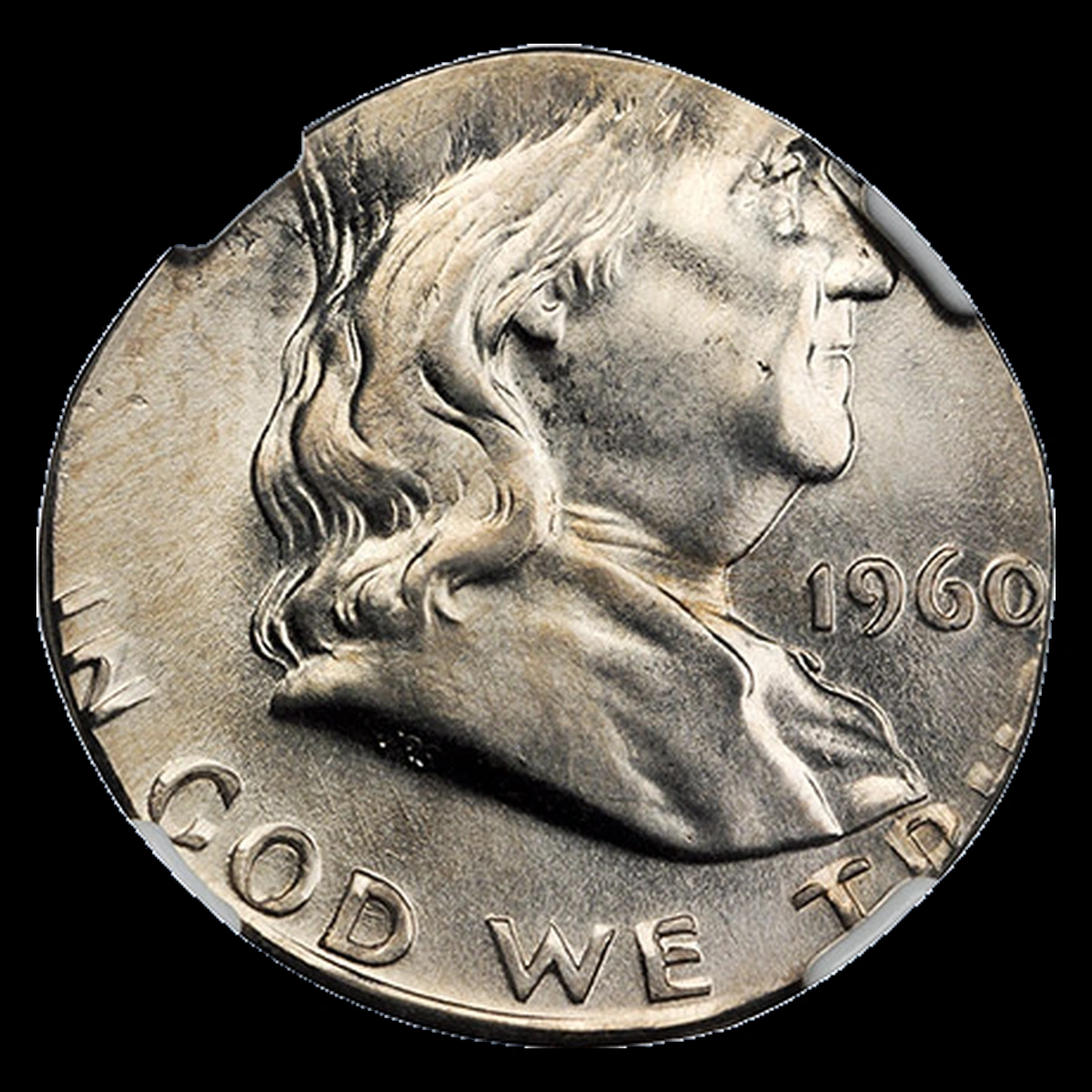
1. 1960 Half Dollar Franklin’s design runs beyond a smaller disc: Nickel Planchet Error
The wrong blank can be easier to recognize from the missing design than from its color. NGC documents a 1960-D half dollar struck on a nickel blank and graded MS66.
A nickel’s copper-nickel disc provides less room than a half-dollar blank, so some of Franklin’s design falls outside the metal. Its denomination must still be supported by composition and measurements.
How to Identify
Compare weight with the approximately 5 grams expected for a normal nickel blank, then record width and thickness. Five grams is a blank standard here, not a measured weight supplied for the NGC coin.
A nickel blank starts around 21.2 millimeters wide but can spread during striking. Inspect the full edge for trimming or filing and test composition independently of the silvery appearance.
Photograph the surviving date, mint evidence, and naturally cut-off half-dollar details. The documented Denver attribution cannot be transferred to another coin solely because its metal looks similar.
What It’s Worth
An authenticated 1960-D nickel-blank strike with strong surviving identity has an estimated $3,000–$7,500 range. No realized price is supplied for the gallery’s MS66 example.
A different-year 1962-D nickel-blank half in NGC MS67 sold for $4,312.50 at Heritage in January 2009. Its grade, surviving design, and date all belong to that comparison coin.
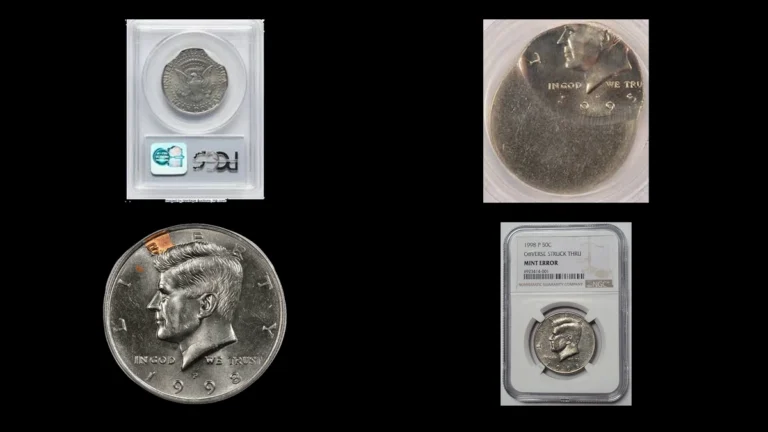
2. 1960 Half Dollar A thin fragment carries design on a rough face: Split Planchet Before Strike Error
A broad separation within a blank can leave a thin piece that still reaches the press. It has less metal available to fill the dies, so the designs may be weak even though they were applied after the split.
The CONECA example weighs 77.3 grains, about 5.01 grams, with the obverse on a smoother outer surface. Its reverse was struck into the rough, lined interior exposed by separation.
How to Identify
Compare thickness as well as weight and diameter. A thin body retaining roughly the usual outline poses a different question from a smaller nickel blank.
Look for genuine struck design on the rough interior surface. If a finished coin split later, the newly exposed interior would not have received that normal die impression.
Inspect the edge profile and remaining grooves for filing or artificial thinning. The combination of original separated texture and design applied to it establishes the useful sequence.
What It’s Worth
The estimate is $400–$1,200 for a substantial split-before-strike error with readable identity and original surfaces. NGC reports a 1960 example sold for $630 including fees at Heritage in June 2023.
No numerical grade is supplied for that auction coin. The record does not establish that it is the same piece as the 5.01-gram CONECA illustration, whose measurements and face descriptions must remain separate.
3. 1960 Half Dollar A rough missing piece interrupts the edge: Ragged Clip Error
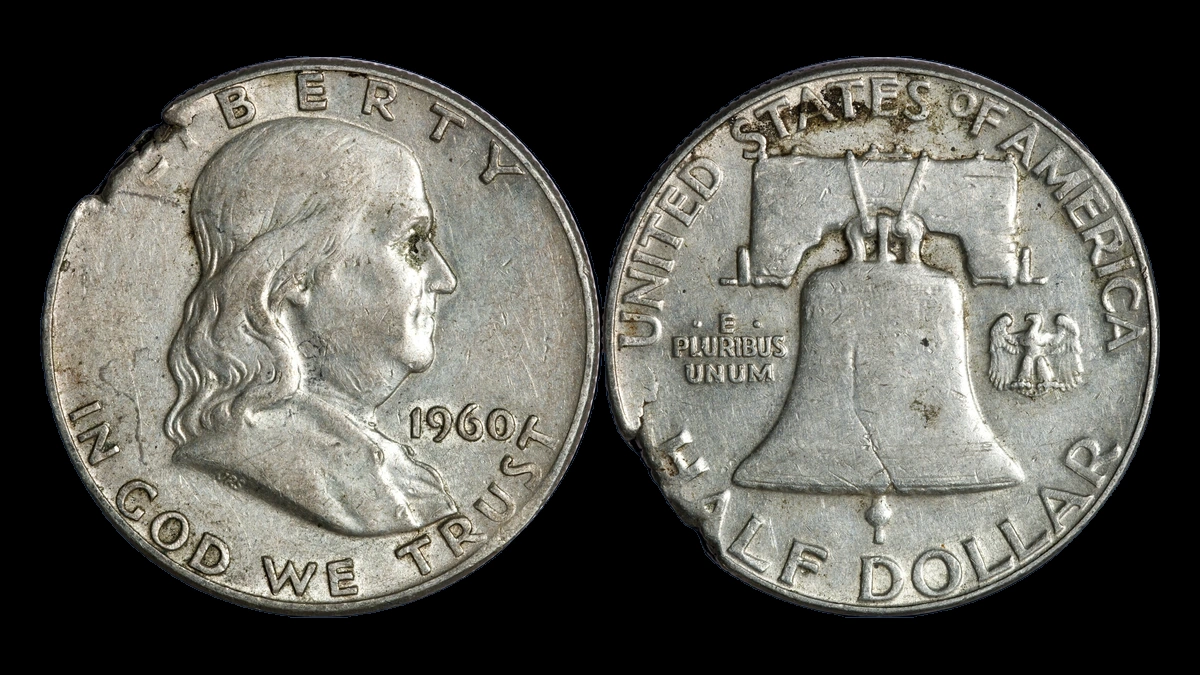
An incomplete blank does not always have a smooth curved gap. The Calkins collection identifies a 1960 Franklin half with a ragged clip, a type associated with an irregular original boundary of the strip from which blanks were cut.
The design was then struck around that incomplete shape. The supplied description gives no mint, percentage, or clock position.
How to Identify
Examine how the rim and design approach the irregular edge in the Calkins collection photographs. File grooves, crushed metal, and a fresh fracture may indicate later damage instead.
Check both faces and the surviving edge grooves. Weakness opposite the missing area can support an incomplete-blank explanation, although it may not be equally visible on every coin.
Lost metal should affect the weight, while an intact span may still measure the normal diameter. Neither a light reading nor a jagged appearance explains the cause on its own.
What It’s Worth
A genuine ragged clip has an estimated $75–$400 range from worn through ordinary unworn condition. The Calkins coin has no quoted sale price.
A 1962-D with a 4% curved clip, graded PCGS MS61, sold for $84 in March 2011. Its smoother boundary and different year make it a modest-error comparison rather than a direct ragged-clip benchmark.
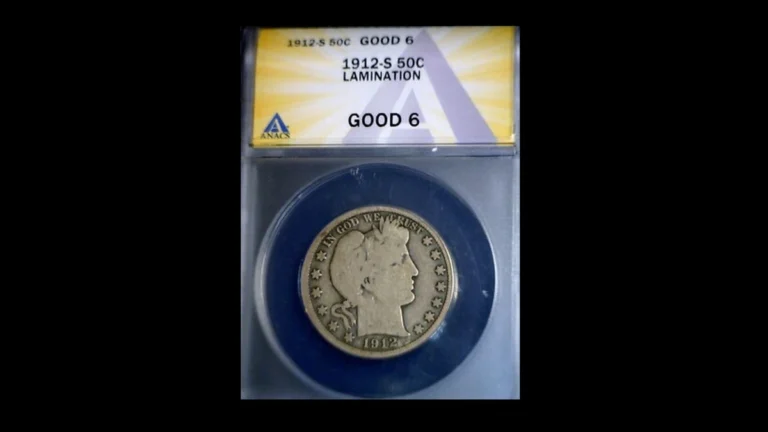
4. 1960 Half Dollar A small layer separates from otherwise intact metal: Localized Lamination Error
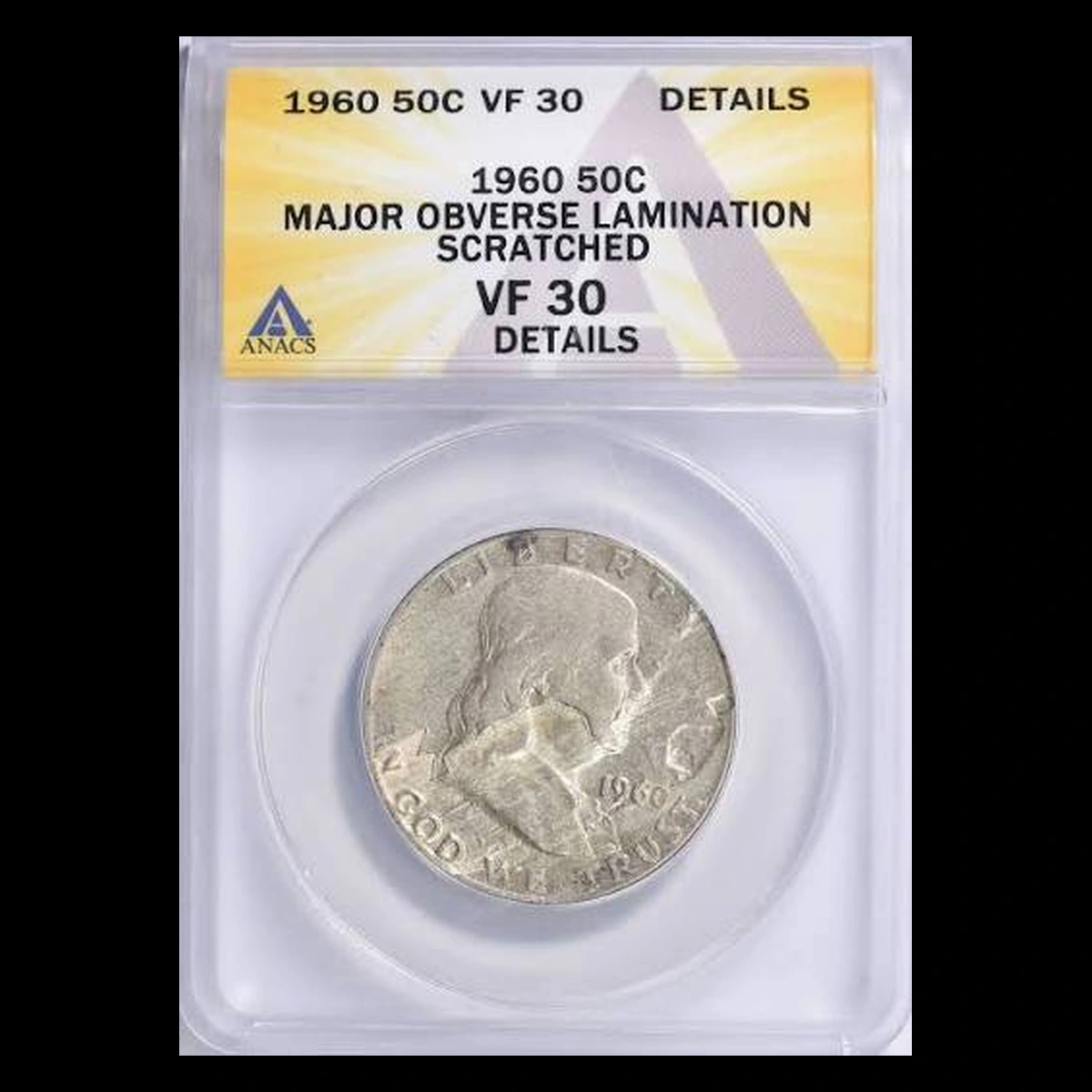
A local weak bond can let a thin sheet lift or fall away without splitting most of the blank. This is the scale of separation described by the two 1960 lamination reports.
The Philadelphia example has an obverse flaw and an ANACS VF30 Details description; the Denver example has a reverse flaw and a CACG MS64 grade. Neither account gives an exact clock position.
How to Identify
Choose the correct face for the particular report, then inspect the peeling boundary under shallow light. A thin layer opening within the metal is more informative than scattered pits or a color change.
Leave an attached flake in place and examine nearby design for a natural relationship to the separation. Cuts, corrosion, and deliberate thinning can also remove silver.
What It’s Worth
Estimated values are $40–$75 for a modest worn Philadelphia example and $100–$200 for visible peeling on an ordinary unworn Denver coin. These ranges follow the different conditions described in the year account.
Details indicates a problem preventing an ordinary numerical grade, so the ANACS coin should not be treated as problem-free VF30. A larger missing patch does not necessarily improve the coin’s appeal.
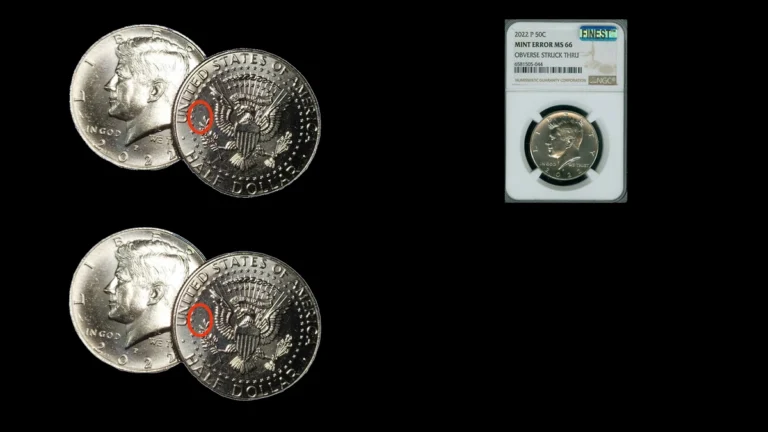
5. 1960 Half Dollar A mark or trapped piece interrupts the design: Strike-Through and Retained Fragment Error
Foreign material can block part of a strike and sometimes remain attached afterward. Fred Weinberg described a small retained aluminum fragment near the lower-left base of the bell on a PCGS AU55 1960-D.
A separate Philadelphia report describes a short mark above a T in TRUST. That impression does not inherit the Denver coin’s aluminum identification or retained-fragment status.
How to Identify
For an empty impression, inspect whether its margins and surrounding design fit formation during striking rather than a later scrape. Shape alone should not be used to name the missing object.
On a retained piece, examine how the coin’s metal and design meet the fragment’s edges. Leave it attached, because that relationship may help establish that the object was present during the strike.
Glue, solder, or loose debris can put material in the same location without showing the same process. An original attachment requires evidence beyond the object’s presence.
What It’s Worth
Modest original impressions have an estimated $50–$150 range; convincing retained fragments on attractive nearly unworn or unworn coins are estimated at $250–$1,000. No exact realized price is assigned to Weinberg’s AU55.
The wider range reflects the visible object and its preserved attachment. Its material, location, and condition remain specific to the documented Denver coin.
6. 1960 Half Dollar A toothlike projection or other transferred shape: Bugs Bunny and Die Clashes Error
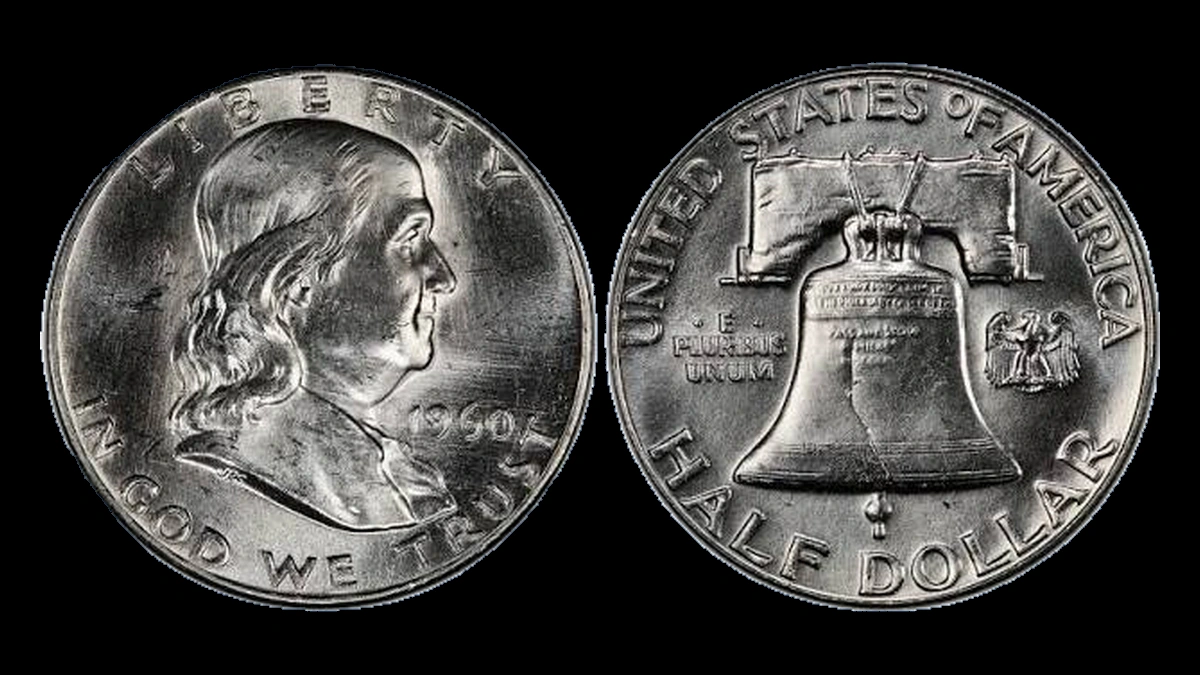
The Bugs Bunny nickname describes a toothlike projection at Franklin’s mouth. PCGS also lists a different 1960 obverse clash, so mouth detail is not a universal test for every clash variety.
Clashing occurs when the dies meet without a blank and acquire traces of the opposing design. Later strikes can reproduce those traces in unexpected places.
How to Identify
Match the mouth effect to a known 1960 Bugs Bunny example, or use the other variety’s own photographs if investigating that clash. Follow the extra shapes and their relationship to the reverse design.
A scratch or die fracture can occupy nearby space without forming a transferred design. Sharp lines at the bell’s bottom describe strike quality and do not establish the clash itself.
What It’s Worth
Estimated values are $50–$200 for ordinary unworn clashes and $200–$500 for stronger certified examples with relevant bell-line quality. The specific variety and preservation determine the useful comparison.
PCGS records a $350 eBay sale in August 2019 for an MS64 FBL obverse-clash example. FBL means Full Bell Lines, and that sale should not automatically price a different mouth-clash die.
7. 1960 Half Dollar Proof lettering and date have repeated contours: Doubled Die Obverse Error
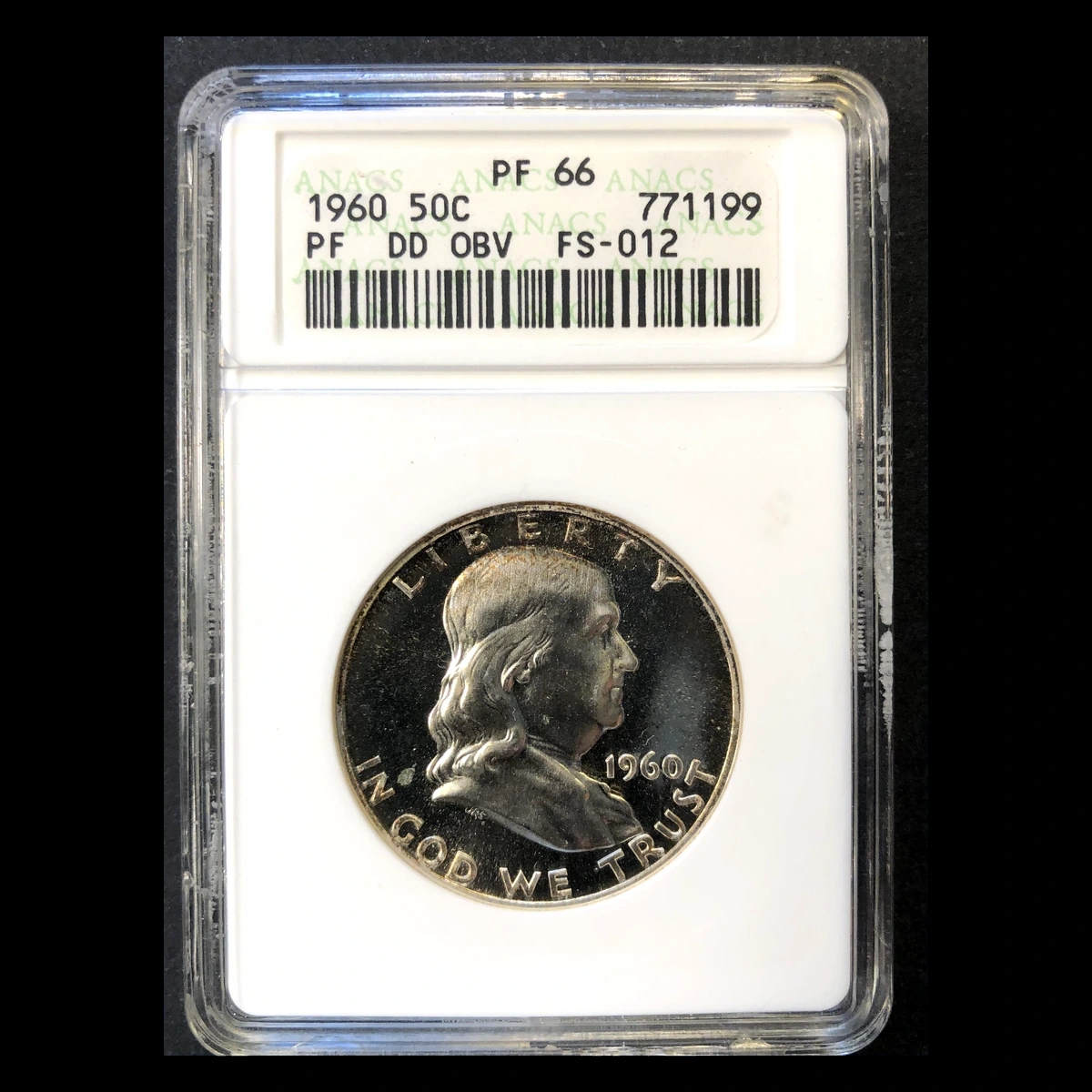
A Proof is specially made for collectors and is not simply an ordinary coin with a shiny surface. The collected 1960 doubled obverse directs attention to LIBERTY, the motto, and the date.
Wexler describes counterclockwise spreading around a pivot near 7 o’clock. Because the doubling turns around that point, different letters need not show equal separation.
How to Identify
Photograph all the relevant lettering and digits together, then compare their spacing with a known Proof example. The added outlines should fit the described turning pattern rather than unrelated directions.
Separate raised duplicate detail from glare and flat shelves caused during striking. Do not wipe the reflective fields, and do not identify the variety from a thick-looking 6 alone.
What It’s Worth
Estimated values are $50–$200 for ordinary identified Proofs through PR67 and $250–$750 for stronger, higher-grade examples. The year guide places PR65 around $125–$150, PR67 around $130–$175, and PR68 above $525.
A PCGS PR67 appears in the Dogood Collection auction record, but no sale price for that coin is supplied here. Clean surfaces and contrast between frosted designs and mirrored fields need their own comparisons.
8. 1960 Half Dollar A Proof’s reverse words repeat: Doubled Die Reverse Error
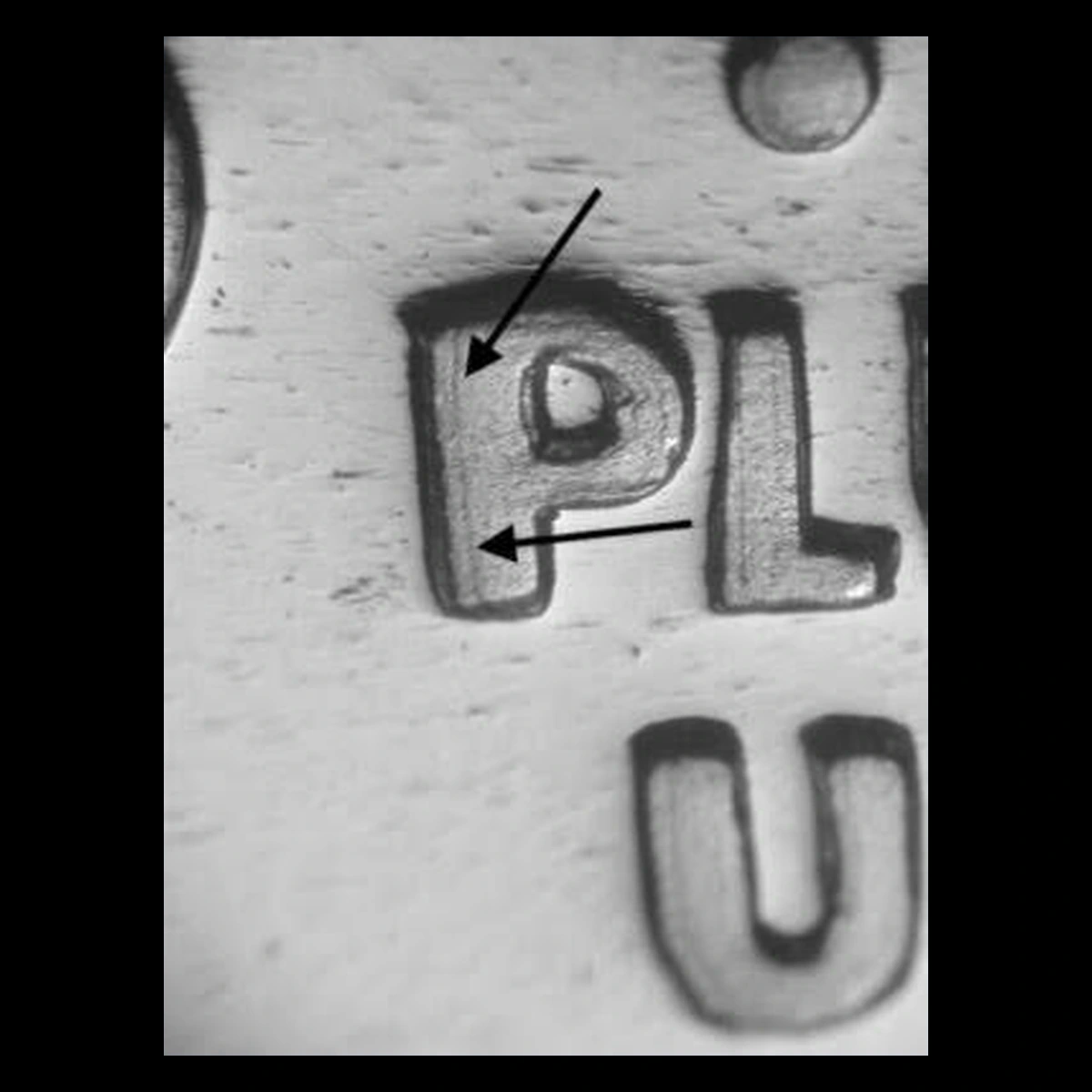
The reverse can carry its own doubled detail whether or not the front shows the better-known variety. Specialists list several 1960 Proof reverse patterns involving lettering and, on some dies, eagle or bell details.
Each pattern originated in a particular die before striking. A known pairing with a doubled obverse may help identification but does not prove the reverse by itself.
How to Identify
Start with E PLURIBUS UNUM and the outer national lettering, then inspect HALF DOLLAR or lower eagle details when the chosen reference calls for them. The CONECA DDR-007 photographs show one specific pattern.
Match a complete set of shapes to one die rather than combining features from unrelated reverses. Reflective Proof backgrounds can create false edges, so compare under consistent light.
What It’s Worth
Minor identifiable reverse varieties have an estimated $40–$250 range on ordinary through attractive higher-grade Proofs. The year guide gives common fine-quality retail comparisons around $40–$60.
Spots, scratches, and the strength of the actual duplication affect the underlying Proof’s appeal. A modest reverse variety should not inherit the stronger obverse variety’s price merely because both involve doubling.
Conclusion
Weight starts an investigation; it does not finish it. A small wrong blank, a thin split piece, and a local peel each leave different relationships between the metal and the struck design.
For ordinary-looking coins, compare the correct clash or Proof variety rather than collecting unrelated doubled-looking marks. Keep retained fragments untouched, and keep every sale tied to its actual year, subtype, and condition.