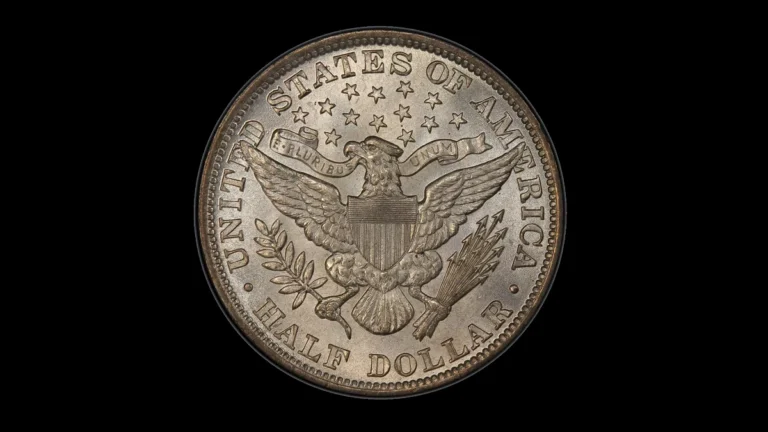
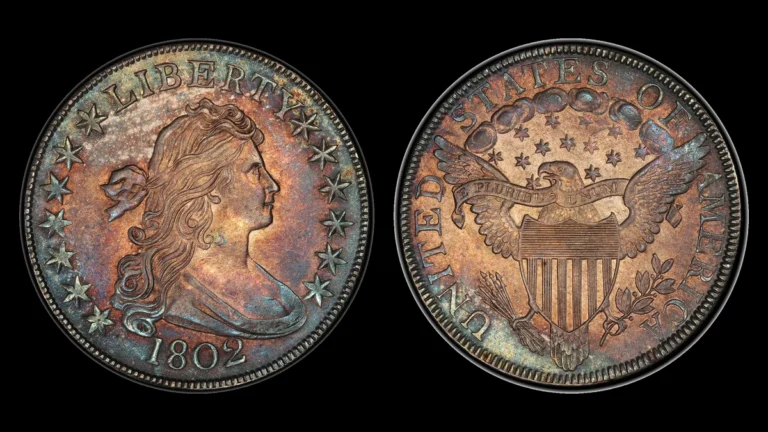
Rare 1907 Half Dollar Errors (List & Pictures)
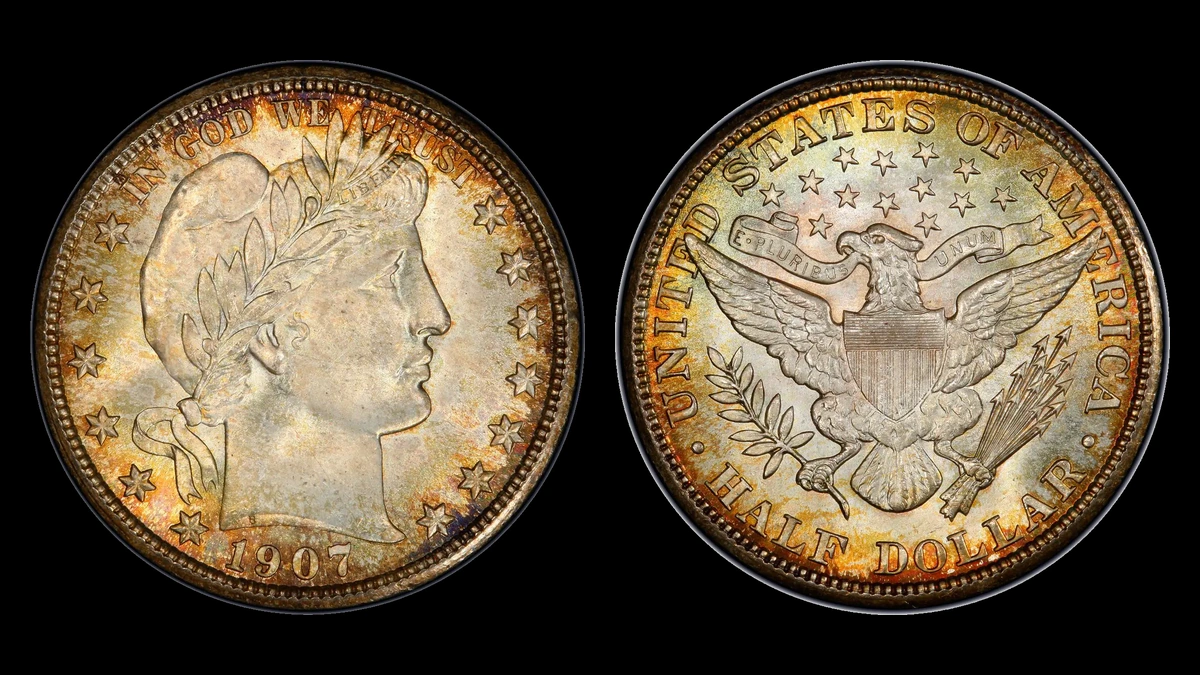
On a 1907 Barber half, the mintmark can raise three separate questions: is it faint, upside down, or repeated? A swollen neck and a peeling surface require entirely different comparisons.
Estimated whole-coin values for 1907 half dollar errors range from $40 to $10,000. The largest supplied auction result is $7,800 for an 1894 off-center coin, a different-year comparison.
Inspect the mint letter first, then the surrounding designs, surface layers, and overall outline.
| Visible clue | Error or reported variety | Estimated value |
|---|---|---|
| O is barely visible | Disappearing O | $40–$125 |
| S has reversed orientation | Inverted mintmark | $150–$900 |
| Extra S or D contour | Repunched mintmark | $75–$1,200 |
| Extra numeral fragment | Misplaced date | $100–$600 |
| Duplicated outer words | Doubled die reverse | $125–$800 |
| Fullness below Liberty’s ear | Mumps die swelling | $250–$3,000 |
| Separating layer | Lamination | $150–$1,500 |
| Wide coin with complete design | Broadstrike | $1,000–$4,000 |
| Bare crescent and lost design | Off-center strike | $4,000–$10,000 |
Normal Barber halves have a grooved edge, standard weight of 12.50 grams, and diameter around 30.6 millimeters. Measurements help when safely available, but wear and missing metal can affect them without explaining the cause.
1. 1907 Half Dollar The O is faint or nearly absent: Reported Disappearing O Error
Before interpreting an empty mintmark position, remember that Philadelphia coins normally have no letter there. The reported Disappearing O concerns a worn New Orleans coin with a weak-looking O, not every blank space below the eagle.
The Barber Coin Collectors’ Society survey records the appearance without settling its cause. Blocked die detail, weak striking, wear, and deliberate removal can produce superficially similar results.
How to Identify
Move the light around the usual mintmark location and search for a surviving curve. Compare its weakness with nearby details to see whether the whole area is similarly worn.
A lowered or scraped patch raises the possibility of removal. An undisturbed surface with a remaining O curve provides more useful evidence, although it does not by itself resolve why the letter became faint.
What It’s Worth
An estimated $40–$125 suits a moderately worn coin matching the report and retaining ordinary collectible surfaces. The basis is the underlying worn 1907-O, with no automatic disappearing-letter premium.
The survey supplies an observation rather than a separately priced certified error or sale. A better-preserved example needs a different comparison, while deliberate mintmark removal is an alteration.
2. 1907 Half Dollar The S appears upside down: Reported Inverted Mintmark Error
The two ends and curves of an S offer clues to its orientation. The Society reports a 1907-S with an inverted mintmark, potentially made when the mint-letter punch was held upside down during preparation of the die.
This is an orientation question. An extra S contour beside the final letter instead raises the repunching question addressed next.
How to Identify
Keep the eagle upright and compare the suspect letter with a normal same-year S at matching magnification. Examine the upper and lower curves and their small ends without rotating one photograph independently.
The Society’s variety survey records the report. Wear, corrosion, and remnants from another punch can change the outline, so the visible letter still needs to support its claimed orientation.
What It’s Worth
The provisional whole-coin estimate is $150–$900 for a worn example with convincingly identified inversion. Much of its value may come from the scarce San Francisco issue itself.
Ordinary 1907-S coins sold for $165 in Fine 12 in January 2026 and $169 in VF20 in May 2025. Those worn-coin sales do not establish a separate inverted-S premium.
3. 1907 Half Dollar Another letter peeks above S or below D: Repunched Mintmarks Error
Repunching leaves evidence of position rather than orientation. When the mintmark punch entered the die again after shifting, part of an earlier impression could remain beside the final letter.
The 1907 reports place extra detail above S and below D on separate mint issues. NGC lists the S/S, while the Denver entry remains a survey report with no example submitted for that row.
How to Identify
Look above a San Francisco S or below the reported Denver D for a recognizable part of the same letter. A flat shelf or simple thickening is not the same as a surviving earlier punch contour.
Inspect adjacent metal for tool cuts or an added mintmark. The NGC variety listing supports S/S separately from the Denver report, so their evidence should remain distinct.
What It’s Worth
Identified worn examples have an estimated $75–$1,200 range, with surface quality and clarity strongly affecting the comparison. No specific Denver sale is supplied.
A 1907-S/S in ANACS Fine 15 Details sold for $74 in December 2025. Details signals a problem preventing an ordinary numerical grade, so this damaged coin is not a clean-surface benchmark.
4. 1907 Half Dollar A numeral fragment lies outside the date: Reported Misplaced Date Error
The area around the date can retain evidence of a punch applied in the wrong place while the die was being made. A fragment surviving the finishing process may appear outside the intended row of numerals.
The Society reports this for 1907-O without identifying the exact digit or border-tooth position. A slightly high or low date alone does not demonstrate an extra date impression.
How to Identify
Photograph the complete date with its neighboring border teeth before isolating a suspicious mark. A useful candidate should preserve a recognizable numeral curve or stroke distinct from the normal repeating border.
Confirm the reverse O and seek a clearly identified example for comparison. A cut, pit, random lump, or misshapen border tooth does not supply the form of a date punch.
What It’s Worth
An identifiable worn example has an estimated $100–$600 range. No completed misplaced-date sale is supplied to narrow that figure.
An ordinary 1907-O AU50 sold for $268 in March 2026, while an AU53 Mumps sold listing recorded $389.99 in February 2026. Both are almost unworn same-year comparisons, but neither establishes the price or diagnostics of this reported misplaced date.
5. 1907 Half Dollar The outer reverse words have added contours: Doubled Die Reverse Error
The reverse inscription provides the inspection area in the Society’s Philadelphia report. Its older wording describes the outer inscription as recut, within the listed doubled-reverse varieties.
A die is the steel tool that stamps the design; duplicated detail on that tool can recur on coins it produces. The report supplies no catalog number or fixed direction for each affected letter.
How to Identify
Keep several neighboring letters in a photograph so their added contours can be compared together. Match them against a known example rather than deciding from a single thick-looking character.
Light reflected from worn edges and flat shelves left by movement during striking can mimic duplication. Confirm Philadelphia’s normal absence of a mintmark, and do not require an unsupported upward or sideways direction.
What It’s Worth
The estimate is $125–$800 for identifiable worn through almost unworn examples. Clear lettering and the condition of the underlying Philadelphia coin determine whether a comparison is useful.
An 1893 Barber half with a separately cataloged tripled reverse sold for $600 in May 2025. That stronger, different-year variety is a scale reference rather than a transaction for the 1907 report.
6. 1907 Half Dollar Liberty’s neck bulges below the ear: Mumps Die Swelling Error
The Mumps nickname points to an unusually full area of Liberty’s neck. On the documented 1907-O from the Larry H. Miller collection, the feature appears on a coin graded NGC MS65.
It is linked to a change in the die surface. Improper hardening has been suggested, but the coin does not prove the die’s exact heating history.
How to Identify
Compare the neck below the ear with a normal portrait showing similar wear. Moving a light across it should reveal a smoothly struck swelling rather than attached material, scraping, or an impact mark.
The Miller collection catalog supplies a documented example. Its weak eagle neck and left-wing-to-shield detail are separate observations and cannot identify Mumps by themselves.
What It’s Worth
Comparable almost unworn coins have an estimated $250–$700 range; attractive MS64–MS65 examples have a separate $1,000–$3,000 estimate. Unworn grades still allow differences in marks and surface appeal.
An MS64 Mumps sold for $920 at Heritage in March 1997. A PCGS AU53 sold listing recorded $389.99 in February 2026, while no additional sale price is assigned here to the illustrated Miller coin.
7. 1907 Half Dollar A thin surface layer lifts or disappears: Lamination Error
Unlike the neck swelling, a lamination concerns separation within the coin’s metal. A weak internal layer can lift as a flap or detach, exposing an irregular area beneath the original surface.
The year reference describes a large reverse lamination on a PCGS AU55 1907-O and also reports Philadelphia examples. Their locations and histories should not be combined into one coin.
How to Identify
Use angled light along the transition from intact surface to the exposed area. A thin layer boundary differs from a uniformly dug-out bowl or scattered corrosion pits.
Leave any surviving flap untouched. The New Orleans account gives no clock position, so an exact location must come from its actual image rather than an assumption.
A lower weight may reflect lost silver or circulation wear. It cannot, by itself, distinguish lamination from metal removed after minting.
What It’s Worth
An estimated $150–$1,500 covers smaller through conspicuous separations on collectible worn coins. The size of the flaw must be considered alongside preservation and appearance.
The year reference gives about $650 for its almost unworn AU55 reverse example without an auction transaction establishing the amount. Treat that as a reported price, not a realized result.
8. 1907 Half Dollar Complete lettering on an expanded coin: Reported Broadstrike Error
When the collar fails to restrain metal during a strike, the coin can grow wider while keeping its full design. The collar is the ring that normally controls the diameter and forms the edge grooves.
The year reference reports 1907 broadstrikes but supplies no specific mint, grade, or measured specimen. Those missing details must come from an individual coin.
How to Identify
Measure the widest and narrowest parts of the outline and inspect all outer lettering for completeness. Expansion should be consistent with naturally struck surfaces rather than later rolling or flattening.
Examine the border and edge for interrupted or absent grooves where restraint failed. A smooth edge or large diameter alone is insufficient, and spreading generally retains metal rather than removing it.
What It’s Worth
The series estimate is $1,000–$2,000 for lightly worn through nearly unworn examples and $2,000–$4,000 for unworn coins. These are guide ranges rather than sales of a named 1907 broadstrike.
The May 2025 specialist guide supplies those Barber-series figures. The extent of natural expansion and the coin’s preservation determine the appropriate comparison.
9. 1907 Half Dollar A bare crescent faces a cut-off design: Reported Off-Center Strike Error
An off-center blank leaves some metal outside the dies while the opposite part of the intended design misses the blank. This differs from a broadstrike because the full design is no longer contained on the coin.
The 1907 reference provides no established mint, percentage, or certification for a specific example. A readable date and the candidate’s own striking evidence remain essential.
How to Identify
Find the unstruck area, then compare the lost or crowded design on both faces. A single uneven border can be caused by one misaligned die and does not establish displacement of the blank.
Inspect the bare metal for original texture rather than a ground-down surface. Record the surviving date and mintmark without borrowing either from another coin’s picture.
What It’s Worth
Substantial authenticated 1907 errors with readable dates have an estimated $4,000–$10,000 comparison range. Small offsets need lower comparisons.
An 1894 NGC AU53 struck 40% off center sold for $7,800 in December 2022. Neither its percentage nor its price documents a 1907 specimen.
The January 2025 guide places lightly worn Barber offsets around $4,000 at 10–15%, with larger shifts reaching $10,000. Those figures provide series context rather than an automatic price for any uneven outline.
Conclusion
Mintmark orientation, repeated mintmark contours, and a nearly missing O each need their own comparison. For Mumps, the neck shape matters more than weak reverse detail; for lamination, the boundary of a separating layer matters more than its size.
Preserve the distinction between reports, guide estimates, asking or reported prices, and completed sales. A correct technical label helps only when the visible evidence belongs to the coin being valued.