Rare 1961 Half Dollar Errors (List & Pictures)
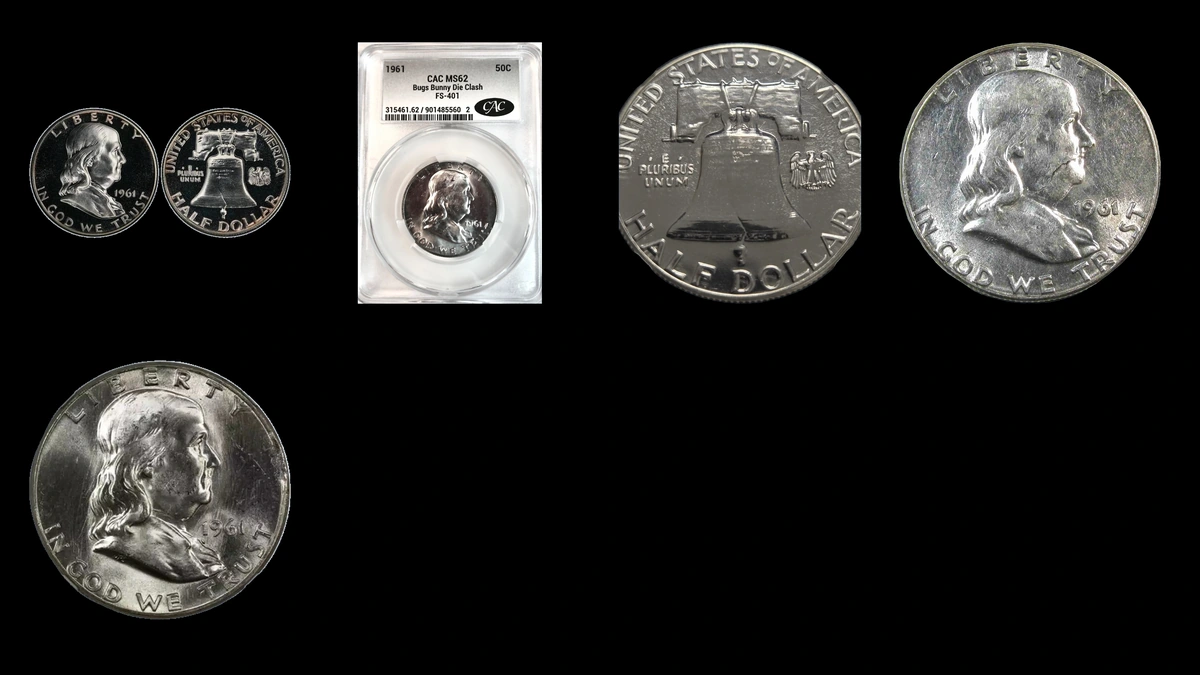
The strong doubled reverse on a 1961 Proof can be visible across several words, while a tiny clipped rim may leave its weight almost unchanged. Matching the particular feature matters more than simply finding something unusual.
Estimated prices for 1961 Franklin half dollar errors range from $50 to $20,000. A PR68 with the dramatic doubled reverse sold for $15,000 in November 2020.
Begin with lettering and mintmarks, move to local surface defects, and finish with the blank’s shape and thickness.
| Visible evidence | Category | Estimated value |
|---|---|---|
| Strong repeated Proof reverse words | Doubled die reverse | $2,500–$15,000 |
| Extra D contour | Reported repunched mintmark | $75–$600 |
| Raised mouth projections | Bugs Bunny clash | $150–$2,000 |
| Interrupted design | Struck through | $50–$800 |
| Local separating layer | Lamination | $50–$300 |
| Missing edge portions | Clipped planchet | $60–$400 |
| Complete expanded design | Broadstrike candidate | $400–$2,500 |
| Blank crescent and lost design | Reported off-center strike | $1,000–$6,000 |
| Thin body with struck split surface | Split before strike | $300–$1,200 |
| Wrong metal or smaller blank | Wrong planchet | $1,500–$20,000 |
The normal silver half weighs 12.50 grams, measures approximately 30.6 millimeters, and has edge grooves. A Proof is a specially made collector coin, and its finish must not be inferred merely from a bright photograph.
1. 1961 Half Dollar Reverse words show substantial separation: Proof Doubled Die Reverse Error
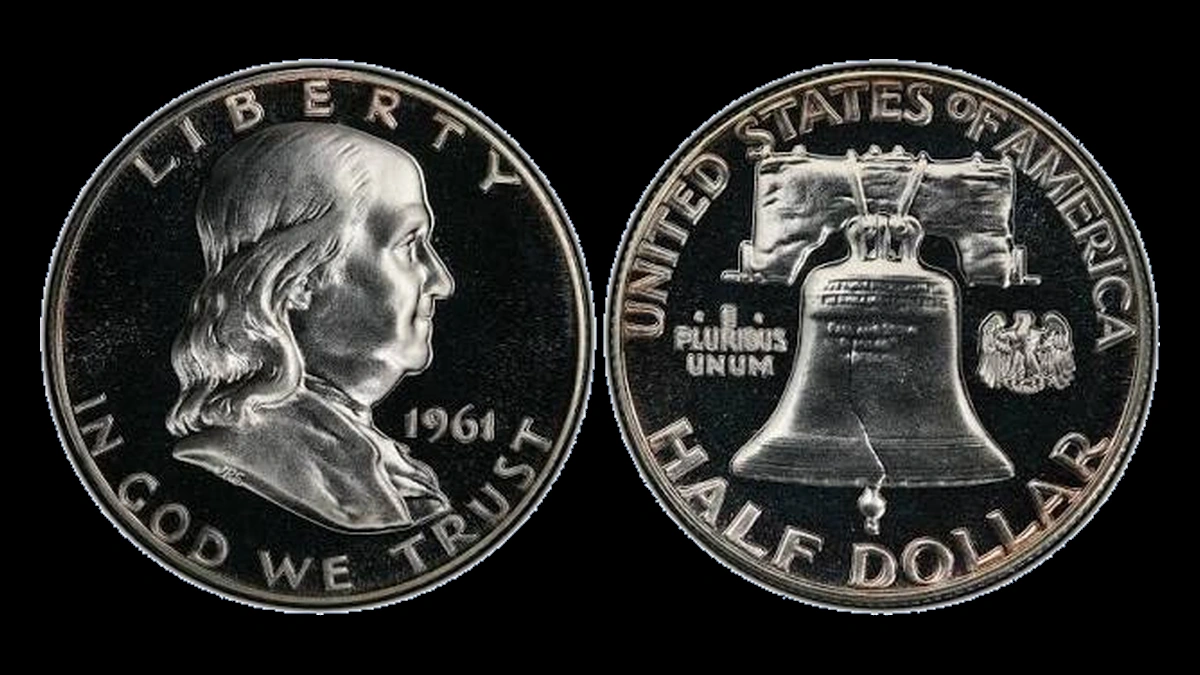
The strong 1961 Proof variety repeats raised outlines in E PLURIBUS UNUM, UNITED STATES, and HALF DOLLAR. PCGS distinguishes this dramatic FS-801 pattern from weaker doubled reverses of the same year.
The duplication formed in the die before coins were struck. The repeated blows normally used to make Proofs do not, by themselves, explain a pattern already present in the tool.
How to Identify
Compare all three inscriptions with the PCGS reference photographs. The matching extra outlines should remain fixed as light moves across the reflective fields.
A flat shelf can change a letter’s apparent width without matching the strong variety. One thick character or a weaker doubled reverse should not receive the FS-801 attribution automatically.
What It’s Worth
The estimate is $2,500–$15,000 for ordinary Proofs clearly matching the strong pattern. PCGS records a PR68 sale of $15,000 at Stack’s Bowers on November 18, 2020.
Weaker varieties need their own comparisons. Cameo coins, with frosted designs contrasting against reflective backgrounds, also require separate consideration rather than a fixed addition to this range.
2. 1961 Half Dollar A second D stroke survives by the mintmark: Reported Repunched Mintmark Error
An owner describes repunching on a PCGS MS65 1961-D. That grade establishes an unworn condition description, not confirmation of the proposed mintmark variety.
Hand punching a mintmark again after a small shift could leave part of the first D in the die. Coins struck from it would carry a recognizable extra raised contour.
How to Identify
Above the bell’s wooden support, inspect the D’s stem, curved side, and adjacent field. Compare with the same-year half-dollar variety rather than a Denver cent or another Franklin date.
Look for a separate rounded stroke that fits an earlier D. A flat extension across several details or a shapeless lump does not provide the same evidence.
A separate Denver coin is reported with both a possible extra D and weak clapper detail. It does not inherit the first owner’s MS65 grade.
What It’s Worth
A clearly identified minor repunched D has an estimated $75–$600 range on collectible examples. No transaction for the owner’s 1961 MS65 is supplied.
PCGS records $590 in May 2021 for a 1952-S FS-501 in MS65. That recognized earlier variety provides Franklin-series context without proving the later owner’s attribution.
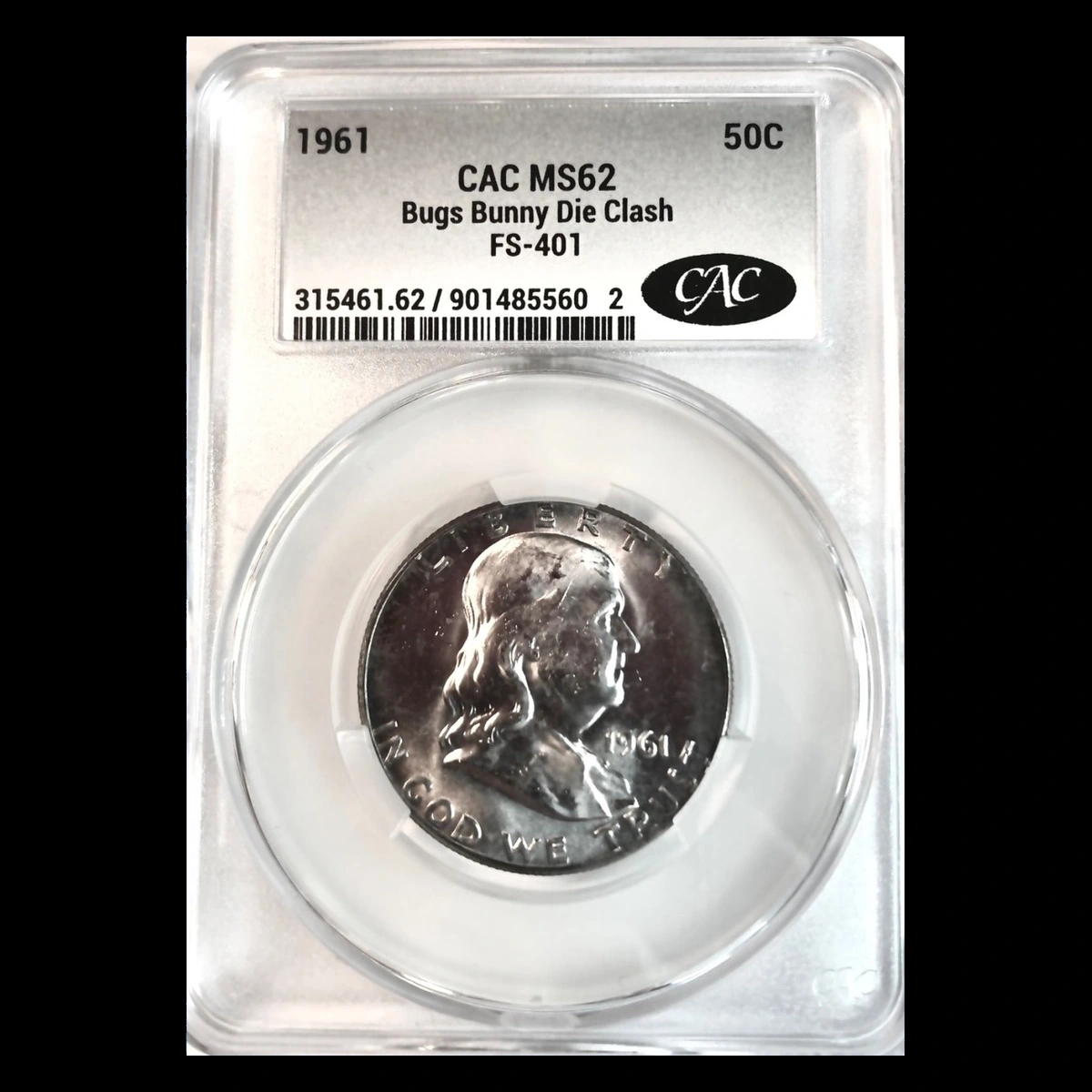
3. 1961 Half Dollar Small projections appear at the upper lip: Bugs Bunny Die Clash Error
The 1961 Philadelphia FS-401 is a regular circulation-strike variety with raised mouth projections. Its Bugs Bunny nickname does not automatically identify a Denver coin, a Proof, or a different year.
When the dies met without a blank, contact transferred part of the opposing design to a tool. Later coins reproduced that trace beside Franklin’s normal portrait.
How to Identify
Confirm 1961 and the absence of D above the bell, then compare the upper lip with a recognized same-year FS-401 image. The familiar 1955 variety cannot replace that exact comparison.
Inspect nearby metal for a hit that could have pushed up a toothlike lump. Matching projections without surrounding damage provide stronger support than the nickname alone.
What It’s Worth
Ordinary recognized examples have an estimated $150–$800 range, with exceptionally preserved coins potentially at $800–$2,000. The upper estimate is not a second recorded sale.
A PCGS MS64 FS-401 sold for $250 at David Lawrence Rare Coins in April 2018. Sharp striking and attractive surfaces must support any substantially higher comparison.
4. 1961 Half Dollar A local area fails to receive normal detail: Struck-Through Error
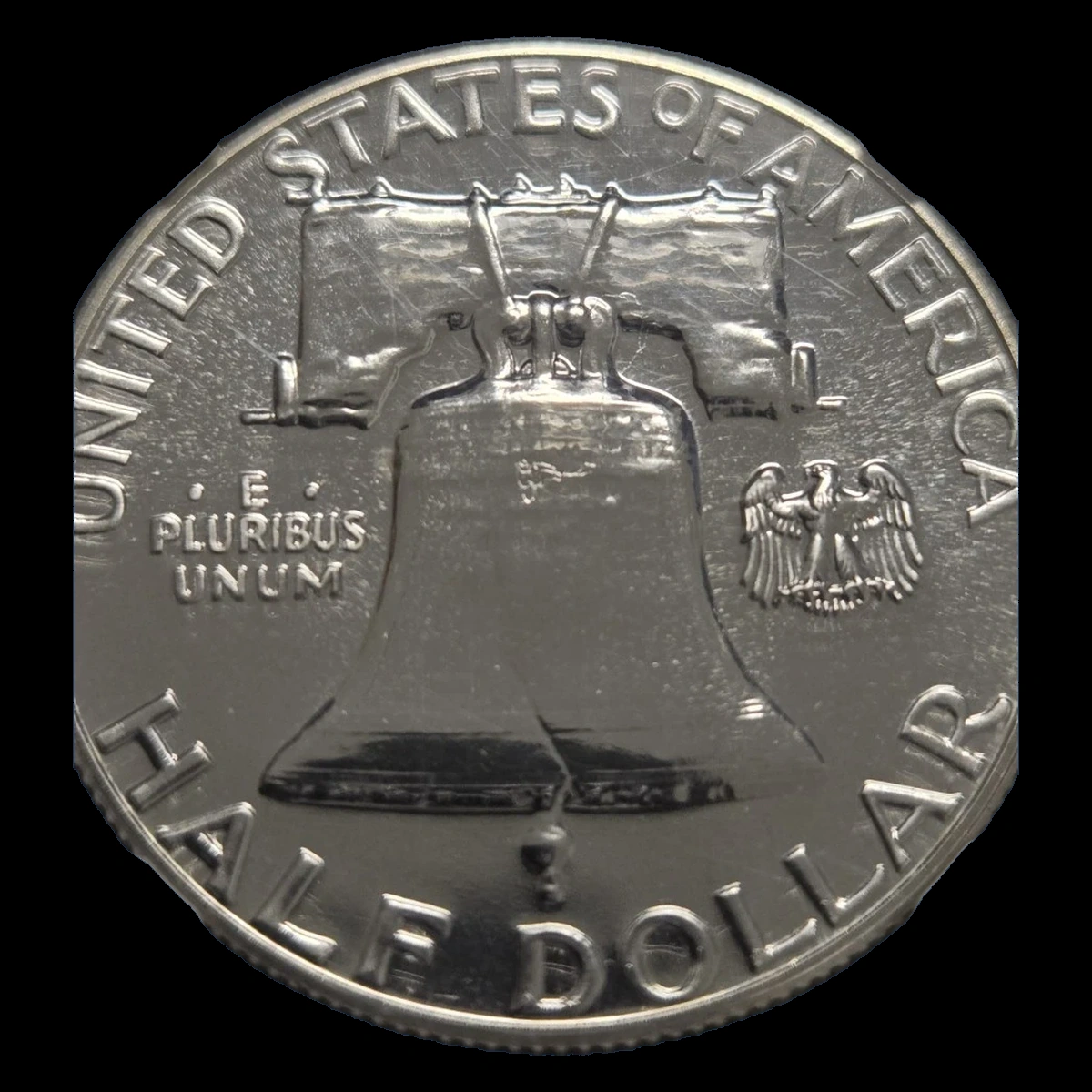
Three supplied accounts concern different coins: a Philadelphia Proof 66 with an obverse strike-through, a seller-described PF67 with a reverse strike-through, and a regular Denver coin with weak detail near the clapper. Grease is proposed only for the Denver report.
Material between a die and the blank can block design or impress a shape. Neither face location nor material should be transferred from one of these reports to another.
How to Identify
For a Proof, change viewing angles to establish that a mark lies on the coin rather than the holder. Cloth or wire needs an identifiable impression, not an unexplained hollow.
On the Denver candidate, compare the clapper area with nearby sharply struck bell detail and check for scraping or rubbed high spots. Examine its suspected repunched D separately.
What It’s Worth
Minor circulation-coin weakness is estimated at $50–$200, while clear Proof impressions may fall around $100–$800. The finish and strength of the interruption affect the comparison.
A 1951-S in NGC MS64 is recorded at $134 in April 2026 for a strike-through, offering a different-year circulation comparison. Any supported extra D on the Denver candidate belongs within one whole-coin valuation rather than a second coin price.
5. 1961 Half Dollar A thin layer peels locally: Lamination Error
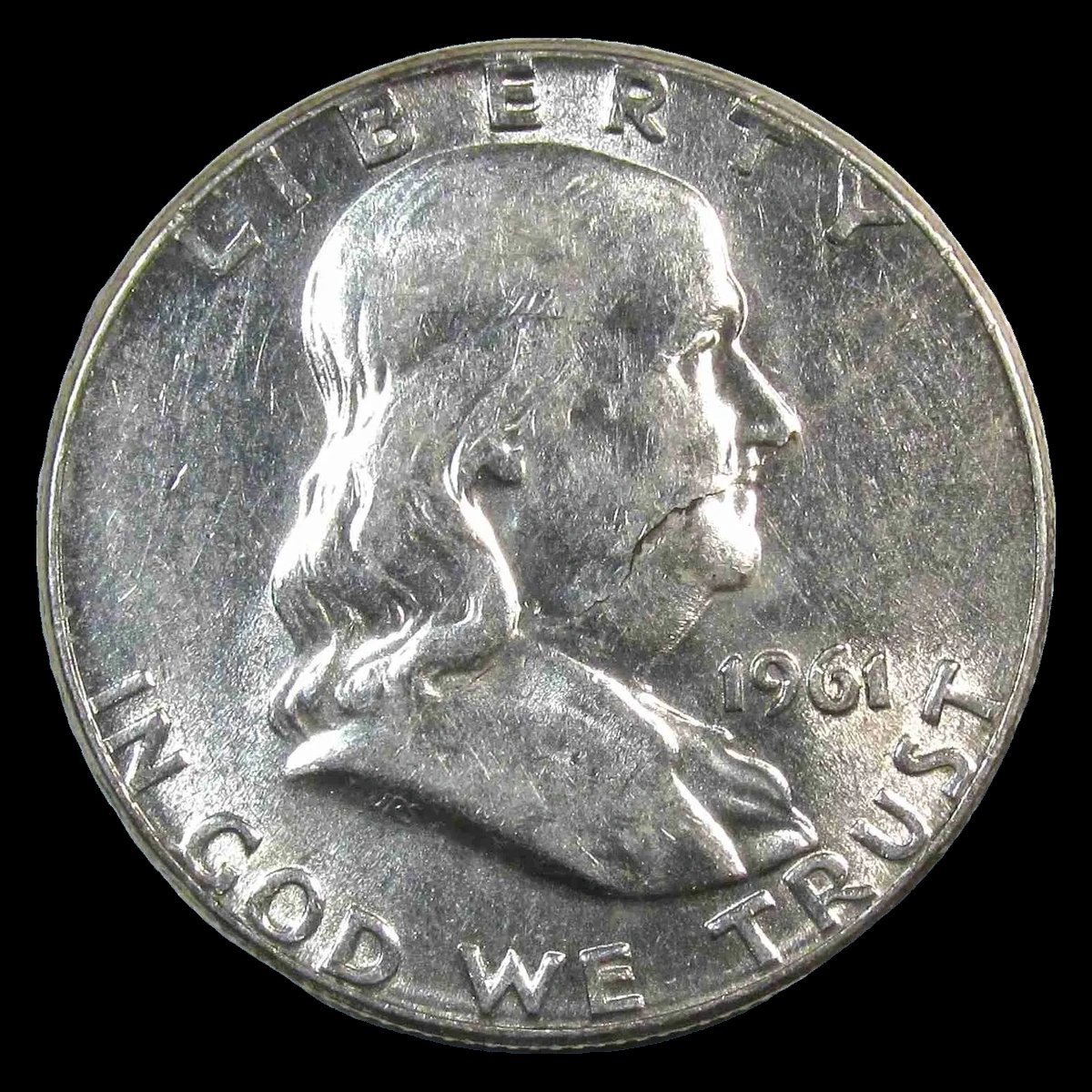
Jeffrey Hoare’s 2002 catalog includes a 1961 lamination without specifying the face, precise location, or mint. Its broad description therefore cannot locate a flaw on a different specimen.
A weak bond in the 90% silver alloy can let a layer separate while the rest stays intact. This localized peeling differs from a blank splitting across much of its thickness before striking.
How to Identify
Look for an overhanging edge or clear layered boundary where the flaw meets the original surface. Scratches and corrosion can make metal rough without separating a sheet.
Leave attached flakes untouched and record surrounding design and edge grooves. A layer still attached may leave the coin’s weight essentially unchanged.
What It’s Worth
The estimate is $50–$300 for visible local lamination in worn through ordinary unworn condition. No realized amount from the 2002 catalog is supplied.
A different-year 1957 in NGC MS63 sold for $74.49 including fees in January 2021. The visibility of a layer and the appeal of the remaining surfaces make that a comparison rather than a universal lamination price.
6. 1961 Half Dollar One or more gaps interrupt the rim: Clipped Planchets Error
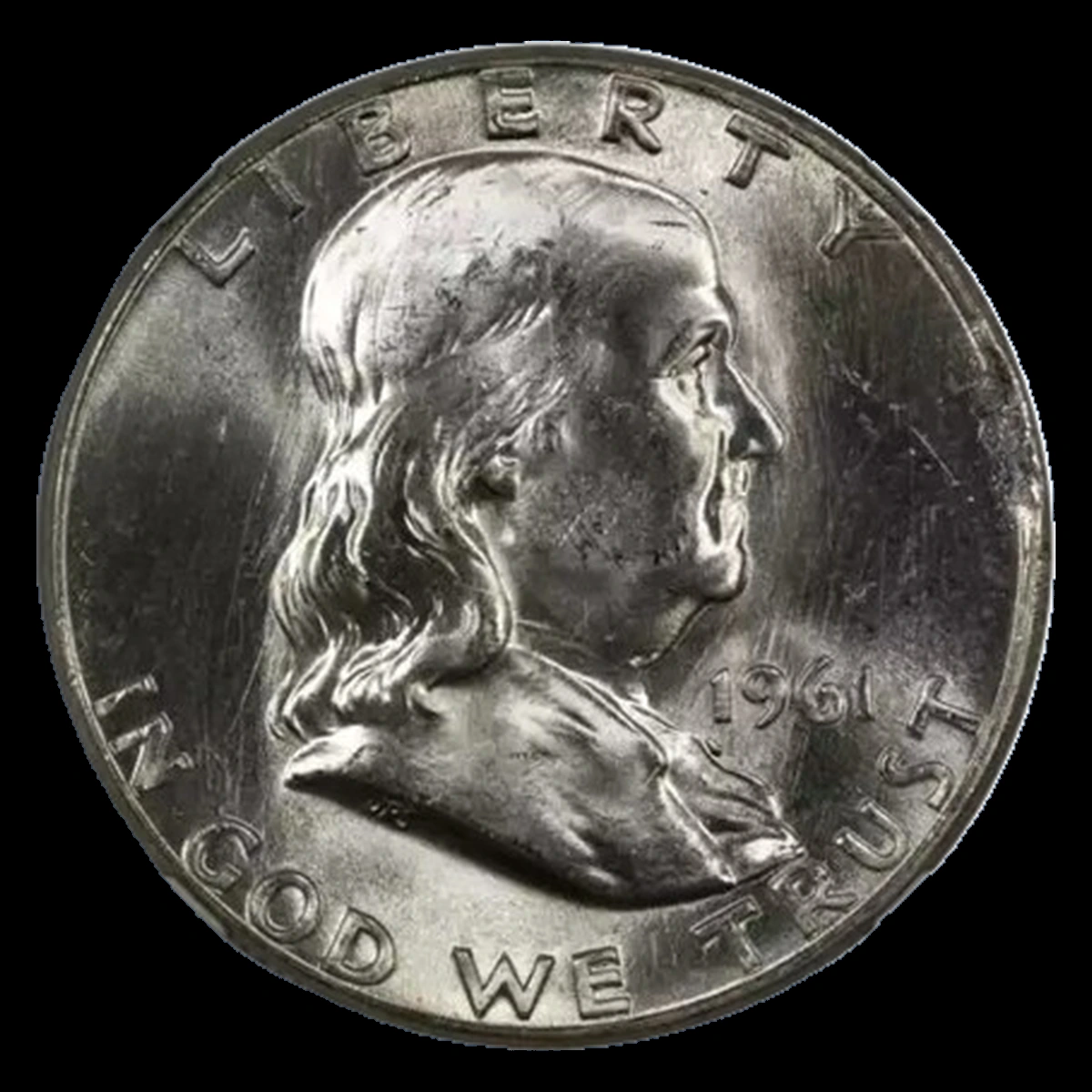
The recorded 1961-D ANACS MS63 curved clip weighs 12.48 grams, only slightly below normal. Other records include a Denver MS63 rim clip, a PCGS MS62 double clip totaling 4%, and separate Philadelphia clip and rim-clip coins.
All concern metal missing before striking, but their shapes, grades, and measurements belong to separate examples. A small rim clip need not resemble a large curved bite.
How to Identify
Do not reject a tiny clip because its weight is nearly normal. Inspect each boundary for design and metal that formed around an existing gap, rather than a sharp cut through the finished coin.
On a double clip, examine both openings independently and photograph the surviving edge grooves. Opposite-rim weakness can help, while intact sections may still span the usual diameter.
What It’s Worth
Ordinary collectible clips have an estimated $60–$400 range. Size, preservation, and credible original boundaries influence the whole-coin value.
A Heritage lot sold for $120 in 2021 contained two straight clips: a 1958 PCGS MS63 and a 1961 ANACS MS63. That price covered the pair and cannot be assigned to either coin individually.
7. 1961 Half Dollar The outline spreads but the design stays complete: Broadstrike Candidate Error
A broadstrike forms when the collar does not restrain the blank’s outward movement as intended. The collar is the surrounding ring that normally controls diameter and forms edge grooves.
The year guide lists the category without identifying an original 1961 specimen. This supplies a possible mechanism to test rather than a documented auction discovery.
How to Identify
Follow the outer design on both faces to confirm that it remains complete inside expanded metal. Measure the outline in several directions and inspect the edge for incomplete grooves.
A later blow can also widen a coin but may crush its finished details. Weight consistent with the original metal supports expansion only when the surfaces and edge fit the same process.
What It’s Worth
A genuine 1961 broadstrike has an estimated $400–$2,500 range, without a supplied exact-year sale. Authentication and visible natural spreading are prerequisites for using it.
A cleaned 1903 Barber broadstrike in ANACS AU50 Details brought $690 in July 2006. Its different series and impaired surfaces limit that silver-half comparison.
8. 1961 Half Dollar The design shifts away from a blank crescent: Reported Off-Center Strike Error
Here, some intended design falls beyond the blank while metal on the opposite side remains unstruck. The year guide reports 1961 offsets without supplying a specific mint, finish, or percentage.
A single crowded border is insufficient because one misaligned die can create unevenness on only one face. Angled photographs can also distort the apparent outline.
How to Identify
Photograph both faces straight on and compare their displacement relative to the blank area. Check that the exposed crescent retains original texture rather than evidence of grinding or flattening.
Record the surviving date and mintmark evidence without filling missing areas by guesswork. Inspect for a second strike as well as cutting or filing around the edge.
What It’s Worth
A genuine, obvious 1961 offset with a readable date has an estimated $1,000–$6,000 range. A slightly uneven rim does not meet that major-error comparison.
The January 2025 Mint Error News guide lists Barber halves 10–15% off center near $4,000 in XF/AU condition. That is a different-series guide figure, not a realized 1961 sale or a measured percentage for the broad report.
9. 1961 Half Dollar A thin piece received the design after splitting: Split Planchet Before Strike Error
The documented auction example weighs 6.0 grams and is described as struck on a split planchet. A broad separation had left less than half the normal metal available for the strike.
A specialist illustrated another 1961 with its rough split surface on the front. The descriptions do not establish that the illustration and the auction coin are the same object.
How to Identify
Compare thickness and diameter along with weight. A thin piece can retain nearly a full half-dollar outline, unlike a smaller quarter blank that lacks room for outer design.
Look for actual stamped letters or design on the rough exposed interior. A split after striking would expose metal that never received that die impression.
Check the edge and remaining grooves for grinding or chemical damage. Low weight alone does not establish the timing or cause of separation.
What It’s Worth
Comparable pieces with original surfaces and readable identity have an estimated $300–$1,200 range. The 6.0-gram NGC example sold for $408 on July 15, 2021.
No numerical grade is supplied for that coin. A different-year 1960 split-before-strike Franklin brought $630 in June 2023, without establishing matching weight or appearance.
10. 1961 Half Dollar Oversized Franklin details occupy the wrong metal: Wrong-Planchet Strikes Error
The strikingly preserved Denver cent-blank example weighs 3.1 grams and is graded NGC MS67 Red Brown. The full date and D survive with WE TRUST and much of the eagle despite the loss of outer design.
Other records describe Denver quarter and nickel blanks, with Philadelphia versions also reported. These were smaller blanks and need not show Lincoln or Jefferson underneath the Franklin design.
How to Identify
Compare accessible weight and composition with the proposed blank: a bronze cent starts near 3.11 grams, a nickel at 5.00 grams, and a silver quarter at 6.25 grams. Starting widths are about 19.05, 21.21, and 24.3 millimeters respectively.
Striking can expand those discs, and they may not reach the half-dollar collar to receive full edge grooves. Check that the large design ends naturally on the available metal rather than at a trimmed boundary.
The cataloged Denver cent-blank coin supplies the specific identity and grade described above. Keep the mint, metal, and surviving date tied to the actual specimen being examined.
What It’s Worth
Estimates are $1,500–$5,000 for quarter blanks, $3,000–$8,000 for nickel blanks, and $8,000–$20,000 for cent blanks. Readable identity and preservation affect each range.
Stack’s Bowers cites a 1961-D cent-blank PCGS MS64 Red Brown sale of $9,400 in August 2013. That sale is separate from the cataloged MS67.
A different-year 1958-D quarter-blank coin in NGC MS62 sold for $1,440 in December 2020. It helps frame the less expensive quarter type without pricing the other blank classes.
Conclusion
Start with the feature’s actual location and finish: strong Proof reverse doubling, a Philadelphia mouth clash, and a reported Denver mintmark require different reference images. Shared dates do not make their diagnostics interchangeable.
For shape and weight problems, distinguish an incomplete blank, a thin split piece, and a smaller wrong blank by their surfaces and design boundaries. Keep multi-coin lot totals and separate specimen grades attached to the correct records.