Rare 1980 Half Dollar Errors (List & Pictures)
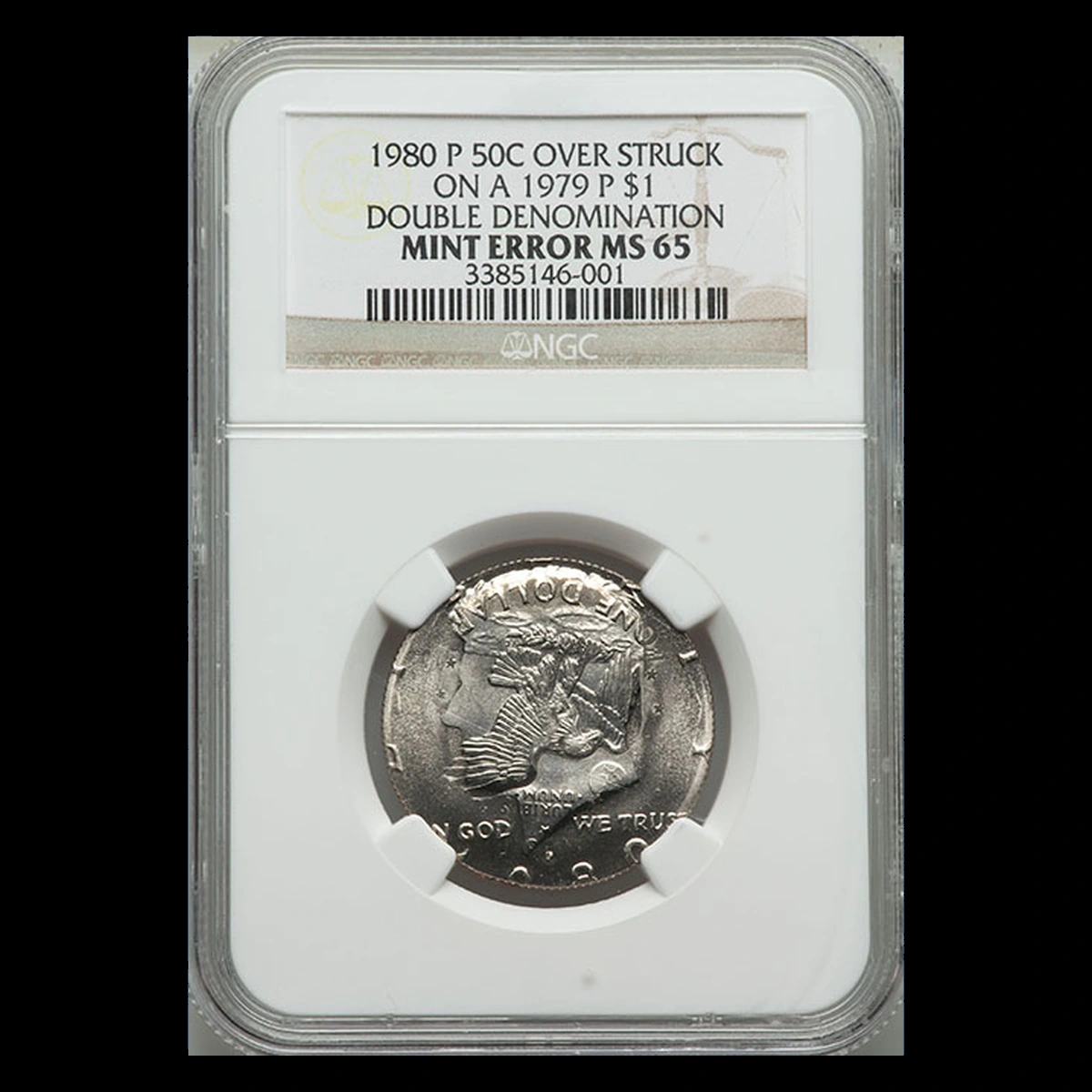
A 1980-P half-dollar design struck over a finished 1979-P Anthony dollar sold for $22,325 in January 2016. Surviving portions of both denominations explain its unusual identity.
Estimated 1980 half dollar errors values span $5–$30,000. First determine what metal entered the press, then inspect strike position and smaller die features.
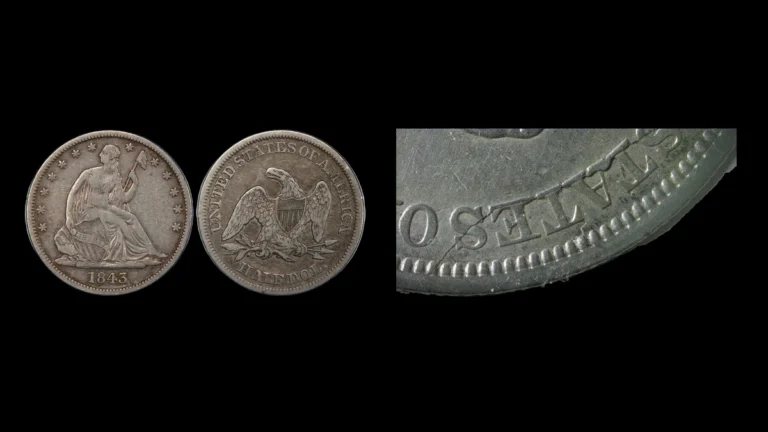
A normal clad half weighs 11.34 grams and measures about 30.61 millimeters, with a reeded edge. The associated detached-layer example below is undated and remains identified that way.
| Evidence | Category | Estimated whole-coin value |
|---|---|---|
| Anthony designs beneath Kennedy | Double denomination | $15,000–$30,000 |
| Different complete blank | Wrong planchet | $600–$20,000 by blank |
| Normal-sized but thinner disc | Wrong stock | $350–$1,500 |
| Very thin detached layer | Associated undated layer strike | $400–$1,800 |
| Plain bounded recess | Indent | $60–$600 |
| Displaced picture and blank area | Off-center strike | $75–$800 |
| Full design in spread metal | Broadstrike | $80–$500 |
| Repeated face-rim teeth | Collar clash | $10–$100 |
| Raised rim-connected patch | Cud or rim break | $20–$450 |
| Raised filling inside P | Filled mintmark | $5–$75 |
| Inward letter repetition | Doubled die | $20–$300 |
1. 1980 Half Dollar An Older Dollar Design Remains underneath: Double Denomination Overstrike Error
The documented NGC MS65 began as a struck 1979-P Susan B. Anthony dollar. It then entered a half-dollar press and received a 1980-P Kennedy design over the existing images.
The remaining dollar portrait, lettering, and date establish that the host was already a coin. A plain Anthony-dollar blank cannot show that earlier design.
How to Identify
Trace recognizable Anthony details beneath Kennedy’s design on both faces. They must belong to the same piece of metal rather than a separate layer, altered photograph, or added impression.
Use the dollar’s original 8.1-gram weight and 26.5-millimeter diameter as starting references. The later strike can spread its outline beyond the dollar’s normal size.
Inspect the edge for seams, cutting, and changes caused by overstriking. Measurements support the surviving images but cannot replace them.
What It’s Worth
The estimated range is $15,000–$30,000 for this rare combination with recognizable designs. Preservation and the clarity of the underlying coin strongly affect appeal.
The January 2016 FUN result was $22,325 for the NGC MS65. That result must not be assigned to a Kennedy struck on an unstruck Anthony blank.
2. 1980 Half Dollar The Blank Has Another Size or Alloy: Wrong Planchet Error
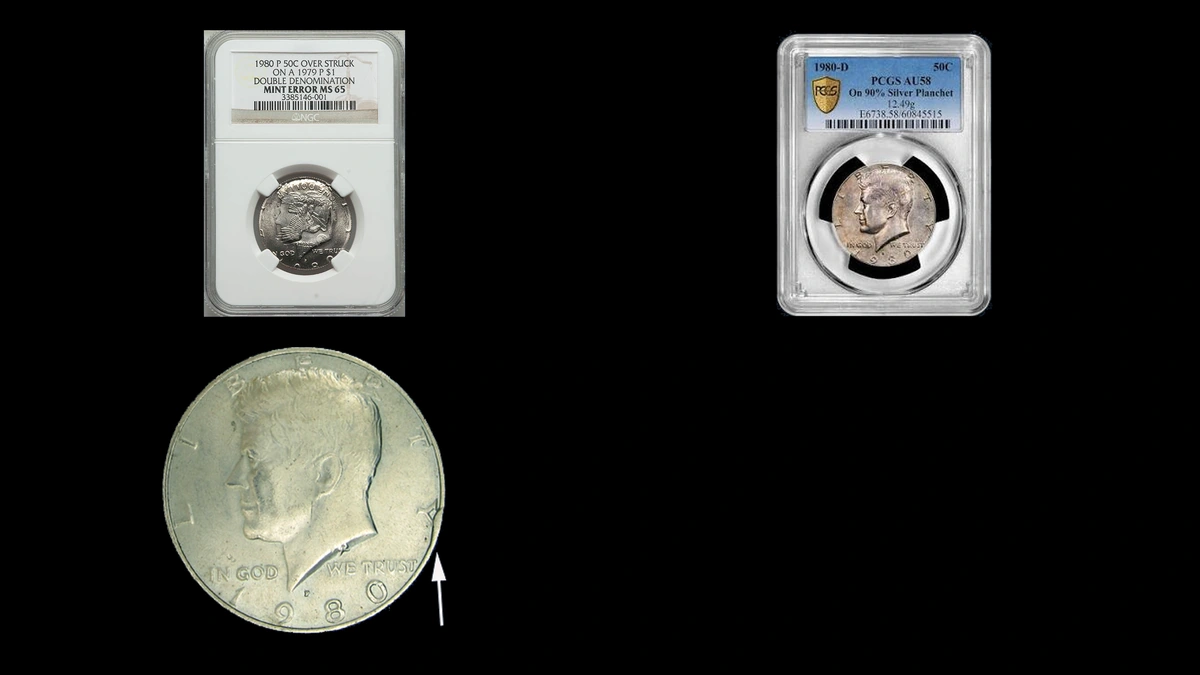
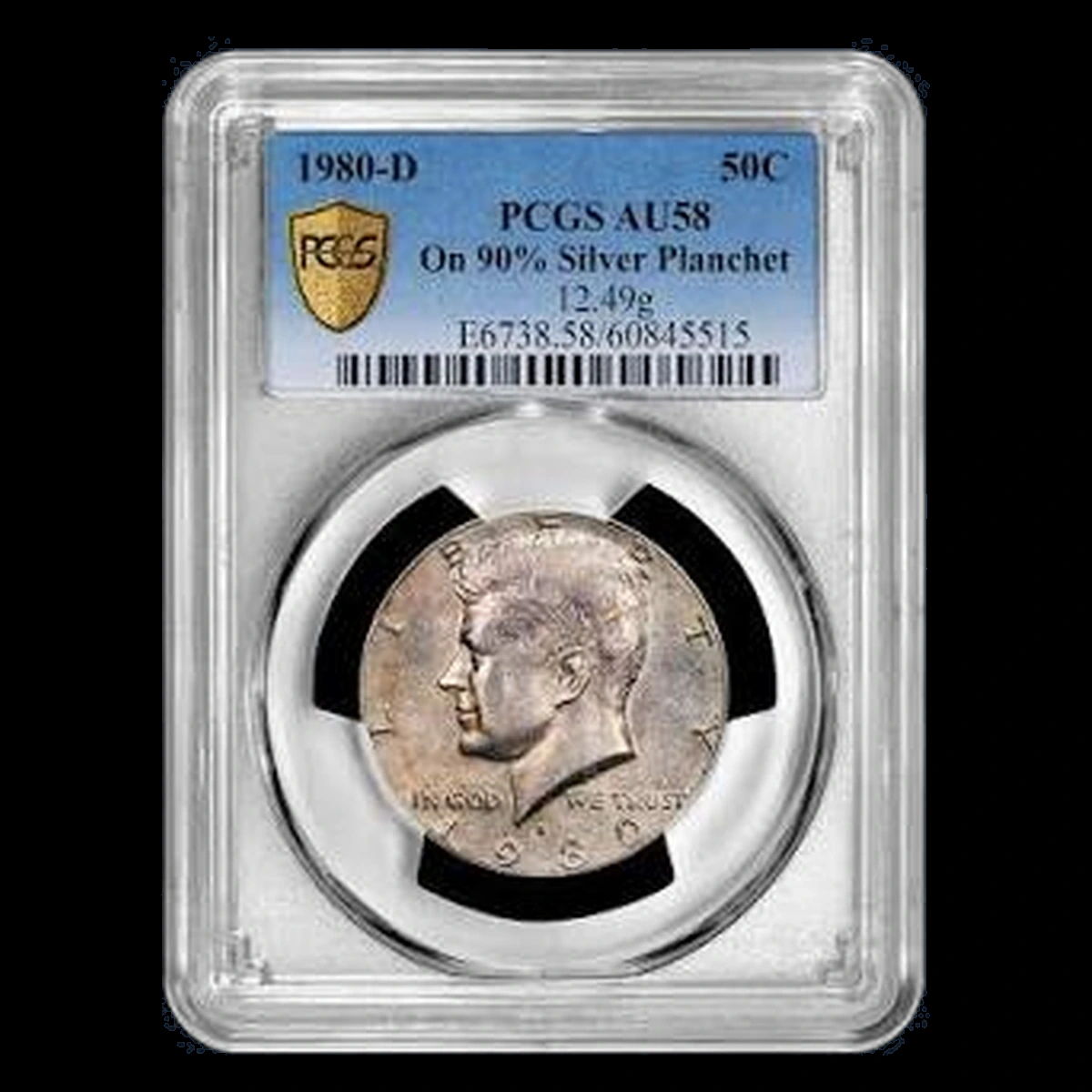
Records describe separate 1980 errors on an Anthony-dollar blank, an unidentified foreign blank, a copper cent blank, and a 90-percent-silver blank. These are not four descriptions of one coin.
The foreign specimen weighs 7.5 grams, with country and exact alloy unidentified. The 1980-D silver specimen weighs 12.49 grams; a suggested leftover-1964 origin remains a catalog explanation rather than proof of the blank’s manufacture date.
How to Identify
Compare the actual weight and composition with the proposed blank. An Anthony blank normally weighs 8.1 grams, while a contemporary copper cent blank normally starts at 3.11 grams.
The cent number is a standard, not a recorded measurement of the error. Its described design retains the upper date but loses HALF DOLLAR, whereas the silver specimen has a more complete-looking half-dollar image.
Inspect edge layers and natural design termination for trimming or alteration. Nondestructive metal testing is needed to evaluate the silver claim, especially when size looks nearly normal.
What It’s Worth
Estimated values are $600–$2,500 for Anthony or foreign blanks, $2,500–$6,000 for cent blanks, and $6,000–$20,000 for the silver error. Blank identity and surviving design make these different comparison groups.
The cent example sold for $3,840 in August 2024, and an Anthony-planchet example brought $1,920 in December 2024. A 1977-D on 40-percent-silver metal sold for $6,405 in June 2026, but its year and alloy differ from the 90-percent-silver 1980-D.
3. 1980 Half Dollar The Diameter Is Nearly Normal but the Disc Is Thin: Wrong Planchet Stock Error
The 1980-P PCGS MS63 wrong-stock coin was cut from metal strip intended for Anthony dollars. Its recorded 168 grains, approximately 10.89 grams, is only about four percent below a normal half.
This concerns the strip’s thickness before blanks were punched. It differs from placing an entire smaller 8.1-gram Anthony blank in the half-dollar press.
How to Identify
Compare diameter and thickness with a normal half, looking for a nearly normal outline and uniformly thinner original metal. Check the actual weight with an accurate scale.
Inspect both designs and the edge for grinding, chemical attack, or layer loss. Each could make a finished coin lighter without proving wrong stock.
A complete design fitting the near-normal outline helps distinguish this coin from smaller-blank errors. Low weight alone cannot identify the original strip.
What It’s Worth
Confirmed wrong-stock examples have an estimated $350–$1,500 range. The described specimen sold for $373.75 in June 2006.
A separate 1980-P on a complete 8.1-gram Anthony blank, also graded PCGS MS63, brought approximately $1,281 in June 2026. Its smaller-blank mechanism and appearance prevent direct substitution for the thin-stock coin.
4. 1980 Half Dollar The Struck Material Is Only a Thin Layer: Associated Undated Split-Off Layer Error
The associated PCGS MS62 example consists of a detached outer layer struck 35 percent off center. Its holder says No Date, so the 1980 discussion does not establish its year.
This is the separated layer receiving a design of its own. A mostly intact half dollar that lost one covering is a different kind of object.
How to Identify
Examine the material from the side and document its thinness before trying to assign a date. Record how the surviving design occupies the layer.
Measure weight, thickness, and outline carefully without pressing the fragile piece flat. Inspect its original surface and any edge evidence for later hammering.
The known example remains undated even if it is displayed alongside 1980 material. A date attribution requires readable evidence on the coin itself.
What It’s Worth
A confirmed half-dollar strike on a detached layer has an estimated $400–$1,800 range. The 2011 offering was marked not sold and supplies no realized price.
A 1974-D missing its front covering sold for $432 in March 2023, graded NGC MS64. It retained the main coin body and is related context rather than an equivalent detached-layer strike.
5. 1980 Half Dollar A Plain Recess Interrupts the Front: Obverse Indent Error
The documented 1980-P ANACS MS60 has an obverse indent. Another metal disc can overlap a blank during striking and prevent the die from directly forming the covered area.
The result is a bounded hollow rather than normal detail. The supplied description establishes no percentage or clock position.
How to Identify
Trace the border between the hollow and normal design, looking for interruption during striking rather than a hit that crushed finished detail. Inspect adjacent metal for a damage lip.
Search the recess for recognizable mirror-reversed letters or designs. Those would require a brockage explanation involving an already struck coin rather than a plain indent.
Keep the full obverse and edge visible with the closeup. A smooth hollow alone still needs context to separate it from later pressure damage.
What It’s Worth
Modest through stronger attractive indents have an estimated $60–$600 range. Boundary clarity and original surface quality affect appeal.
The ANACS MS60 sold for $77 on October 10, 2022, according to the Heritage record. MS60 is an unworn grade with substantial marks, and the upper estimate assumes a more compelling comparison than the mere presence of a hollow.
6. 1980 Half Dollar A Shifted Picture Ends beside Plain Metal: Off-Center Strike Error
The reported 1980-P is described as 15 percent off center toward two o’clock, with additional spreading. Its auction-index wording calls it brilliant uncirculated, which is an appearance description rather than a numerical grade.
The blank sat partly outside the dies, leaving some metal unstruck. The direction and percentage belong to this reported example only.
How to Identify
Read 1980 and P on the actual coin, then compare both faces at the transition from struck to blank metal. Their missing details should fit one displacement.
For the described specimen, compare the direction with two o’clock while holding the front upright. Other candidates need their own measurements.
Inspect smooth areas and surviving reeding for filing or later removal. An uneven border on only one face can reflect die misalignment instead.
What It’s Worth
Dated genuine off-center examples have an estimated $75–$800 range. Surviving identity, displacement, and attractive surfaces guide the comparison.
A 1990-P struck ten percent off center, graded NGC MS66, sold for $198 in September 2025. That different-year result does not assign its grade or percentage to the reported 1980-P.
7. 1980 Half Dollar A Complete Design Remains inside Expanded Metal: Reported Broadstrike Error
With inadequate collar restraint, metal can spread outside the intended diameter while the full image remains on the coin. This is a broadstrike rather than a design partly missing the blank.
No specific graded 1980 specimen or diameter is supplied for this report. A wide outline or smooth edge alone does not establish the cause.
How to Identify
Measure several widths and check every outer design element on both faces. The complete image should fit the naturally expanded outline.
Look for edge formation consistent with unrestrained spreading and inspect details for later crushing. Grinding and pressure after minting can imitate parts of the appearance.
Weight should remain compatible with a complete blank and any wear. Expansion itself does not remove metal.
What It’s Worth
Confirmed examples are estimated at $80–$500, depending on spread and preservation. Attractive original margins matter alongside size.
A 1990-P ANACS MS61 sold for $192 in March 2025, while a 1983-P NGC MS65 carried a $175 dealer asking price. Those are a sale and an offer from other years, not a 1980 transaction.
8. 1980 Half Dollar Evenly Spaced Teeth Appear on the Face’s Rim: Collar Clash Error
The collar’s ridges can strike a die near its rim and leave damage that repeats on later coins. This creates a collar-clash pattern on the face rather than a transferred eagle or portrait outline.
Error-Ref illustrates a 1980-P with marks from approximately seven to eleven o’clock. A stepped side edge from partial collar engagement is a different feature.
How to Identify
Match several marks in the illustrated sector against the 1980-P reference. Their spacing should fit the collar’s regular ridges rather than random nicks.
Turn the coin sideways to inspect the actual reeded edge. Keep edge steps separate from reproduced marks on the face’s rim.
Change the light to exclude reflections and retain a full-face view. One isolated toothlike projection is less useful than a coherent sequence.
What It’s Worth
Collectible collar-clash examples have an estimated $10–$100 range. Clarity and extent influence the premium.
A seller offered an ungraded 1983-P with misalignment and collar-clash claims for $9.50 and described it as AU55. That is a different-year asking price with a seller’s grade, not an independently graded sale.
9. 1980 Half Dollar Raised Metal Joins the Rim: Cuds and Rim Breaks Error
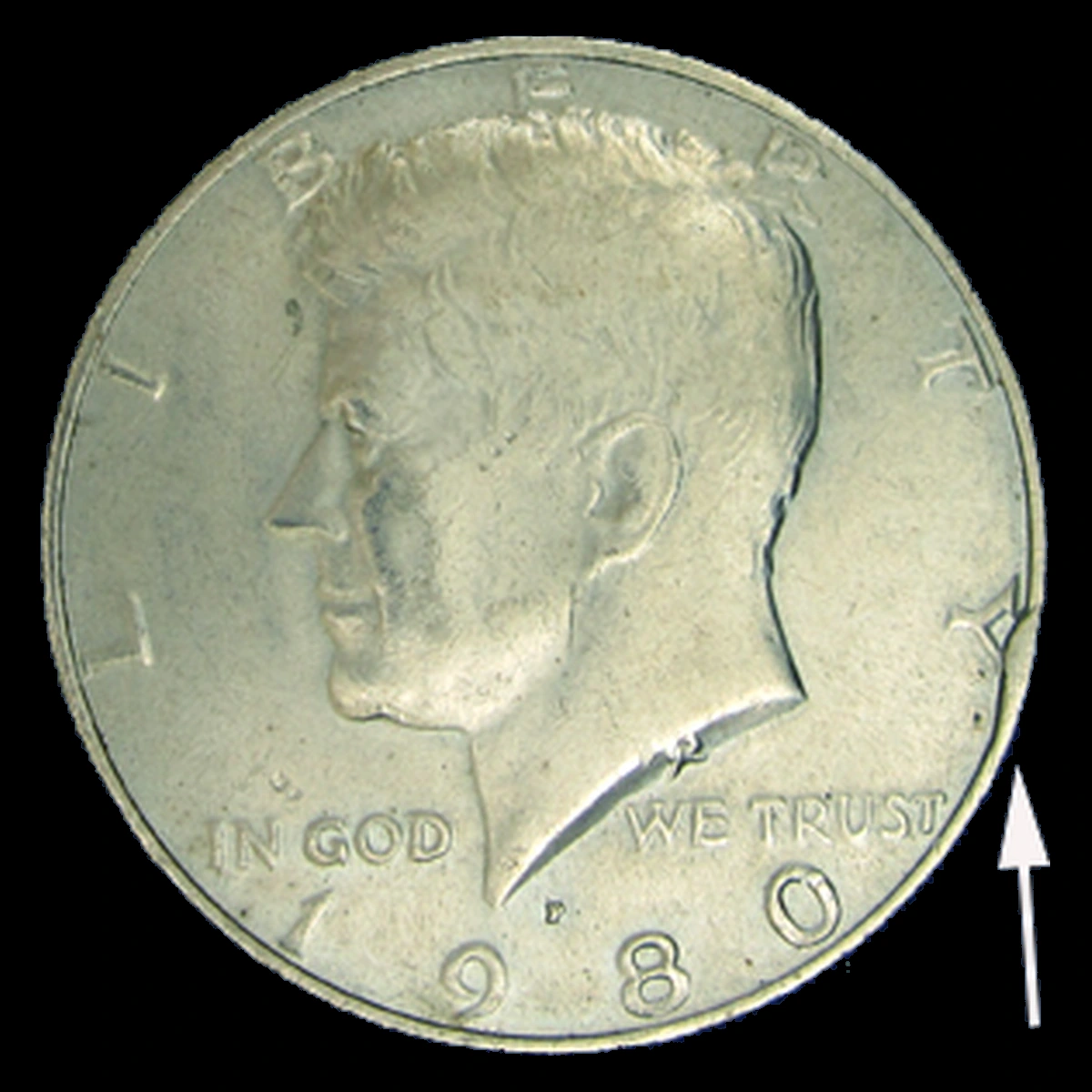
Cuds on Coins lists two Philadelphia and two Denver 1980 examples with numbers ending P-01, P-02, D-02, and D-03. They represent separate specimens or die features within the same broad category.
A broken die edge leaves space for raised metal instead of the normal rim or design contour. Size, face, and position must be matched to the individual entry.
How to Identify
Select a reference for the actual mintmark, then compare the precise raised outline and its rim connection. A P coin cannot be matched to a D entry merely because both have a rim lump.
Inspect the boundary for solder, glue, or a fragment folded inward by impact. Check nearby reeding and design for original strike formation.
The break need not cover a huge area, but it must be a genuine raised feature. Keep the catalog identity with a whole-coin photograph.
What It’s Worth
Confirmed examples have an estimated $20–$450 range. Small rim failures and broad design-interrupting patches warrant different comparisons.
A 1976-D reverse die break graded NGC MS65 sold for $256 in June 2026. It gives larger-break context without assigning that condition or size to every cataloged 1980.
10. 1980 Half Dollar Raised Metal Fills the Center of P: Filled Mintmark Feature Error
A solid-looking center in P can result from a small die break that leaves extra raised metal in the letter’s opening. It is different from a weak or partly missing P.
The year guide supplies no numbered filled-P variety. Dirt, lighting, corrosion, or damage can also obscure the opening.
How to Identify
Light the P from opposite sides and decide what is physically present: raised filling, weak letter detail, or a substance covering the center. Those are separate observations.
Inspect the surface texture of the filling and its connection to the letter. Avoid scraping the opening, since that can destroy the evidence.
Normal measurements document the host coin but do not establish a mint-made filled center. A matching original feature on another coin can provide additional support.
What It’s Worth
A clear original filled center has an estimated $5–$75 value. Most tiny examples belong near the lower end.
The $256 1976-D reverse-break comparison above concerns far more obvious die failure. It cannot be transferred directly to a small ambiguous mintmark feature.
11. 1980 Half Dollar LIBERTY Has Inward Extra Edges: Doubled Die Varieties Error
The Philadelphia obverse variety is listed as DDO-001 and WDDO-001, two names for the same die. Its repeated edges point inward in LIBERTY, especially at T and Y.
A crack above T develops in a later stage and need not appear on earlier coins. Reverse doubling is separately reported without a specific matching variety established here.
How to Identify
Compare the inward T and Y contours with a confirmed obverse example. Use the crack above T as a later-stage marker rather than an absolute requirement.
Distinguish repeated raised design from a flat shelf or changing reflection. The die carried the duplication before striking, so a second blow to the coin is unnecessary.
Inspect reverse claims independently without borrowing the obverse number or markers. Keep the P and whole face visible alongside the lettering closeup.
What It’s Worth
A confirmed variety has an estimated $20–$300 range. The known obverse provides the clearest attribution, with preserved separation and clean surfaces supporting stronger comparisons.
A 1974-D doubled die graded ANACS MS64 sold for $49 in May 2026. That modest different-year result does not establish a recognized 1980 reverse variety or its value.
Conclusion
The largest 1980 price differences depend on what entered the press: an unstruck blank, thinner stock, a detached layer, or an already finished dollar. Those categories need different evidence even when their metal looks similar.
Keep the detached-layer example undated and treat the proposed silver blank’s history as an explanation rather than proof. For ordinary die features, precise mintmark, letter, and rim matches should come before applying any estimate.