Rare 1863 Dime Errors (List & Pictures)
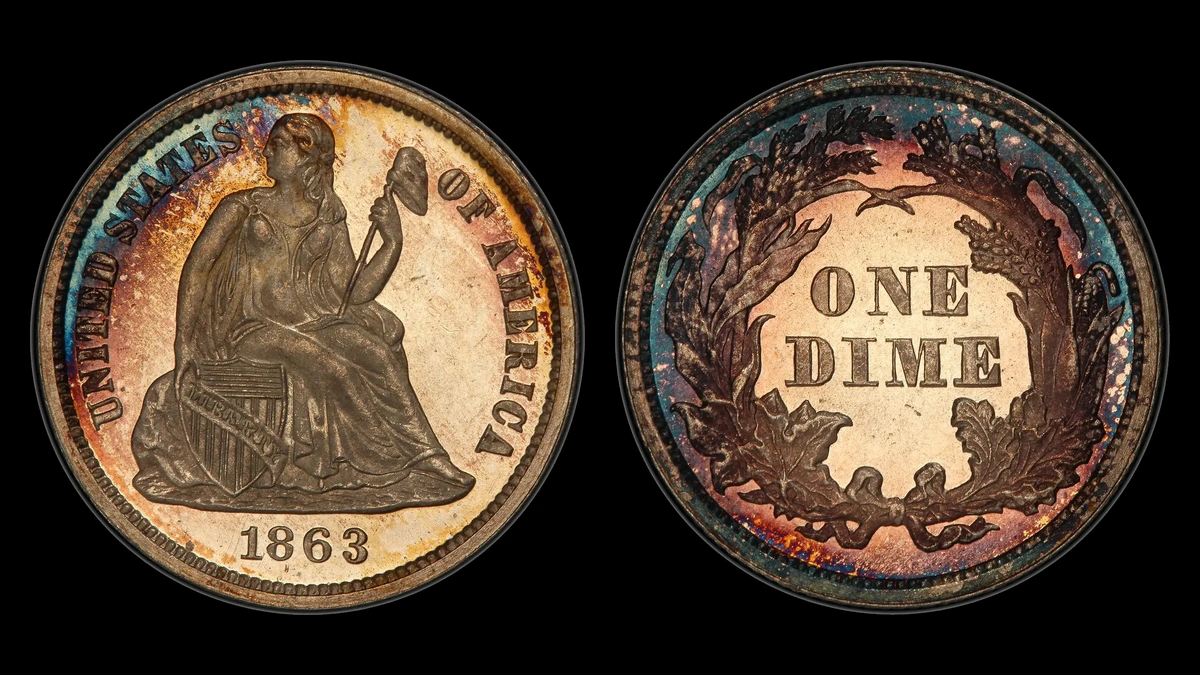
Three overlapping profiles are a very different finding from tiny marks in the reverse lettering. Both appear among the 1863 dime errors and die features below, with estimated whole-coin values of $600–$8,000.
An F-101 Proof sold for $5,160 in January 2020, while a separate triple-struck Proof brought $2,875 in 2007. Compare the large portrait overlap first, then inspect the smaller reverse marks and determine the coin’s finish.
1863 Dime Two Extra Profiles beside Liberty: Triple Strike with Obverse Rotation Error
The NGC PF65 triple strike has two additional profiles to the left of Liberty’s principal head. Those distinct outlines preserve three impressions that failed to stay aligned.
Proof manufacture normally involves repeated blows to develop the design, but the impressions should coincide. The error is the displaced sequence, described on this coin as triple striking with obverse rotation.
How to Identify
Follow each extra profile as a coherent outline instead of treating every bright line as another strike. Look where one impression crosses or flattens parts of the preceding design.
Change the lighting angle to separate fixed contours from reflections, then compare the pattern with photographs of the PF65. A flat shelf beside a single letter does not account for three large, separated profiles.
The Philadelphia Proof normally measures about 17.9 millimeters and weighs about 2.49 grams, with a grooved edge. Check the reverse and edge as well as the strikingly doubled-looking front.
What It’s Worth
A working estimate is $2,000–$8,000 for the documented form in comparable condition. The NGC PF65 sold for $2,875 in May 2007.
The PF65 grade describes preservation, not how many strikes the coin received. Ordinary Proofs with properly aligned blows do not qualify for the same error comparison.
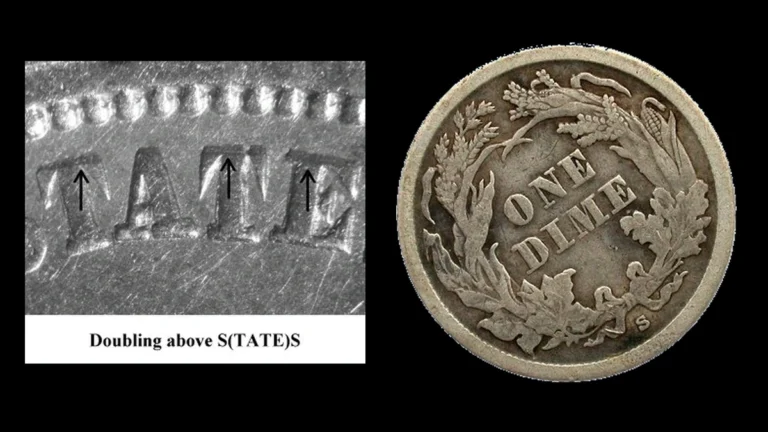
1863 Dime Small Marks in ONE DIME: Reverse Die Defects Error
The O in ONE and the I and M in DIME carry small recorded irregularities. Together they identify a reverse die used for the F-101 Proof pairing and the related F-101a regular strike.
The specialist account calls them die defects without determining a particular crack or chip as the cause. Their repeated shapes and exact locations are what can be matched.
How to Identify
Compare all three letters while retaining the surrounding words in view. An isolated scratch or bit of dirt at one letter does not establish the complete pattern.
Determine the finish separately by examining rims, design quality, and the whole surface against an identified example. A reflective field or the shared reverse marks alone cannot turn an ordinary strike into a Proof.
Both Philadelphia forms have the same basic weight and diameter, so measurements cannot separate them. Confirm the absence of an S mintmark before using these specific pairing descriptions.
What It’s Worth
Regular strikes are estimated at $600–$6,000 from circulated through high grades; collectible Proofs are estimated at $800–$6,000. The PCGS PR66+ Cameo F-101 with CAC approval sold for $5,160 in January 2020.
A separate NGC MS66 F-101a regular strike realized $4,560 in March 2022. These whole-coin results incorporate preservation and manufacture, with Cameo describing frosted designs against reflective fields on the Proof.
The letter marks assist attribution but have no independently priced premium in these records. The higher-grade F-101 result is also separate from the triple-struck PF65 sale.
Conclusion
Large overlapping profiles establish a displaced striking sequence, while the small reverse marks identify a die used for more than one finish. Each finding needs its own visual comparison, and the shared reverse alone cannot establish Proof manufacture.
Compare the complete coin’s preservation and finish before choosing a sale, keeping the triple-struck PF65 distinct from the higher-grade F-101 and F-101a examples.