Rare 1904 Dime Errors (List & Pictures)
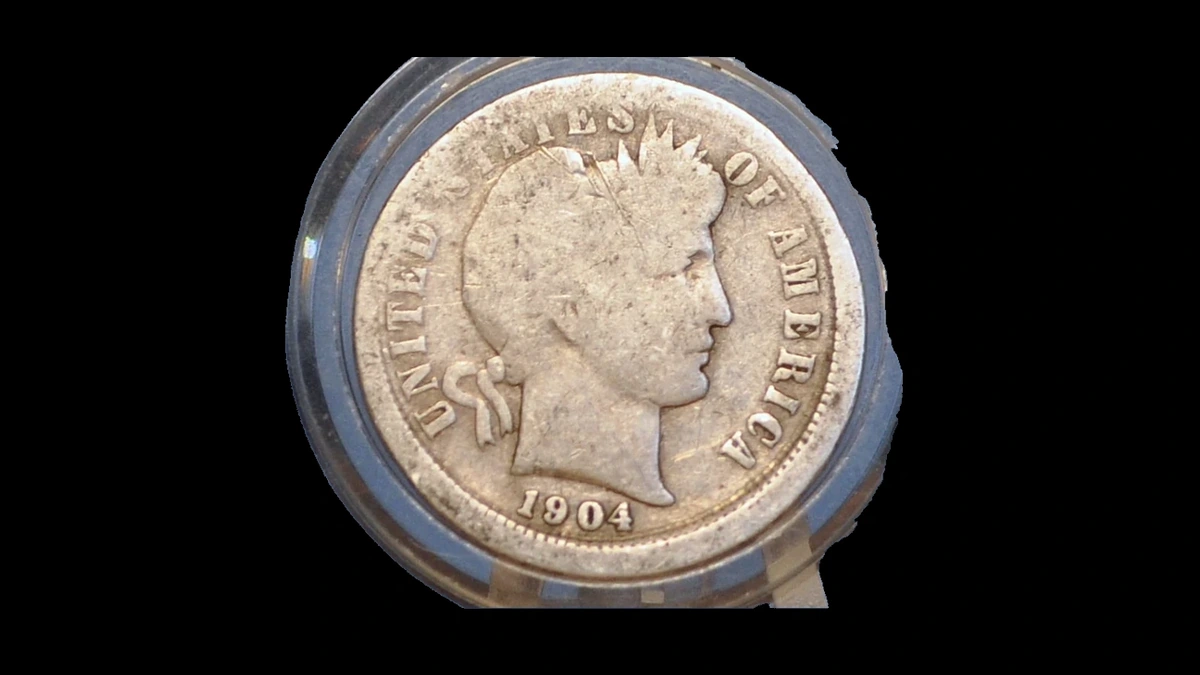
A dime that flipped before a second strike sold for $4,025 in February 2009, making it a striking example among 1904 dime errors. Estimated whole-coin values across the eight categories below run $20–$6,000.
Begin with the outline and overlapping designs, then inspect local surface features, date remnants, and orientation.
| Observation | Feature | Estimated whole-coin value |
|---|---|---|
| Missing design opposite unstruck metal | Off-center strike | $250–$1,500 |
| Complete design on expanded metal | Broadstrike | $150–$2,000 by mint |
| Opposite-face details overlap | Flipover double strike | $3,000–$6,000 |
| Thin surface metal separates | Reported lamination | $30–$400 |
| A local area lost design during striking | Reported strike-through | $300–$2,000 |
| Extra curved date strokes | Repunched date | $30–$700 |
| Faint opposite-side shapes appear | Die clash | $20–$1,200 by mint |
| Reverse leans after a controlled flip | Reported rotated die | $75–$1,200 |
1. 1904 Dime Part of the design falls outside the blank: Off-Center Strike Error
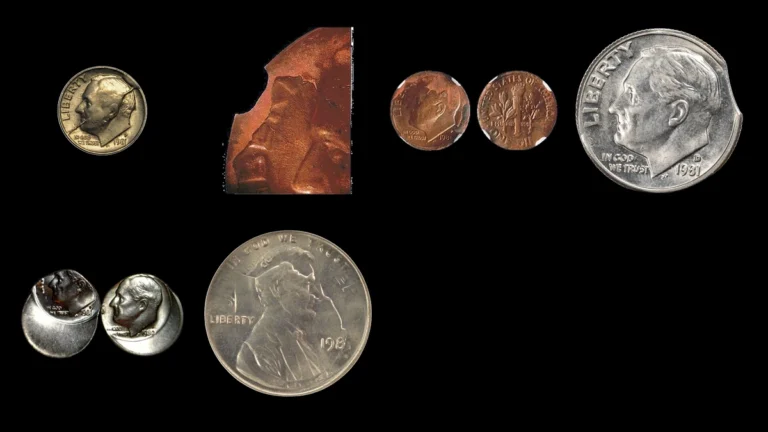
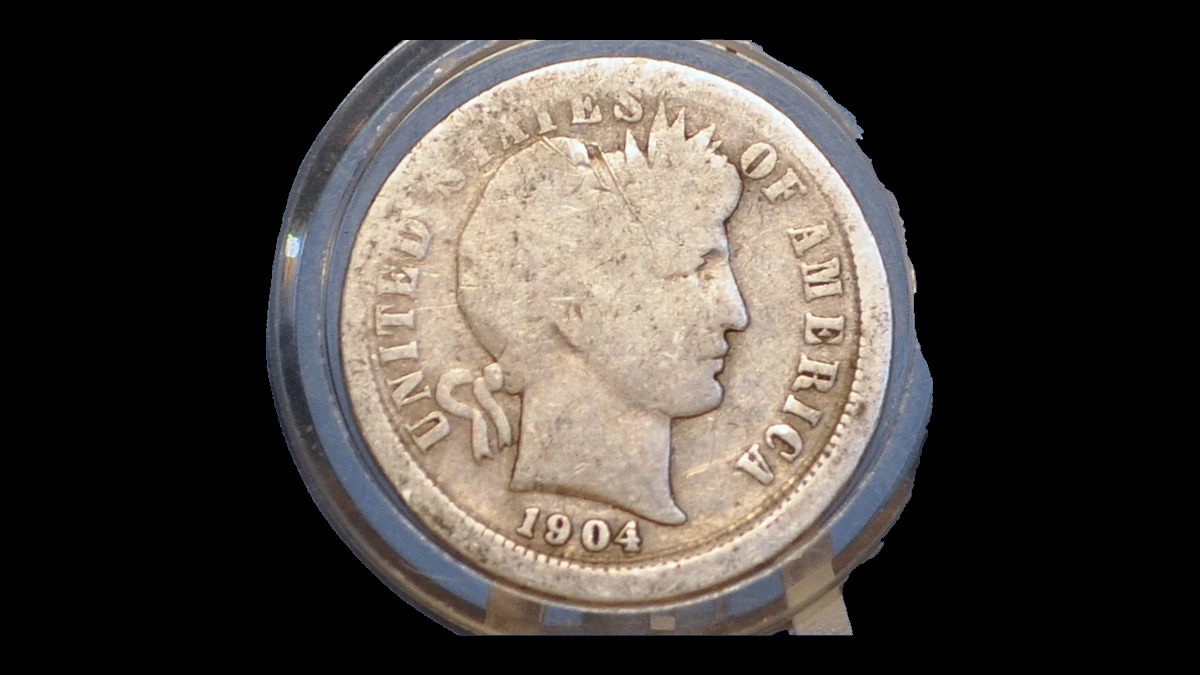
The documented Philadelphia PCGS AU50 was struck 10% off center toward one o’clock. A separate NGC MS63 is also reported at 10%, but matching percentages do not merge their identities.
The error begins with a blank outside its intended position. Some design misses the metal, leaving an unstruck area elsewhere along the outline.
How to Identify
Examine both faces and identify the actual missing letters or picture elements. Retain the full blank crescent and date in photographs.
For the AU50 reference, compare the one-o’clock displacement with Liberty upright. A different genuine example need not share that direction.
A wide margin with every design element present may be a broadstrike instead. Check the boundary and edge for later cutting or grinding before accepting an original offset.
What It’s Worth
The estimated range is $250–$1,500 for worn through lower-grade unworn whole coins with a readable date. The PCGS AU50 brought $373.75 on February 26, 2005, from the Larry Rausch collection.
AU50 indicates light wear. No transaction price is assigned to the separate MS63 example, and its grade is not another sale record.
2. 1904 Dime The coin widens but keeps the whole picture: Broadstrike Error
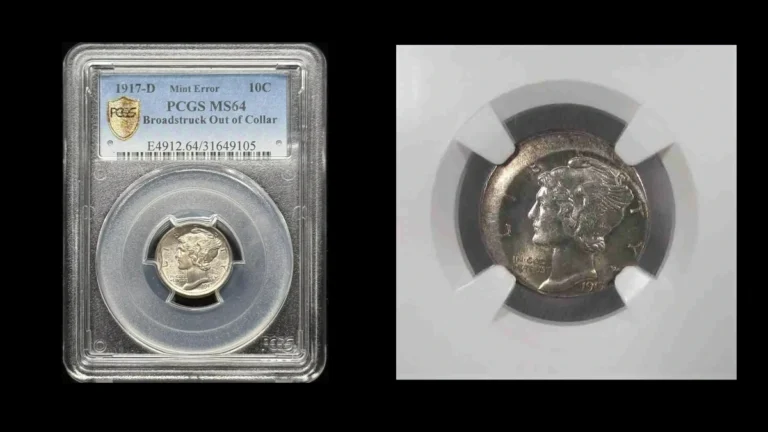
The recorded 1904-S broadstrike is an NGC AU55 example. A Philadelphia guide also reports broadstriking, without establishing the same specimen or history.
The collar normally controls diameter during the strike. When it fails to contain the blank, metal can spread outward while retaining the complete design.
How to Identify
Check both designs for completeness, then measure the outline in several directions if the coin is accessible. Original Barber dime specifications are about 2.50 grams and 17.9 millimeters, in 90% silver with a grooved edge.
Inspect for abnormal collar contact or incomplete grooves. Later hammering can also widen a dime, but often flattens existing design instead of preserving the evidence of original spreading.
Locate S beneath the wreath bow before applying the San Francisco comparison. An example with no mintmark needs the Philadelphia assessment.
What It’s Worth
Estimates are $400–$2,000 for San Francisco and $150–$700 for Philadelphia, covering worn through lightly worn whole coins. Original surfaces and clear expansion support better comparisons.
The NGC AU55 1904-S sold for $460 on September 28, 2007. Its slight wear and S mintmark belong to that sale and should not be assigned to the separate Philadelphia report.
3. 1904 Dime Portrait and reverse details overlap: Flipover Double Strike Error
The recorded Philadelphia PCGS XF45 received a displaced second strike after turning over. As a result, recognizable portions of the portrait and reverse design can occupy the same face.
This involves two blows to one coin. It differs from a doubled die carrying repeated design in advance or a clash that alters the dies before later blanks enter the press.
How to Identify
Separate portrait fragments from wreath or denomination fragments in photographs of both faces. Look for the coherent relationship between the first impression and the displaced second one.
A few unexplained lines cannot establish a flipover strike. Compare the full arrangement with images of the graded specimen.
Later squeezing can create sunken backward impressions and crushed edges. Inspect for that damage and record the changed outline without assuming normal symmetry.
What It’s Worth
The estimate is $3,000–$6,000 for similarly recognizable worn examples with clear evidence of both strikes. The PCGS XF45 sold for $4,025 on February 8, 2009.
XF45 means wear with much detail remaining. The clarity of the two impressions matters alongside grade, and the flip and displacement are valued together as one combined error.
4. 1904 Dime A thin flap separates from the silver: Reported Lamination Error
The Philadelphia report lists lamination without identifying one graded specimen or fixed location. A weakness within the alloy can allow surface metal to lift or detach naturally.
Barber dimes contain silver and copper mixed throughout. This is not the loss of a modern clad outer layer over a copper core.
How to Identify
Confirm no mint letter for the Philadelphia report, then inspect the separation under low-angle light. Keep nearby struck detail visible around the thin boundary.
Leave an attached flap untouched. A scraped hollow with fresh tool marks or pushed-up metal is a different kind of damage.
Detached silver can reduce weight, but a small attached flap may change it very little. The natural separation structure is more useful than the size of a recess alone.
What It’s Worth
The estimated range is $30–$400 for worn through lightly worn whole coins with genuine peeling. Larger visible separations can attract more attention.
A separate 1902-S report mentions a $150 asking price for peeling on both sides. That is neither the same year nor a completed 1904 sale.
5. 1904 Dime A local area interrupts otherwise normal detail: Reported Strike-Through Error
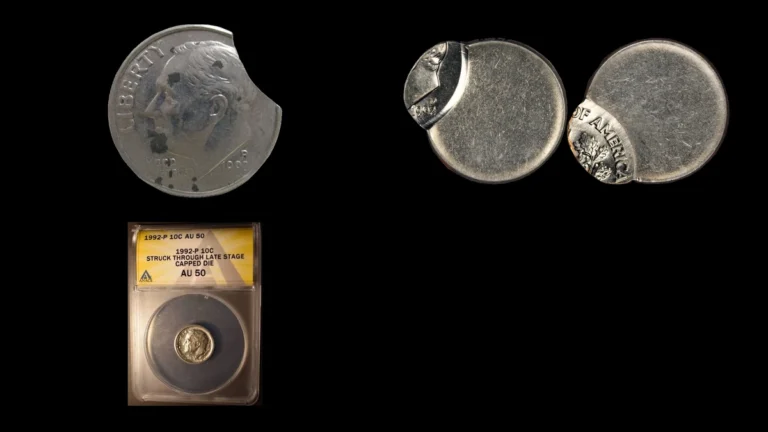
A guide describes a 1904-S MS60 struck-through coin but supplies neither an original auction lot nor an exact affected location. The report does not establish cloth, grease, or a metal fragment as the obstruction.
A strike-through occurs when something interferes between die and blank, leaving missing detail or a shaped depression. General portrait weakness alone does not demonstrate that local event.
How to Identify
Confirm S and inspect the boundary between affected and normal struck metal. Use side lighting to distinguish a local interruption from broader wear or weak striking.
Check for torn edges or metal pushed outward by a later scrape. Do not search for an invented material texture or clock position that the report never established.
What It’s Worth
The estimated range is $300–$2,000 for a genuine 1904-S with a clear local obstruction mark, from worn through lower unworn grades. The annual guide reports $950 in 2018 for an MS60 example.
MS60 is unworn but permits many marks. The $950 figure remains a reported price from the guide, not an independently supplied original auction record.
6. 1904 Dime A curved earlier stroke borders the date: Repunched Date Error
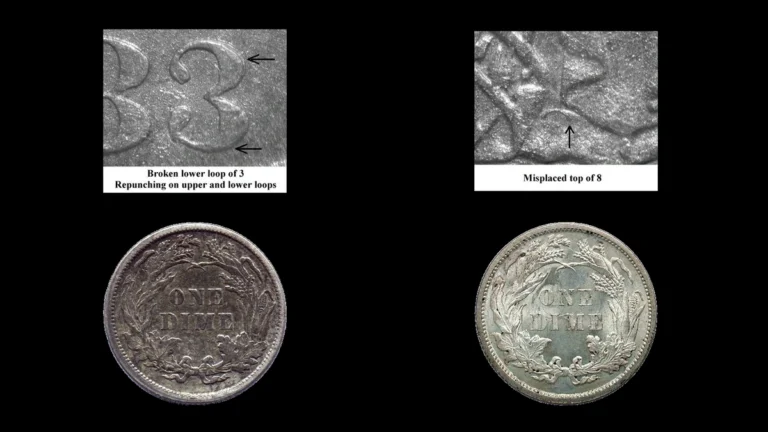
An owner described a Philadelphia PCGS MS63 as RPD-L101 in a 2017 discussion, showing an extra lower contour on 0. A separate annual guide mentions 1 and 9, which should not automatically be assigned to that same die.
Repunching leaves pieces of an earlier date entry in the stamping tool. A normal later strike can reproduce those remnants without striking the individual dime twice.
How to Identify
Compare the full date with the owner’s L101 photographs before magnifying the lower edge of 0. Follow the raised curved contour rather than a general fuzzy edge.
Record any marks on 1 or 9 separately. A flat shelf or scratch around a numeral does not establish the same earlier punch position.
What It’s Worth
The whole-coin estimate is $30–$700 for worn examples through approximately MS63. The owner’s illustrated MS63 provides a shape reference without a stated transaction.
A 2026 marketplace entry summarized by CoinValueChecker records $399.95 for a seller-described unlisted repunched date in PCGS MS64. It does not identify L101, so it is nearby market information rather than an exact-variety price.
7. 1904 Dime Faint shapes echo the opposite design: Die Clash Error
Philadelphia 1904 dimes are specifically noted with clashing by PCGS, separately from soft detail caused by worn dies. A guide also reports San Francisco clashes, which require their own comparisons.
When the dies meet without a blank, they can acquire traces of one another’s designs. Later coins may reproduce pieces of portrait or wreath where they do not normally belong.
How to Identify
Compare each extra shape with the opposite face while retaining the surrounding design. A recognizable transferred outline carries more information than a random scratch.
PCGS also notes soft upper-lip and rounded reverse detail associated with tool wear. Those effects do not by themselves prove a clash.
Use a mint-specific reference before assigning an exact pattern to an S-mint coin. Philadelphia’s general description does not identify a particular San Francisco die.
What It’s Worth
Estimated whole-coin ranges are $20–$500 for Philadelphia and $75–$1,200 for San Francisco. The former covers worn through lower unworn coins, while the latter concerns worn through lightly worn examples.
No recorded sale is assigned to the pictured clashed specimens. The stronger underlying San Francisco value helps explain the different ranges.
8. 1904 Dime The two faces disagree after a controlled flip: Reported Rotated Die Error
A year-specific listing includes rotation without identifying a mint, measured angle, or named specimen. It supports retaining a reported category rather than inventing a particular number of degrees.
Rotation concerns the angle between the two designs. Each face can look normal when viewed separately.
How to Identify
Secure the coin with Liberty upright and turn it from top to bottom without a sideways twist. Compare the reverse with a vertical guide and repeat the movement.
The same angle should return each time if it belongs to the coin. A sideways flip, a loose coin, or a slanted photograph can produce a false impression.
Inspect the edge for a seam from joined halves. The reported category does not excuse the need to measure the actual specimen.
What It’s Worth
The estimate is $75–$1,200 for genuine substantial rotations on worn through lightly worn whole coins. Mint and condition must be established individually.
This is not a sale range for a named 1904 specimen. A slight deviation generally warrants less interest than a strong repeatable angle, and an unsupported seller claim establishes neither.
Conclusion
Complete views distinguish widening from displacement and help establish a genuine flipover strike. Smaller features require their own evidence: a natural separation boundary, an earlier numeral stroke, or a recognizable transferred shape.
The $20–$6,000 span includes both documented examples and broader reports. Preserve those differences, keep each mint and grade attached to its actual record, and avoid inventing locations or angles where none were supplied.