Rare 1996 Nickel Errors (List & Pictures)
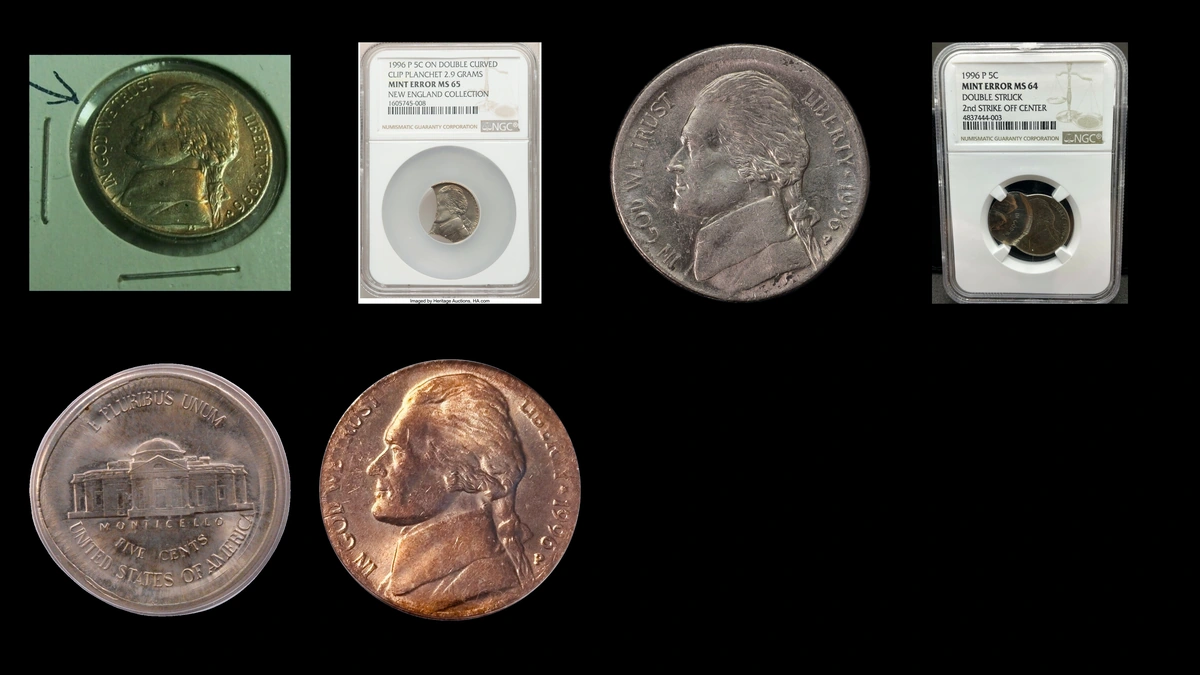
A light 1996 nickel might be missing pieces of its original blank, or it might have begun on entirely different metal. The reported 1996 nickel errors also include split dies, repeated strikes and two-coin pairs that preserve one shared event.
Estimated values range from $10 to $2,500, including complete pairs. A side-by-side pair sold for $632.50 in August 2010; examine the design, missing or displaced metal, and any matching piece before choosing a comparison.
| Observation | Error | Estimated value |
|---|---|---|
| A strong raised break | Split die | $75–$500 |
| Gaps in the original outline | Clipped planchet | $50–$600 |
| Full design within expanded metal | Broadstrike | $10–$250 |
| Design misses part of the blank | Off-center strike | $40–$750 |
| Large impressions overlap | Multiple strike | $25–$1,500 |
| A depression joins other strike effects | Indent combination | $100–$1,000 |
| Recessed backward design | Brockage combination | $150–$1,500 |
| The coin forms a cup | Die cap | $80–$1,000 |
| Small copper-colored disc weighing four grams | Unidentified wrong blank | $300–$1,500 |
| Small layered-metal disc | Dime planchet | $300–$2,000 |
| Two related contact edges | Side-by-side mated pair | $400–$2,000 per pair |
| One coin matches the other’s hollow | Overlapping mated pair | $600–$2,500 per pair |
1. 1996 Nickel A Major Raised Break across the Design: Split Die Error
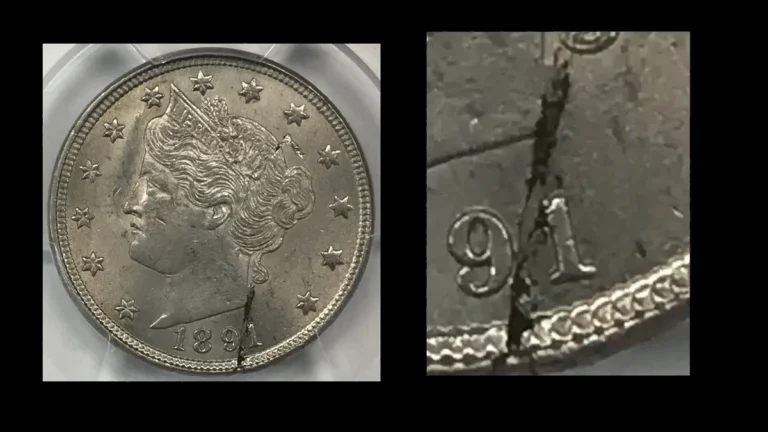
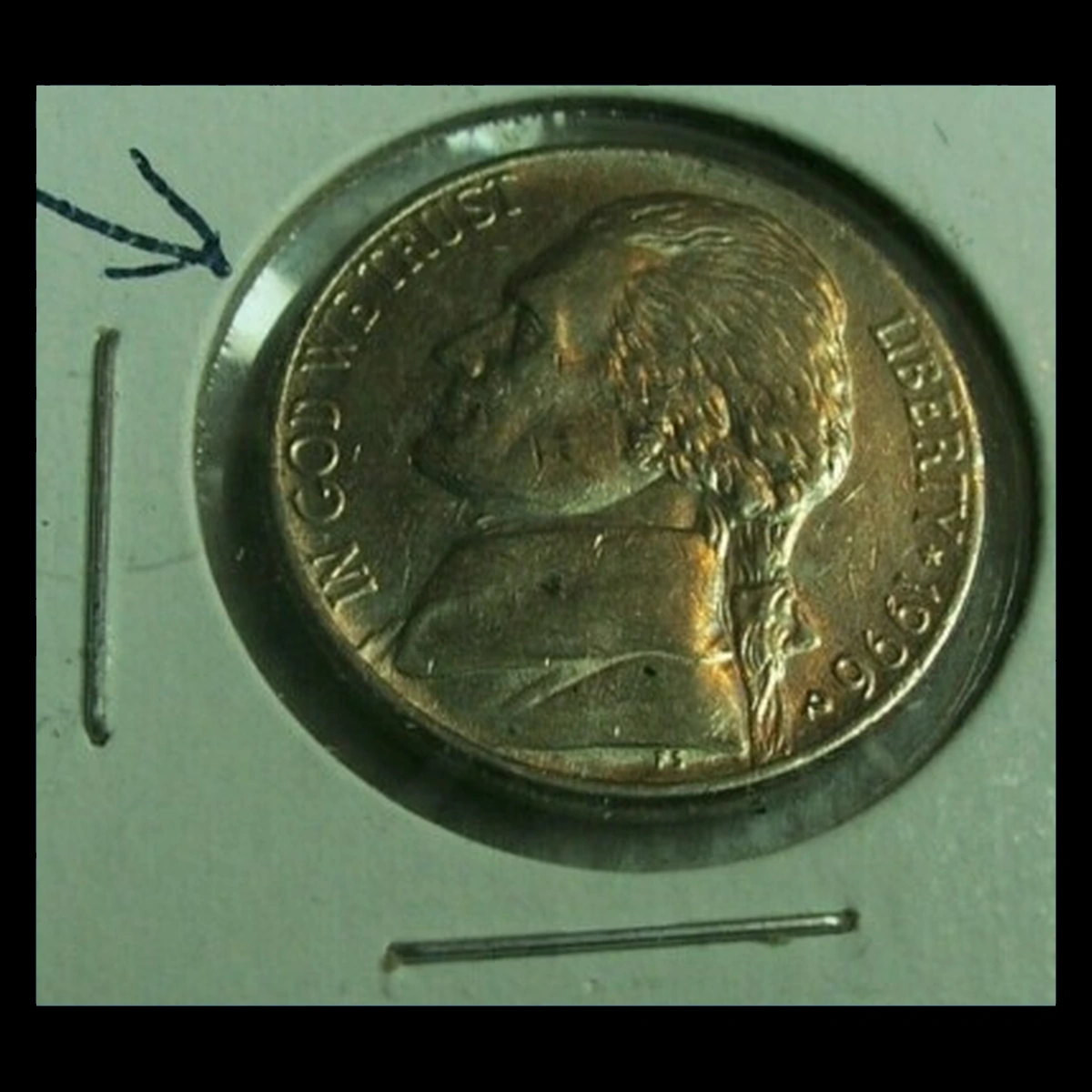
A split-die strike records failure of the steel tool, rather than a nickel broken into two pieces. As sections of the die separate, the coin can receive a strong raised break and displaced nearby design.
The recorded Philadelphia example is graded ANACS MS60. Its supplied description does not specify the affected face or the break’s direction.
How to Identify
Determine whether the coin carries a raised impression or a crack through its own metal. Bending can fracture a finished coin without involving a split die.
Follow the break under angled light and inspect how nearby design relates to it. A scratch with a cut floor and pushed-up edges is not the same as metal filling an opening in the die.
What It’s Worth
$75–$250 is estimated for clear but less attractive split-die examples, with $250–$500 for stronger appealing pieces. An auction index reports $192 in January 2023 for the ANACS MS60 1996-P.
MS60 is an unworn grade that permits substantial marks. Both the visible tool failure and those surface limitations belong in the comparison.
2. 1996 Nickel Pieces Are Missing from the Outline: Clipped Planchet Error
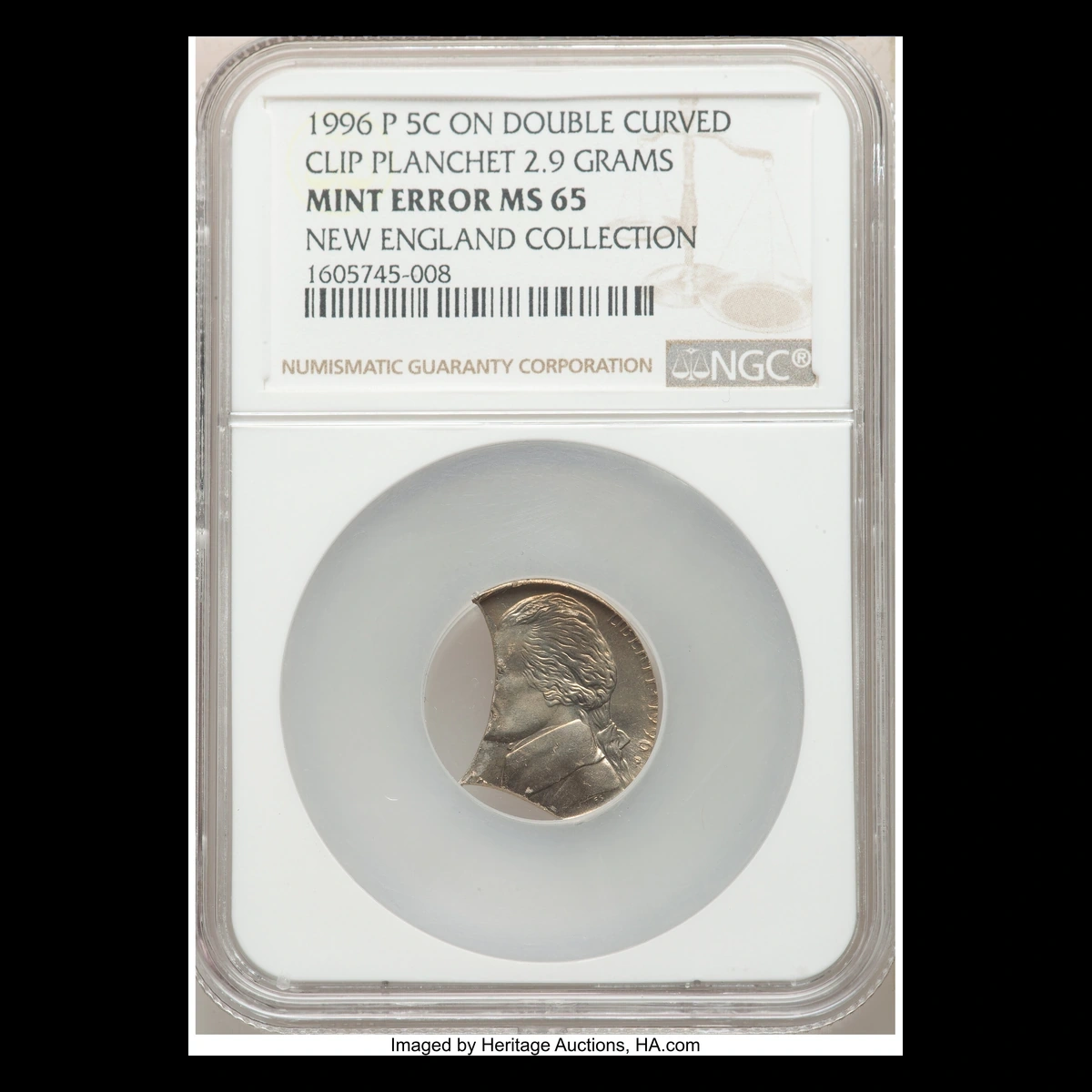
A documented Philadelphia double clip weighs 2.9 grams because two curved areas were absent from its blank. Overlap during blank cutting left incomplete metal before the design was added.
A separate Philadelphia specimen combines a 10% clip with a strike about 65% off center. One feature removes blank metal, while the other leaves existing metal unstruck.
How to Identify
Inspect the ends of each gap and the way the design approaches it. Saw grooves, fresh filing or a sharp cut through finished lettering suggest later removal.
For loose nickels, normal reference measurements are 5 grams and 21.21 millimeters across, with a plain edge. The double clip’s low weight should not be mistaken for proof of a wrong blank when its missing sections already explain the loss.
What It’s Worth
$50–$200 is a working estimate for clear clipped blanks, rising to $200–$600 for dramatic attractive combinations. The 2.9-gram double clip sold for $99 in October 2021.
A comparable catalog record brought $94 in August 2010, without establishing that it was a different coin. The indexed clip-and-off-center example brought about $69 in February 2015, so two error descriptions do not guarantee a high price.
3. 1996 Nickel The Border Expands around Complete Detail: Broadstrike Error
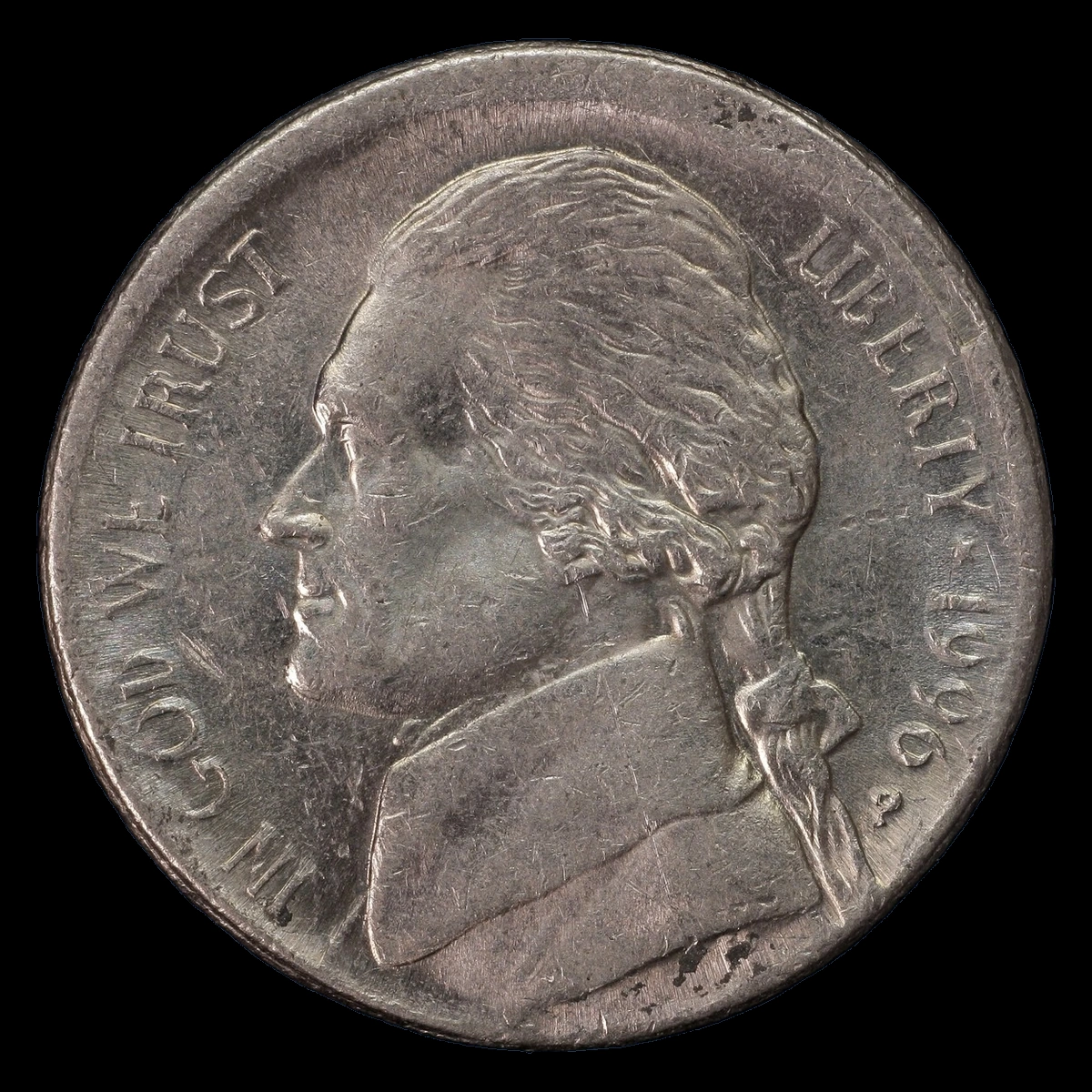
The collar normally limits outward movement during striking. When it fails to contain the blank, metal may spread while still receiving the full design.
A straightforward 1996-P example is recorded in an ICG MS62 holder. It is separate from the expanded coins that also have indents or repeated strikes.
How to Identify
Compare the complete outline with an ordinary nickel and confirm that outer lettering remains present on both sides. A wide border with design lost opposite it requires a different explanation.
Look for crushed high points, repeated impact marks or folded metal that might show later hammering. A smooth edge is normal on a nickel and cannot establish a broadstrike by itself.
What It’s Worth
$10–$100 is estimated for ordinary broadstrikes, with $100–$250 for especially attractive spreads. The indexed ICG MS62 1996-P brought about $10 in December 2008.
That old result illustrates the modest end of the category. A large diameter does not compensate automatically for scratches or flattened detail.
4. 1996 Nickel A Large Bare Area Remains beside the Strike: Off-Center Strike Error
A Philadelphia example graded NGC MS65 is described as 60% off center. Its blank sat far enough outside the intended position that a substantial part received no design.
How to Identify
Check which date digits and mintmark survive, then compare both faces using the same edge as an orientation reference. One displaced blank should account for both struck and unstruck areas.
A shift affecting just one face can come from die misalignment, while a broadstrike retains complete detail. Examine the bare metal for grinding lines or erased lettering before calling it originally unstruck.
What It’s Worth
$40–$200 is estimated for readable ordinary off-center examples, with $200–$750 for dramatic attractive coins. The lot containing the MS65 60% specimen sold for $126.50 in 2010, but it contained four coins.
That group total cannot be assigned to this nickel alone. A separate 2000-P off-center nickel brought $52 in April 2022, with its own displacement and condition.
5. 1996 Nickel Repeated Designs Shift or Rotate: Multiple Strike Error
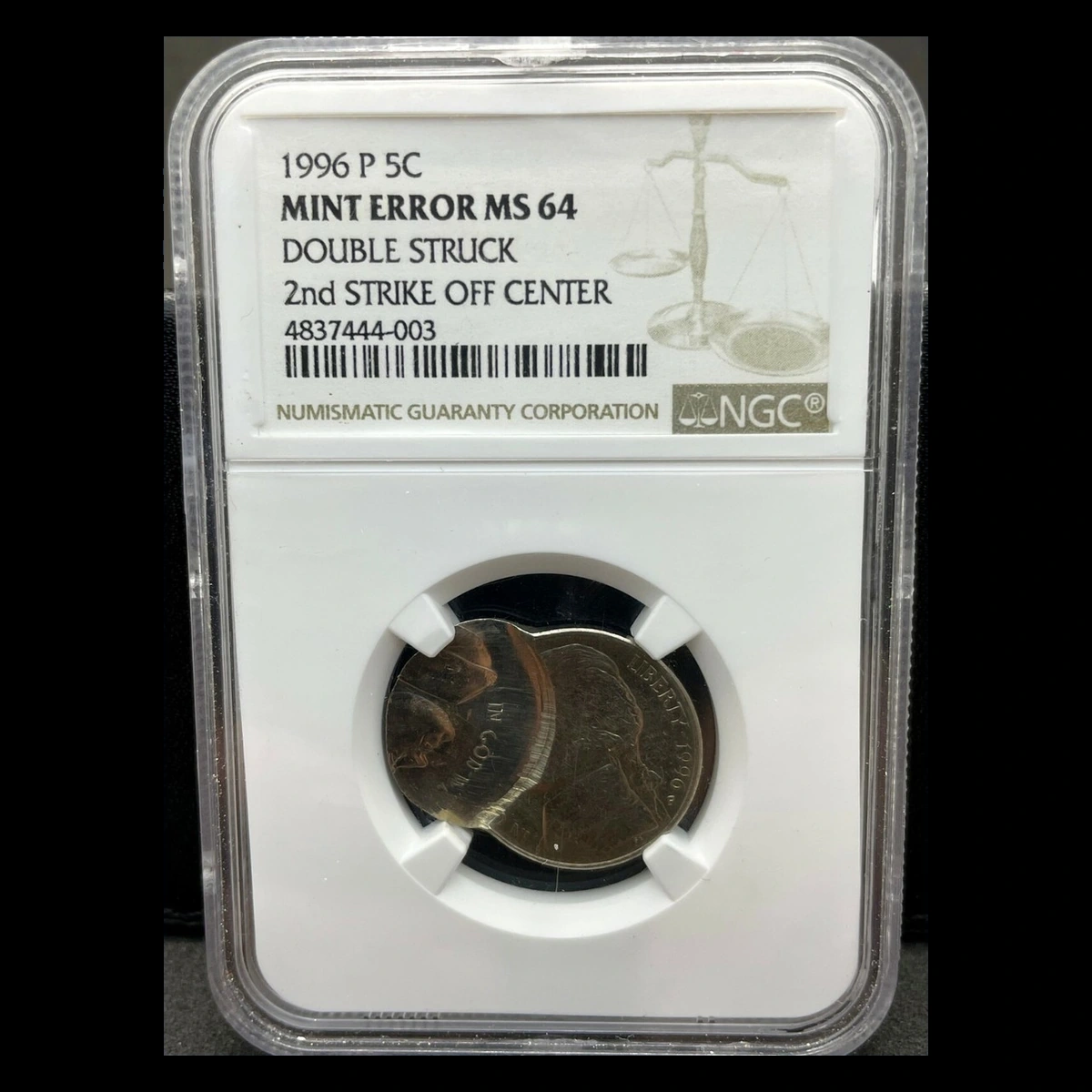
The reported layouts include a 1996-P second strike 35% off center and a separate Denver displaced second strike. Other Philadelphia coins rotated within the collar or spread outside it during additional blows.
A triple-strike description places the later blows 70% and 85% off center, with one face partly blocked in those areas. Those percentages describe that specimen, not a progression shared by all multiple strikes.
How to Identify
Trace surviving parts of the earliest design before identifying later letters, rims or portrait fragments. Separate complete impressions from a narrow shelf beside one letter.
The triple-struck form retains a complete first date and P, while its later date is weak. Its partly blocked later strike areas do not necessarily represent missing metal.
A rotated extra impression can remain within a nearly normal outline if the collar still contains the coin. Check that the edge and both faces fit the proposed sequence.
What It’s Worth
$25–$500 is estimated for straightforward doubles, with $500–$1,500 for especially dramatic multiple strikes. The Philadelphia 35% second strike sold for $282 in July 2014.
Indexed records also report about $161 for a rotated double in January 2010, $66 for an expanded double in May 2014 and $26 for another double strike. Each result values a complete coin rather than charging separately for every blow.
6. 1996 Nickel A Hollow Interrupts an Expanded or Repeated Strike: Indent Combination Error
An overlapping object can press a depression into a blank as the dies strike it. One Philadelphia example combines a front indent with a broadstrike, and another combines a front indent with multiple strikes.
A further catalog describes a 98% indentation on its own specimen. Full Steps on the expanded example describes Monticello’s preserved steps, not an extra mint error.
How to Identify
An indent moves metal rather than cutting a crescent away from the outline. Compare the depression, surrounding design and opposite face to distinguish strike-time overlap from a later impact.
Look inside the hollow for readable backward detail. A recognizable recessed mirror image introduces brockage, whereas a featureless indent alone does not prove the overlapping object was an already struck coin.
What It’s Worth
$100–$400 is estimated for straightforward combinations, with $400–$1,000 for especially clear attractive examples. The NGC MS64 multiple-strike Philadelphia coin with a front indent sold for $373.75 in September 2010.
The indexed 98% indent brought about $129 in February 2015. Neither that percentage nor the number of accompanying errors provides a separate amount to add to the coin’s price.
7. 1996 Nickel A Backward Image with Expansion or an Edge Step: Brockage Error
A caught struck coin can impress its raised design into another blank, leaving a recessed mirror image. Philadelphia examples include broadstrikes with an 80% brockage description and a separate 20% front brockage.
Another specimen combines about 15% front brockage with a partial collar. Its stepped edge records unequal collar restraint, whereas the 80% description does not specify the affected face.
How to Identify
Confirm both reversed lettering and recessed relief under angled light. A normal raised second impression belongs to another striking arrangement.
For the partial-collar example, inspect the side for a step between differently restrained portions of the plain edge. Broadstruck coins may spread without sharing that step, and later squeezing against another coin must also be excluded.
What It’s Worth
$150–$600 is estimated for clear partial brockages, with $600–$1,500 for dramatic attractive examples with strong expansion. The combined features are valued together.
A Heritage listing groups a 1996 nickel with 1997 and 1999 errors in a three-coin lot. Its listing is not evidence of an individual sale price for the 1996 brockage.
8. 1996 Nickel The Edge Rises into a Cup: Die Cap Error
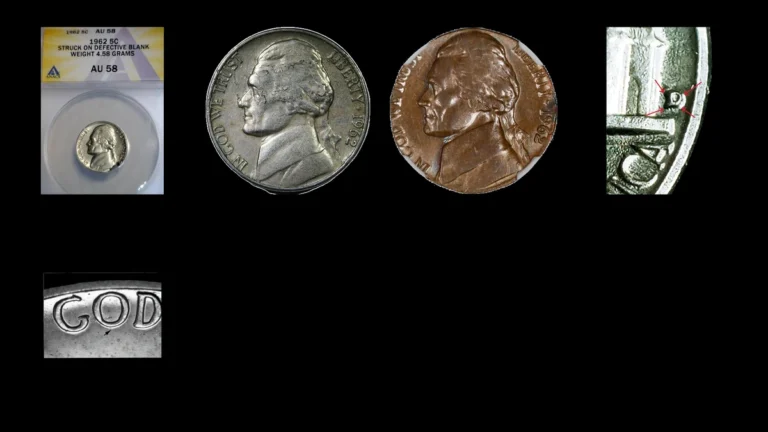
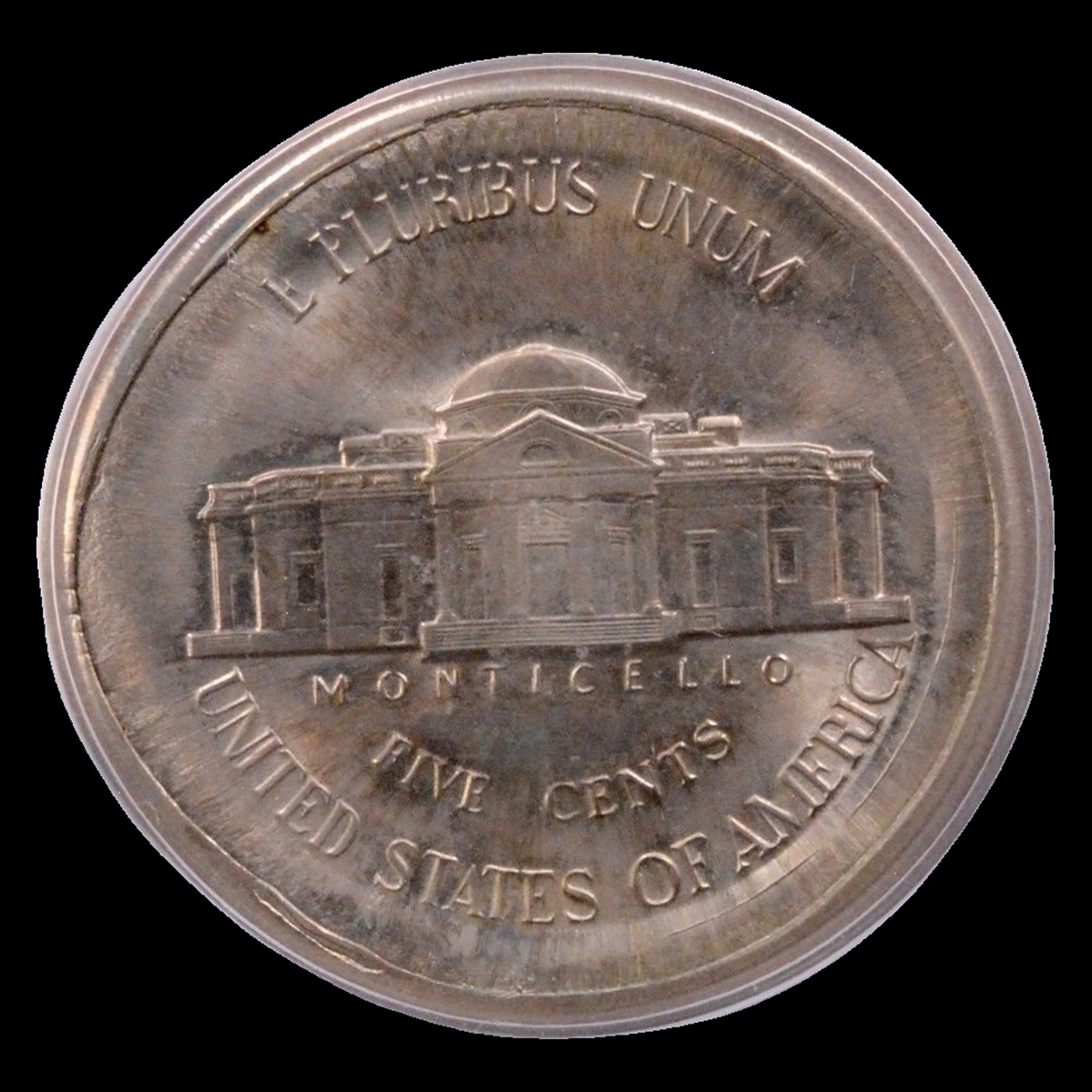
The recorded Philadelphia die cap is graded ANACS MS65. A coin that stayed attached to a die changed shape during continued striking, spreading and rising around the tool.
The supplied record identifies a cap without specifying which face formed the base. A later coin struck beneath that cap would be a separate object.
How to Identify
Use side and overhead views to follow the wall from the struck base and observe how the design stretches. A bent rim without corresponding strike evidence does not establish cap formation.
Look for plier marks, cuts or scratches from later shaping. Preserve the three-dimensional form rather than forcing it flat or squeezing the walls for measurements.
What It’s Worth
$80–$350 is estimated for shallow or less dramatic caps, with $350–$1,000 for strong attractive shapes. An auction index reports about $80 in August 2013 for the ANACS MS65 1996-P.
Its depth, design and surface preservation explain more than the cap label alone. A flat coin struck through a cap requires a different price comparison.
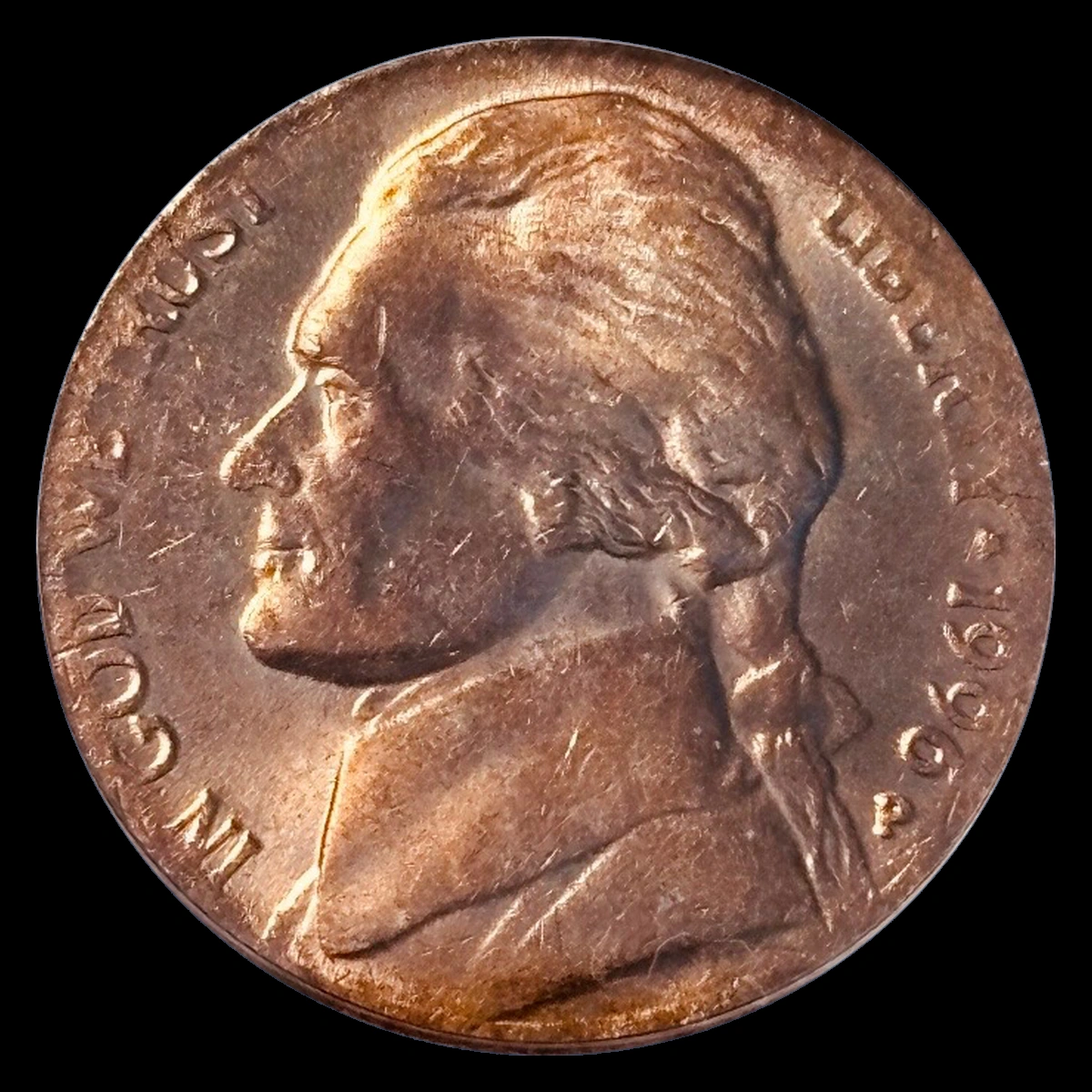
9. 1996 Nickel A Small Copper-Colored Disc Weighs Four Grams: Unidentified Wrong Blank Error
The recorded 1996-P has a smaller copper-colored blank that does not accommodate all the outer nickel design. Heritage described it as a foreign-planchet error, while a later dealer description said the copper blank did not match a known foreign issue.
How to Identify
Keep its measured four-gram weight separate from assumptions about country or denomination. Neither is established by the supplied descriptions.
Examine where lettering runs beyond the smaller disc and check the edge for filing or the surface for acid damage. Composition and dimensions should support a genuinely different blank rather than a normal nickel reduced after striking.
What It’s Worth
$300–$800 is estimated for a genuine comparable wrong-blank strike, with $800–$1,500 for stronger preservation or particularly clear features. The PCGS MS63 four-gram example realized $373.75 in August 2011.
That result does not establish an unnamed foreign denomination. Its value rests on the documented unusual blank and coin, not an invented country attribution.
10. 1996 Nickel Nickel Lettering Runs beyond a Dime-Sized Disc: Dime Planchet Error
A separate Philadelphia report concerns a nickel design on an unused dime blank. That blank starts near 2.268 grams and 17.91 millimeters, with layered metal rather than the nickel’s uniform alloy.
How to Identify
Assess weight, dimensions, edge layers and the outer design that could not fit on the smaller blank. The strike may expand its final diameter, so the starting size is a reference rather than a fixed finished measurement.
Do not require dime reeds, which would normally be formed during striking inside a dime collar. Surviving Roosevelt details would indicate an already struck dime and a different error from this unused-blank report.
What It’s Worth
$300–$1,000 is a conditional estimate for an authenticated example, reaching $1,000–$2,000 for outstanding preservation and clear design. No completed sale for the reported 1996 dime-planchet specimen is supplied.
The same-year four-gram coin’s $373.75 result provides only broad wrong-blank context. Its weight and metal are not those of a dime blank.
11. 1996 Nickel Two Coins Share Matching Contact Edges: Side-by-Side Mated Pair Error
An auctioned pair contains left and right pieces, each about 60% off center, together in one NGC holder. The blanks contacted at their edges while struck, leaving related boundaries in the spreading metal.
A separate chain-strike listing places the year and Philadelphia attribution in parentheses. That notation should remain when identifying information comes from the pair rather than fully readable details on each piece.
How to Identify
Compare the approach of the design and metal flow to both contact boundaries without forcing or rubbing the pieces together. A convincing pair explains the strike on each coin, not just two outlines that appear to fit.
Inspect for filing or glue that could make unrelated coins look matched. Read each surviving date and mintmark independently before assuming both pieces show complete 1996-P details.
What It’s Worth
$400–$1,000 is estimated for clear genuine pairs, with $1,000–$2,000 for especially attractive ones. The 60% pair sold for $632.50 in August 2010, and a chain-strike pair listing brought $470 in August 2013.
The records alone do not determine whether the same pair appeared twice. Both figures cover two pieces together, rather than the price of each individual nickel.
12. 1996 Nickel One Coin Matches the Other’s Hollow: Overlapping Mated Pair Error
In this recorded pair, a broadly expanded coin has an approximately 25% indent. The other coin was struck twice, with its later blow about 75% off center, and reportedly fits the first coin’s depression.
The dealer catalog grades both PCGS MS64. It does not establish a mintmark, so the pair should not automatically be called Philadelphia.
How to Identify
Compare the hollow and the second coin’s shape in photographs without pressing them together. Their design boundaries and metal flow should support the same overlap.
Trace the second coin’s two impressions and keep its 75% later displacement separate from the first coin’s 25% indentation. Shared dates or a convenient physical fit alone cannot establish a mated pair.
What It’s Worth
$600–$1,200 is estimated for a genuine comparable pair, with $1,200–$2,500 for exceptional attractiveness and a clear relationship. The dealer catalog offered the two coins for $850, an asking price rather than a completed auction result.
The indent, expansion and extra strike describe the event preserved by both pieces. They should not be priced separately and added as though each were a different purchase.
Conclusion
A complete view often resolves an apparent contradiction: a low-weight coin can have large clips, and a nearly round coin can still preserve multiple strikes. Identify what happened to the design and the metal before assigning a category.
For pairs, the relationship between both pieces is central evidence. Keep pair prices, mixed-lot totals and dealer asking prices distinct when using the recorded examples as comparisons.