Rare 1881 Nickel Errors (List & Pictures)
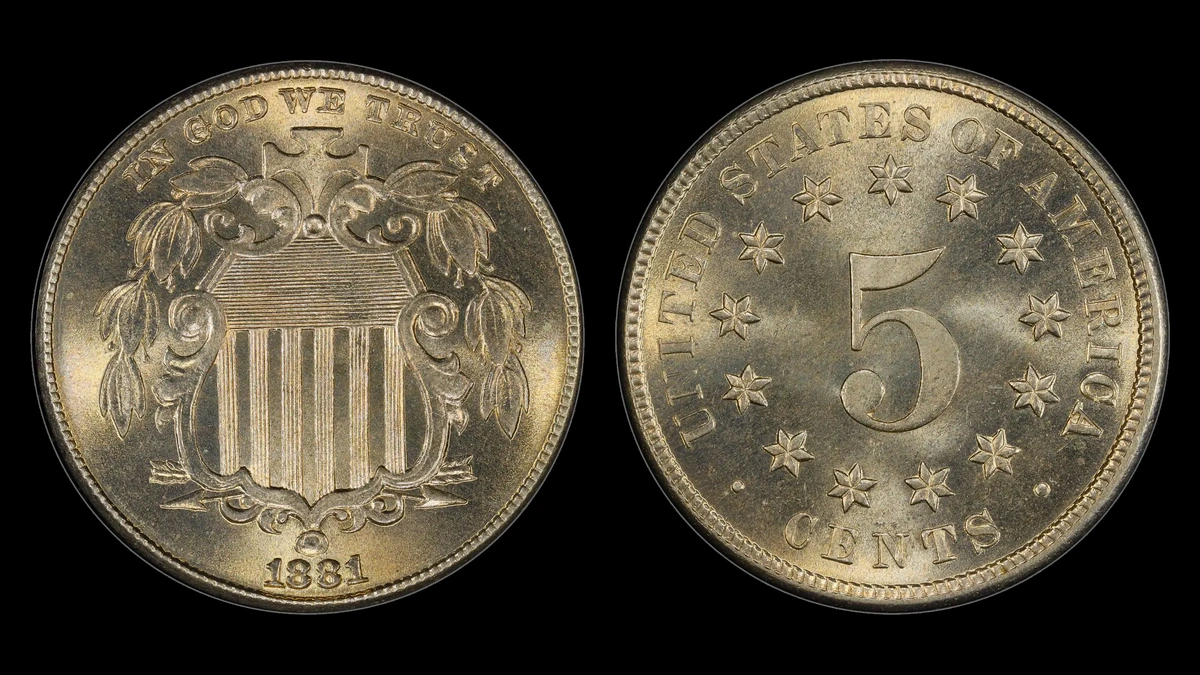
A crack crossing a date digit and a second curve beneath it record different changes to a die. Both can appear on one 1881 Shield nickel, so they need separate identification rather than separate full-coin prices.
Estimated values for 1881 nickel errors span $200–$3,500, with a well-preserved cracked MS66 example selling for $2,350. Examine the motto’s upper edges, the date remnants, and the raised crack paths in that order.
| Inspection area | Feature | Estimated whole-coin range |
|---|---|---|
| Tops of motto letters | Doubled die | $300–$2,500 |
| Below or within date digits | Repunched date | $300–$3,000 for ordinary strikes |
| Second 8 or upper design | Die cracks | $200–$3,500 |
1. 1881 Nickel Letter Tops in the Motto Carry Extra Outlines: Doubled Die Error
The documented variety shows repeated contours at the tops of IN GOD WE TRUST. Those shapes were already present in the die and could be reproduced on coins struck from it.
The specialist catalog also notes Longacre doubling, another outline effect around design edges. A general halo therefore should not be treated as sufficient proof of the doubled-motto variety.
How to Identify
Compare several upper-letter contours with the Shield Nickel Varieties listing. Change the lighting angle to distinguish stable relief from reflected highlights.
Flat ledges and uniformly worn edges need a different explanation from the matching repeated pattern. Check that the coin’s reverse has 5 CENTS and stars without rays between them.
What It’s Worth
$300–$2,500 is an estimated whole-coin range for attributed examples from collectible worn grades through attractive unworn pieces. An ANACS XF45 doubled-motto example brought $373.75 in September 2002.
The scarce date and surviving condition contribute to those values. A vague halo should not receive the same attribution or price treatment.
2. 1881 Nickel Earlier Numeral Curves Survive beneath the Date: Repunched Date Error
One recorded pattern preserves earlier strokes below 881 and also has a crack through the second 8. The date remnants came from shifted punch impressions during preparation, while the irregular crack developed in the die separately.
How to Identify
Photograph the full date and follow the rounded lower remnants independently of the crack. Other examples have much smaller traces inside an 8, so every marked date should not receive the same variety name.
A year guide also reports minor repunching on Proofs without establishing one pattern for every collector strike. Confirm the finish and the particular numeral shapes separately.
A loose Shield nickel normally weighs about 5 grams, measures 20.5 millimeters, and has a plain edge. Those standards apply to the coin’s identity but cannot distinguish Proof manufacture or date repunching.
What It’s Worth
$300–$3,000 is an estimated range for identifiable ordinary-strike repunched dates. A separate conditional range of $300–$2,000 applies to verified repunching on Proofs in ordinary collectible grades.
An NGC MS66 repunched-date example with thin cracks sold for $1,495 in September 2002. Its very well-preserved unworn surfaces are part of that comparison, and the accompanying cracks do not create another coin to price.
3. 1881 Nickel Raised Lines Cross the Date or Upper Design: Die Cracks Error
Metal pressed into a fracture in the die leaves a raised line on the coin. A later stage of the repunched-date die has a stronger break through the second 8 along the earlier crack’s route.
A different documented MS66 coin has a line from the rim through IN and another through the highest leaves and cross. Those upper-design paths should not be assembled with the date crack as though all were required on one specimen.
How to Identify
Choose the visible route and compare it with the corresponding example. Under low side lighting, inspect whether the line’s center rises above the surface or cuts into it with displaced metal alongside.
A die crack can cross relief without scraping the design away. It does not require an actual opening through the coin’s edge or body.
Where a crack crosses the second 8, follow its irregular path separately from the rounded remnants of date punching. Each feature should make sense on its own.
What It’s Worth
$200–$3,500 is an estimated whole-coin range for collectible 1881 nickels with genuine visible cracks. The PCGS MS66 upper-design example sold for $2,350 on October 30, 2015.
Much of that result reflects the scarce date and excellent preservation. Fine raised lines may interest specialists, but do not automatically account for a large premium by themselves.
Conclusion
Keep the three kinds of evidence distinct on an 1881 nickel: repeated motto contours, rounded remnants of earlier numerals, and irregular raised crack paths. One coin may combine them without every example sharing the same details.
Compare condition and finish before using a high-grade sale. The values here concern complete coins, so the price of an attractive scarce-date nickel should not be presented as payment for a fine crack alone.