Rare 1982 Quarter Errors (List & Pictures)
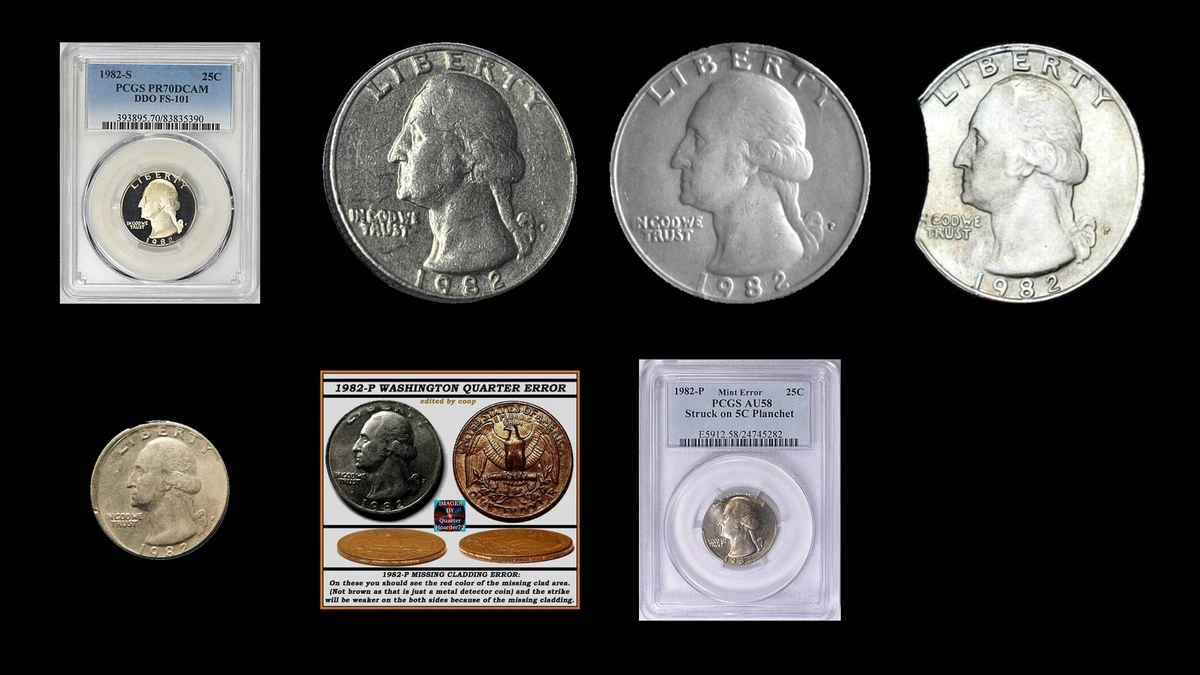
Thick letters are not always rare on a 1982 quarter: some doubling was inherited from an early design tool and appears across mintmarks. At the other end of the scale, a quarter struck on a nickel blank sold for $234 in January 2023.
Estimated values for the 1982 quarter errors here run from $0.25–$2,000. Compare the actual detail first, then use the edge and metal to check the larger errors.
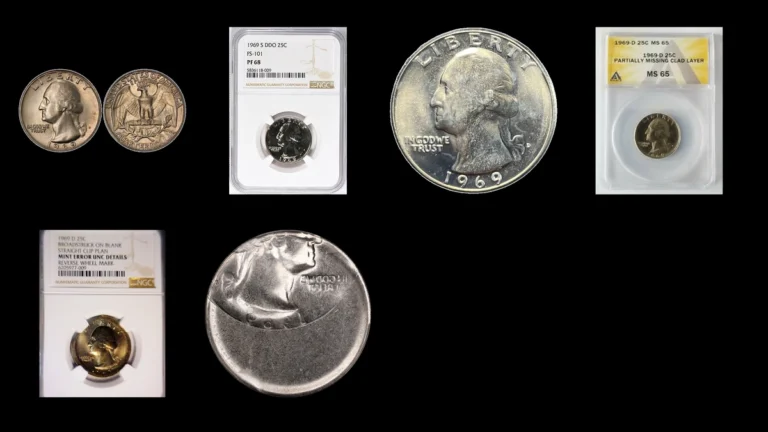
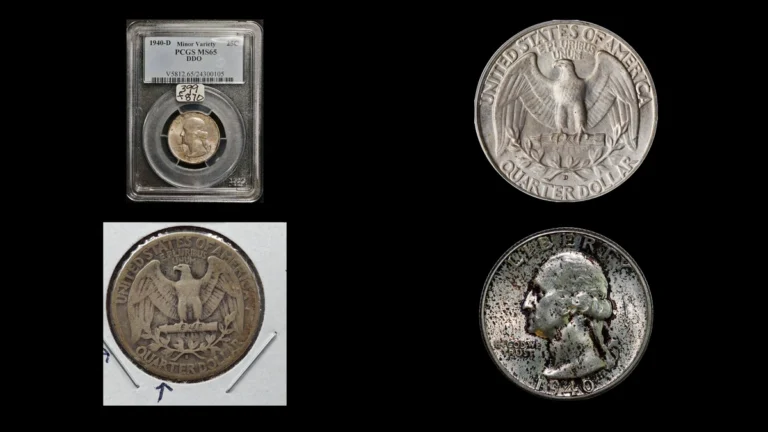
1. 1982 Quarter Thick Motto Letters or Close Reverse Doubling — Doubled Design Error
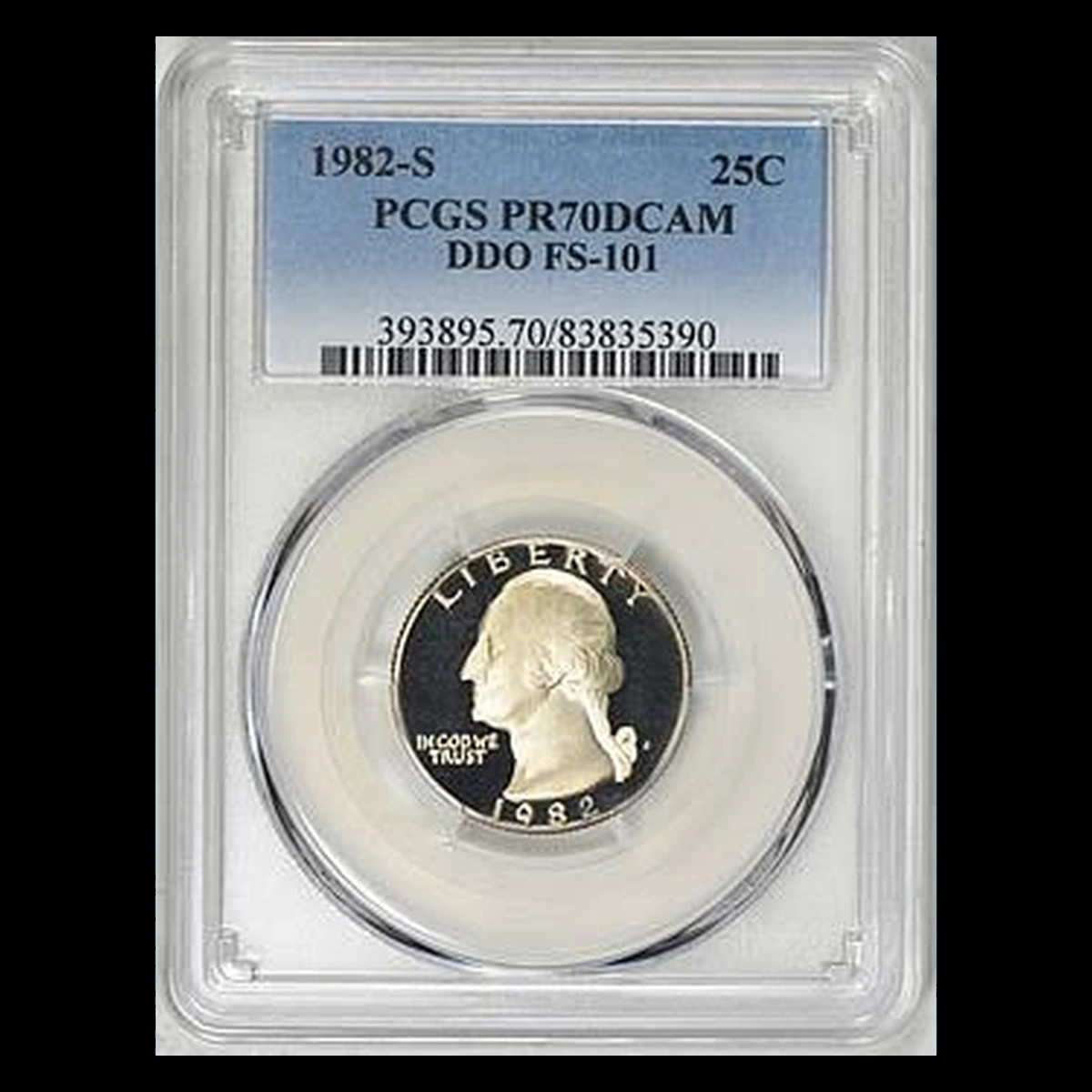
Wexler identifies shared motto thickening and slight date doubling on P, D, and S coins as a master-die feature. It passed from an early tool into later dies, making it different from a rare feature confined to one working die.
The S form has carried the FS-101 name, which PCGS still lists despite the different catalog treatment. A separate Philadelphia WDDR-001 has very close inward doubling on DOLLAR and the RICA ending of AMERICA.
How to Identify
Compare ordinary same-year quarters before treating thick motto letters as scarce. Common inherited doubling can appear under more than one mintmark.
For the separate reverse variety, match the close inward outlines with Wexler’s Philadelphia catalog. Other P-front and D-reverse reports need their own comparisons.
What It’s Worth
$0.25–$150 spans common inherited doubling and separate identified varieties. The common feature generally fits $0.25–$25 depending on finish and condition, with little special premium.
A matched working-die variety is estimated around $15–$150. A catalog number alone does not justify a rarity premium, and exceptional normal-coin grades require separate pricing.
2. 1982 Quarter A Faint Opposite-Side Shape — Die Clash Error
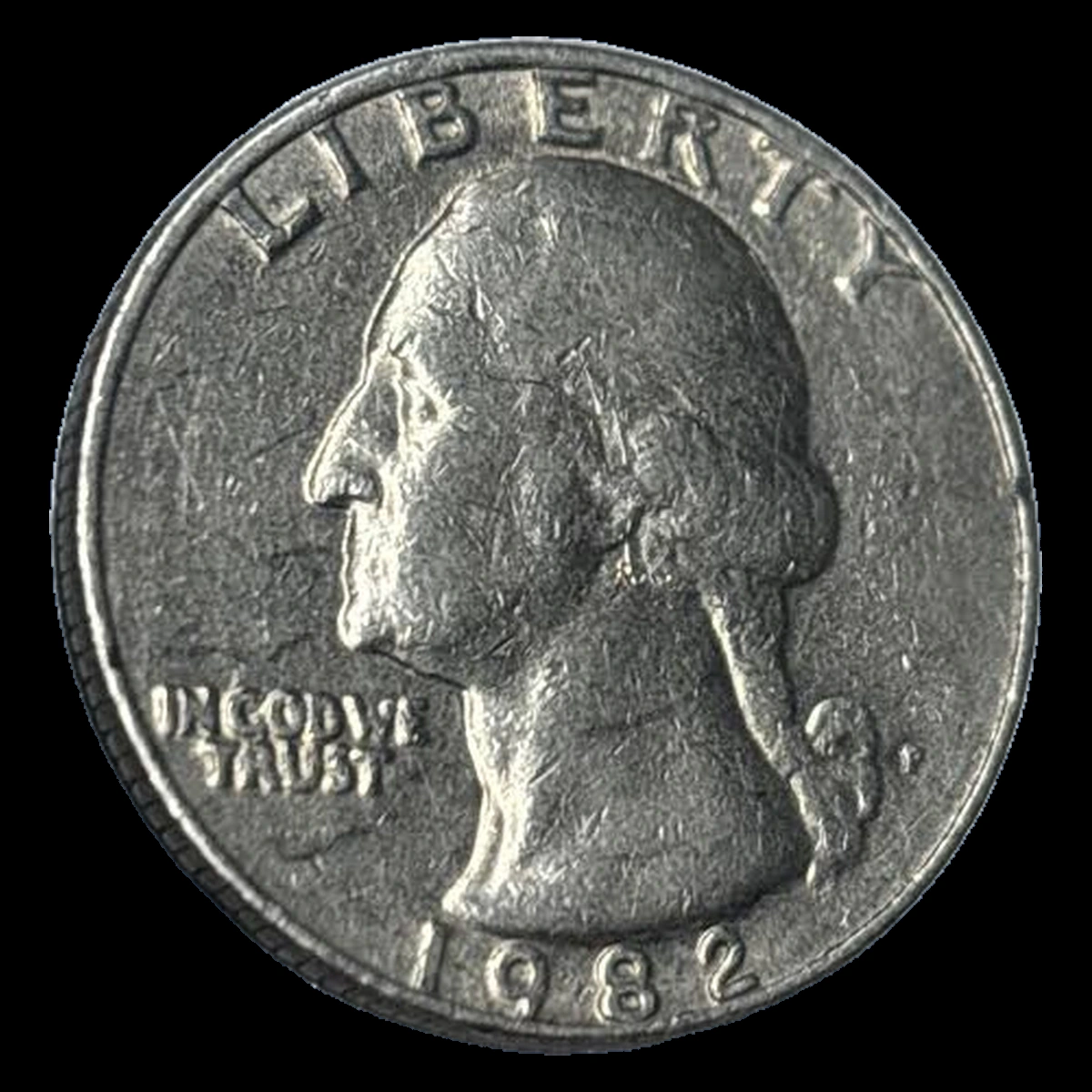
When the two dies meet without a blank between them, they can mark each other. Coins struck afterward may show faint traces of the opposite design.
The 1982-P report suggests the neck or cheek area and spaces beside the eagle as places to examine. Those are starting points, not proof that every nearby line is a clash.
How to Identify
Compare straight-on photographs of both faces, reversing one design for alignment. A useful trace must fit the position as well as the shape of the opposing detail.
Follow several related lines where possible. A scratch, stain, or an imagined feather does not become a die clash simply because it resembles something familiar.
What It’s Worth
$10–$200 is an estimated range for genuine ordinary 1982-P clashes. Clear transferred shapes and clean surfaces provide stronger examples than faint marks hidden by wear.
3. 1982 Quarter Raised Metal Fills a Letter or Reaches the Rim — Chip or Cud Error
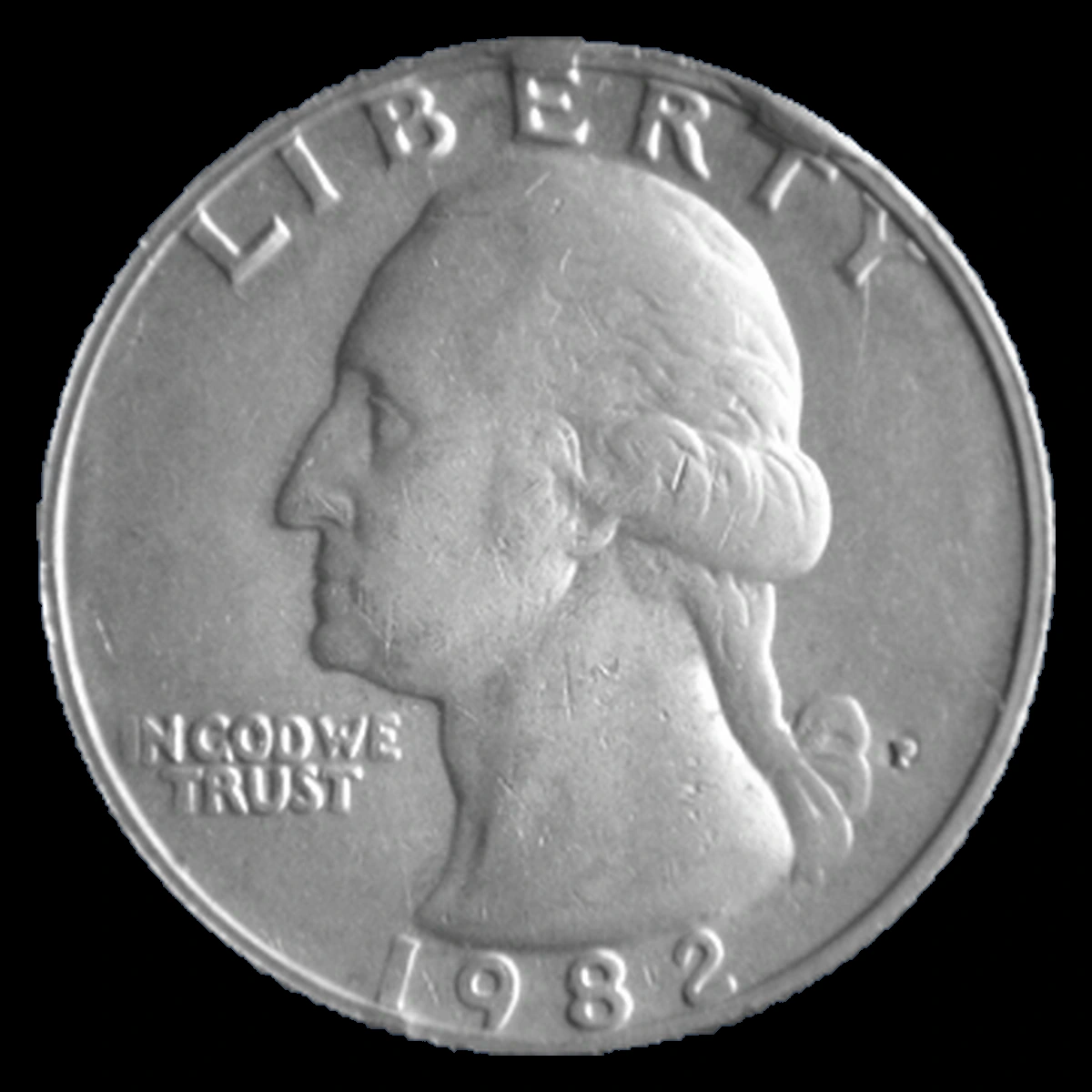
A raised filling inside P or D can come from a small die break, although dirt can imitate it. This differs from a whole letter weakened by material blocking the tool.
Larger rim-connected breaks are called cuds. The 1982-P catalog includes two front and three back listings, each with its own shape.
How to Identify
Inspect the mintmark center under angled light without digging out any material. Look for original raised metal rather than a deposit.
For a cud, follow the patch from the rim into the area where normal design is missing. Solder, added metal, or a crushed edge can create a lump with a different boundary.
What It’s Worth
$2–$400 is the estimated span for this group. Small genuine mintmark fillings generally fit $2–$30, while clear cuds can fall around $30–$400.
A 1970-D nickel with two cuds sold for $63 in October 2022. That is a broad comparison from another year and denomination.
4. 1982 Quarter A Weak T or a Textured Proof Face — Struck Through Error
P and D reports describe a weak T in TRUST, making the motto appear to read WE RUST. Material blocking the die is the reported explanation, but the material itself is not established.
A separate S Proof graded NGC PR68 has a granular, uneven front while its back retains normal reflective areas and frosted details. That whole-face effect is distinct from the missing-T reports.
How to Identify
For the T, compare nearby lettering and portrait wear with the affected letter. Scraping or broad wear can remove detail after minting.
For the Proof, compare the altered front with the normal back and inspect for scratches or corrosion. The texture alone does not identify the blocking substance as grease.
What It’s Worth
$5–$1,000 spans the two levels of interruption. Genuine weak-T examples are estimated at $5–$75, while a clear Proof with the recorded full-front texture can fit $150–$1,000.
The NGC PR68 Proof did not sell in its 2008 auction offering. A 1986-P struck-through nickel sold for $204 in June 2023, providing only a broad comparison with a different kind of coin.
5. 1982 Quarter Grooves Meet a Smooth Edge Step — Partial Collar Error
A blank partly inside the collar ring can form a narrow grooved section beside a wider smooth section. Their meeting line creates the step of a partial-collar strike.
The reported 1982-P example needs its own edge examination. The transition can be level or sloped depending on how the blank sat.
How to Identify
View the coin from the side and follow the line around its edge. A face-on photograph of an uneven rim cannot show the entire feature.
Check for machining, cuts, or crushed grooves. The restrained band and expanded metal should join naturally as parts of the same strike.
What It’s Worth
$25–$200 is an estimated range for genuine partial-collar quarters. A clear step and original surfaces make the error easier to demonstrate.
A 1990-P nickel with this error sold for $99 in June 2025. That different-denomination result is not a sale price for the reported 1982 coin.
6. 1982 Quarter A Gap in the Round Outline — Clipped Blank Error
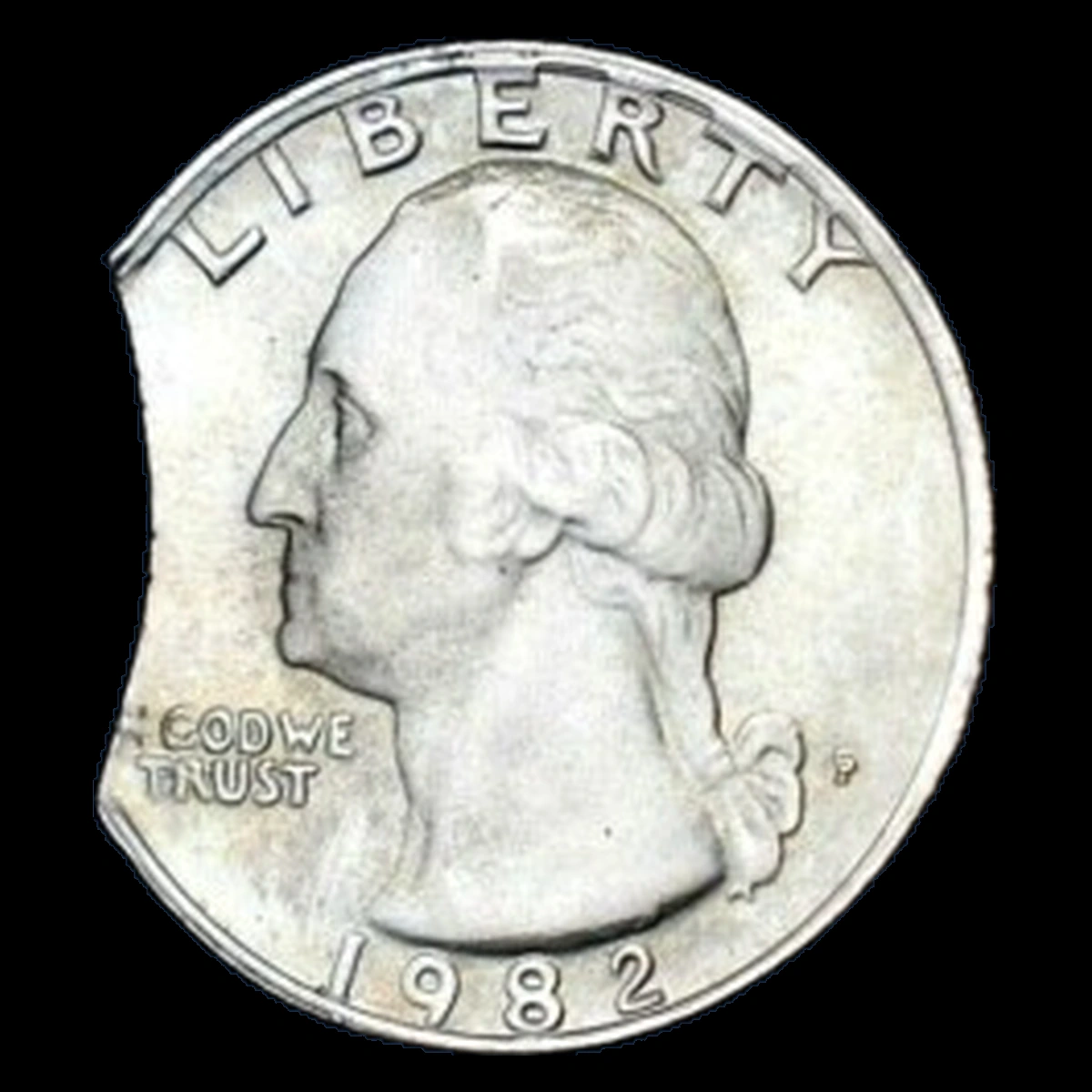
A blank cut from an incomplete part of the metal strip can lack a section before it receives its design. The 1982 report does not fix the mint, gap size, or position.
A later cut can imitate the outline, so the neighboring struck surfaces matter more than the shape alone.
How to Identify
Follow the gap’s boundary into both faces and inspect its endpoints. Natural cut-and-break texture and original struck detail differ from fresh saw tracks or burrs.
The opposite rim can be weak on a genuine clip, but that clue is not always present. Lower weight shows missing metal without proving the time of its loss.
What It’s Worth
$25–$250 is the estimated range for genuine clips. A 1999-D Pennsylvania quarter with overlapping clips sold for $74 in December 2024.
The missing area’s size, remaining date, and condition guide the comparison; the later coin does not establish those details for 1982.
7. 1982 Quarter A Wide Outline Holds the Whole Design — Broadstrike Error
A blank spreads outward when the collar fails to contain it during striking. The complete design can remain inside the wider border even if that border is uneven.
Philadelphia broadstrikes are reported for 1982, while some descriptions leave the mint unspecified.
How to Identify
Trace the outer letters on both sides to check that the intended design fits on the metal. Design running beyond one side points toward an off-center feature instead.
A normal clad quarter is 24.26 mm across and weighs 5.67 grams. Compare the natural expansion with those standards and inspect for hammering or ground-down edges.
What It’s Worth
$30–$300 is an estimate for ordinary genuine broadstrikes. Obvious original spreading with readable details generally makes the better display.
Two 1990-P ANACS MS63 broadstrikes sold together for $101 in July 2021. That lot total is not an individual price for either coin or for a 1982 quarter.
8. 1982 Quarter Untouched Metal beside Cut-Off Design — Off-Center Strike Error
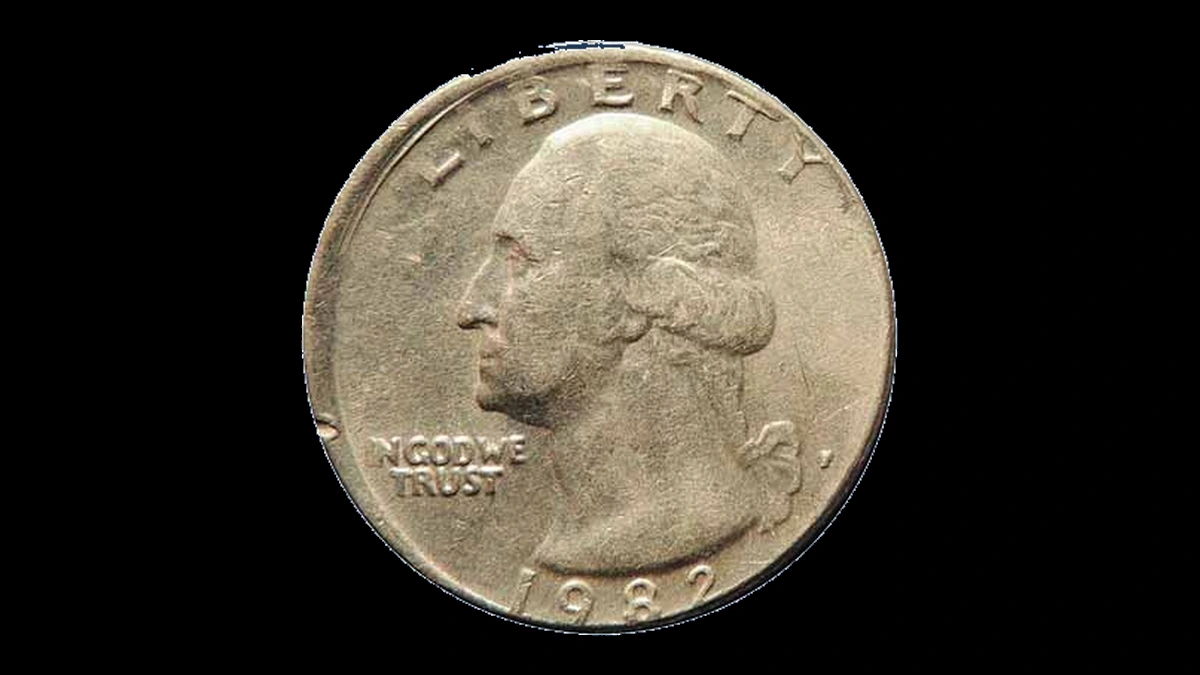
Both Philadelphia and Denver off-center quarters are reported for 1982. Their blank position left a plain crescent opposite design that missed the available metal.
Each coin needs its own date, mintmark, direction, and displacement measurement. A shift restricted to one face may instead come from one die being misaligned.
How to Identify
Check that both designs agree with the same misplaced blank. Inspect the crescent for original metal rather than scraping or grinding.
Read the remaining date and mintmark instead of borrowing them from another specimen’s description. If a detail is missing, retain reliable identification with the coin.
What It’s Worth
$50–$500 is an estimated range for genuine dated examples. A 1990-P quarter struck 40% off center sold for $109 in January 2022.
That percentage belongs to the later coin. A readable date and good surfaces can matter more than the size of the blank area.
9. 1982 Quarter Copper Exposed on One Face — Missing Clad Layer Error
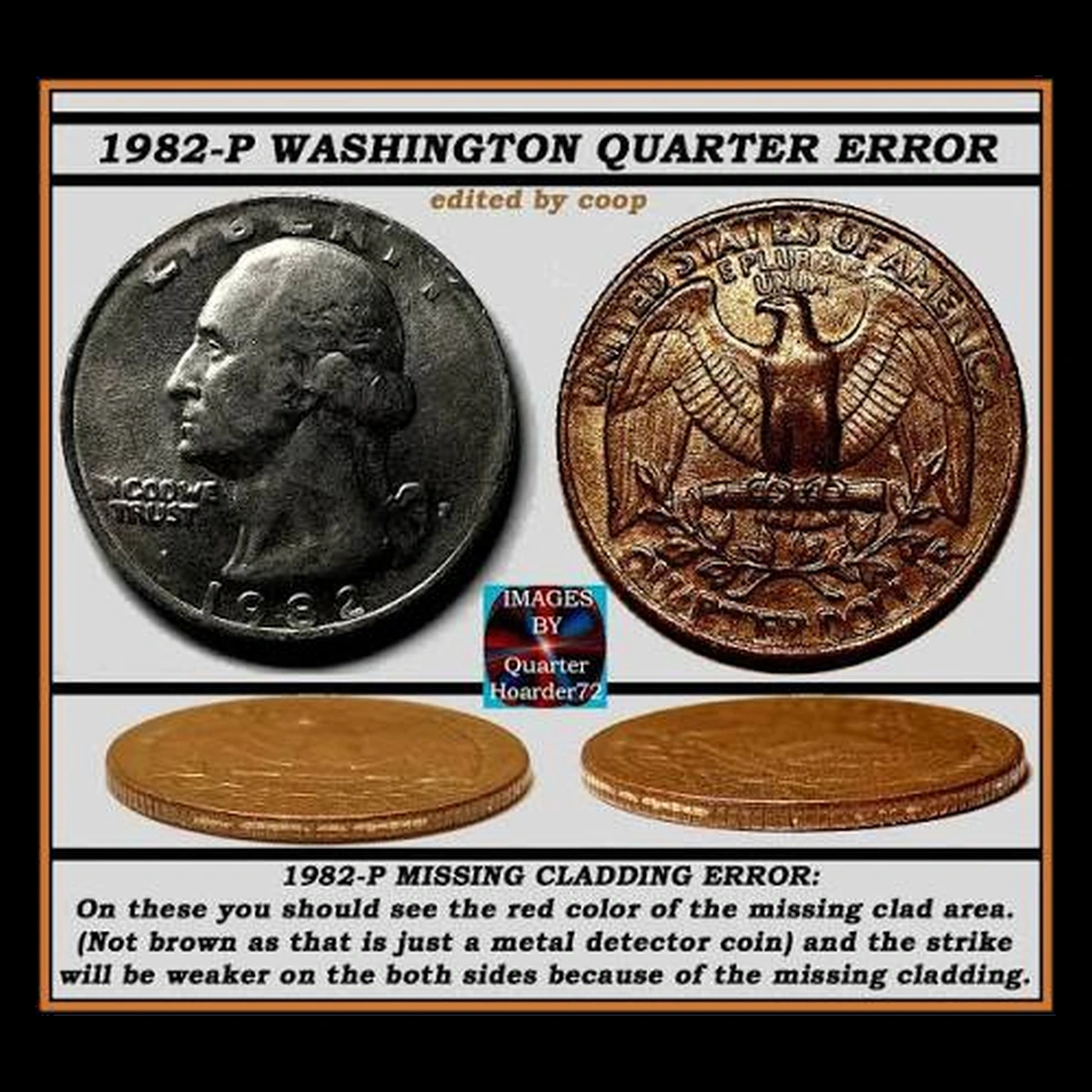
A missing outer copper-nickel layer can reveal the copper center of a clad quarter. The 1982-P report does not specify which face lost its layer or provide an actual weight.
If the layer was absent before striking, the exposed copper can receive design directly. Staining or plating changes color without the same construction.
How to Identify
Inspect the remaining layers at the edge and compare the actual weight with the full clad standard. A lost face can lower weight while leaving the diameter close to normal.
Look for grinding, chemicals, or an added coating. Original exposed design and an undisturbed layer boundary should explain the same loss of metal.
What It’s Worth
$50–$600 is the estimated range for genuine layer losses. A 1986-P quarter missing its front layer, graded PCGS AU55, sold for $62 in September 2024.
The comparison does not establish that the front is the missing side on the 1982 report.
10. 1982 Quarter Quarter Details on Another Coin’s Blank — Wrong Planchet Error
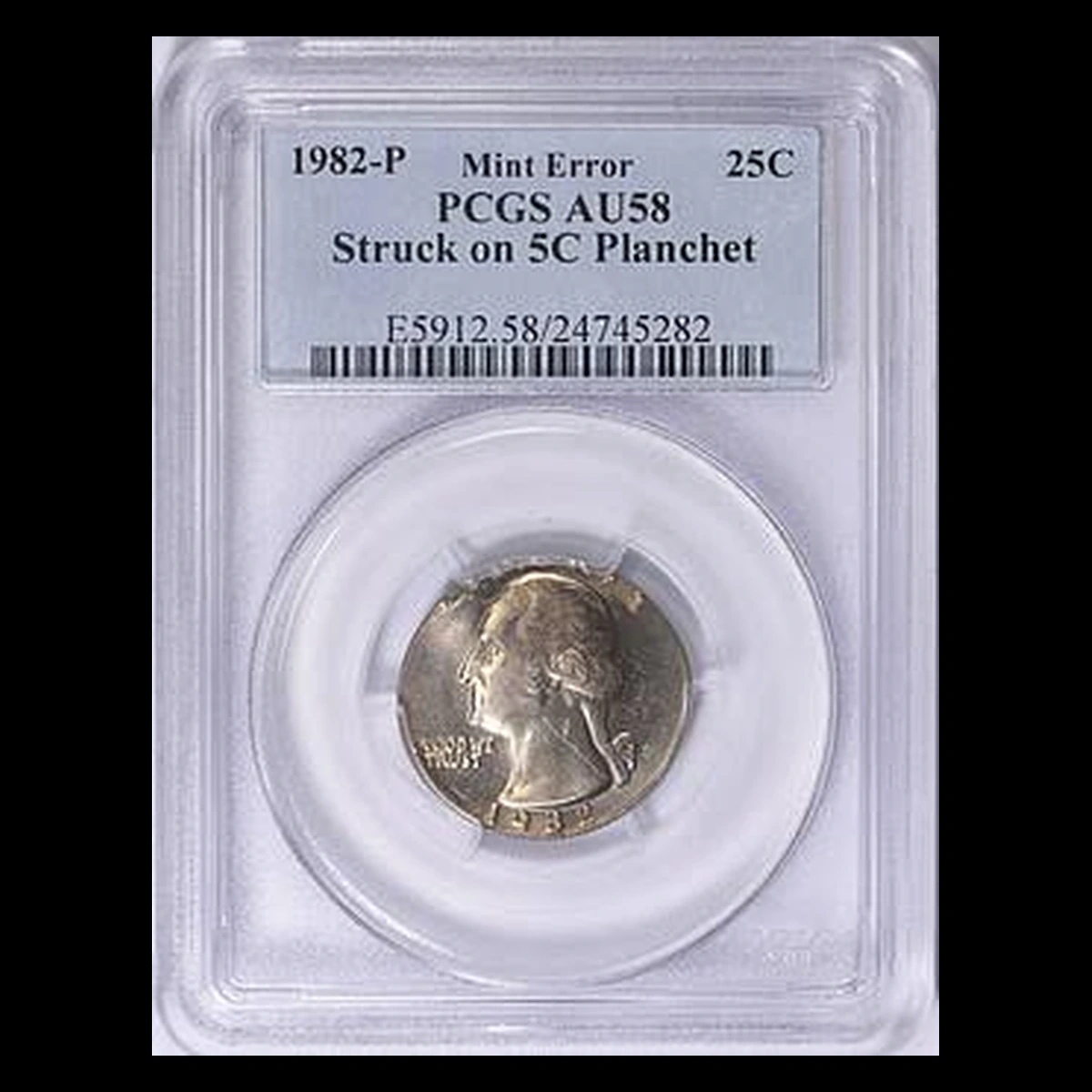
A 1982-P NGC MS64 quarter was struck on a nickel blank and weighs 5.0 grams. A separate Denver nickel-blank report has no actual measurement supplied.
Philadelphia reports also include dime and bronze-cent blanks. Each requires its own metal and size identification rather than the nickel coin’s weight.
How to Identify
Nickel blanks start near 5 grams and 21.2 mm; clad dime blanks start near 2.268 grams and 17.91 mm. A bronze cent blank starts around 3.11 grams and 19.05 mm.
Striking can enlarge a smaller blank, so examine the actual weight, composition, and naturally cropped quarter design together. Grinding an ordinary quarter smaller leaves a different edge.
What It’s Worth
$150–$2,000 spans the reported blank types. Nickel-blank examples are estimated at $150–$700, and the 5.0-gram Philadelphia coin sold for $234 in January 2023.
Authenticated dime-blank pieces are estimated at $350–$1,200, and bronze-cent-blank pieces at $500–$2,000. A 1994-P dime-blank quarter sold for $504 in April 2022, supplying context without identifying any 1982 specimen.
Conclusion
On a 1982 quarter, begin by separating common inherited doubling from a matched working-die variety. Then decide whether an unusual edge has gained width, lost metal, or retained an unstruck section.
Keep the textured S Proof distinct from the ordinary missing-T reports. For wrong blanks and missing layers, the original metal construction and measured weight should support the same explanation as the visible design.