Rare 1967 Dime Errors (List & Pictures)
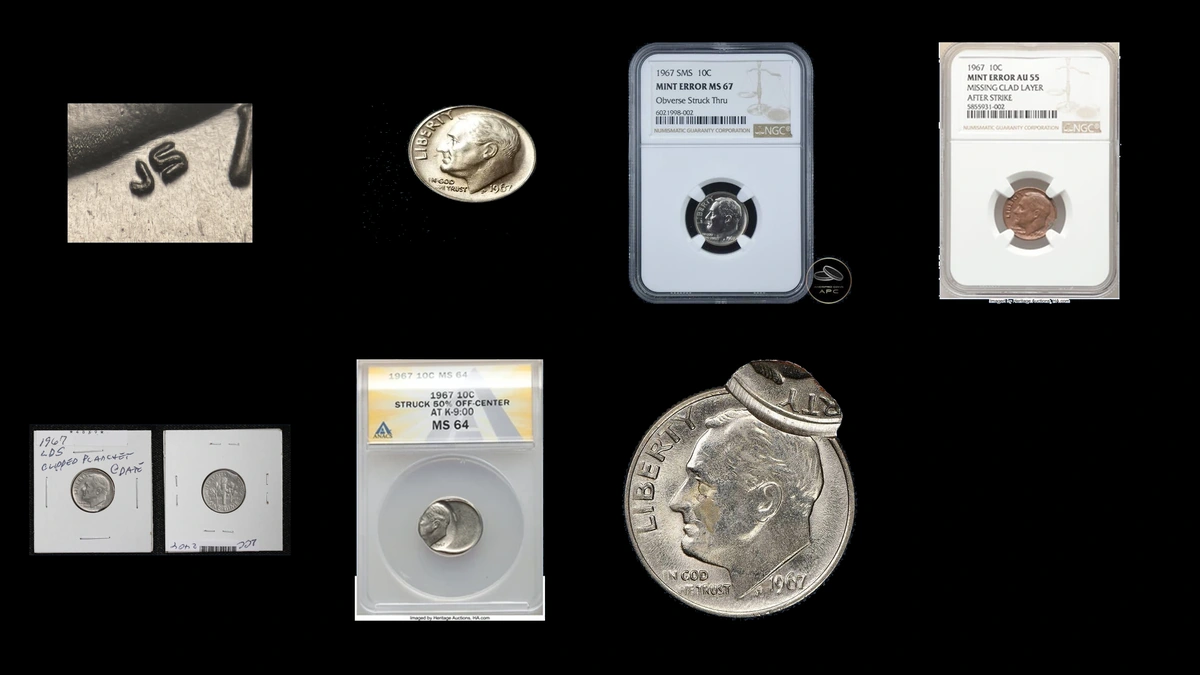
A missing mint mark is normal on both ordinary and Special Mint Set dimes dated 1967. The 1967 dime errors covered here instead involve identifiable changes to the design, blank, or striking sequence, with supplied estimates of $5–$35,000.
A later 1976-S Proof quarter strike over a finished 1967 dime sold for $15,000 on January 21, 2021. Check the coin’s finish and visible feature first, then use its metal and overlapping designs to investigate more complex combinations.
| Clue | Category | Estimated value |
|---|---|---|
| Repeated ordinary or SMS detail | Doubled die | $15–$1,000 |
| Raised lower-front line | Die crack | $5–$100 |
| Opposite-design traces and blocked patch | Clash with struck-through debris | $40–$400 |
| Weak local detail and shifted border | Reported grease/off-center combination | $5–$200 |
| Broad shallow design | Weak strike | $20–$250 |
| Absent outer metal | Missing or separated clad layer | $40–$350 |
| Missing curved or straight segment | Clip | $20–$300 |
| Full design in a wider outline | Broadstrike | $20–$300 |
| Unused crescent beside lost design | Off-center strike | $30–$500 |
| One face lacks an impression | Reported uniface strike | $100–$1,000 |
| Separate later impression | Double strike | $150–$1,200 |
| Thin layer struck by itself | Detached-layer strike | $200–$1,500 |
| Genuine older silver blank | Reported transitional wrong metal | $5,000–$20,000 if authenticated |
| Later cent or quarter over the dime | Double denomination | $3,000–$35,000 |
1. 1967 Dime Repeated Details Depend on the Finish: Ordinary and SMS Doubled Dies Error
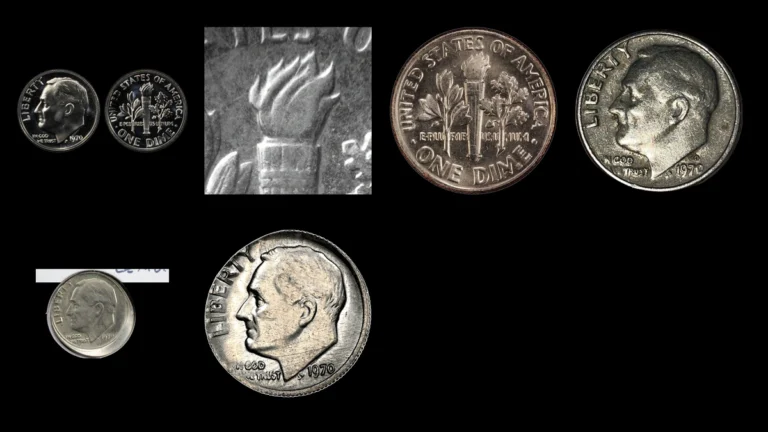
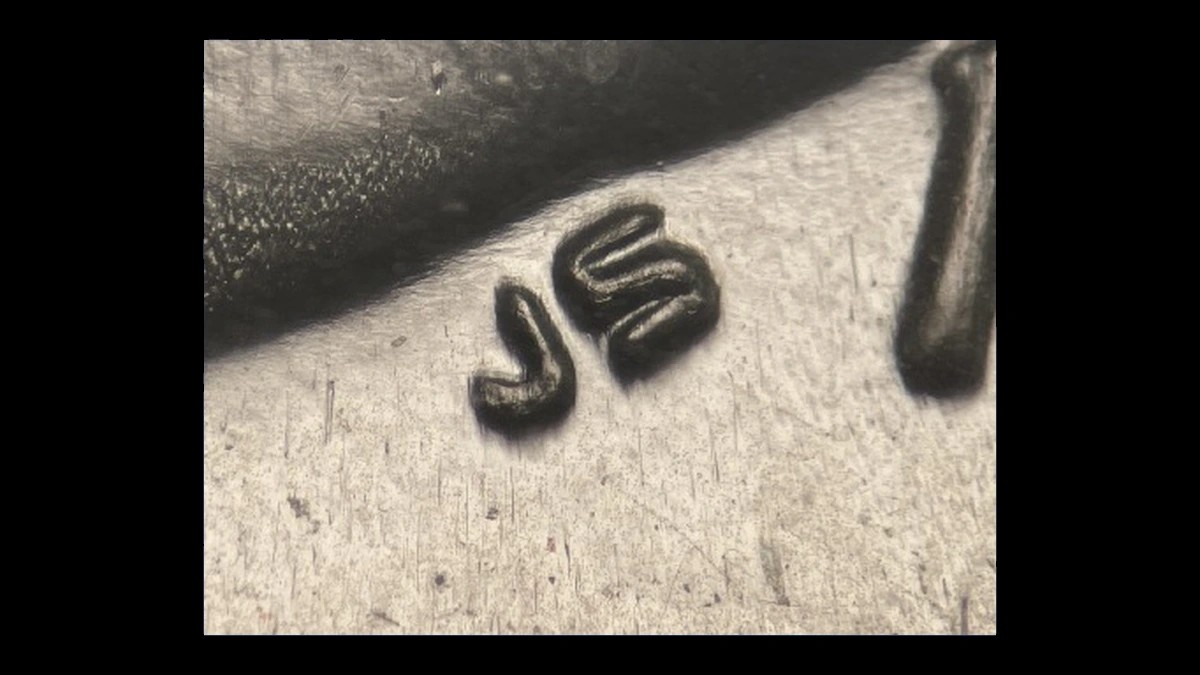
The ordinary 1967 FS-101 doubled die affects the motto, JS initials, and date. Special Mint Set coins, abbreviated SMS, have separate reported patterns.
SMS WDDO-001 concerns mild front doubling, while WDDR-001 affects reverse words. A separate CONECA DDR-001 entry describes weak ONE DIME doubling and should not automatically be assumed to name the same die as WDDR-001.
How to Identify
Establish ordinary or SMS identity before selecting a reference; neither has a mint mark. For ordinary FS-101, compare IN GOD WE TRUST, JS, and the date as a connected pattern.
SMS WDDO-001 has slight inward doubling in JS, the motto, and LIBERTY, with a head chip and vertical forehead tool line as supporting clues. These markers should not be assigned to the ordinary variety.
For SMS WDDR-001, inspect UNITED STATES OF AMERICA and ONE DIME and the small raised dot above and right of the second S in STATES. Compare the CONECA entry independently before establishing any cross-reference.
What It’s Worth
$100–$1,000 is the estimate for ordinary FS-101, while the minor SMS patterns are estimated at $15–$250. An ordinary PCGS AU53 FS-101 sold for $600 in May 2019.
The same date does not make the ordinary auction result a price for an SMS variety. Pattern, finish, and preservation must agree with the comparison.
2. 1967 Dime An Extra Ridge Appears on the Lower Front: Die Crack Error
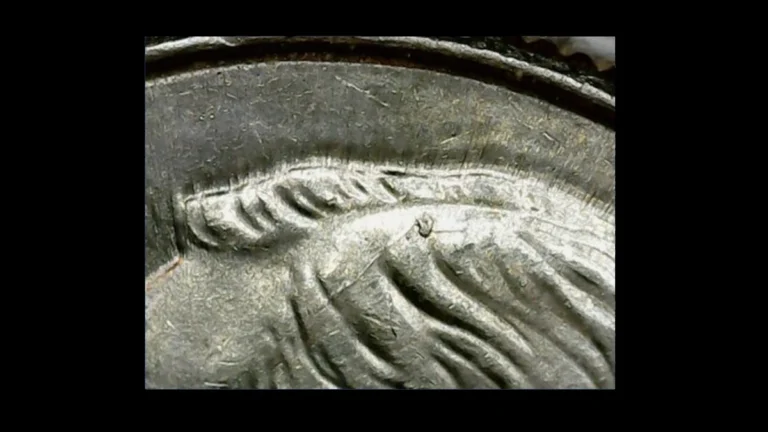
A crack in the die can accept metal and leave a raised line on the dime. The supplied 1967 report places the feature on the lower obverse without establishing an exact path.
How to Identify
Compare with normal portrait detail and follow the extra line under light from opposite directions. A genuine ridge differs from a groove with displaced metal along one side.
Keep the whole path visible and leave deposits untouched. The small head chip associated with an SMS doubled die is a separate feature, not this lower-front report.
What It’s Worth
$5–$100 is the estimate for a genuine small raised crack. Visibility through wear and the condition of the surrounding surface influence its appeal.
A later scratch does not qualify merely because its lip is raised. The metal should explain a defect copied from the die.
3. 1967 Dime Clash Traces Accompany an Interrupted Patch: Clash with Struck-Through Debris Error
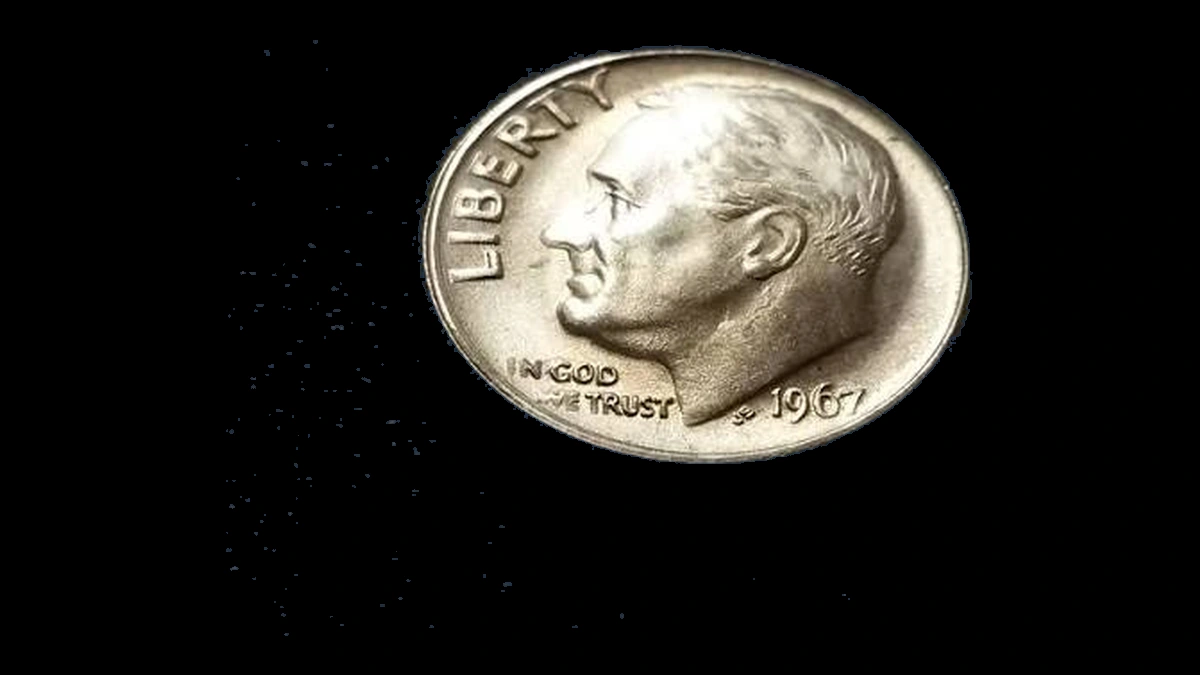
The ANACS AU58 recorded example combines heavy die-clash traces and a strike through debris. The clash came from dies meeting without a blank, while an obstruction separately blocked part of this coin’s design.
How to Identify
Inspect the blocked patch’s boundary, then compare the clash outlines with the opposite-face design. These effects need distinct evidence even though they appear together.
The record does not establish a fixed location or exact debris material. Do not infer cloth, wire, or a second blow on the coin merely from the combined description.
What It’s Worth
$40–$400 is the estimate for a comparable genuine combination. The ANACS AU58 dime sold for $67 in March 2023.
AU58 describes slight wear, and the price covers the whole coin. Separate full values for clash and obstruction should not be added.
4. 1967 Dime Weak Detail Appears beside a Shifted Border: Reported Grease Combination Error
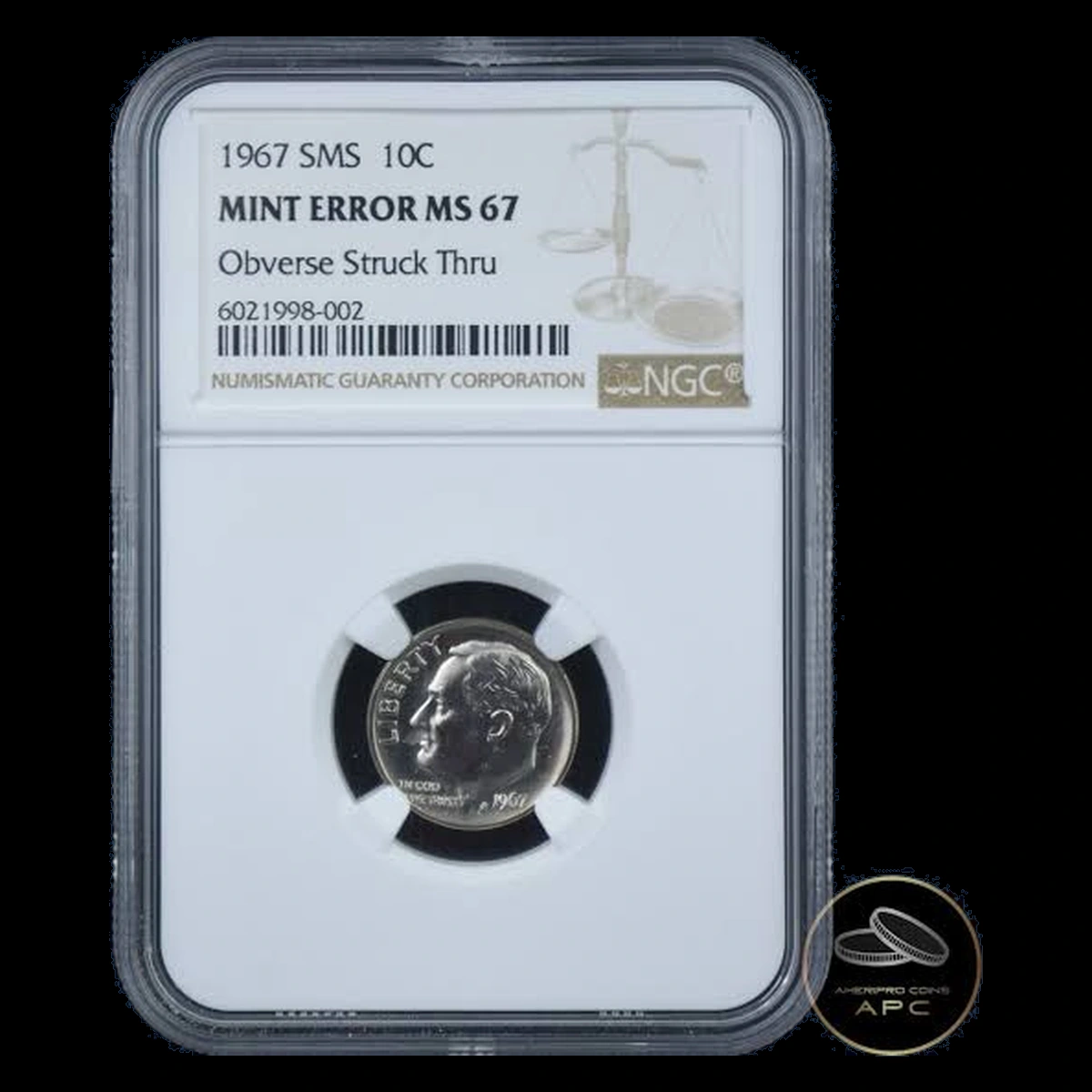
An offered dime was described as both grease-blocked and off center. The seller’s wording does not itself prove the obstructing material or establish that the blank moved relative to both dies.
How to Identify
Compare the two faces for corresponding lost design and unstruck metal. A shifted front with a centered reverse may instead reflect a misaligned die.
Examine the weak patch separately for sharp neighboring detail and an original boundary. Scraping, rubbing, or chemical roughness can erase a finished feature.
What It’s Worth
$5–$75 is the estimate for genuine localized grease blockage, with $30–$200 conditional on an established off-center combination. These overlapping ranges are not amounts to add.
One weak letter and an uneven border do not automatically establish both claims. The visible coin must support the combination before its combined range applies.
5. 1967 Dime Both Faces Have Shallow Detail: Weak Strike Error
A light blow may fail to push metal fully into the die’s recessed design. Some such pieces are called die-adjustment strikes, but the shallow image alone cannot prove an intentional press test.
How to Identify
Compare protected spaces and exposed high points to distinguish weak formation from circulation wear. Inspect both faces to determine how broadly the shallow detail extends.
Normal texture differs from etched or corroded surfaces that lost detail later. A normal weight can exclude some severe metal loss without proving an experimental or setup purpose.
What It’s Worth
$20–$250 is the estimate for an identified weakly struck dime with original surfaces. Broad obvious weakness can be more interesting than ordinary localized softness.
The range does not include an added premium for an unproven Mint experiment. Describe the observed strike rather than assuming the press’s purpose.
6. 1967 Dime A Pale Outer Layer Is Missing or Separated: Clad-Layer Loss Error
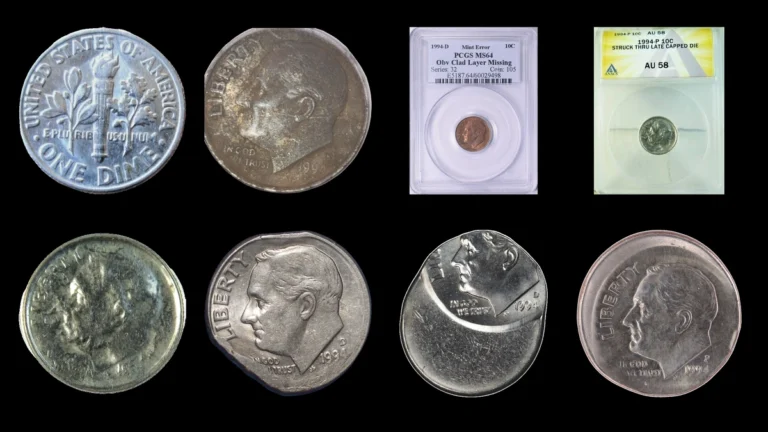
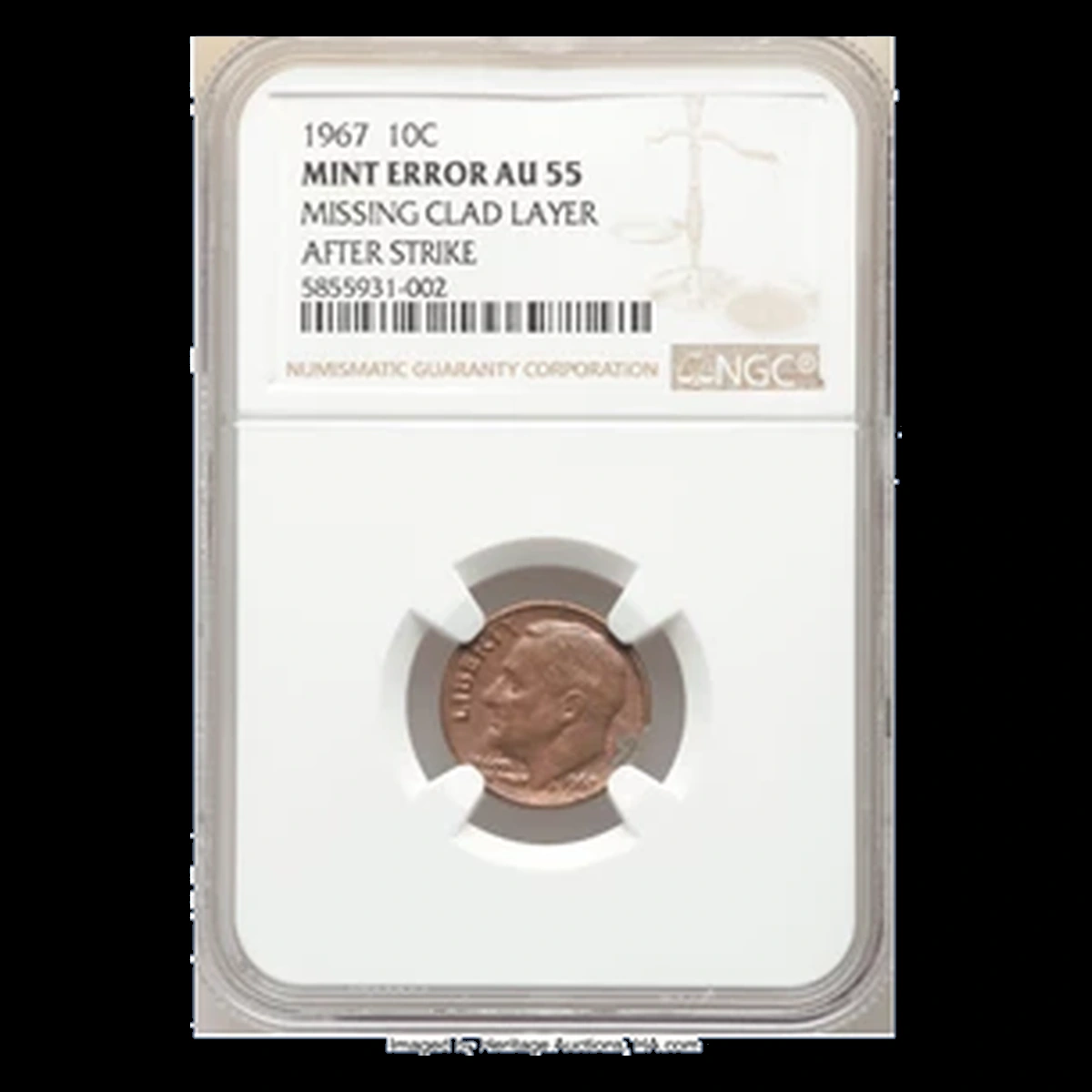
A PCGS MS62 example lacks its obverse layer, while a separate MS62 coin lacks the reverse layer. An NGC AU55 dime is described as losing a layer after striking.
These cases involve different faces or stages of separation. A layer absent during the blow can leave a different exposed surface from one that peels away afterward.
How to Identify
Compare the edge sheets with the affected face and inspect the exposed metal for remaining design, tearing, or later damage. Do not lift any attached material.
The normal clad dime weighs 2.268 grams, but that is not a recorded error weight. Staining, scraping, and chemical pits can produce other explanations for copper color or reduced mass.
What It’s Worth
$40–$350 is the estimated range for comparable identified layer-loss dimes. The obverse-layer MS62 coin sold for $159 in December 2024, and the separate reverse-layer MS62 example brought $51 in February 2006.
The NGC AU55 after-strike separation sold for $61 in September 2020. Keep the affected face and timing attached to each record.
7. 1967 Dime Curved or Straight Segments Are Absent: Clipped Blank Error
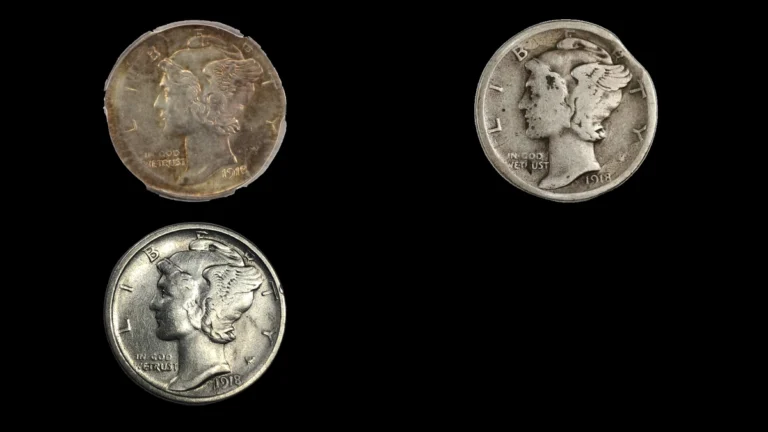
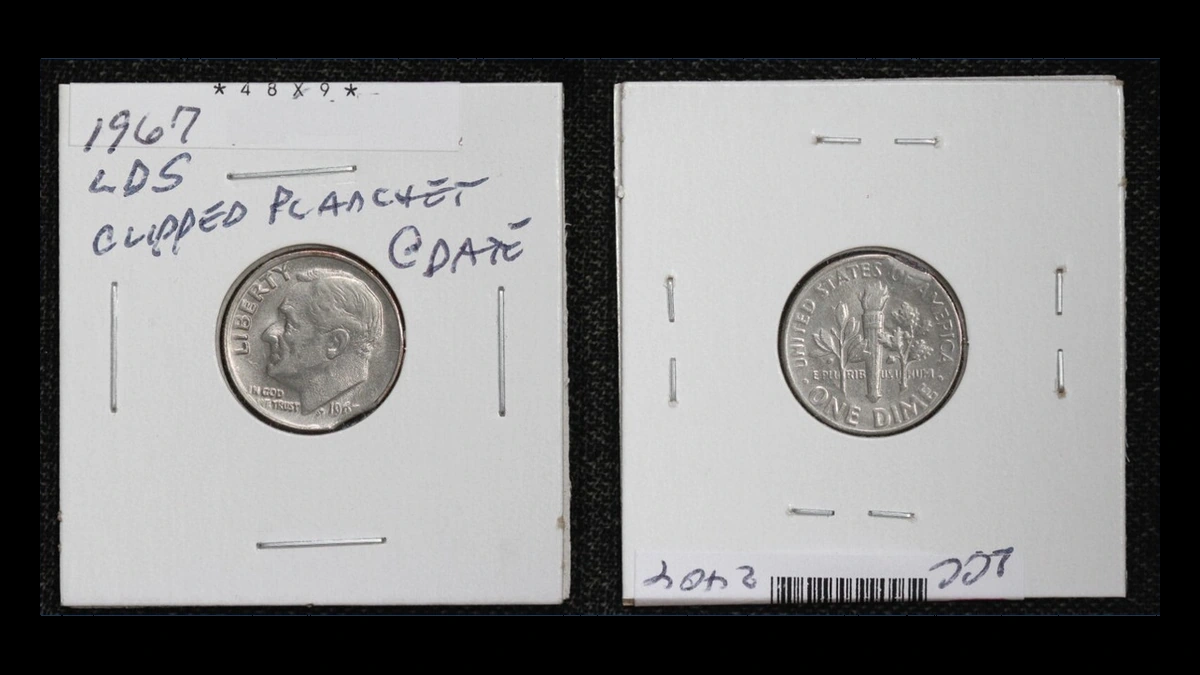
One dime with a curved clip plus a small rim clip weighs 2.05 grams. Separate large curved-clip examples weigh 1.16 grams and 0.92 gram.
A 0.9-gram straight-clip piece attributed to 1967 is reported with 60% loss but lacks a complete readable year. Its attribution and shape must remain separate from the large curved clips.
How to Identify
Read the surviving date before comparing the gap and inspect its junctions with the rim for original metal flow. Later cutting can also lower weight but slices into an already finished coin.
A weak opposite rim can support a curved clip without being mandatory. Retain each weight with the actual specimen rather than combining the strongest measurements and date evidence.
What It’s Worth
$20–$300 is the estimate for identifiable clips. The 2.05-gram ANACS AU58 coin sold for $30 in March 2022, and the 1.16-gram NGC MS64 curved clip brought $79 in July 2021.
A larger gap can make a dramatic display while removing useful date evidence. AU58 indicates slight wear, whereas MS64 describes an unworn coin with marks.
8. 1967 Dime The Complete Design Fits on Expanded Metal: Broadstrike Error
A broadstrike forms when the collar ring fails to contain the blank normally. The dime can grow wider while retaining the intended design, even if the surrounding border is uneven.
How to Identify
Compare several diameters with the ordinary 17.91-millimeter standard and trace the outer words on both faces. Lost design opposite a plain crescent instead suggests an off-center strike.
Inspect the edge together with the portrait and torch for evidence of later crushing. No single measured diameter proves that expansion occurred during striking.
What It’s Worth
$20–$300 is the estimate for a genuine simple broadstrike. Clear spread and intact readable design support useful comparisons.
A hammered dime may also be wide. Its altered finished surface does not qualify for this error range.
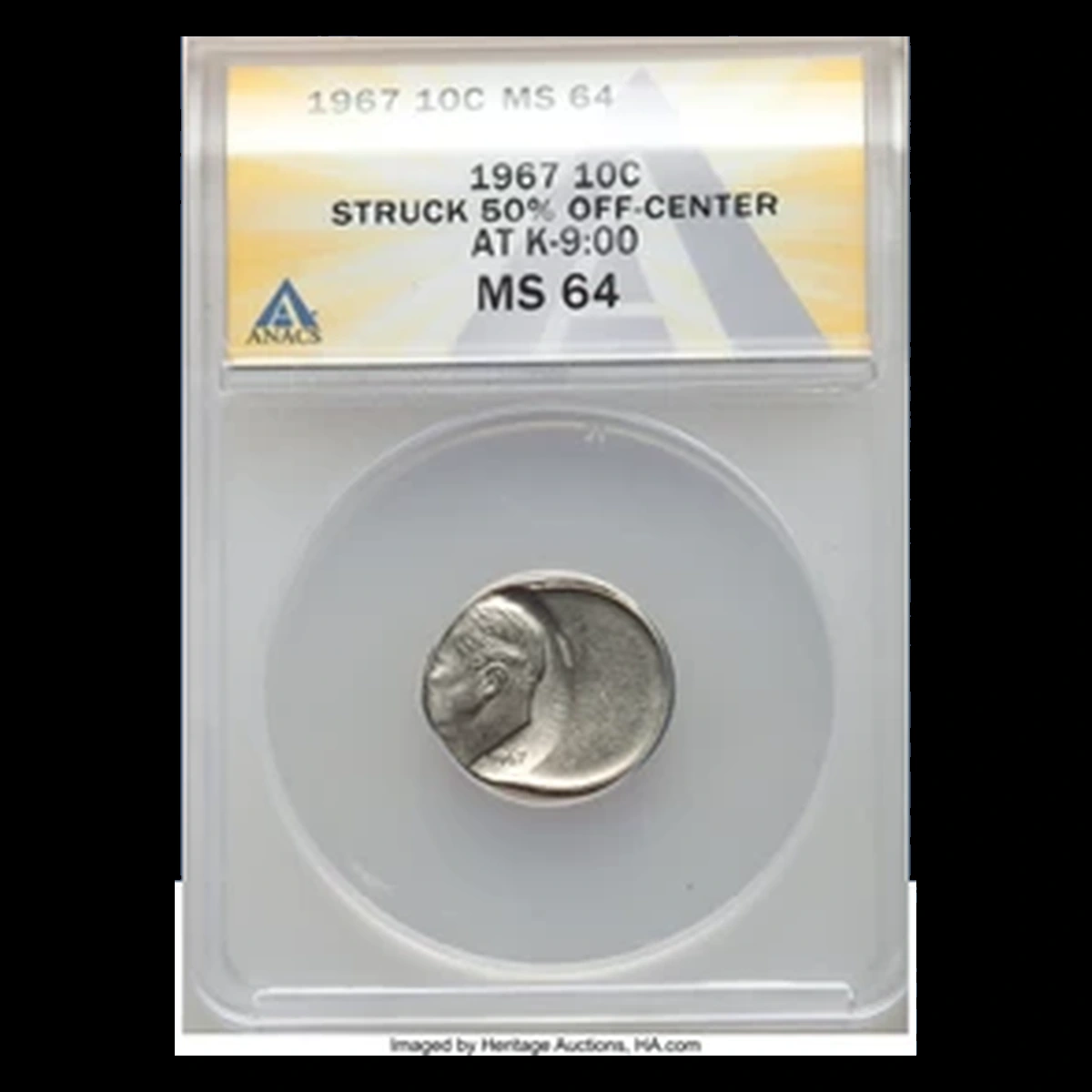
9. 1967 Dime Half the Design Misses to the Left: Off-Center Strike Error
The documented ANACS MS64 example is 50% off center toward nine o’clock. That describes sideways displacement rather than a ninety-degree rotation between blows.
How to Identify
Locate the unstruck metal and the opposite boundary where intended design runs off the edge. Both faces should fit one misplaced blank.
Read each surviving year digit and check the plain area for sanding or erased detail. The 50% leftward description belongs to this specimen, not every 1967 off-center dime.
What It’s Worth
$30–$500 is the estimated range for identifiable 1967 off-center examples. The documented ANACS MS64 coin sold for $93 in January 2022.
A substantial shift can reduce date readability. Preservation and identity remain important alongside the size of the unstruck area.
10. 1967 Dime Only One Face Has a Normal Impression: Reported Uniface Strike Error
Uniface describes a coin with one formed face and an unformed opposite surface. Another blank can block one die, but the appearance alone does not establish one specific accident.
How to Identify
Inspect the blank-looking face for sanding, a lowered center, or remnants of removed lettering. Check the complete edge for a seam or an added face.
Compare full-face photographs at the same scale and record actual weight and thickness for a loose coin. A normal blank blocked on one side must be distinguished from a thin separated layer.
What It’s Worth
$100–$1,000 is the conditional estimate for an authenticated 1967 one-sided strike on an otherwise normal dime blank. Original surfaces and readable identity support the comparison.
A ground-away face does not qualify. The edge and metal must explain an original unformed surface.
11. 1967 Dime A Later Impression Barely Reaches the Edge: Double Strike Error
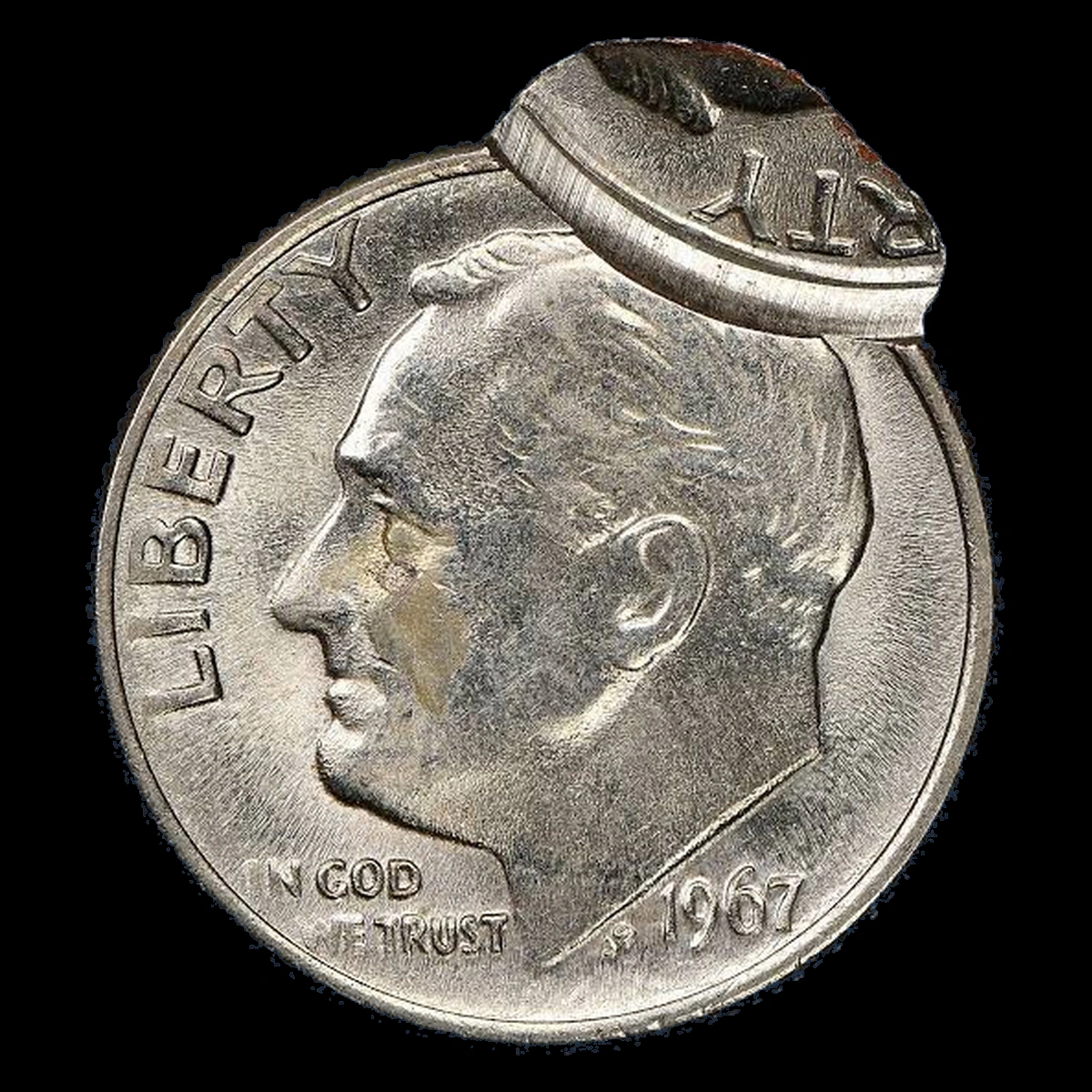
An October 1968 advertisement described a 1967 dime with a normal first strike and a second 90% off center toward three o’clock. A separate modern listing identifies an NGC MS65 double strike.
The records do not establish that these are the same specimen. Their details should not be joined without matching evidence.
How to Identify
Search near the edge for connected remnants of another design and compare the opposite face for the same later contact. One thick letter need not indicate another blow.
The old advertisement’s 90% figure describes displacement, not rotation. Inspect overlapping metal for squeezing or joined pieces before accepting the sequence.
What It’s Worth
$150–$1,200 is the estimate for an identified 1967 double strike. A different-year 1976 flipover double strike sold for $423 in January 2017.
That comparison turned over between strikes and does not establish the history of either 1967 report. No realized price is supplied for the older advertised coin.
12. 1967 Dime A Thin Separated Layer Receives the Design: Detached-Layer Strike Error
A reported 1967 piece combines a thin detached layer with an off-center, one-sided strike. Fine lines in its unstruck front area were identified as the original inner bonding surface.
Those observations support separation before striking in this account. No exact weight or percentage is supplied.
How to Identify
Inspect the edge and fine lines under angled light without bending the layer. Their relationship to the displaced design should support an inner surface that existed before the strike.
Later scratches do not establish that sequence. Compare both faces to distinguish a layer struck alone from one peeled off a finished dime.
What It’s Worth
$200–$1,500 is the estimated type range for an authenticated detached-layer strike with readable 1967 identity. It is not a recorded sale of this reported specimen.
The thin material and original strike must be established together. A shaved dime does not qualify simply because it is unusually light.
13. 1967 Dime The Metal Is an Older Silver Alloy: Reported Silver-Planchet Strike Error
A genuine silver dime blank would be the wrong metal for a regular 1967 Roosevelt dime. Both ordinary and SMS issues normally have copper-core clad construction.
How to Identify
Confirm Roosevelt and the torch design first; a Canadian 1967 silver dime is a different coin. The older U.S. silver dime standard is 90% silver and 2.50 grams.
Record actual measurements and obtain nondestructive composition testing alongside examination for plating and alteration. A pale edge or heavy reading alone cannot prove the claimed blank.
The correct alloy must still agree with a genuine 1967 strike. An authenticated transitional error from another year does not establish this coin’s identity.
What It’s Worth
$5,000–$20,000 is a conditional estimate for a professionally authenticated 1967 dime on a genuine silver dime blank. It is not a supplied 1967 auction result.
A 1965 quarter on a silver quarter blank sold for $9,300 in July 2022. Its different denomination makes it broad wrong-metal context rather than an exact dime comparison.
14. 1967 Dime Later Cent or Quarter Designs Cover the Dime: Double Denomination Error
A PCGS MS65 piece carries a 1980s cent strike 20% off center toward three o’clock over a finished 1967 dime. The dime date is complete, but the cent’s final year digit is not established.
A separate NGC PF67 example carries a 1976-S Bicentennial Proof quarter design over a 1967 dime. These later impressions do not mean both designs were applied during 1967.
How to Identify
Trace the older dime beneath the newer design on both faces. On the cent example, Roosevelt is above Lincoln relative to the cent’s usual orientation, and the cent date must remain incomplete where its last digit is absent.
For the quarter overstrike, compare the surviving dime with the 1776–1976 design. PF67 describes the later Proof grading, not the original dime’s finish.
Check the overlapping relief and continuous edge for original striking rather than joined pieces or novelty impressions. The two designs must support the documented order.
What It’s Worth
$3,000–$8,000 is the estimated cent-over-dime range, while the quarter-over-dime type is estimated at $10,000–$35,000. The PCGS MS65 cent-over-dime sold for $5,170 on June 9, 2017.
The Byers NGC PF67 quarter overstrike has no disclosed sale price. Heritage sold an NGC PR67 1976-S Proof-over-1967-dime example for $15,000 on January 21, 2021, without establishing that it was the same Byers-listed coin.
Conclusion
A 1967 dime’s finish, layers, and surviving design provide more information than its normally absent mint mark. Keep ordinary and SMS die varieties separate, and distinguish a missing layer from a thin layer that entered the press by itself.
When another denomination overlaps the dime, identify both designs and their sequence independently. Measurements, dates, and auction prices belong to specific specimens, especially when the second strike occurred years after 1967.