Rare 2020 Sacagawea Dollar Errors (List & Pictures)
A 2000-P Sacagawea dollar struck off center sold for $3,120 in April 2021, providing a different-year comparison. Estimated values for 2020 Sacagawea dollar errors range from $20–$4,000 across the reported and conditional types below.
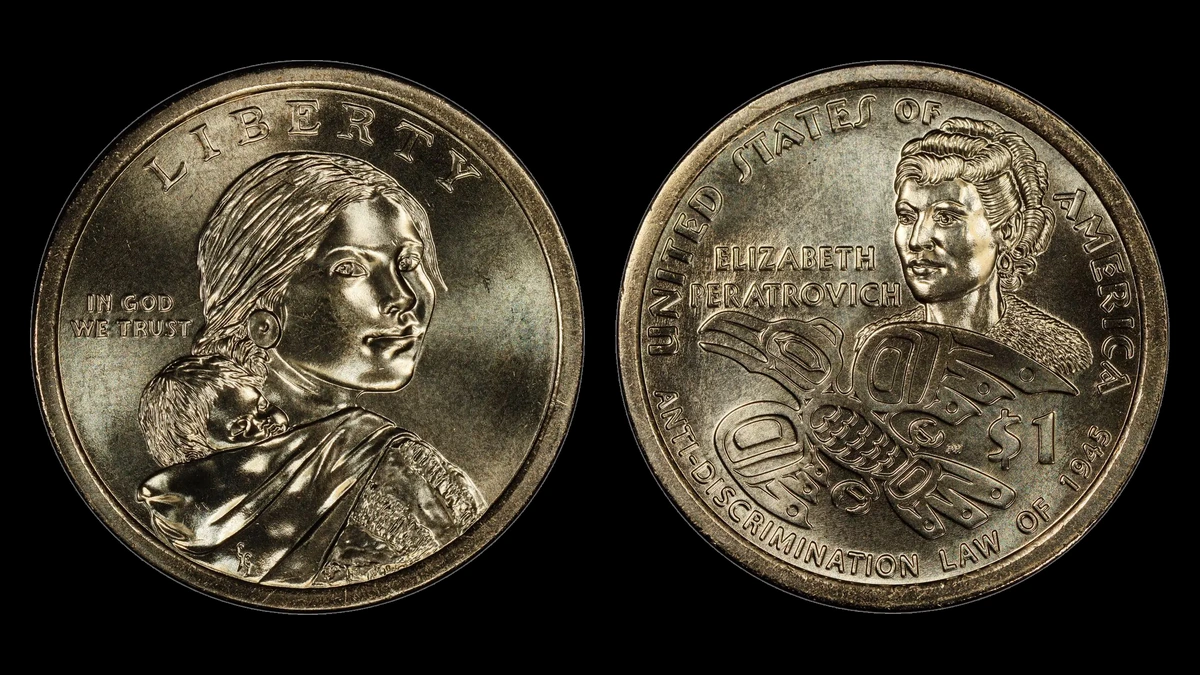
This guide explains the evidence while keeping the intentional 1945 law inscription on Elizabeth Peratrovich’s reverse separate from the coin’s 2020 edge date.
| Category | Estimated value | Evidence limit |
|---|---|---|
| Doubled design | $20–$250 | No authenticated pattern supplied |
| Missing or weak edge letters | $20–$300 | Smooth-edge owner report requires examination |
| Front strike-through | $30–$400 | Owner reports NGC MS66; material unnamed |
| Repeated edge letters | $40–$400 | No securely identified specimen supplied |
| Improper annealing | $50–$500 | Color alone is insufficient |
| Off-center strike | $100–$4,000 | No authenticated 2020 specimen supplied |
1. 2020 Dollar Reported Doubled Design Error
A coherent secondary outline on letters or portrait detail could indicate a doubled die. The repeated image would already have existed in the stamping tool before coins received it.
The 2020 report does not identify an authenticated specimen or exact location. It should not be treated as a named established variety.
How to Identify
Compare the suspected feature with the same area of an ordinary 2020 coin. Follow several corners and adjacent details rather than relying on one thick-looking stroke.
Rounded extra design differs from a flat lowered shelf caused by movement during striking. Include both faces and edge date in photographs so a specialist can evaluate the proposed pattern in context.
What It’s Worth
A properly identified doubled-design example has a conditional estimated range of $20–$250. This is not a documented 2020 auction price.
Clear separation on original surfaces would provide stronger evidence than blur or reflected light. A matching pattern on another coin from the same die would also strengthen an attribution.
2. 2020 Dollar Missing or Weak Edge Lettering Error
An owner reported a Peratrovich dollar with a smooth edge, where the year, mintmark, and E PLURIBUS UNUM should appear. The account alone does not exclude later removal.
Ordinary coins receive the inscription after the two main faces are struck. Missing that step can leave all characters absent, while weak contact can leave partial lettering.
How to Identify
Confirm the Peratrovich reverse before comparing edges. Sacagawea dollars from 2000 through 2008 normally have plain edges and do not demonstrate this 2020 error.
Inspect the full circumference under changing light and record every surviving character. Check for filing, rounding, or coatings that could hide lettering; a normal dollar measures 26.49 millimeters across.
Partial characters require a weak-letter description, whose separate 2020 report lacks an identified specimen. A missing mintmark also prevents assigning P or D from the faces alone.
What It’s Worth
Genuine weak-to-missing edge lettering has an estimated range of $20–$300. No sale price accompanies the smooth-edge owner’s report.
A different 2007 Madison dollar with missing lettering, graded NGC MS67, brought $119 at Heritage in July 2025. That earlier issue is a comparison rather than a transaction for this 2020 candidate.
3. 2020 Dollar Reported Front Strike-Through Error
A collector reported a Philadelphia coin from a Mint set with an NGC MS66 front strike-through designation. The owner’s account says NGC did not identify the obstructing substance.
The owner suggested grease, but that suggestion should remain distinct from the reported designation. Material between a die and blank can interrupt the design without leaving its identity obvious.
How to Identify
Compare the affected Sacagawea-side area with an undamaged coin and follow where normal detail changes into the patch. Scraping or pushed-up impact edges can indicate damage after striking.
The reported designation concerns the front. An unexplained reverse mark requires its own examination rather than automatically sharing that identification.
What It’s Worth
Genuine front strike-throughs have estimated values of $30–$400. The reported MS66 specimen has no disclosed transaction price.
A 2014-P Native Hospitality dollar with a front strike-through, also graded NGC MS66, sold for $31 in October 2016. That modest different-year result shows why the visible interruption matters alongside grade.
4. 2020 Dollar Reported Repeated Edge Lettering Error
An ordinary dollar passing through the lettering operation again can receive two overlapping sets of recessed characters. The repeated edge inscription is a different manufacturing feature from doubling on either face.
The 2020 entry is a possibility without a securely identified specimen. It supplies neither a mint nor an amount of overlap.
How to Identify
Trace one recognizable word around adjoining edge sections, then follow the second inscription separately. More than one isolated crowded letter should support the relationship.
Expected characters sink into the edge rather than standing as random raised contact marks. Inspect the rims and any repeated date for alteration and agreement with the Peratrovich design.
What It’s Worth
An authenticated repeated-edge example has a conditional estimated range of $40–$400. Two readable sets would be more useful than a small uncertain patch.
A 2007-P John Adams dollar with overlapping doubled edge lettering, described by NGC as brilliant uncirculated, sold for $59 in March 2010. It illustrates another issue’s market rather than confirming a 2020 specimen.
5. 2020 Dollar Reported Improper Annealing Error
Annealing heats blanks to soften them before striking. A production problem can change the surface appearance, but later chemicals, heat, and environmental exposure can produce similar discoloration.
No authenticated 2020 annealing-error example is identified in the supplied report. Ordinary golden dollars also vary in tone.
How to Identify
Compare the candidate and a normal dollar under neutral light, inspecting protected areas, open fields, and the edge. Look for coating, spots, or texture changes rather than relying on brown or gray color alone.
A normal dollar weighs about 8.1 grams, but normal weight cannot establish when a color change occurred. Keep the surface untouched so its original texture remains available for examination.
What It’s Worth
A confirmed 2020 annealing error has an estimated range of $50–$500. This assumes a manufacturing-related surface change rather than alteration after striking.
A different 2009-P Native American dollar with improper annealing, graded NGC MS64, sold for $61 in November 2011. That older result does not authenticate a similarly colored 2020 coin.
6. 2020 Dollar Reported Off-Center Strike Error
A misplaced blank can leave part of the design beyond the metal and an unstruck crescent on the opposite side. Both images should fit that same displacement.
The 2020 report has not been matched to an authenticated specimen. No specific mint, direction, grade, or percentage should be supplied without evidence.
How to Identify
Compare the two design centers with the complete outline of the disc. A shift limited to one face may concern die alignment rather than the blank’s position.
Inspect the transition into blank metal for grinding or erased detail. Use Peratrovich’s artwork and any surviving edge characters to establish the issue; 1945 commemorates the law and is not its production year.
What It’s Worth
An authenticated off-center example has a conditional estimated range of $100–$4,000. Readable annual design, original surfaces, and visible displacement influence the comparison.
NGC reports $3,120 in April 2021 for a 2000-P Sacagawea dollar struck fifty percent off center and graded MS66. That different-year result supplies neither a grade nor a displacement percentage for a 2020 candidate.
Conclusion
The Peratrovich reverse and edge information identify the 2020 issue, while the 1945 inscription belongs to its intended artwork. Plain edges on earlier Sacagawea dollars, ordinary inscription direction, and natural toning are not equivalent errors.
Preserve the full circumference and original surface when documenting a candidate. Each reported feature needs its own explanation before the conditional price ranges or a different-year auction comparison can be applied usefully.