Rare 1880 Quarter Errors (List & Pictures)
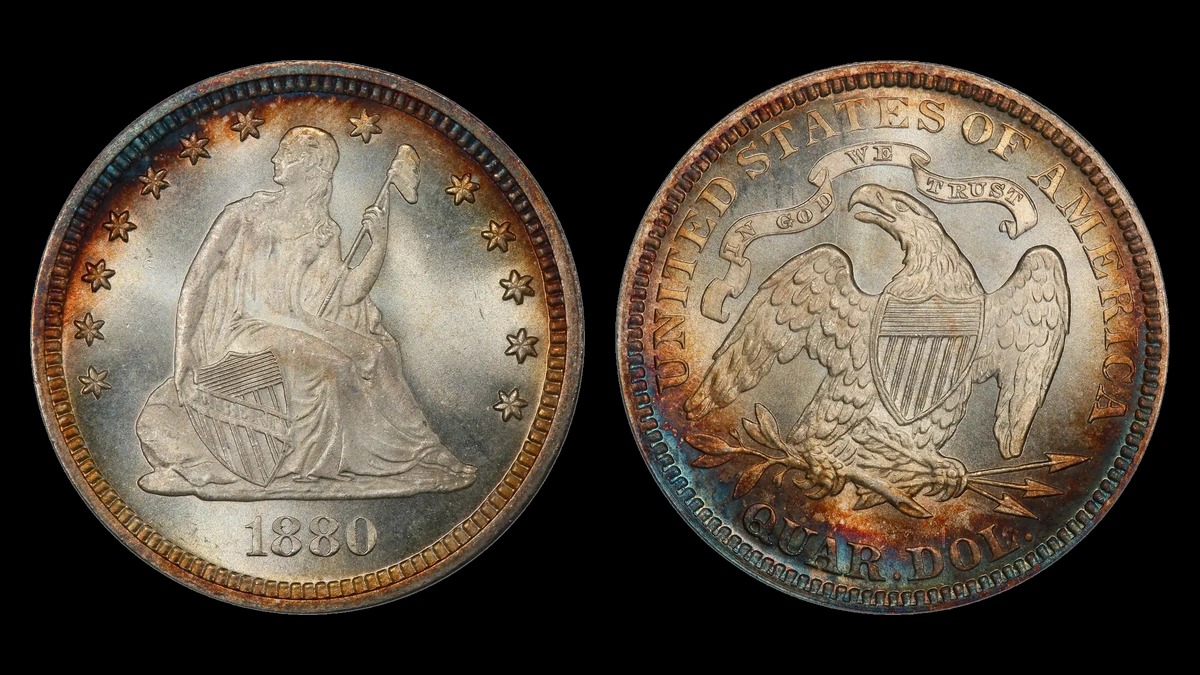
On an 1880 Proof quarter, one ribbon fold can look almost empty while nearby folds remain complete. These 1880 quarter errors and tool-made features help distinguish different backs, with estimated whole-coin values of $600–$6,000 in ordinary Proof grades.
An exceptional Proof 68+ sold for $28,200 in November 2013. That is a preservation comparison, not a price established for either small feature below.
1880 Quarter A Hollow Ribbon Fold: Overpolished Die Error
Look at the ribbon carrying IN GOD WE TRUST above the eagle. On most Proofs with the later Type II back, the second recessed bend from the left has only two thin outlines.
Polishing removed some of the design from the die, the steel stamping tool. Coins made afterward received that reduced fold.
Ordinary circulation coins keep the fold complete. Some Proofs do as well, so one complete fold cannot settle the coin’s finish.
How to Identify
Hold the back upright and count inward from the ribbon’s left end. Find the second low bend and compare it with the folds beside it.
The PCGS description identifies the two remaining border lines around the missing interior detail. Check that specific shape rather than general weakness across the ribbon.
Rubbing or wear can weaken several exposed areas at once. Examine the eagle, surrounding surface, and neighboring folds for that broader change.
Two recorded Proof backs retain the full fold and have other marks at the shield or ribbon. Use those combinations in the next section when the fold alone gives an incomplete answer.
What It’s Worth
$600–$5,000 is the estimated whole-coin range in roughly Proof 62 through 65. These are specially made collector coins with different levels of marks and surface disturbance.
The incomplete fold is common on this issue and does not create a large premium by itself. Original reflective surfaces, color, and freedom from cleaning matter more.
The $28,200 Proof 68+ result belongs to a much higher preservation level.
1880 Quarter A Raised Shield Line or Small Lumps: Die Marks Error
One earlier Type I Proof back has a raised line extending from the shield’s left border into adjoining feathers. A cut in the tool produced that raised trace on the coin.
A different Type II Proof back has two raised lumps at the ribbon’s leftmost bend and more in the shield’s center. Small recesses in the tool produced those extra spots.
Both backs retain the complete second low ribbon fold. The line and the lumps describe separate backs, not one set of marks expected together.
How to Identify
Choose the correct route before enlarging the image: the shield-border line or the ribbon-and-shield lumps. Keep a full reverse photograph with the close-up.
For the Type I line, follow the shield’s left edge into the feathers. Move the light to distinguish a raised trace from a scratch cut into the finished surface.
For the Type II spots, start at the first bend at the far left of the ribbon. Then compare the raised spots in the shield’s center and confirm the complete second fold.
A matching combination is stronger evidence than an isolated bump. Do not scrape a spot to test whether it is struck metal or a deposit.
What It’s Worth
$800–$6,000 is the estimated range for reasonably preserved Proofs with these marks. The less common Type I back may interest specialists beyond the visible line itself.
The exceptional Proof 68+ sale was $28,200 on November 15, 2013. The supplied record does not identify it as either marked back described here.
Use it as a condition comparison only. A small line or lump does not move a cleaned or heavily marked coin into that price level.
Conclusion
Read the ribbon and shield together: the hollow second fold, shield-border line, and paired groups of lumps identify different appearances. A complete fold alone does not rule out a Proof.
The estimates describe whole collector coins, with condition doing much of the work. Preserve the reflective surfaces and match the correct back before using a high-grade sale as a comparison.