Rare 2022 Sacagawea Dollar Errors (List & Pictures)
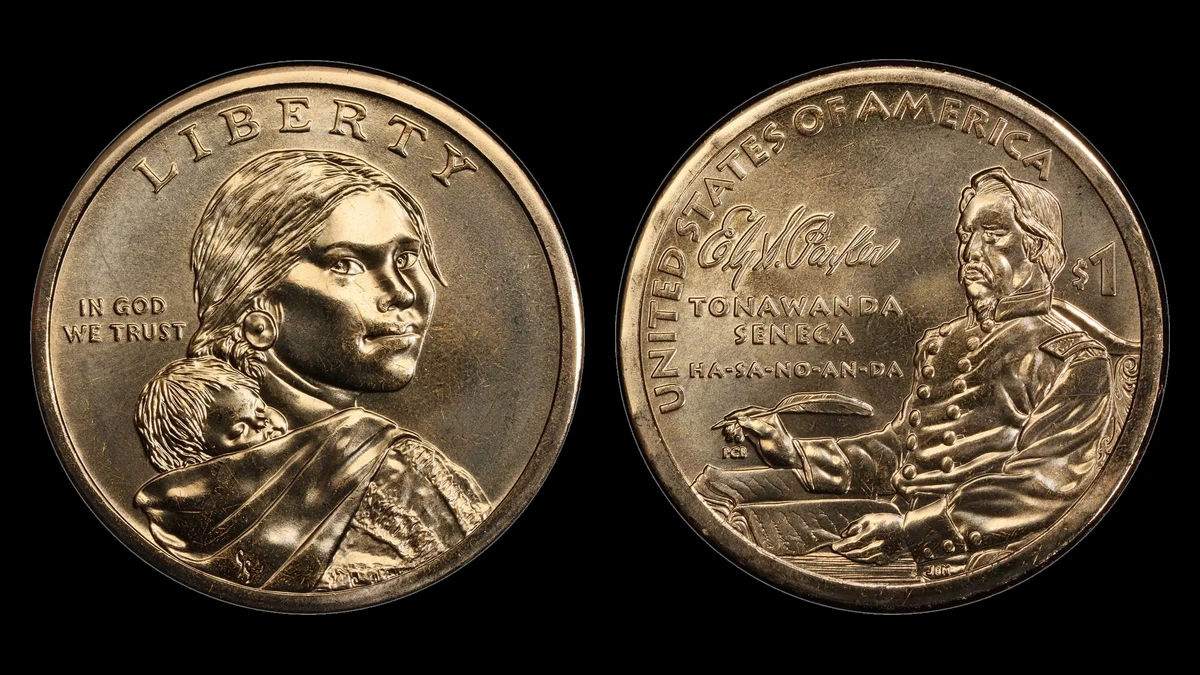
Ely Parker identifies the annual reverse when examining 2022 Sacagawea dollar errors. The reported possibilities include unusual Proof edge lines, extra design outlines, absent edge text, displaced strikes, and wrong blanks, with several still awaiting a confirmed 2022 specimen.
Authenticated examples have supplied estimates of $25–$6,000. The largest actual comparison is $4,440 for a 2004-P dollar on a quarter blank in August 2024; begin with the edge and Parker’s design before considering the more dramatic shape and metal claims.
1. 2022 Dollar Raised Lines along a Proof Edge: Reported Collar-Related Defect Error
A collector described raised edge lines on seven Ely Parker Proof dollars. The report establishes an observation, but does not determine whether the lines are abnormal defects or ordinary traces of the segmented collar.
The collar surrounds the blank while the coin is struck, and joins between its sections can leave seams. Similar reported lines on other years make that normal construction an essential comparison.
How to Identify
Keep the Proof protected and photograph the line beside nearby edge letters, including S where visible. Change the light direction to determine whether the feature is raised, recessed, or a cut with displaced metal.
Compare its position with collar joins on a normal Proof of the same design. A regular seam at a section boundary should not be relabeled as an error simply because it is visible.
An irregular raised patch extending away from a normal join deserves specialist assessment. Both face views help establish that the edge belongs to the claimed 2022 Proof.
What It’s Worth
$25–$250 is estimated only for a small authenticated abnormal edge defect. A normal collar seam adds no error premium, and the supplied ordinary loose-Proof reference is roughly $5–$20.
Those are alternative identifications, not two prices for a confirmed error. Handling scratches can also reduce the value of the complete Proof regardless of the line’s cause.
2. 2022 Dollar Extra Contours on Parker’s Uniform or Words: Doubled-Die Report Error
The year report names Parker’s uniform, UNITED STATES OF AMERICA, TONAWANDA SENECA, and HA-SA-NO-AN-DA as inspection areas. It does not establish a mint, finish, or independently certified specimen with one fixed diagnostic pattern.
A genuine doubled die contains duplicated detail in the stamping tool before striking. It therefore differs from a coin that moved and received another blow.
How to Identify
Compare the uniform with an ordinary Parker reverse to identify intended folds first. Then inspect one complete word at a time, recording which edges actually carry additional raised contours.
Keep the coin still while moving the light to eliminate reflections as the explanation. Flat lowered shelves beside letters can result from movement during striking rather than a duplicated design in the die.
Use the strongest matching details for specialist examination. An unusual Parker-side feature does not establish doubling on Sacagawea’s side.
What It’s Worth
$25–$300 is estimated for a confirmed example with modest visible doubling. The supplied broader modern-dollar guide begins around $50 and reaches several hundred dollars for stronger features, but neither range is a documented 2022 sale.
3. 2022 Dollar The Full Edge Lacks Text: Missing Edge Lettering Error
The year, mint letter, and E PLURIBUS UNUM normally appear on the edge. An ordinary dollar that bypassed its separate lettering operation could therefore lack a readable date or mint on the entire coin.
Complete missing lettering remains a candidate requiring authentication for the Ely Parker issue. An older dollar auctioned during 2022 does not become a 2022 issue, and either normal edge-letter direction is acceptable on ordinary P and D coins.
How to Identify
Establish the annual design from Parker’s portrait and inscriptions before studying the edge. Take overlapping views around the whole circumference under low-angle light.
Look for faint surviving portions of digits, letters, and stars. Any original characters change the identification from complete absence to weak or incomplete lettering.
Check for filing, polishing, and a narrowed or rounded edge. The missing mint letter leaves the mint unresolved rather than identifying Philadelphia.
What It’s Worth
$50–$650 is estimated for an authenticated 2022 missing-edge dollar. The PCGS Native American guide lists 2010 examples around $65–$650 across several unworn grades as a different-year comparison.
That guide range is not a 2022 transaction. The edge must be original before the provisional error estimate applies.
4. 2022 Dollar Parker’s Design Ends beside Bare Metal: Off-Center Strike Error
A misplaced blank can receive only part of the intended image while retaining an unstruck crescent. Both faces then reflect the same disk’s position in the press.
The 2022 listing does not establish a particular off-center specimen or percentage. An uneven border without genuinely missing design is insufficient evidence.
How to Identify
Follow Parker’s outline and the surrounding words to the edge, looking for design that runs beyond the metal. Compare Sacagawea’s side for the corresponding relationship to the untouched area.
A centered front opposite a shifted reverse suggests a tool-alignment problem instead. A complete image inside a wide margin also needs a different explanation from an off-center strike.
Inspect the bare crescent for added metal, flattened detail, or grinding, and record all surviving edge text. The annual design and physical evidence must support the identity rather than a guessed year on a seller’s label.
What It’s Worth
$300–$3,500 is estimated for an authenticated 2022 off-center dollar. A 2000-P Sacagawea dollar struck 50% off center in MS66 sold for $3,120 in April 2021.
That older eagle-reverse coin provides the documented comparison. Its grade and percentage cannot be assigned to the unconfirmed 2022 category.
5. 2022 Dollar The Dollar Image on Unusual Metal: Wrong Planchet Error
A smaller or differently colored disk can raise the possibility that the press received another coin’s blank. The 2022 candidate has no established blank identity in the supplied material.
The normal golden appearance comes from the dollar’s outer alloy, not gold plating. A coating or chemical treatment can change that color without changing the original blank.
How to Identify
Compare how the dollar image fits around the outer inscriptions before relying on color. A smaller blank may lose outer detail, although striking can spread its original diameter outward.
Normal dollar references are 8.10 grams and 26.49 millimeters. Record a loose candidate’s actual weight and diameter without treating standard figures as measurements of a specific error.
Inspect the edge for flaking coatings or material covering old marks, without scraping to test it. A grading service can compare composition and dimensions with possible blanks.
Preserve original packaging, especially for a Proof, and leave holders sealed. Normal measurements accompanied only by odd color do not establish a wrong blank.
What It’s Worth
$1,000–$6,000 is a provisional estimate after authentication of a 2022 wrong-planchet strike. A 2004-P Sacagawea dollar on a quarter blank in ANACS MS64 realized $4,440 in August 2024.
The quarter blank is established for that older coin only. Its sale is neither evidence of a 2022 quarter-blank discovery nor a price for a merely silver-colored dollar.
Conclusion
Ordinary Proof seams, reflected uniform edges, and acceptable edge-letter directions can look unusual without being errors. Use a normal Ely Parker dollar to establish what belongs in the design and on the edge.
For stronger claims, preserve the full circumference, both faces, and actual measurements. The older auctions provide context, while several 2022 categories remain conditional until a specific coin and its manufacturing explanation are confirmed.