Rare 1834 Quarter Errors (List & Pictures)
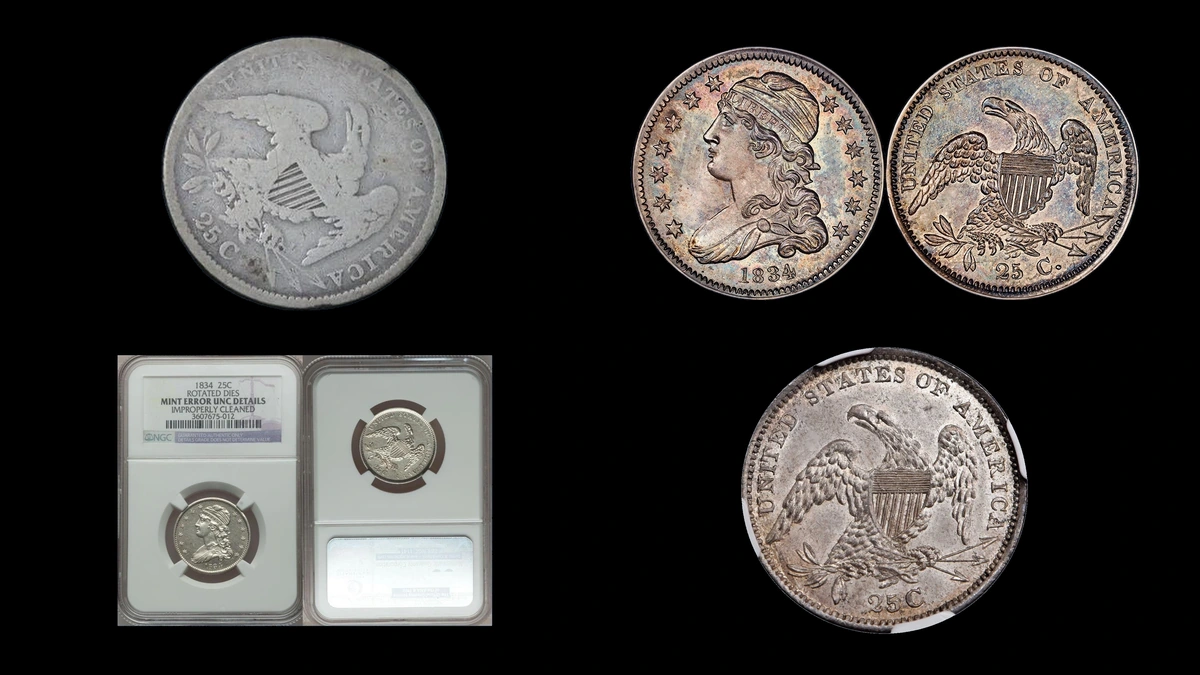
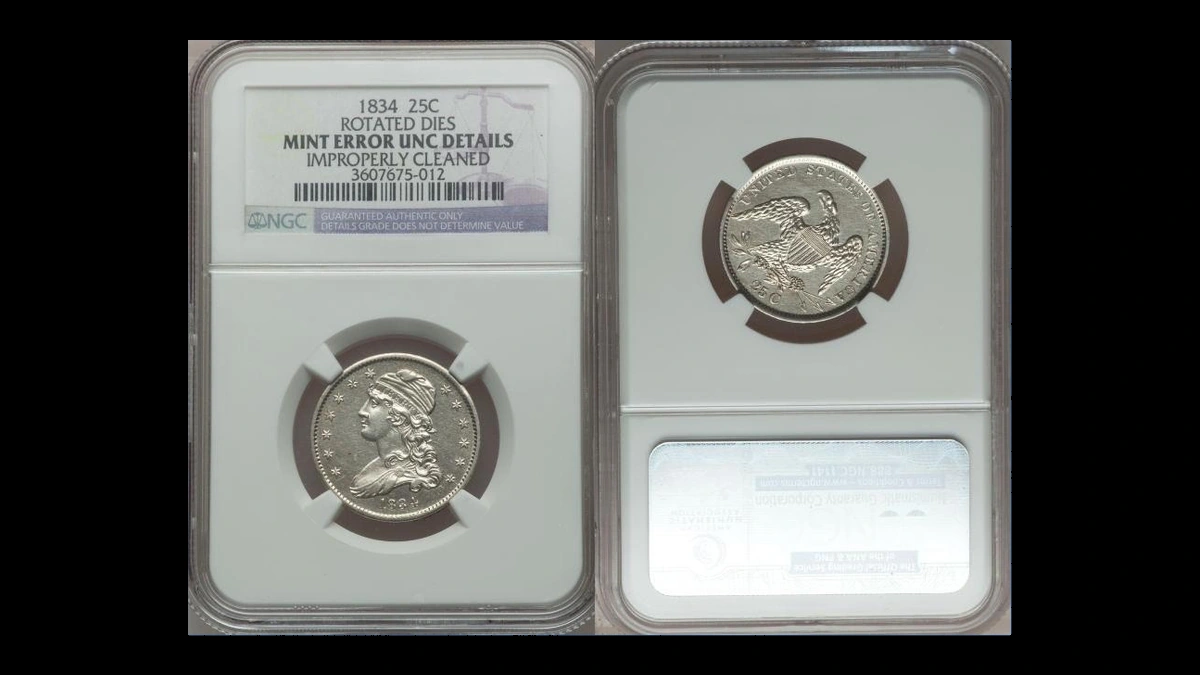
An 1834 quarter with rotated dies sold for $180 in May 2019. The 1834 quarter errors and die features below have estimated whole-coin values of $100–$3,000 across the stated conditions.
Test the alignment of the two faces, then examine the lower portrait, faint transferred outlines, and reverse letter remnants.
| Where to look | Feature | Whole-coin range |
|---|---|---|
| Reverse after a top-to-bottom flip | Rotated dies | $150–$2,500 |
| Lower portrait and thirteenth star | Crossing die crack | $100–$2,000 |
| Chin, ear, and hair | Die clash traces | $100–$2,000 |
| OF and AMERICA | Recut reverse letters | $100–$3,000 |
1. 1834 Quarter The eagle stays tilted after a controlled flip: rotated dies Error
The dies were meant to produce a normal relationship between the portrait and eagle. If one tool turned from that alignment, the reverse can remain tilted after the upright portrait is flipped top to bottom.
A recorded NGC VF25 example has no angle specified in the written account. A separate collector-owned coin is described as 50 degrees clockwise, with NGC Uncirculated Details status and cleaning noted.
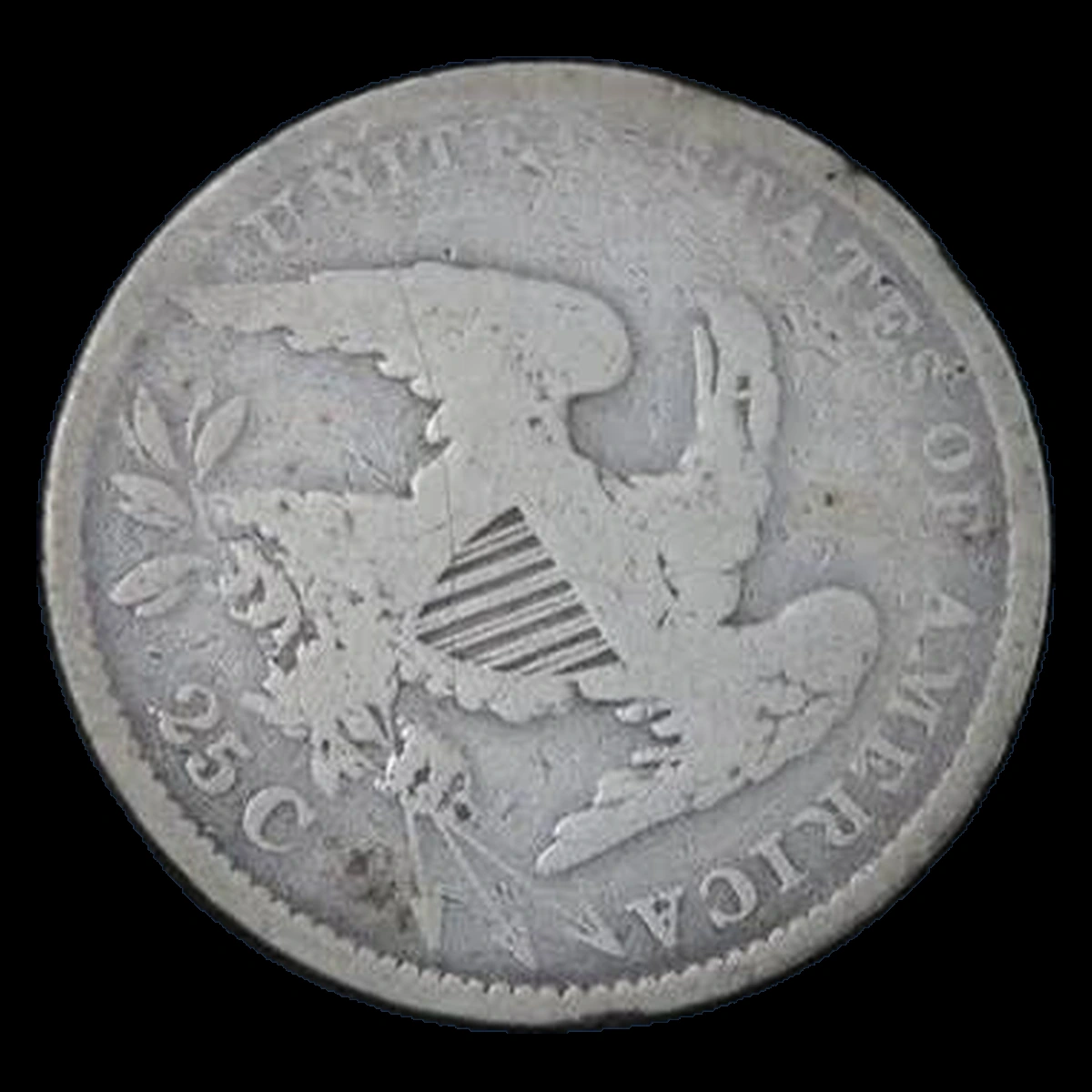
How to Identify
Practice with a normal quarter by holding its portrait upright and turning it around a horizontal axis. The reverse should finish upright when the motion does not include a sideways twist.
Repeat with the 1834 coin and record a continuous flip or aligned photographs. A sealed coin can stay in its holder throughout the check.
Measure the candidate’s own angle from the photographs. Do not assign 50 degrees to the VF25 example or another coin merely because the collector’s specimen has that reported rotation.
What It’s Worth
Genuine rotated examples have an estimated whole-coin range of $150–$2,500 from circulated through lower unworn condition.
PCGS records the NGC VF25 coin at $180 in a May 2019 Heritage sale. The matching certification also appears in a 2023 GreatCollections listing with the price hidden.
The separately owned cleaned 50-degree coin should not inherit that sale price. Its unworn detail and surface problem both belong in its own comparison.
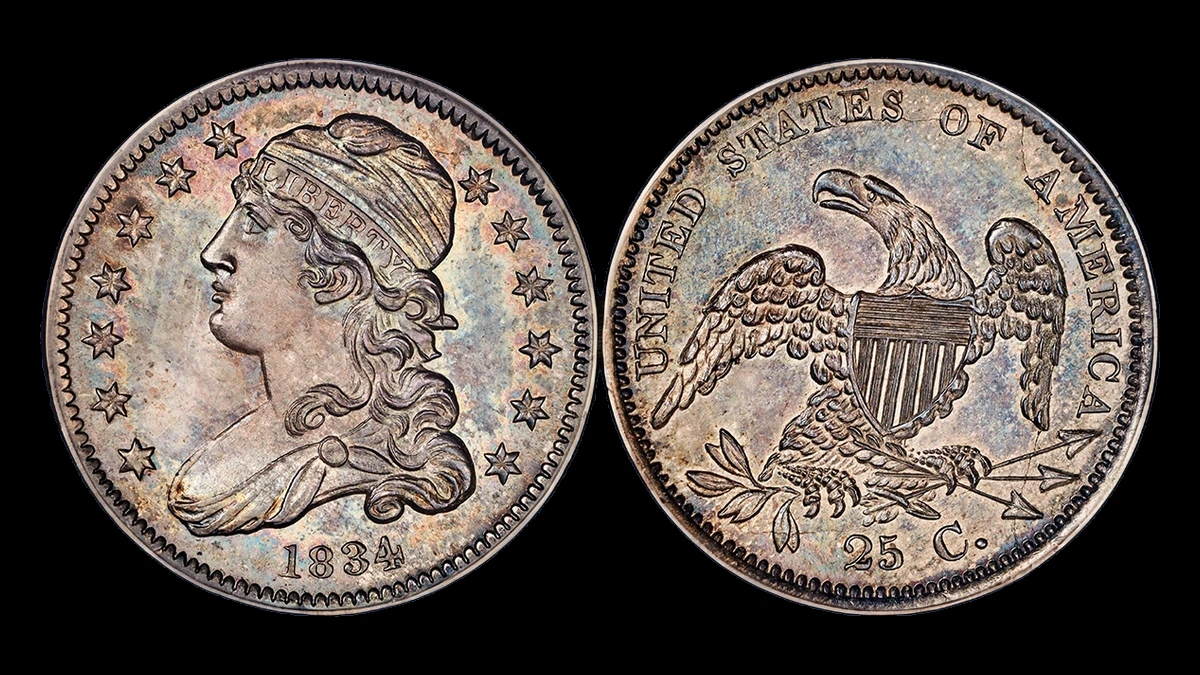
2. 1834 Quarter A raised line crossing the lower portrait: die crack Error
A collector describes a crack starting near 4:30, crossing the thirteenth star, and curving into a curl toward 7:30. PCGS also describes a crossing front crack developing on Browning-1.
The ridge formed when silver entered a split in the die. It is not an opening through the quarter’s own metal or a large raised rim patch from a missing die piece.
How to Identify
Set the date upright and locate the thirteenth star at the lower right. Follow the raised route from the 4:30 edge through that star and onward across the lower portrait toward the 7:30 border.
Move the light to distinguish the ridge from normal hair detail and scratched channels. Examine interruptions carefully before combining several unrelated marks into one crack.
What It’s Worth
Identifiable crack-bearing examples have an estimated whole-coin range of $100–$2,000 in worn through lower unworn condition.
The collector’s example has unworn detail but was cleaned, and also carries the rotation and clash marks described here. These features do not create three separate whole-coin prices to add together.
3. 1834 Quarter Extra outlines beneath the chin and ear: die clash Error
The same collector reports strong clash traces below Liberty’s ear, within the hair, and beneath the chin. A clash begins when the dies meet without a blank and acquire marks from the opposing design.
Later coins then carry those transferred shapes alongside their intended artwork. The collection entry supplies the owner’s observations, rather than independent grading-service certification of each small trace.
How to Identify
Begin below the chin, then compare the ear and hair areas. Relate the extra outlines to the eagle-side design instead of treating any curved line as a clash.
Keep the crossing crack separate from the faint transferred shapes where their locations approach one another. Full-front photographs help preserve that distinction.
Ordinary hair strands and scratches cutting into the silver do not establish opposing-design traces. Several matching points in a reference are more persuasive than an isolated resemblance.
What It’s Worth
Recognizable clash examples have an estimated whole-coin range of $100–$2,000 across worn through lower unworn condition.
No separate sale is supplied for the owner’s clash-bearing coin. Its cleaning remains relevant despite its unworn detail and additional crack and rotation.
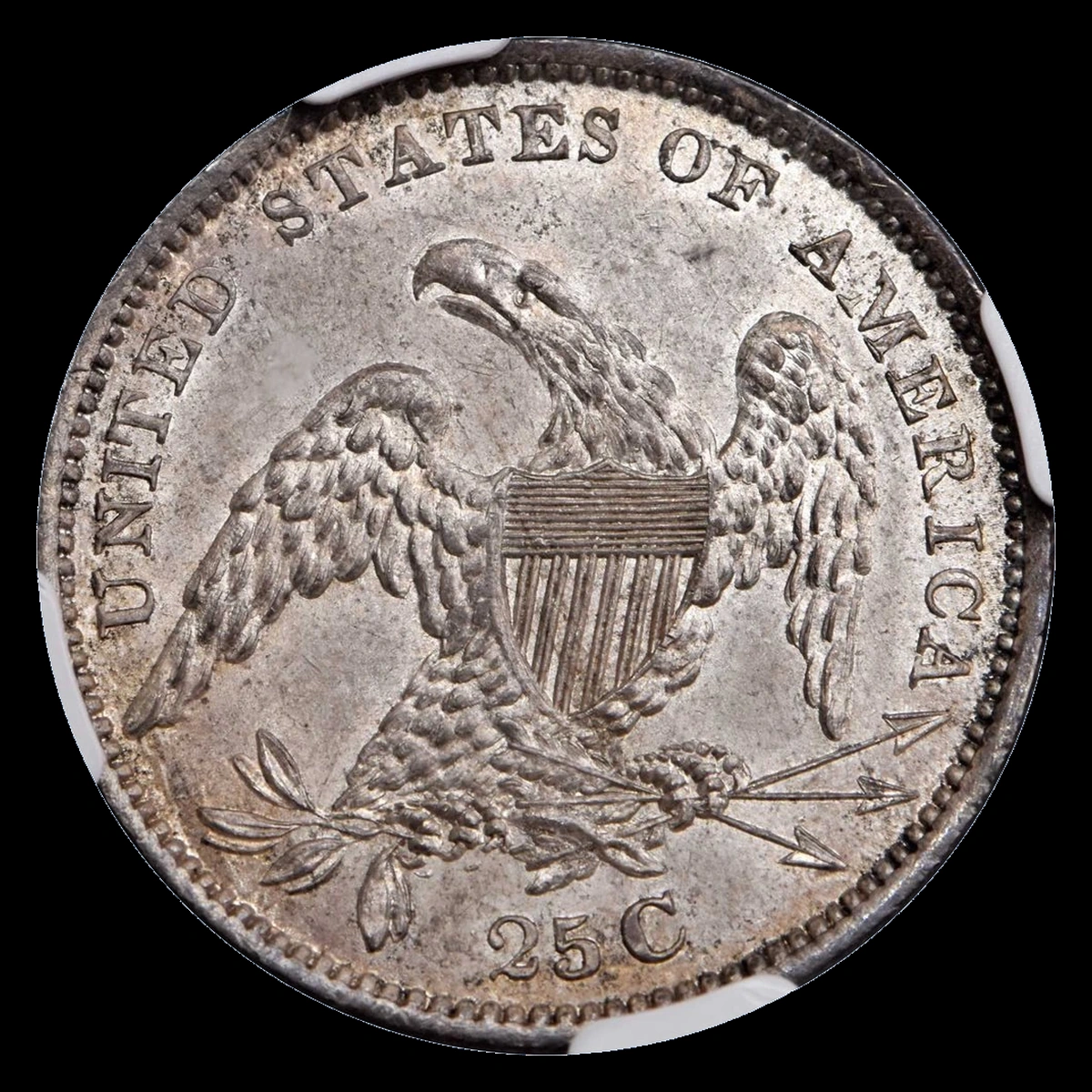
4. 1834 Quarter Extra F and A remnants on the reverse: recut legend Error
An early Browning-1 reverse has a second F between the normal O and F. The top of an earlier A also appears between OF and AMERICA.
The inscription was entered again during die preparation, leaving parts of previous letters. The old O/F nickname does not fully describe these two separate remnants.
This reverse also has two lines in each shield stripe and no period after the denomination. Later die polishing could remove the extra-letter traces.
How to Identify
Find the extra F between O and F before moving right to the earlier A above the space preceding AMERICA. Photograph both remnants together to preserve their spacing.
Check the shield stripes and the area after 25 C for the supporting reverse details. General thick lettering is not a substitute for the matching remnants.
Their absence needs interpretation because later polishing can weaken or remove them. For a clear recut-letter example, visible F and A traces remain the most direct comparison.
What It’s Worth
Examples with recognizable extra letters have an estimated whole-coin range of $100–$3,000 in worn through modest unworn condition.
No individual realized sale is supplied for the recut-letter feature. Wear, cleaning, and marks crossing the inscription affect how useful any comparison will be.
Conclusion
The flip test addresses die rotation, while close inspection separates a raised crack, transferred clash traces, and earlier reverse letters. Each feature requires its own comparison.
Three occur together on the collector’s cleaned coin, but the VF25 auction result belongs to a different specimen. Keep condition, measured angle, and reported marks attached to the correct coin when using the estimated whole-coin ranges.