Rare 1989 Quarter Errors (List & Pictures)
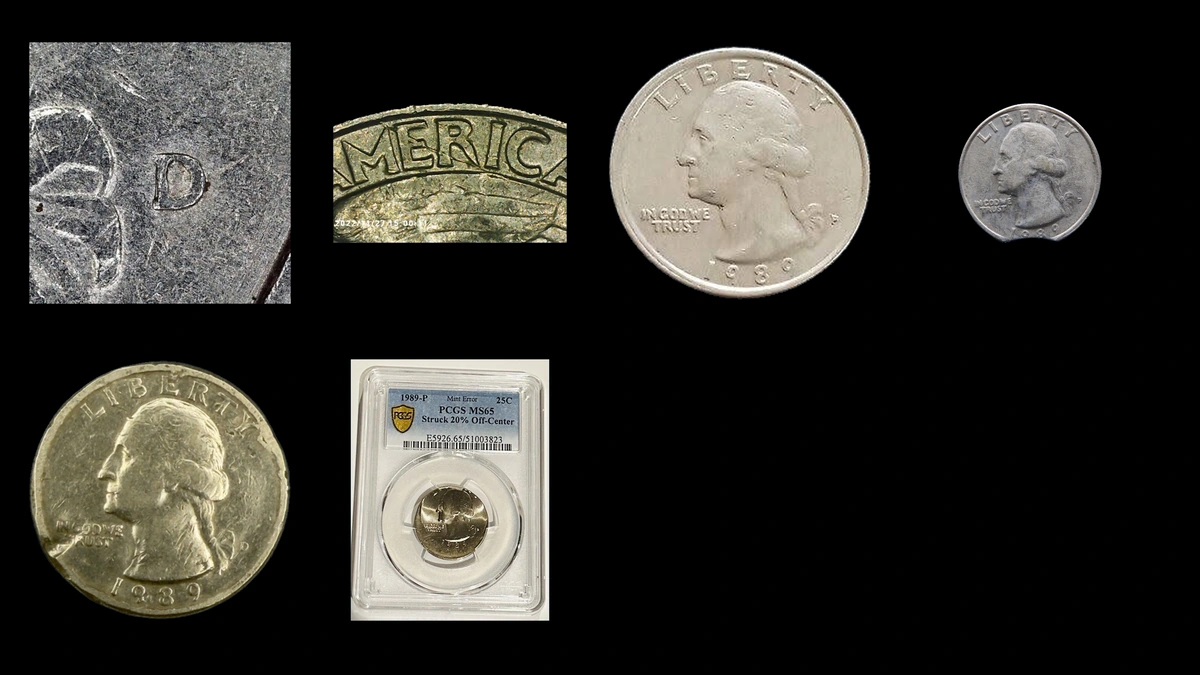
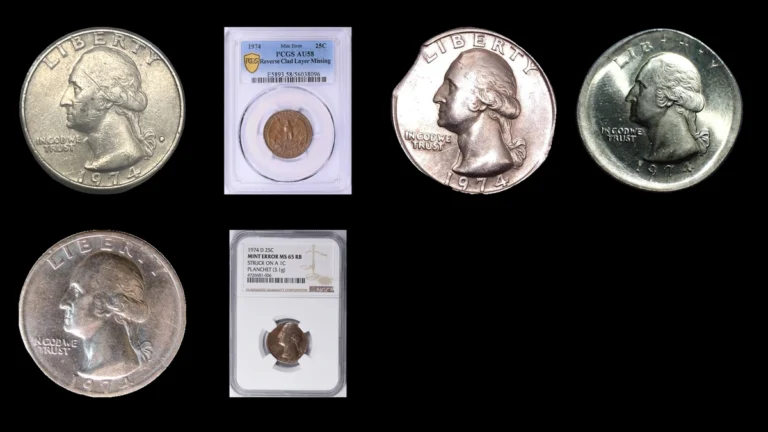
A missing P, a filled P, and an extra P outline lead to different explanations for 1989 quarter errors. The strongest supplied sale is $2,280 for a 1989-P quarter struck on a cent blank in January 2018.
Estimated whole-coin values span $2–$5,000. Begin with the mintmark and face details, then examine orientation, the metal boundary, and the coin’s complete outline.
| Clue | Possible group | Estimated value |
|---|---|---|
| Faint or absent P | Grease-blocked detail | $5–$150 |
| Extra mintmark outline | Repunched mintmark | $10–$500 |
| Repeated face details | Doubled die | $10–$400 |
| Raised line, lump, or rim patch | Cracks, chips, cuds | $2–$500 |
| Shifted or turned design | Misaligned or rotated die | $5–$300 across groups |
| Copper exposure or a smaller blank | Layer loss; wrong planchet | $50–$4,000 |
| Gap, step, expanded or displaced design | Clip; partial collar; broadstrike; off-center | $15–$5,000 |
| Mirrored or repeated pictures | Brockage; additional strikes | $50–$3,000 |
1. 1989 Quarter A P That Fades or Disappears: Grease-Blocked Detail Error
The expected P sits just right of Washington’s hair ribbon. Grease filling the corresponding recess in the die can prevent the mintmark from forming while nearby detail survives.
This No-P explanation differs from a mintmark omitted during die preparation. Separate Philadelphia grease-struck examples do not specify a missing letter and are not automatically No-P coins.
How to Identify
Compare the mintmark location with a normal Philadelphia quarter under changing light. Faint remaining strokes may become visible even when the P initially looks absent.
A P whose outer outline remains but whose center is filled is a different appearance. Also inspect for scraping, a lowered hollow, or disturbed metal that may indicate removal after striking.
For another grease-struck example, locate its actual weak patch and follow the transition from sharp detail. Do not impose a missing P where the certified description identifies only a general grease strike-through.
What It’s Worth
$5–$150 is the supplied estimate for genuine grease-blocked detail. A clearly absent P beside a sharp original portrait generally makes a stronger comparison than slight weakness on a worn coin.
PCGS explains the grease-related 1989 No-P feature and historically quoted $25–$60. Those figures are older guidance, not recent completed sales.
2. 1989 Quarter An Earlier Letter Beside the Mintmark: Repunched Mintmark Error
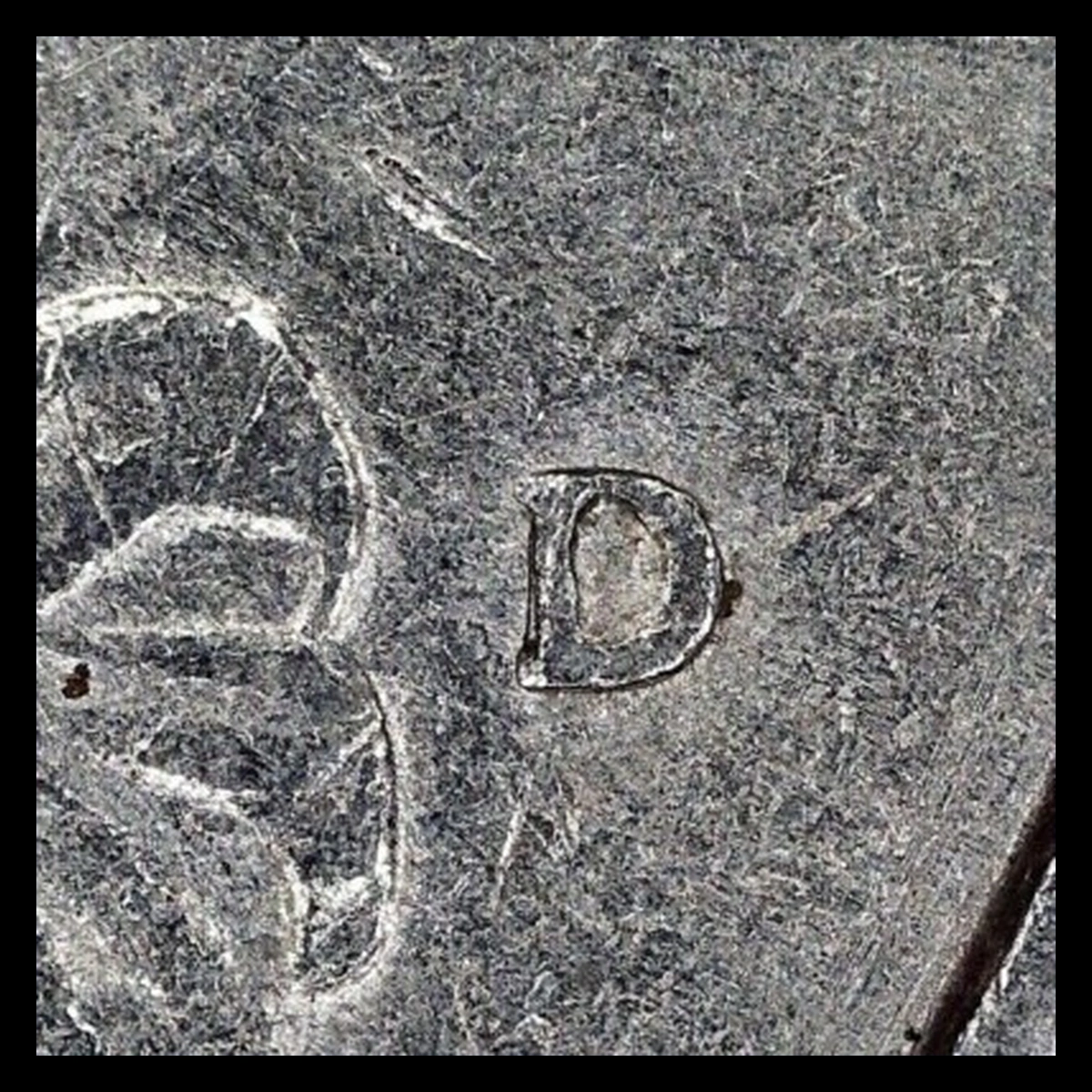
The cataloged Denver pattern retains an earlier D outline toward the left, or west. A second impression of the hand-applied mintmark punch left part of the first shape in the die.
The separate Philadelphia repunched-P report has no established matching pattern or direction. It needs its own evidence rather than a transfer of the Denver diagnostics.
How to Identify
Trace the curved remnant to the left of D and compare it with the main letter. The added shape should make sense as part of another D rather than a random lump.
Change the light while keeping the mintmark upright to distinguish fixed raised detail from reflections. Dirt, corrosion, or displaced metal at the junction can create deceptive outlines.
For a Philadelphia candidate, require a recognizable earlier P and an independent comparison. Neither a filled center nor an absent mintmark demonstrates repunching.
What It’s Worth
$10–$500 is the supplied estimate for confirmed repunched mintmarks of differing clarity and preservation. The upper range needs an identifiable earlier letter and attractive surfaces.
The Denver attribution provides a specific western outline to compare, while the Philadelphia report remains conditional. No completed transaction is supplied for either here.
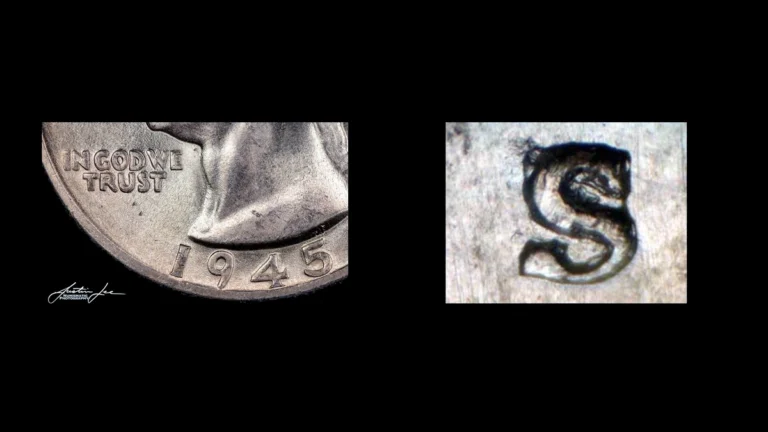
3. 1989 Quarter Repeated Letters, Braid, or Branch Detail: Doubled Dies Error
Philadelphia’s cataloged front variety begins at LIBERTY, while Denver’s cataloged reverse affects the country name, QUARTER DOLLAR, and the right branch stem. Each pattern was repeated in its die before the coin was struck.
The San Francisco Proof has light separation at TY, the braid, mintmark, and ribbon ends. Additional Denver-front and Philadelphia-reverse reports lack exact catalog matches in the supplied material.
How to Identify
Match mint and face before choosing a reference. An S Proof needs its collector finish established along with the small repeated details; a shiny ordinary coin is not automatically a Proof.
The less-specific Denver-front report mentions LIBERTY and the eye or ear, while the Philadelphia-reverse report includes QUARTER DOLLAR. Retain their provisional identity until their own pattern is matched.
Compare several rounded repeated contours under magnification. Flat shelves caused during striking or thick worn letters do not establish the same doubled tool.
What It’s Worth
$10–$400 is the combined supplied estimate: $10–$250 for identified ordinary-strike varieties and $20–$400 for the Proof comparison. These ranges concern recognizable patterns rather than any thick letter.
Unworn surfaces preserve small separations more clearly. Scratches and wear may obscure the evidence needed for attribution, even before their effect on appearance is considered.
4. 1989 Quarter Raised Lines, a Face Dot, or a Filled P: Die Damage and Related Reports Error
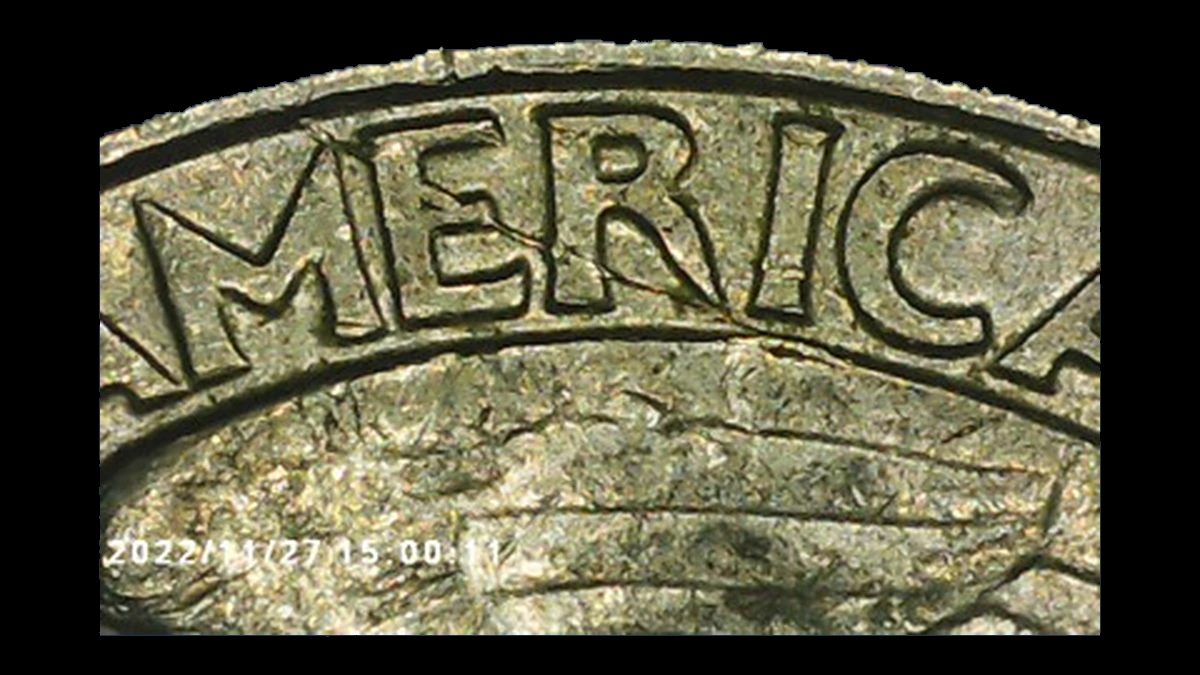
A crack in a die may leave a ridge, while a chipped-out piece can leave a raised lump. A larger break joined to the rim produces a cud that replaces normal design.
The reports include reverse cracks and a cud without fixed mint or location, plus Philadelphia examples with a dot in front of Washington or a filled P. The filled letter’s cause remains unresolved rather than automatically proving a chipped die.
How to Identify
Find a claimed cud’s actual rim connection and the design it replaces. A small dot within the face area is an interior feature and requires a different description.
Inspect the dot without scraping, because attached material can resemble raised coin metal. For a filled P, preserve the outer letter in the photograph and examine what occupies its center.
On a reverse line, use changing light to distinguish a raised ridge from an incuse scratch with pushed-up edges. The full-face view should connect the close-up to the appropriate letters or rim.
What It’s Worth
$2–$500 is the supplied overall estimate, with roughly $2–$25 for tiny authentic cracks or chips and $50–$500 for larger clear rim breaks. Visibility and preservation account for much of the difference.
A filled P needs its cause established before an error premium is assigned. Dirt or added material in the letter does not belong in a die-failure comparison.
5. 1989 Quarter Unequal Border Width on the Front: Reported Misaligned Die Error
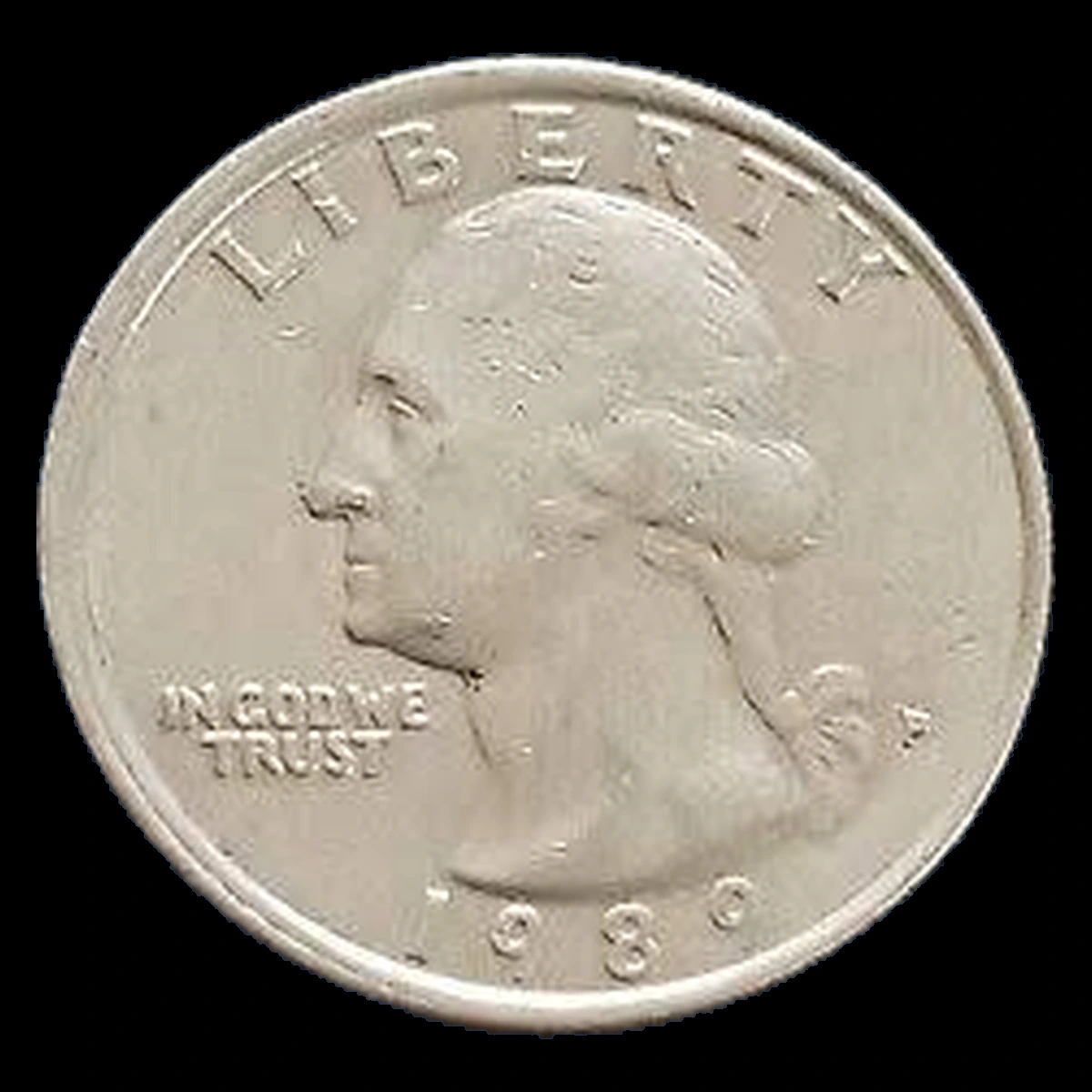
The Philadelphia report emphasizes spacing at Washington’s right and lower-right border. A die shifted sideways can move its own design while leaving the other face centered.
This differs from an off-center blank affecting both designs. Camera angle and local rim damage can also exaggerate border differences.
How to Identify
Photograph Washington directly overhead with the entire rim visible, then do the same for the eagle at equal scale. Compare the front’s right-side spacing with the opposite border and with the reverse centering.
A centered eagle behind a displaced portrait supports front-die misalignment. Inspect narrow areas for folding or impact flattening that changed the rim without moving the whole design.
What It’s Worth
$5–$75 is the supplied estimate for a clear authenticated minor misalignment. Very slight differences can add little.
The reported Philadelphia candidate needs a two-face comparison before the range applies. A cropped portrait image cannot establish what happened on the reverse.
6. 1989 Quarter A Turned Eagle After Flipping the Coin: Reported Rotated Die Error
A die turned around its own center changes the relative orientation of the two faces. One year guide reports a 180-degree rotation without an established mint, while a collector separately recalled a Philadelphia example about 140 degrees clockwise.
These accounts require their own confirmed specimens and do not identify one shared coin. Die orientation is also separate from which die moves in the press.
How to Identify
Practice with a normal quarter, holding Washington upright and flipping top to bottom around a horizontal axis without a sideways twist. The eagle should finish upright.
Repeat with the candidate and record both positions against fixed guide marks. Do not rotate the images afterward or allow the coin to turn unnoticed inside a loose holder.
Measure the actual result instead of imposing either reported angle. A consistent wrong orientation is more useful evidence than the way two seller photographs are arranged.
What It’s Worth
$10–$300 is the supplied conditional estimate for genuine 1989 rotations. Large easily repeated turns generally offer more interest than slight deviations.
Neither report supplies a completed auction price. Original surfaces and clear upright design landmarks help demonstrate the effect.
7. 1989 Quarter Copper Exposed Across Part or All of a Face: Missing Clad Layer Error
A quarter’s pale outer metal is bonded to a copper center. Complete layer-loss reports for 1989 establish no specific face-and-mint combination, while a separate Denver report concerns partial loss.
Partial loss leaves some pale metal alongside exposed copper. A 1989-S Proof is normally clad too, so silver-colored Proof surfaces do not imply a silver composition.
How to Identify
Copper along an ordinary quarter’s edge is expected; the proposed error exposes it across a face. On a partial-loss candidate, trace the actual boundary between copper and remaining pale metal.
Examine original design at that boundary for layer structure rather than chemical pits or scraping. A loose coin below the normal 5.67 grams supplies supporting information, but damage can also remove weight.
Record both faces and the edge without cleaning. Color by itself cannot distinguish layer loss from staining or other later changes.
What It’s Worth
$50–$1,000 is the supplied estimate for authenticated partial or complete layer loss. The affected area and preservation determine the closest comparison.
A 1993-D missing-layer quarter in ANACS MS62 Red sold for $156 in November 2020. This different-year result does not establish a 1989 mint-and-face identity.
8. 1989 Quarter The Quarter Portrait on a Cent-Sized Disc: Wrong Blank Error
The documented 1989-P cent-blank quarter retains its date and P while losing all of LIBERTY beyond the smaller disc. NGC graded it MS63 Red and recorded a weight of 2.5 grams.
Its blank is copper-coated zinc, not solid copper. A separate dime-blank report establishes neither a mint nor a certified specimen and needs a different comparison.
How to Identify
Identify Washington’s quarter design and examine how the outer details meet the small original boundary. The recorded cent example’s missing LIBERTY and readable date are specific features of that coin.
Compare a loose candidate’s weight with the recorded 2.5 grams and the normal quarter standard of 5.67 grams. A dime blank normally weighs 2.27 grams and has clad layers, but that is a reference specification rather than a measurement of the unverified 1989 report.
Inspect for edge filing or an added coating before requesting metal testing. Do not scratch through the cent blank’s thin copper surface to reveal its zinc center.
What It’s Worth
$300–$4,000 spans the supplied group estimates, with $800–$4,000 for comparable genuine cent-blank strikes and $300–$2,000 conditionally for an authenticated dime-blank example. The actual substitute blank must be established first.
The NGC MS63 Red cent-blank quarter sold for $2,280 on January 5, 2018. Its readable year and mint retain a strong identity despite the missing outer word.
9. 1989 Quarter One or Two Curved Gaps: Clipped Blanks Error
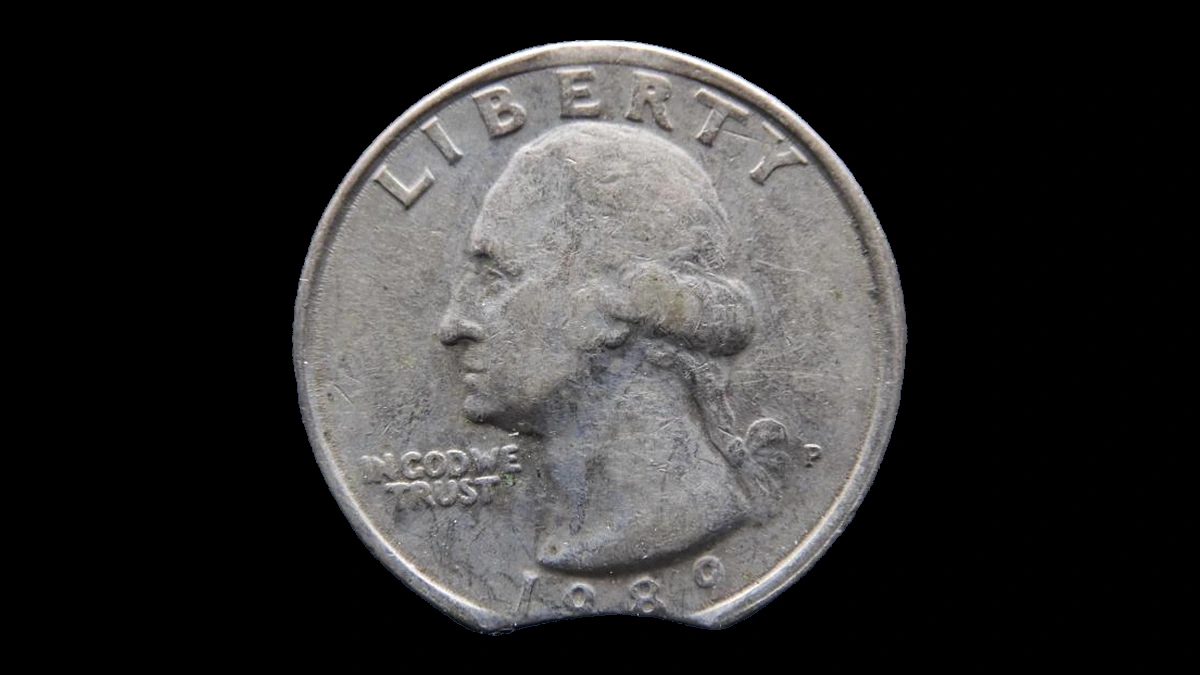
A blanking punch overlapping an earlier opening in the metal strip can create a curved missing section. The incomplete disc then receives the quarter design.
Single curved clips are reported without one established mint. A particular Denver double clip has about 5% missing near two-thirty and 3% near eight o’clock.
How to Identify
Keep both Denver gaps in one full-face view before enlarging their endpoints. Other clips must retain their own positions and measurements.
Inspect where the struck rim approaches each opening and consider any opposite-rim weakness as supporting evidence. Saw lines, burrs, or filing may show removal after the design formed.
Compare both faces at the gap rather than judging only its curve. A single-clip candidate need not fit the Denver two-gap arrangement.
What It’s Worth
$15–$600 is the supplied estimate for authentic 1989 clips. Readable identity and convincing original edge surfaces are important alongside the amount missing.
No completed sale is provided for the Denver double clip. Its two gaps form one coin and must not receive two separately added valuations.
10. 1989 Quarter A Step Between Edge Bands: Reported Partial Collar Error
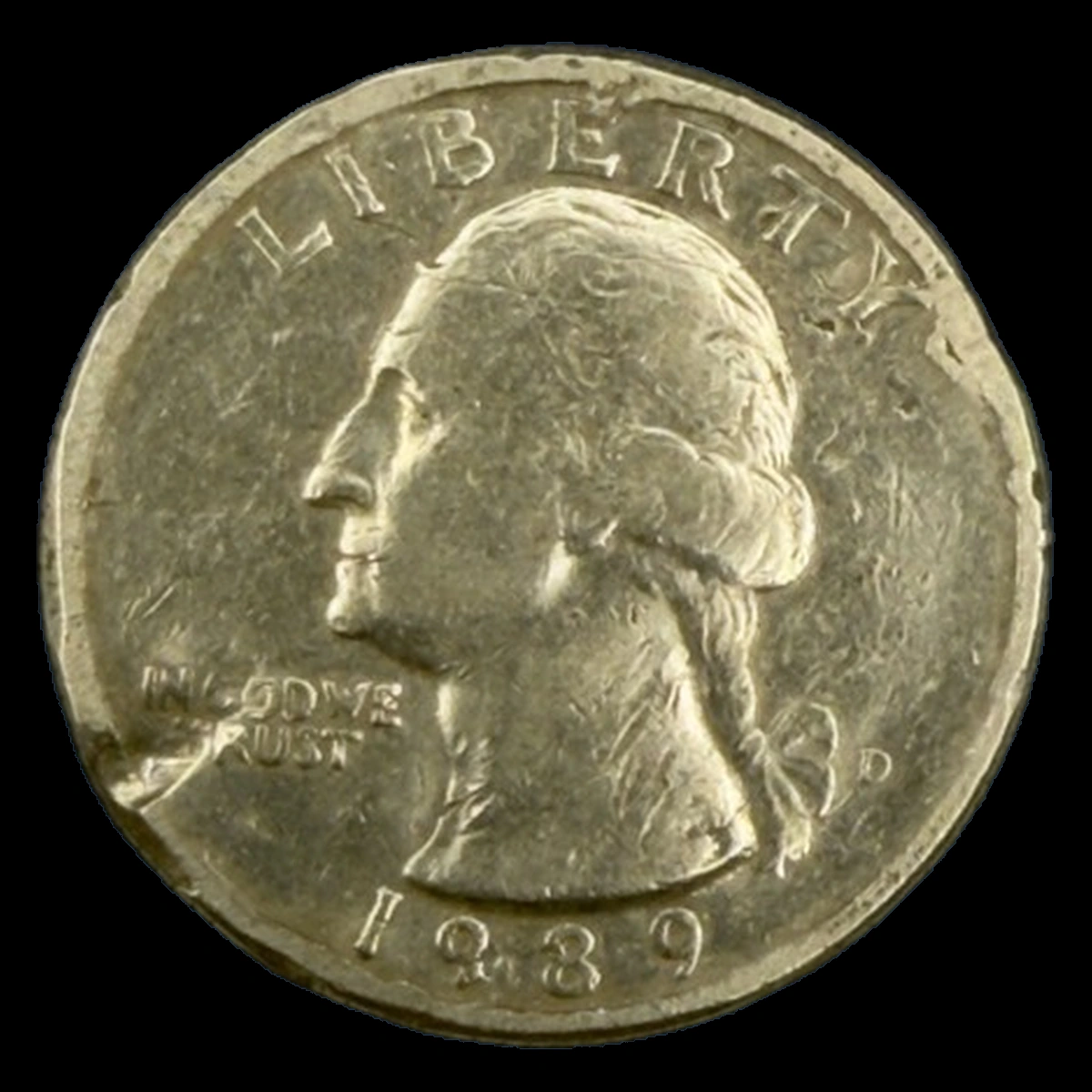
A seller described a Denver candidate as a partial-collar strike, while some accounts also call it a broadstrike. The physical question is whether one band remained confined while another spread beyond the collar.
The collar is the ring that limits width and forms the edge grooves during striking. A two-level side profile needs to demonstrate partial engagement rather than simply a wide or battered rim.
How to Identify
Turn the coin while viewing its edge at eye level and follow the different-width bands. Compare the narrow section’s grooves with a normal quarter.
Changing light helps separate a real ledge from a reflection. Flattened grooves, folded metal, and impact marks may instead explain a locally crushed edge.
Photograph several edge sections and both full faces. The original collar-contact band should explain the step more convincingly than the seller’s terminology.
What It’s Worth
$50–$600 is the supplied working estimate for an authenticated Denver partial-collar quarter. The reported candidate needs the edge structure confirmed before that range applies.
The source supplies no completed result for the specimen. Clarity of the step and absence of later edge damage affect the comparison.
11. 1989 Quarter Complete Designs in an Expanded Outline: Broadstrikes Error
A Philadelphia broadstrike was cataloged in ANACS MS64. A separate Denver example has an uncentered design inside widened metal, showing that a broadstrike need not have an evenly centered picture.
The Denver coin has a strong reverse rim and four short lines between about two-forty-five and four o’clock. Those lines formed in one downward stroke, not four complete strikes.
How to Identify
For the Philadelphia coin, trace outer lettering on both faces to confirm the intended design remains complete. Inspect expanded metal for crushing that could indicate later hammering.
On the Denver example, compare its right-reverse lines and strong rim with the front’s outer blank margin. The American Numismatic Association explanation identifies a collar-contact trace and reconstructs the single downward stroke.
Those marks help establish which die moved in the press. That machine arrangement is not a rotated-die error and does not create several separately priced strikes.
What It’s Worth
$50–$1,000 is the supplied estimate for authentic ordinary broadstrikes and clear uncentered examples. Expansion and preservation of the full design determine the useful comparison.
No sale result is supplied for the studied Denver coin. Its extra lines add identifying interest but do not justify treating it as four errors.
12. 1989 Quarter A Backward Eagle on the Front: Partial Brockage with Broadstrike Error
A recorded Philadelphia quarter carries recessed reversed eagle-head, neck, and wing shapes near one o’clock on Washington’s side. The affected area covers about 30% of the front.
A previously struck coin acted as an unintended stamping surface, producing the mirror impression called brockage. This ANACS MS63 example also expanded as a broadstrike, and the coin that transferred the image was not included.
How to Identify
Keep Washington and the full rim visible while locating the backward eagle details. They should be recessed and reversed rather than ordinary raised artwork.
Verify the wider outline independently so both parts of the combined identification are supported. A close-up alone may conceal which face carries the extra image.
Later squeezing between coins can also leave backward impressions. The complete surface needs assessment for pressure damage before a reversed shape is accepted as genuine brockage.
What It’s Worth
$50–$1,500 is the supplied estimate for comparable authentic partial brockages. Recognition of the eagle and preservation of original surfaces affect appeal.
The documented brockage-and-broadstrike coin sold for $69 on September 11, 2004. That older whole-coin result already includes both features and does not price a missing partner coin.
13. 1989 Quarter Additional Large Designs or Opposite-Face Traces: Repeated Strikes Error
Double-strike reports for 1989 do not fix one specimen’s mint. A separate Philadelphia seller claim concerns a coin said to have flipped between blows, leaving cross-face traces.
The proposed flip-over sequence is unconfirmed. Die clashing or later squeezing may imitate some of the same unfamiliar shapes and must be excluded.
How to Identify
For an ordinary double strike, follow a repeated large letter into neighboring repeated artwork. The connected details should explain a coherent second impression.
The Philadelphia candidate reportedly has a wing near the neck and chest, inscription traces between Y and 9 and between L and 1, plus motto remnants on the reverse. These marks must fit one turning sequence rather than separate guesses based on familiar-looking lines.
Record whether each trace is raised or recessed and inspect for pressure damage. A specialist should distinguish genuine additional strikes from clash marks and post-Mint contact before confirming the complex claim.
What It’s Worth
$150–$3,000 spans the supplied estimates: $150–$1,500 for confirmed ordinary double strikes and $500–$3,000 conditionally for a convincing flip-over. Readable identity and understandable overlap are essential.
The seller’s proposed angle is not a verified sequence or completed price. Vague cross-face marks must be resolved before applying authenticated multiple-strike comparisons.
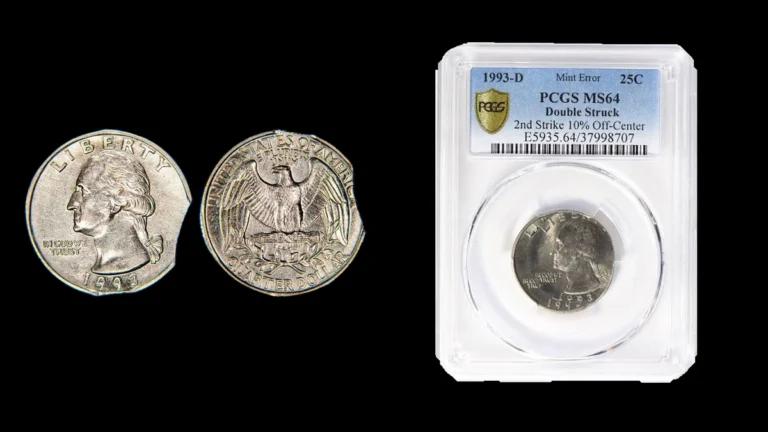
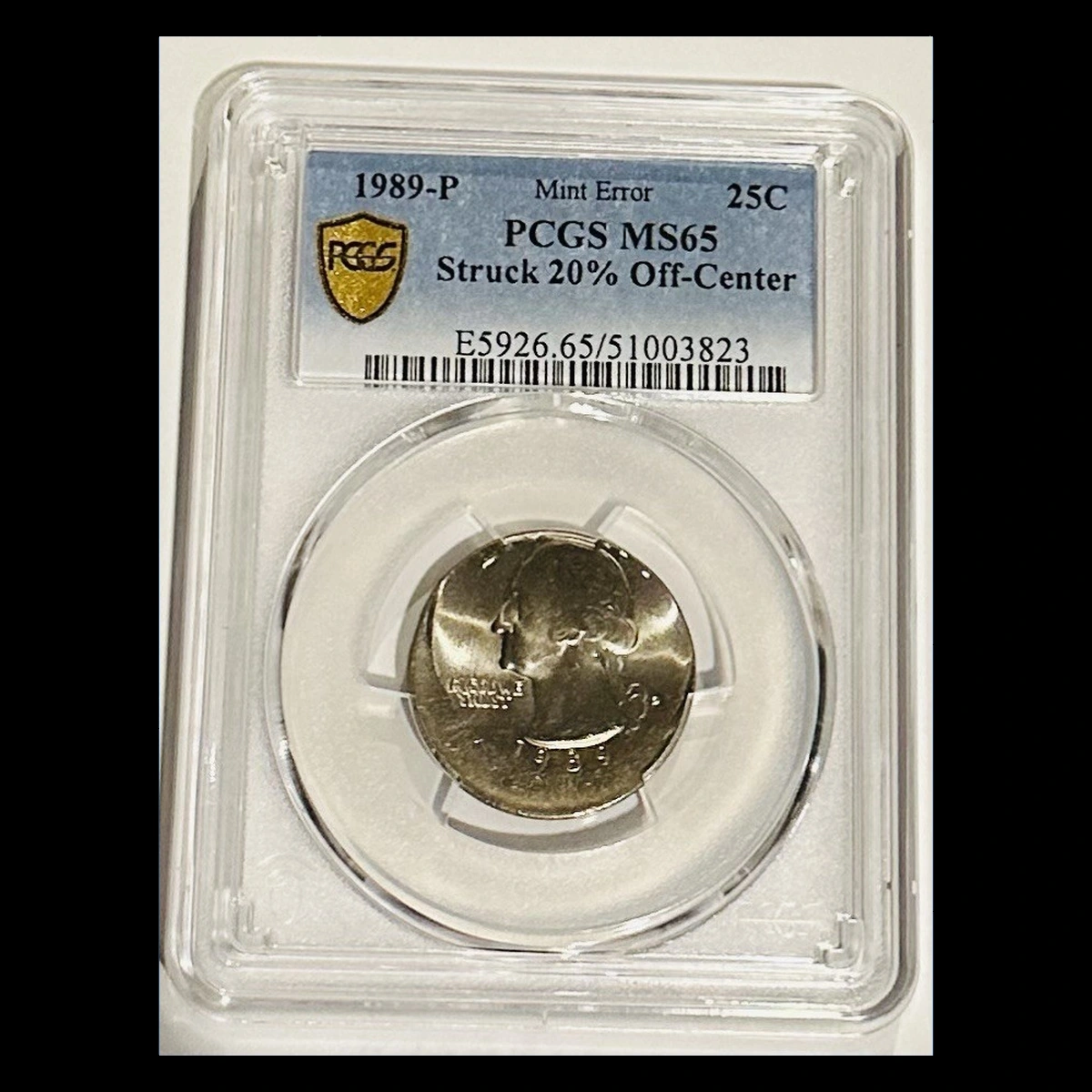
14. 1989 Quarter An Original Blank Crescent Beside Lost Design: Off-Center Strikes Error
Philadelphia examples are described at 10%, 15%, 20%, 35%, and 55% off-center. These percentages belong to separate coins whose blanks missed the proper striking position.
A Denver report supplies no fixed displacement. A reported San Francisco example would be a clad Proof and requires its own authentication of mint, finish, and error.
How to Identify
Find design running beyond the metal and corresponding original unstruck space. Both faces should reflect the same misplaced blank.
A full design inside a wide margin may be a broadstrike, while one shifted face behind a centered opposite face suggests misalignment. Keep each Philadelphia percentage tied to its own specimen.
For a claimed S Proof, verify the collector finish and readable S independently. All 1989 Proof quarters normally use clad metal, and a shiny Philadelphia coin is not a substitute comparison.
What It’s Worth
$25–$5,000 is the combined supplied range: $25–$1,500 for ordinary strikes and $500–$5,000 conditionally for an authenticated San Francisco Proof error. The Proof estimate does not establish a confirmed specimen or sale.
Surviving date, finish, displacement, and overall appearance determine the closest comparison. The largest percentage does not automatically command the highest price.
Conclusion
Keep the visible change and its cause together when examining a 1989 quarter. A missing mintmark differs from a filled or repunched letter, just as an expanded complete design differs from one displaced beyond the blank.
Preserve the original edge and surface, and retain each specimen’s mint, finish, measurements, and evidence status. Reported rotation or flip-over claims need confirmation before their estimates become useful, while combined features should be valued as one complete coin.