Rare 1981 Quarter Errors (List & Pictures)
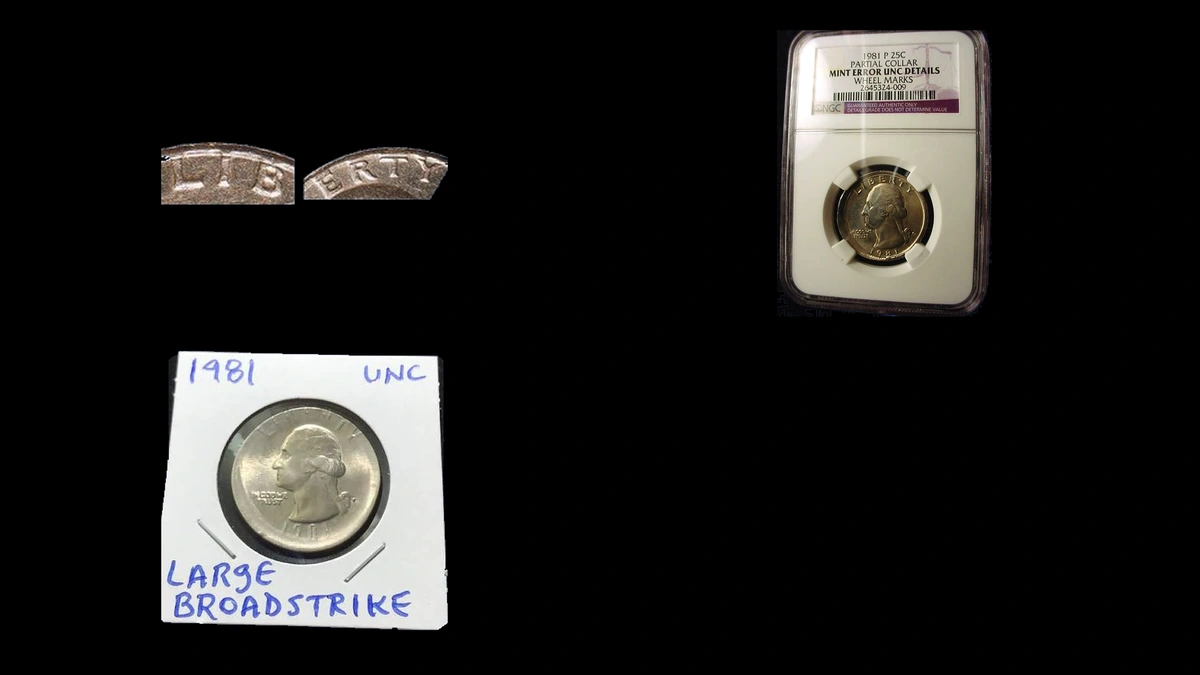
A Denver flipover double-struck quarter sold for $7,200 in August 2020. The 1981 quarter errors below span estimated prices of $5–$12,000, including minor die flaws and a matching two-coin pair.
Compare small raised details first, then the metal and edge, before interpreting displaced artwork or designs from another denomination.
| Visible clue | Possible category | Guide range |
|---|---|---|
| Raised line, repeated contour, or rim letter | Die flaw, doubled die, or rim duplication | $5–$500 |
| Changed covering or excess thickness | Cladding defect, missing layer, or thick blank | $30–$1,200 |
| Stepped, expanded, or displaced outline | Collar error, broadstrike, or off-center strike | $20–$2,000 |
| Distorted design or cup shape | Capped-die strike or die cap | $100–$3,000 |
| Incorrect blank or earlier coin design | Wrong planchet or double denomination | $150–$6,000 |
| Flipped strikes or matching pair | Complex striking combination | $2,000–$12,000 |
1. 1981 Quarter A raised line or filled mint letter: die cracks and chips Error
A fractured die can leave a raised ridge across the design. A small piece breaking inside the die’s mintmark can instead allow extra metal to fill part of P or D.
The supplied year reports do not establish a shared crack route or named variety. A faint mintmark is a different appearance that may come from weak or blocked detail.
How to Identify
Follow the line under side lighting and inspect for a cut running between raised scratch edges. A genuine die-crack ridge stands above the coin’s original surface.
At P or D beside Washington’s neck, distinguish raised filling from shadow, dirt, or shallow lettering. Do not scrape the opening to test it.
What It’s Worth
Minor genuine cracks or filled-letter die defects have an estimated range of $5–$250.
No completed sale is supplied for a particular pattern. A clear, developed break provides a stronger comparison than a tiny unexplained spot.
2. 1981 Quarter Inward repeated contours on letters and date: doubled die Error
Philadelphia WDDO-001 has inward spread on LIBERTY and the date. A weak raised dot to the upper right of the final 1 serves as a supporting marker.
Another catalog lists Philadelphia DDO-001 without an established equivalence to WDDO-001. Denver front doubling and reverse doubling reports also require their own patterns.
How to Identify
Use the Wexler photographs to compare the Philadelphia inward outlines and companion dot together. A doubled die contains the repetition before the coin is struck.
Reverse reports require separate checks through E PLURIBUS UNUM, the denomination, and eagle feathers. Rounded raised repetition differs from a flat shelf produced during striking.
What It’s Worth
Identified doubled-design varieties have an estimated whole-coin range of $10–$400.
No realized price is supplied for these named patterns. A second catalog label for an equivalent pattern would not create another premium.
3. 1981 Quarter Letter tips copied onto the rim: rim duplication Error
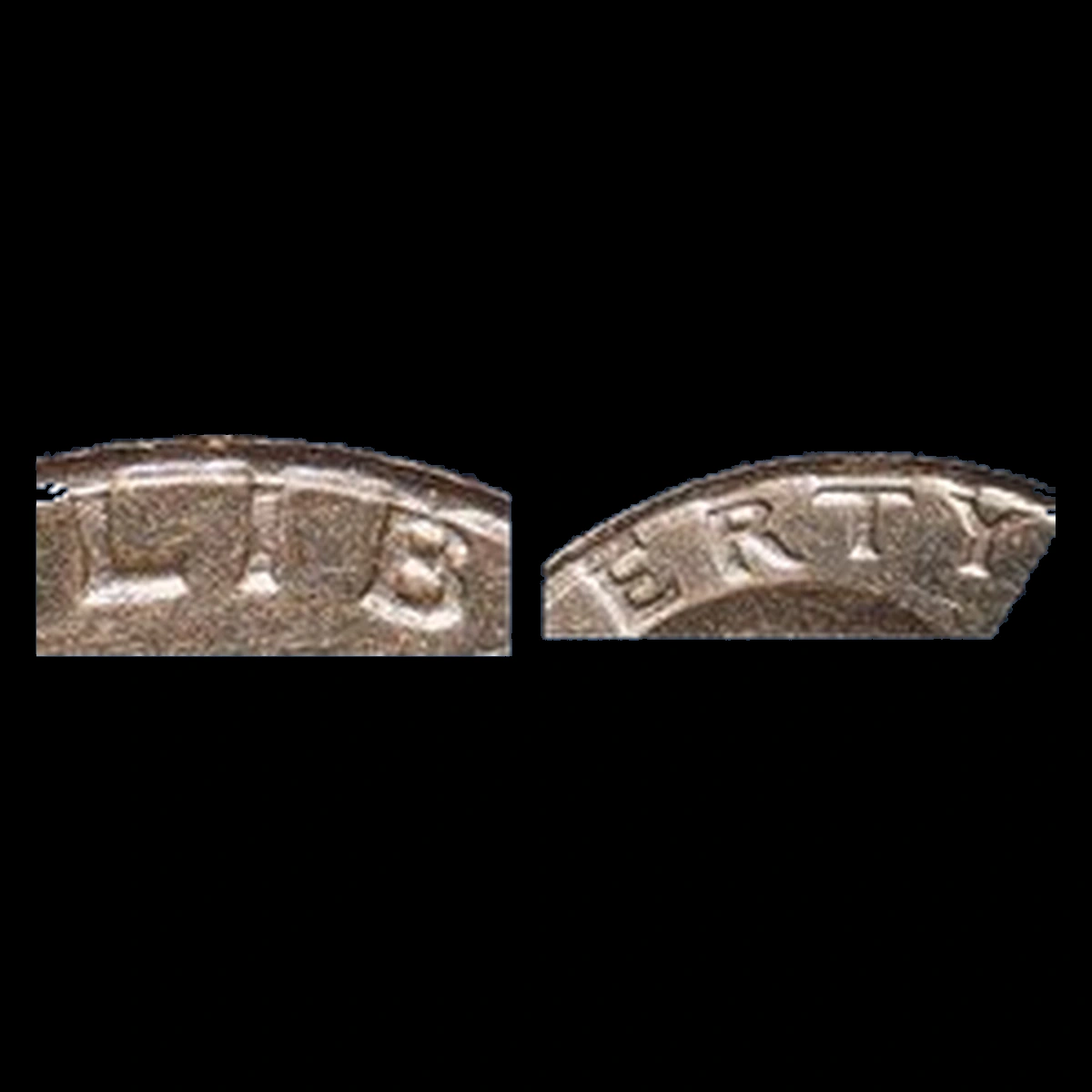
A Philadelphia coin has parts of LIBERTY repeated on the raised rim. Error specialist Mike Diamond examined it directly and identified copied letter tips and fine outward-flowing lines.
The spaces between those tips were flattened by the die surface. Separate sliding marks below BERT help distinguish this local event from a conventional doubled die or full second strike.
How to Identify
Compare the repeated tips above LIBERTY with the letters below them, including their spacing. Then inspect the flattened spaces and the separate lower BERT marks.
Diamond’s examination describes the combined evidence. If photographs cannot resolve the tiny height changes, the physical coin needs examination.
What It’s Worth
A confirmed comparable rim-duplication error has an estimated range of $50–$500.
The documented examination is an identification reference, not a completed sale. Ordinary rim damage does not qualify merely because it lies above LIBERTY.
4. 1981 Quarter A local reverse covering defect: defective cladding Error
A Philadelphia NGC MS63 quarter was cataloged with defective cladding on the eagle side. Its actual recorded weight is 5.6 grams.
Cladding consists of outer metal layers bonded to a copper center. A local bonding or covering defect can affect part of a face while leaving much of the outer layer intact.
How to Identify
Locate the boundary between affected and normal metal and inspect any connection with the edge. Scraping or corrosion can also create an irregular patch after striking.
A normal quarter weighs about 5.67 grams and measures about 24.3 millimeters across. The specimen’s 5.6 grams distinguishes it from the much lighter whole-layer-loss example below.
What It’s Worth
Authenticated local cladding defects have an estimated range of $30–$600.
The NGC MS63 reverse-cladding example sold for $312 in June 2023. Its result belongs to that coin’s actual defect and unworn condition with visible marks.
5. 1981 Quarter A largely copper face and lost weight: missing clad layer Error
A Philadelphia quarter graded ANACS MS62 Brown was cataloged at 4.73 grams with missing cladding. The text does not establish which face is exposed.
Denver examples are also reported, but require their own photographs and measurements. Brown color alone may be staining or toning instead of metal loss.
How to Identify
Compare both faces under the same light and inspect the remaining edge layers. Actual missing covering, reduced weight, and the exposed design should support one explanation.
Check for grinding, chemical roughness, or other removal after minting. Do not assign the Philadelphia specimen a particular affected side without its image.
What It’s Worth
Authenticated missing-layer quarters have an estimated range of $50–$1,200.
No completed sale is supplied for the 4.73-gram ANACS MS62 Brown coin. Its grade indicates an unworn coin with noticeable marks, while its weight is a specimen measurement rather than a requirement for all layer losses.
6. 1981 Quarter Excess original thickness: reported thick blank Error
A historical error-coin trading table lists a 1981-P quarter weighing 6.75 grams. It describes XF wear and separately notes a scratch on the front.
The report identifies thick metal without naming a foreign blank. Extra weight by itself does not reveal another intended country or denomination.
How to Identify
Check thickness around several edge positions, avoiding reliance on one raised rim. Weigh the loose coin on a checked scale and inspect for added plating, seams, or attached material.
Composition testing can help establish whether the excess belongs to the original blank. The front scratch remains a separate condition problem.
What It’s Worth
An authenticated thick-blank example of this kind has an estimated range of $50–$750.
No completed sale is established by the trading-table record. A worn, scratched specimen should not be treated as a pristine comparison merely because it is heavy.
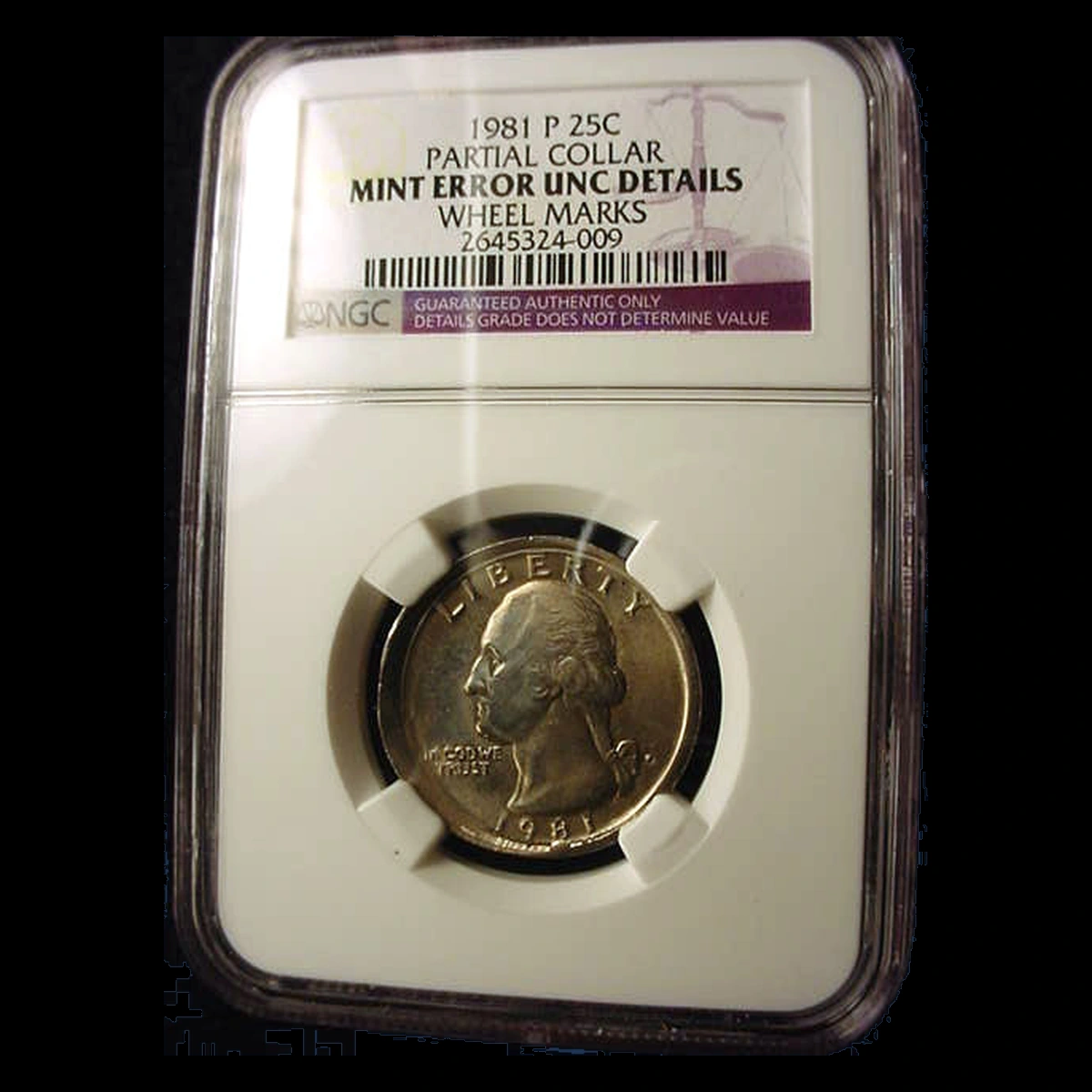
7. 1981 Quarter A stepped edge with partial grooves: partial collar Error
The collar is the ring that confines the blank and forms its grooved edge. If the blank sits only partly inside it, one section stays restricted while another spreads.
A Philadelphia example was cataloged by ANACS as AU Details with a net XF40 assessment because of damage.
How to Identify
View the edge in profile and follow the step between restrained and expanded metal. Surviving grooves beside the transition help explain the collar’s involvement.
Inspect nearby design for later squeezing or crushing. Keep the cataloged coin’s damage qualification with its description rather than presenting XF40 as a problem-free grade.
What It’s Worth
A genuine partial-collar 1981 quarter has an estimated range of $20–$500.
No individual sale price is supplied for the damaged ANACS example. A clear original step on intact surfaces offers a stronger comparison.
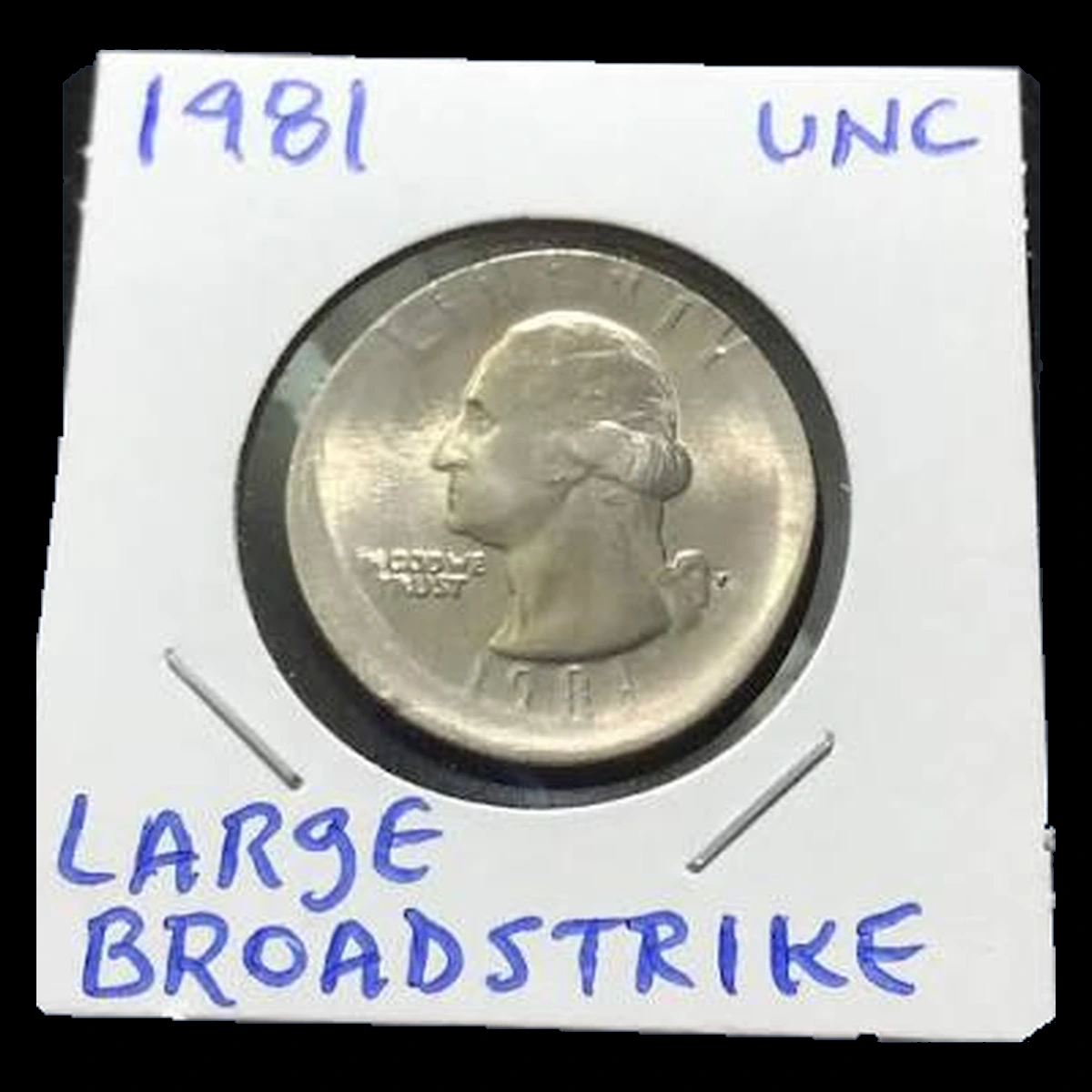
8. 1981 Quarter Complete design within expanded metal: broadstrike Error
A broadstrike spreads without normal collar restraint while retaining the intended design. Its outer border can be uneven without being a true off-center strike.
The general 1981 report establishes no particular mint or specimen. The special pair discussed later includes a broadstruck member with additional features.
How to Identify
Read the outer lettering on both faces and compare the expanded outline with normal dimensions. Check for hammering or squeezing that crushed an already finished design.
Missing artwork beyond the metal points toward off-center placement instead. A smooth edge from wear or filing alone does not prove unrestricted striking.
What It’s Worth
An ordinary authenticated broadstrike has an estimated range of $25–$800.
This range does not borrow the price of the matched pair’s broadstruck nickel overstrike. No completed sale is supplied for the general report.
9. 1981 Quarter An unstruck crescent, sometimes beside a clip: off-center strike Error
Philadelphia and Denver off-center strikes are reported for 1981. One Philadelphia CACG MS65 coin combines a 10% off-center strike with a 16% curved clip.
The clip is missing metal, while the unstruck crescent is metal still present without its normal design. They record different features on the same blank.
How to Identify
Locate the blank crescent and corresponding artwork lost beyond the opposite edge on both faces. Inspect a curved gap separately for original rim formation rather than later cutting.
The two percentages do not establish clock positions. Record each feature’s actual location and do not assign another specimen the cataloged coin’s measurements.
What It’s Worth
Genuine 1981 off-center strikes have an estimated range of $25–$2,000.
The 10% off-center, 16% clipped CACG MS65 example sold for $159 on June 29, 2026. That price covers the complete combined-error coin once.
10. 1981 Quarter Distorted detail from a covered die: capped-die strike Error
A coin stuck over a die can block or distort the next blank’s design. The dollar-like label “capped die” describes the covered tool, while the affected quarter is the later coin it struck.
A Philadelphia specimen received an NCS Uncirculated Details assessment with improper cleaning noted. The stuck cap itself is a different object.
How to Identify
Compare the transition from recognizable to distorted detail with the opposite face. Ordinary weak pressure or a small obstruction may soften detail without producing the same pattern.
The supplied description does not locate one affected face precisely. A matching reference and the holder’s full cleaning notation should accompany the photographs.
What It’s Worth
Comparable genuine capped-die strikes have an estimated range of $100–$1,500.
PCGS’s auction record lists the cleaned NCS example at $633 in July 2009. Uncirculated Details indicates no circulation wear but does not erase the cleaning problem.
11. 1981 Quarter A cup-shaped quarter: front die cap Error
A coin that stays on the front die can spread around it as further blanks arrive. Its sides rise into a cup, forming the die cap that may obstruct later strikes.
A Philadelphia 1981 front die cap was cataloged by NGC as Uncirculated Details with cleaning.
How to Identify
Photograph the side wall and the surviving front design at the base. Stretched metal and evidence of repeated contact differ from sharp bends imposed on a finished quarter.
Wall height alone cannot establish a strike count. Keep the cleaning qualification with the coin and do not flatten it or force it into a standard-size opening.
What It’s Worth
Genuine 1981 front die caps have an estimated range of $300–$3,000.
No realized price is supplied for the cleaned NGC specimen. Shape, recognizable design, and original surface quality influence its comparison.
12. 1981 Quarter Quarter artwork on another blank: wrong planchet Error
Philadelphia cent-blank and nickel-blank strikes are documented. The cent example graded NGC MS64 Red-Brown weighs 3.1 grams.
A PCGS MS62 dime-blank coin is shifted toward 2 o’clock with its mintmark beyond the metal. Another Philadelphia coin used a Dominican Republic twenty-five-cent blank and was graded ANACS AU53.
How to Identify
Compare the actual metal, edge, weight, and cropped artwork rather than assigning a denomination from color. The dime-blank specimen’s missing mintmark must remain unassigned.
The similar-looking Dominican blank needs specialist measurement and composition checks; slightly weak high points do not establish it. Visible older Jefferson or Monticello artwork would instead identify a finished nickel host.
What It’s Worth
The combined estimated range is $150–$4,000 across authenticated wrong-blank types.
The 3.1-gram cent-blank MS64 sold for $960 in April 2018, while a separate nickel-blank MS63 sold for $322 in July 2008. The Dominican-blank AU53 brought $178.25 in January 2003.
13. 1981 Quarter Jefferson or Lincoln remnants below quarter artwork: double denomination Error
A Philadelphia quarter over a finished 1981 Jefferson nickel was graded PCGS AU58. The nickel was flipped relative to the quarter design, leaving Monticello traces on Washington’s side and Jefferson details on the eagle side.
A separate guide reports a Lincoln-cent overstrike. It requires its own earlier cent artwork rather than the appearance of an unused copper blank.
How to Identify
On the quarter reverse, inspect above OF for the older FS designer initials and clothing lines, and below D STAT for nickel-date remnants. Here FS is not a variety catalog number.
On Washington’s side, look above IN for RICA, with other reported EP and building traces near 3 o’clock. Match several remnants and do not infer the nickel’s mint from the quarter’s P.
The Lincoln claim needs recognizable Lincoln or Memorial details on the same object. A small copper-colored quarter alone cannot establish a finished cent host.
What It’s Worth
Authenticated comparable double-denomination coins have an estimated range of $500–$6,000.
The quarter over the 1981 nickel sold for $990 in March 2023. That sale does not establish a confirmed Lincoln-cent overstrike result.
14. 1981 Quarter Two date-and-D impressions after a flip: double strike with indent Error
The Denver PCGS MS64 specimen turned over between strikes, preserving dates and mintmarks from both impressions. Its second date is sharper.
Another object left a partial indent across the lower reverse during the first strike. During the second, another blank stood between the coin and the eagle-side die, blocking that part of the process.
How to Identify
Locate each date-and-D combination on full photographs of both faces. Trace the older artwork beneath the sharper later impression while accounting for the coin having flipped.
Separate the first strike’s lower-reverse indent from the obstruction during the later blow. The marks need to explain one consistent sequence, not merely a crowded surface.
What It’s Worth
A comparable authenticated combination has an estimated range of $2,000–$10,000.
The PCGS MS64 flipover coin sold for $7,200 on August 15, 2020. The price covers its complete set of strike and contact features.
15. 1981 Quarter A nickel overstrike and double-struck quarter: mated pair Error
This Philadelphia pair combines a broadstruck quarter over a finished Jefferson nickel with a separate double-struck quarter. Heritage cataloged them together with an NGC MS64 description.
The nickel host’s date is not established by that account. Its earlier design and the two coins’ related contact evidence support the pairing.
How to Identify
Identify the member with old nickel artwork and an expanded border, then document the companion’s two quarter impressions. Each piece must fit its own description first.
Compare contact boundaries at the same scale without pressing the coins together. Keep both holders and their records together so a specialist can examine the claimed relationship.
What It’s Worth
A comparable authenticated pair has an estimated combined range of $3,000–$12,000.
The two coins sold together for $6,600 on March 20, 2023. That is the pair total, and the separate $990 nickel-overstrike sale does not price either member individually.
Conclusion
The smallest 1981 features belong to particular dies, while major examples preserve unusual blank material or a sequence of contacts in the press. Keep those explanations separate even when a coin displays several abnormalities.
Measurements and surviving host designs help distinguish wrong blanks from finished-coin overstrikes. Preserve cleaning qualifications, leave complex shapes intact, and keep related pair members together when comparing the recorded prices.