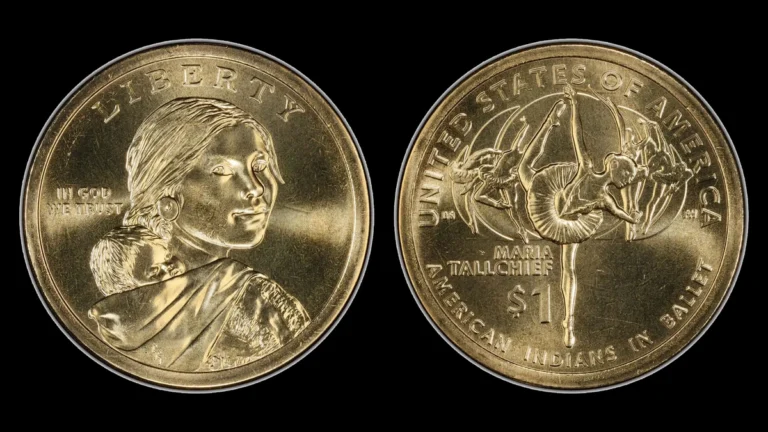
Rare 2006 Dollar Errors (List & Pictures)
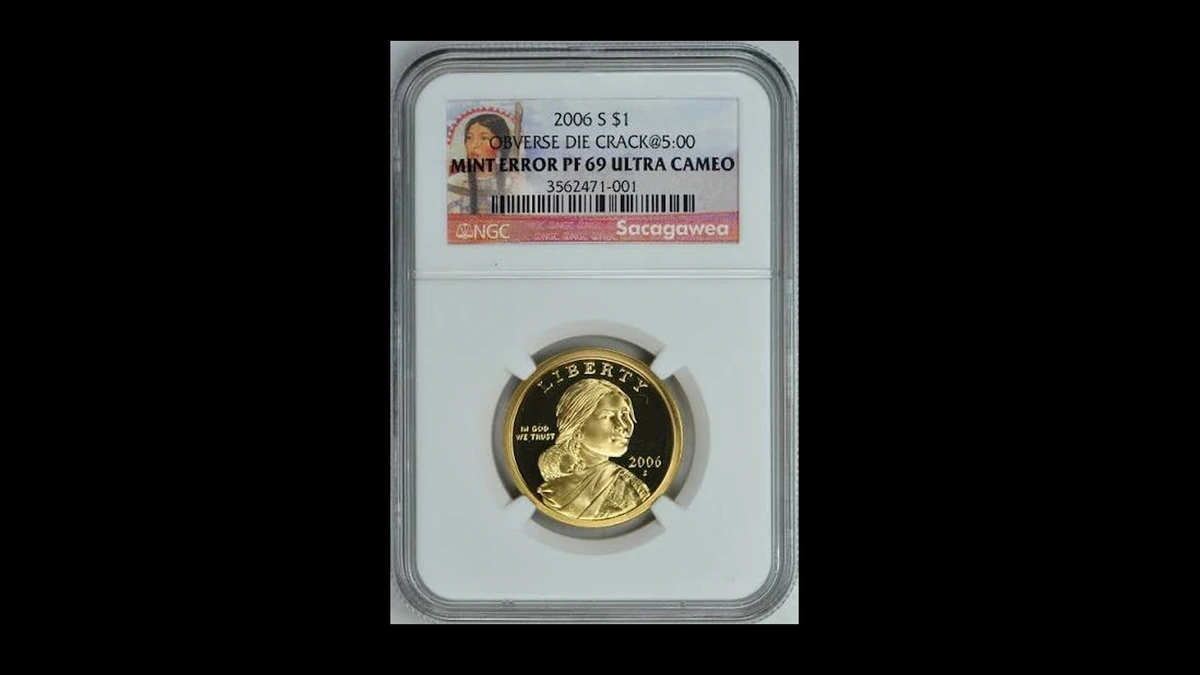
Extra letters crowd LIBERTY on one documented 2006-P dollar, while a 2006-S Proof shows a narrow raised crack beside the portrait. These give two concrete starting points for 2006 Sacagawea dollar errors.
The five categories have estimated values of $30–$12,000. A wrong-blank comparison from another year, a 2000-P dollar on quarter stock, brought $7,800 in April 2021.
Check the original design and metal carefully; a plain edge is normal for 2006.
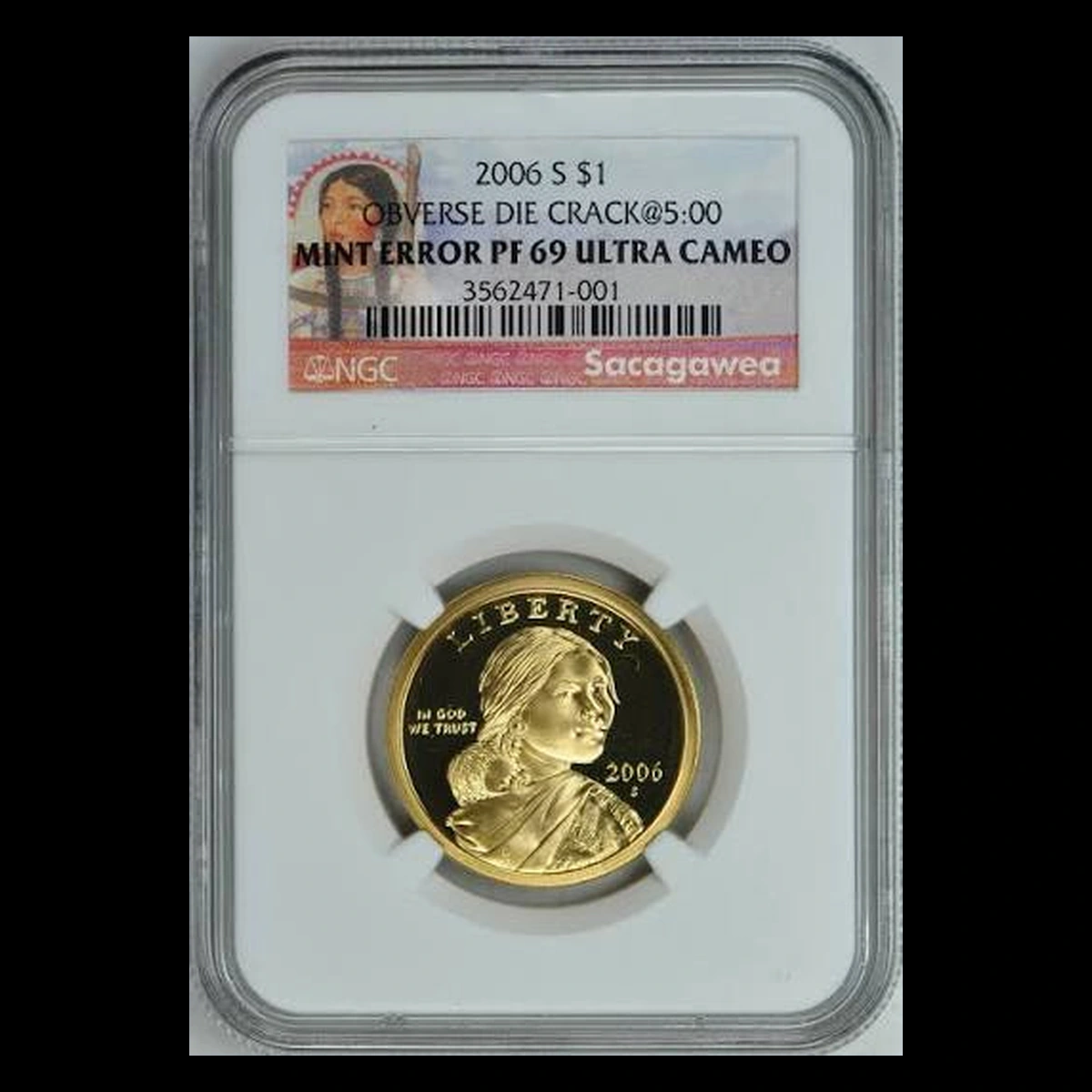
1. 2006 Dollar A Raised Line near Five O’Clock: Proof Die Crack Error
A documented 2006-S Proof has a raised line beside the lower-right portrait, running toward the rim near five o’clock. Silver-colored reflections on its golden surface should not be confused with the actual ridge.
The line formed when metal entered a split in the die. A larger rim-connected break, called a cud, remains a possible 2006 type without a confirmed example in the supplied account.
How to Identify
Confirm the S below the date and compare the Proof’s lower-right portrait area. Move the light to check whether the line is solid raised metal or a scratch with pushed edges.
A cud needs a broad raised patch joined to the rim, with normal design missing inside. The thin documented crack does not prove that such a larger break developed.
What It’s Worth
$30–$1,000 spans cracked Proofs and the conditional cud estimate. Comparable Proof cracks may fit $30–$250, while an authenticated large 2006 cud could fit $100–$1,000.
The NGC Proof 69 Ultra Cameo crack example sold in August 2012, but its public price is unavailable. The grade describes near-flawless preservation with strong design contrast.
2. 2006 Dollar Earlier Letters beneath LIBERTY: Double Strike Error
A documented 2006-P dollar has remnants of a faint first impression beneath a stronger second strike. Extra letters overlap at LIBERTY, and the date also retains earlier details.
The Stack’s Bowers catalog identifies the PCGS MS65 coin as double-struck within the collar. The collar is the ring that controls the edge during striking.
The first impression was described as perhaps 15% displaced. That is approximate displacement, not an exact rotation angle.
How to Identify
Separate the faint and stronger letters in LIBERTY, then trace the matching repeated date details. Several connected remnants explain a second picture better than one thick letter.
Compare the reverse without changing the coin’s orientation. The catalog reports repeated features there as well.
Look for earlier raised struck details beneath the later impression. A sunken backward copy from pressing finished coins together after minting needs a different explanation.
What It’s Worth
$300–$4,000 is the estimate for an authenticated double strike of this kind. Clear overlapping words and matching reverse evidence make the sequence easier to follow.
The cataloged MS65 has no circulation wear and relatively few marks. Its description supplies a physical example, not a realized price used in this guide.
3. 2006 Dollar A Gap in the Original Outline: Clipped Blank Error
A 2006-P year guide reports clipped blanks without a specific size or location. An incomplete disc received the dollar design after some metal was already missing.
The nearby rim can weaken as metal flows around the gap. A similar-looking notch cut into a finished dollar has a different origin.
How to Identify
Follow the raised rim toward each end of the opening. Look for natural changes in the struck detail and inspect the inner surface for saw marks, filing, or burrs.
Check the opposite rim for supporting weakness, while remembering that it varies among genuine clips. Reduced weight from the normal 8.1 grams supports missing metal but does not establish when it was removed.
What It’s Worth
$30–$500 is the estimated whole-coin range for an authenticated 2006-P clip. A larger clear gap with a readable date generally displays better than a tiny notch on a marked coin.
The range is based on comparable modern-dollar clips, not a verified sale of the year-guide example.
4. 2006 Dollar An Unstruck Crescent beside Incomplete Designs: Off-Center Strike Error
The 2006-P off-center report concerns a blank that sat partly outside the dies. Sacagawea and the eagle shifted, leaving some metal bare and some design beyond the opposite edge.
The guide does not establish one percentage or direction. Those details need to come from a specific coin.
How to Identify
Compare where both designs run out of metal and how they relate to the same unstruck crescent. A shift on only one face suggests a die-position problem instead.
Check the bare surface for grinding or flattened design remnants. If all intended detail fits inside a wide outline, a broadstrike may be the better comparison.
Keep the surviving date and P in the same photographs as the shifted designs. The ordinary plain edge supplies no missing-letter error here.
What It’s Worth
$100–$2,000 is the estimate for an authenticated 2006-P off-center dollar. Original surfaces, strong displacement, and readable identity support the higher comparisons.
This range concerns a single shifted strike. A coin with a second overlapping picture needs a double-strike comparison as well.
5. 2006 Dollar A Dollar Design on Smaller or Different Metal: Wrong-Blank Candidate Error
A blank intended for another denomination can enter a dollar press. Its smaller size may cut off outer lettering, while its alloy changes the expected weight or color.
The 2006 type remains a possibility without a confirmed same-year specimen in the cited account. Its illustrated quarter-blank example is a 2002-D coin.
How to Identify
Record a loose candidate’s weight and width before choosing a blank type. Normal dollar references are about 8.1 grams and 26.49 millimeters.
A normal quarter blank weighs about 5.67 grams, but that is not a measured weight for a known 2006 dollar error. The smaller blank can also spread during striking.
Inspect how the original dollar design fits and have the metal checked without damaging it. Plating, chemical attack, and trimming can create misleading color or measurements.
What It’s Worth
$2,000–$12,000 is a conditional estimate for an authenticated 2006 wrong-blank discovery. Exact metal, surviving identity, and condition would determine the closest comparison.
A 2000-P Sacagawea dollar on quarter stock graded PCGS MS68 sold for $7,800 in April 2021. Its earlier date and exceptional preservation must stay attached to that result.
The sale does not establish a 2006 specimen, mint, or grade. It provides context for the potential error class.
Conclusion
The photographed Proof crack and cataloged double strike offer specific details to match. The clipped and off-center reports need their own original boundaries, while a wrong-blank claim needs both physical evidence and a secure date.
Keep normal plain edges and satin collector texture out of the error count. A useful comparison preserves the actual mint, finish, and specimen details rather than borrowing them from a more dramatic older coin.