Rare 1839 Dollar Errors (List & Pictures)
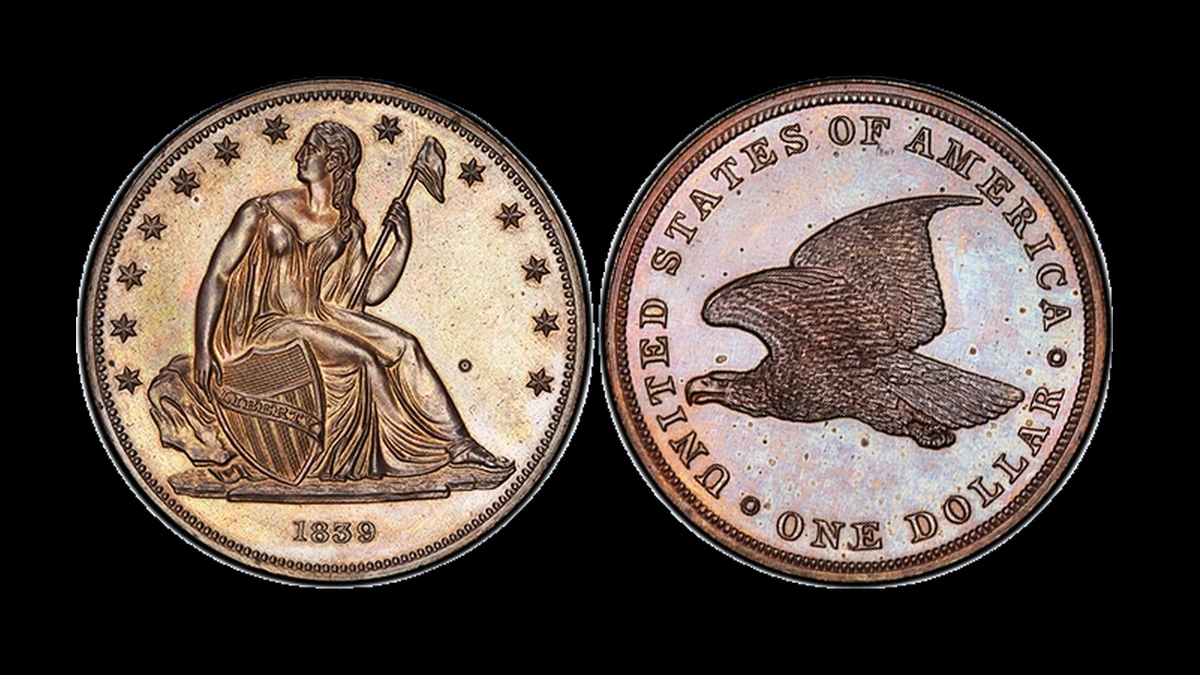
The eagle’s background comes before any small crack when examining 1839 dollar errors. These Gobrecht dollars exist in distinct starless and starry-reverse versions, whose small die marks require separate comparisons.
A starry-reverse J-108 graded PR64 sold for $184,000 in January 2004, the highest supplied completed result. Estimated whole-coin values span $20,000–$250,000; establish the full version first, then inspect the letter-area lines and spur described below.
1839 Dollar Raised lines cross reverse letters: die cracks and the D spur Error
A Gobrecht dollar has a flying eagle rather than the perched bird familiar from later silver dollars. Specialist J-numbers distinguish versions with different designs and metals.
On the starless reverse, recorded cracks lie near ITE in UNITED, MER in AMERICA, and LAR in DOLLAR. Later use of that tool also left a small projecting spur near the top of the D in UNITED.
The narrow ridges formed when silver entered splits in the die during striking. They record the tool’s condition rather than a crack opening through the coin itself.
Starry-reverse versions were made later while retaining the 1839 date and have different crack routes. The background stars are intentional design elements, not scattered striking errors.
How to Identify
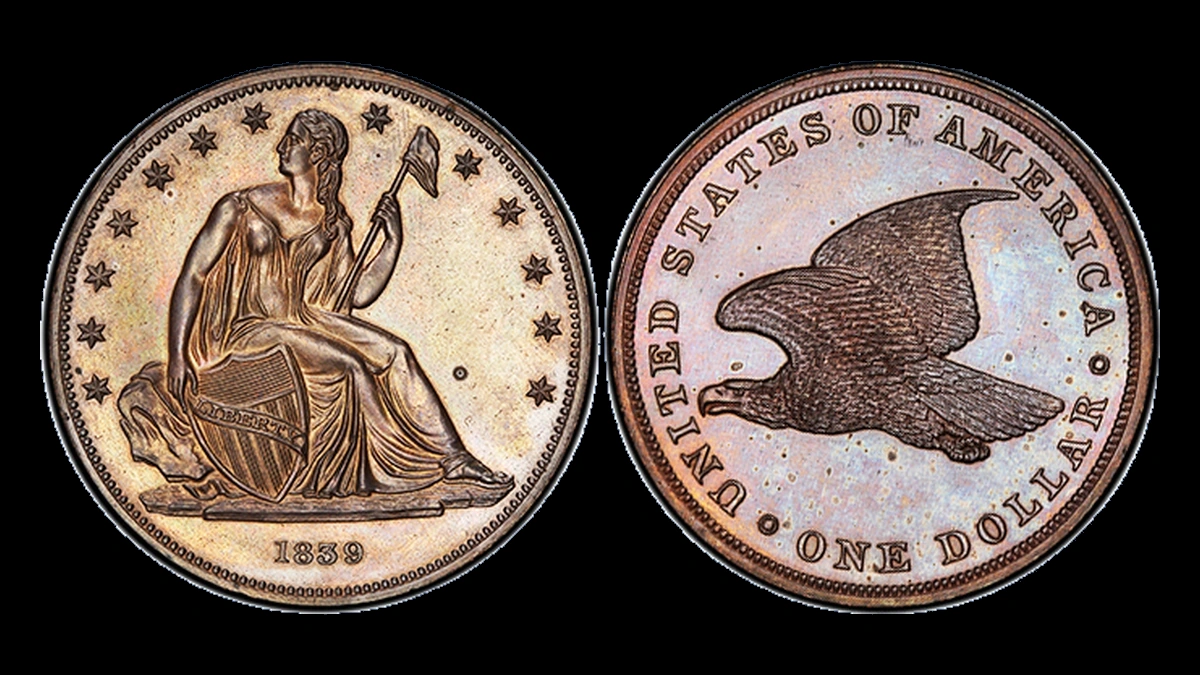
Photograph the entire flying eagle and surrounding background before magnifying a letter. Determine whether the reverse is starless or starry so the small marks are compared with the right version.
For the starless reverse, inspect the tops of ITE and MER, then the bases of LAR. Examine the upper D in UNITED separately for its small spur.
For starry J-108 silver or J-109 copper versions, the supplied comparisons instead concern cracks around NITED STATES O and OLLAR. Another reported line runs from the foot of A in DOLLAR toward the tooth-like border.
Keep those routes attached to their respective design versions rather than combining them into one required pattern. A spur is also a different shape from a long thread-like ridge.
Use side lighting to establish that a line rises above the surface. An incuse scratch or a dark streak of toning is not the same physical feature.
The full design, metal, and specialist attribution must agree before a tool state is interpreted. One faint crack cannot settle the actual manufacturing date of an individual 1839-dated coin.
What It’s Worth
$20,000–$250,000 is the supplied estimate across authenticated examples of these rare versions. Most of that value belongs to the underlying Gobrecht dollar, exact variety, and preservation.
PCGS records $184,000 in January 2004 for a J-108 graded PR64. It is a starry-reverse silver Proof with some visible imperfections.
That sale cannot be assigned to the copper J-109 or a starless example simply because all carry the same date. It also does not establish a separate dollar premium for every ridge or spur.
A useful comparison should preserve the version’s identity and the complete coin’s condition. Marks, cleaning, or a different metal can change the assessment far more than the prominence of one small line.
Conclusion
Begin with the flying eagle’s whole background and the coin’s exact version. Only then do the starless letter cracks, later D spur, or different starry-reverse routes become meaningful diagnostic details.
The $184,000 comparison belongs to a specific silver J-108 Proof, while the wider estimate covers different rare coins. Preserve that distinction and avoid using one faint raised line as the sole evidence for when a dollar was made.