Rare 1902 Quarter Errors (List & Pictures)
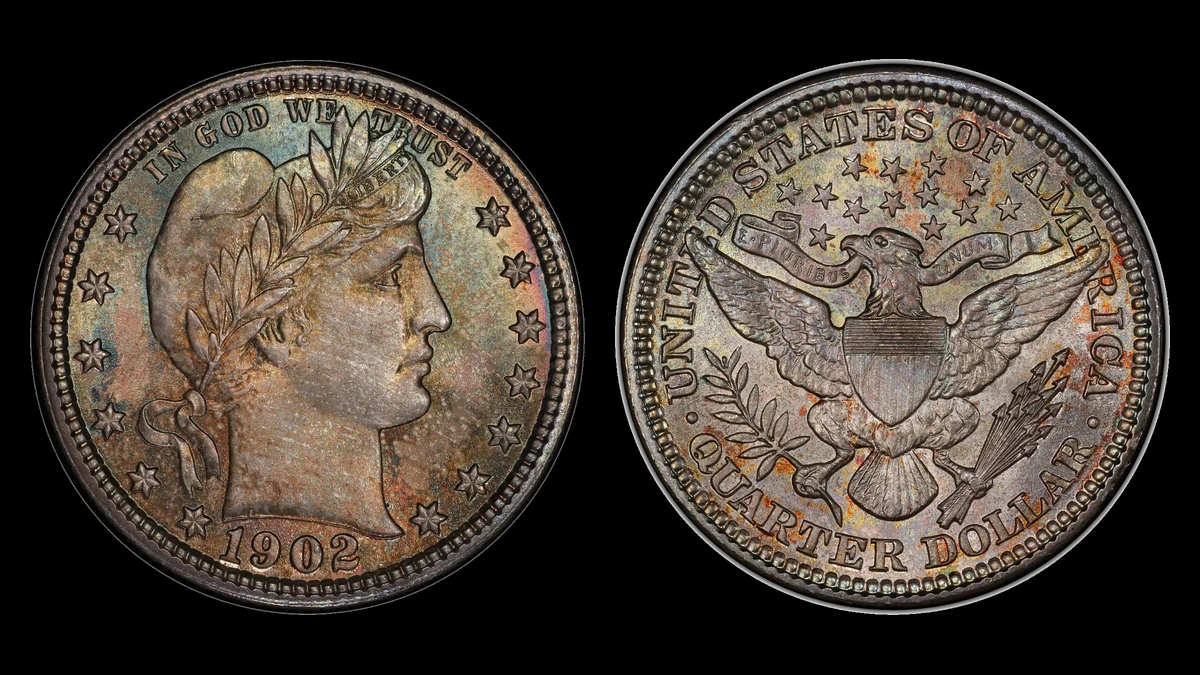
A Philadelphia quarter with a misplaced zero fragment sold for $139 in March 2024. The 1902 Barber quarter errors and reported varieties below span estimated whole-coin values of $30–$5,000.
Start at the date and mint mark, then examine portrait outlines, raised die damage, or displacement using evidence from the actual coin.
| Clue | Category | Estimated range |
|---|---|---|
| Extra strokes beside or below the date | Repunched or misplaced date | $50–$2,000 |
| Possible second O or S | Repunched mint mark, conditional | $50–$1,000 |
| Repeated headband, brow, or ear details | Doubled front, conditional | $50–$2,500 |
| Raised thread or rim-connected mass | Die crack or cud | $30–$1,000 |
| Incomplete design beside bare metal | Off-center strike, conditional | $200–$5,000 |
1. 1902 Quarter Numeral traces sit beside or below the date: date-punch varieties Error
Philadelphia reports describe an earlier 1 below or below-left of its final position and a separate misplaced 0 in the border. The first concerns repetition beside a digit; the second lies farther from the intended date.
New Orleans has its own southwest repeated-date report and a separate low misplaced-date report. The exact numerals must come from matching O-mint evidence, not the Philadelphia descriptions.
How to Identify
Read the reverse mint area before choosing a date reference. Philadelphia lacks a letter, while O requires a New Orleans comparison.
For Philadelphia’s repeated 1, inspect below and below-left of that digit. For the documented MPD-001, locate the top of 0 among the border beads below and right of the normal zero.
Keep all four digits visible while comparing small curves with genuine numeral remnants. Damaged beads or scratches can create false fragments.
On O-mint coins, match the entire date with the appropriate reference. Southwest describes the reported earlier position without proving which Philadelphia-like digit should appear.
What It’s Worth
Matching date-punch varieties have an estimated whole-coin range of $50–$2,000.
The Philadelphia MPD-001 graded ANACS XF45 sold for $139 in March 2024. Its misplaced-zero result should not be assigned to every repeated-date pattern.
2. 1902 Quarter Another curved edge seems to follow O or S: possible repunched mint mark Error
Repeated hand punching of a mint mark can leave remnants of an earlier letter. A surviving extra curve should represent part of another O or S.
The supplied 1902 report still needs a specific confirmed pattern. A tilted letter, changed position, or nearby bump does not establish repunching.
How to Identify
Compare upright mint marks from the same mint at the same scale. Follow the suspected extra outline around the letter rather than judging one thick corner.
Flat striking shelves, small die chips, and dents can imitate letter fragments. Seek a reliable matching example and specialist attribution before naming a 1902 variety.
What It’s Worth
The conditional estimate for a verified repunched mint mark is $50–$1,000.
No exact sale was supplied. An S-mint quarter can already have considerable value from date and condition, which should not all be described as an error premium.
3. 1902 Quarter The headband, brow, or ear repeats: reported doubled front Error
Philadelphia quarters are reported with extra outlines near LIBERTY, the brow, and the ear. A true doubled die contains repeated design before it strikes the coin.
The exact appearance still requires a reliable matching specimen. Thick worn lettering or flat shelves from striking movement can resemble part of the report.
How to Identify
Compare the entire portrait’s wear with an ordinary Philadelphia coin. Then inspect the headband, brow, and ear at equal magnification.
Look for related repeated contours or splits across more than one feature. Change the light to separate fixed raised edges from moving reflections.
Have several features assessed together rather than choosing an attribution from one enlarged LIBERTY letter. The source does not provide a complete diagnostic map.
What It’s Worth
A confirmed collectible doubled front has an estimated whole-coin range of $50–$2,500.
This is conditional on identification, not a quoted sale. Ordinary thickness or shelf-like doubling does not receive the same comparison.
4. 1902 Quarter A thread or rim mass rises above the silver: die cracks and breaks Error
A crack in a die can leave a raised line when silver enters the opening. A larger missing piece at the die’s edge can produce a rim-connected mass called a cud.
The coin’s own shape and design relationship must establish the category. No fixed location from another year’s quarter should be transferred to 1902.
How to Identify
Use side lighting to distinguish a ridge from a recessed scratch and any metal pushed beside that scratch. Inspect a larger mass where it joins the rim and replaces normal design.
A rim impact may pile metal beside a dent instead. Weakness on the opposite face can support a die-break explanation but cannot prove it alone.
What It’s Worth
The combined estimate is $30–$1,000, with confirmed cracks around $30–$400 and substantial cuds around $100–$1,000.
No exact transaction accompanies this group. Mint, wear, and the strength of a verified feature determine the useful whole-coin comparison.
5. 1902 Quarter An unstruck crescent remains beside missing design: possible off-center strike Error
A misplaced blank can receive only part of the intended picture. Bare original metal remains opposite the design that missed the disc.
This category needs confirmation on a dated 1902 example. A portrait alone or an uneven border cannot establish the year and mechanism.
How to Identify
Locate the surviving date first and compare the same physical margin on both faces. Their incomplete designs should fit one displaced blank.
Inspect the transition into unstruck metal for filing or flattening. A complete design on expanded metal suggests broadstriking, while a shift limited to one face suggests die misalignment.
Keep any surviving O or S visible. If the mint-mark area missed the strike, an absent letter cannot establish Philadelphia.
What It’s Worth
The conditional range for a genuine dated example is $200–$5,000.
A readable year and substantial original crescent make stronger evidence than an unidentified damaged outline. No completed 1902 off-center sale was supplied.
Conclusion
The documented misplaced zero provides a specific starting point, while several other 1902 categories require closer confirmation. Keep each mint’s date and portrait reports separate instead of borrowing missing details from another pattern.
Use both faces and the original surface to test raised lines, extra letters, and displaced designs. The $139 MPD-001 sale is one identified quarter’s result, not a price assigned to every reported feature.