Rare 1883 Morgan Dollar Errors (List & Pictures)
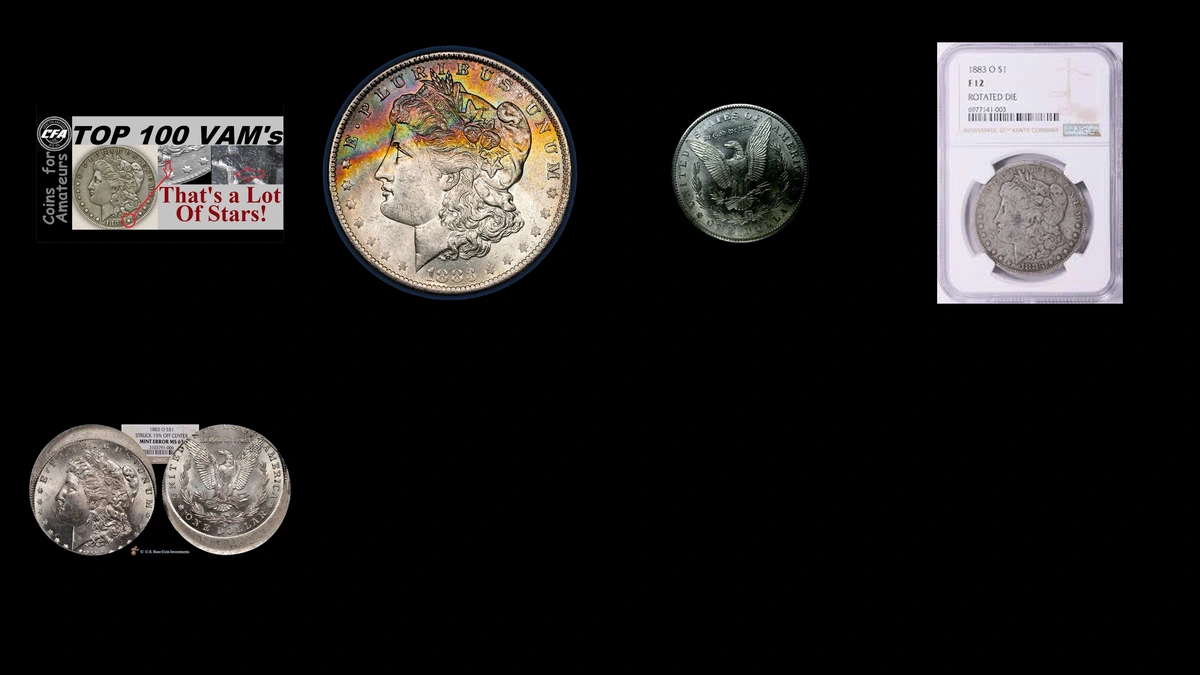
An 1883-O off-center dollar sold for $2,520 in May 2024. The 1883 Morgan dollar errors and varieties below span estimated whole-coin values of $60–$6,500.
Match small design details by mint first, then compare surface waves, alignment, and three different forms of an enlarged or displaced strike.
| Clue | Category | Estimated range |
|---|---|---|
| Many outlines on Philadelphia stars | Repeated die design | $75–$3,000 |
| Extra date strokes on CC or S coins | Date varieties and associated marks | $75–$2,500 |
| Extra O curves | Repunched mint mark | $75–$750 |
| Letters on the wrong face | Letter-transfer clash | $60–$500 |
| Wavy reverse fields | Distorted die | $75–$600 |
| Eagle tilted after controlled flip | Rotated die | $100–$1,000 |
| Stepped edge with some grooves | Partial collar | $200–$1,000 |
| Wide blank and complete designs | Broadstrike | $600–$4,500 |
| Incomplete designs and blank crescent | Off-center strike | $1,500–$6,500 |
1. 1883 Dollar Nested points on the right-side stars: repeated die design Error
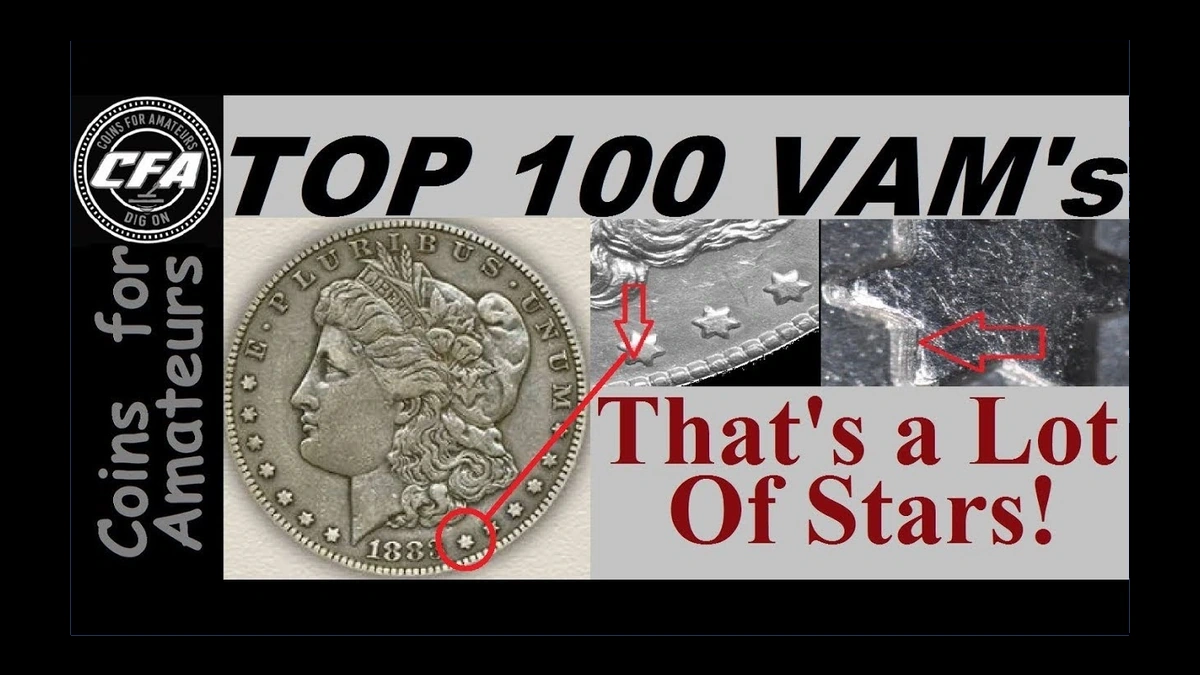
Philadelphia VAM-10 can show as many as six outlines on the right-side stars. Extra date traces include a short dash below the second 8.
VAM-9 instead has outward doubling of stars and motto letters, extra strokes at the top and base of 1, and lighter repetition on the first 8. These catalog numbers name different die patterns.
How to Identify
Inspect several neighboring stars together under magnification. Repeated shapes across multiple points are more useful than one reflected edge.
For VAM-10, compare the right stars and second-8 dash as one pattern. For VAM-9, use its outward star-and-motto repetition and the details of 1 and the first 8.
Wear can reduce the number of visible outlines. A flat shelf beside one star should not be counted automatically as another doubled image.
What It’s Worth
The Philadelphia patterns have an estimated whole-coin range of $75–$3,000.
PCGS records VAM-10 at $2,500 on eBay in February 2023, graded XF Details. That label indicates wear and a condition problem.
A separate MS62 VAM-9 is recorded at $85 in June 2021. Similar-looking stars do not make the two varieties equivalent.
2. 1883 Dollar Extra date strokes with supporting marks: CC and S varieties Error
Carson City VAM-5 combines repeated date and CC details, a dash below the second 8, and a reported mark at the eagle’s mouth. The features belong to one identifying pattern.
San Francisco VAM-14 repeats 18-3 and has a small raised chip left of the first 8 between its loops. Its S is relatively high and left.
San Francisco VAM-4A, formerly VAM-16, pairs repeated 18-3 with a cataloged thread impression. The earlier name is an alias, not another error to add to the coin.
How to Identify
Read CC or S before comparing the date. On VAM-5, examine the second 8 and CC, then use the eagle-mouth mark as supporting evidence.
For VAM-14, find the chip between the first 8’s loops and compare the rest of its pattern. For VAM-4A, match the thread’s actual position with an identified photograph rather than guessing from an unrelated line.
What It’s Worth
The combined estimate is $75–$2,500, comprising $250–$1,500 for CC VAM-5 and $75–$2,500 for the S patterns.
These ranges cover circulated through modest unworn examples. Associated chips and lines help identify the coin without becoming separate prices added to its value.
3. 1883 Dollar Another curve inside and below O: repunched mint mark Error
New Orleans VAM-4 preserves an extra curved line inside O and another trace below it. The mint mark was punched into the die more than once in slightly different positions.
The same variety has repeated detail on 1, the first 8, and 3. Those front features help confirm the reverse identification.
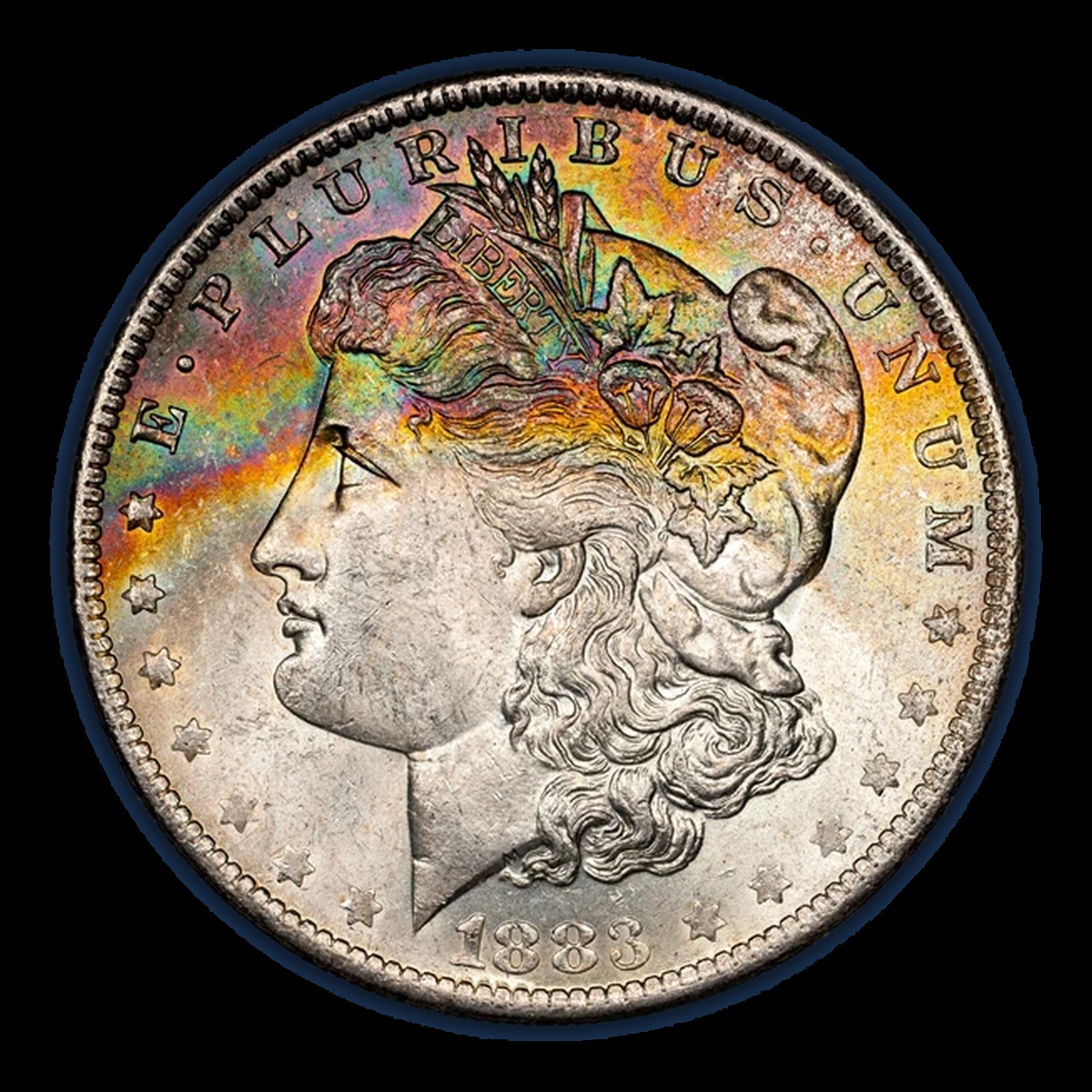
How to Identify
Inspect the opening in O between the wreath bow and ONE DOLLAR. Separate the extra inner curve from the letter’s normal wall, then check the lower outside remnant.
Compare the specified date strokes with the same VAM-4 reference. A toned ring changes with lighting; a raised curve retains its physical shape.
What It’s Worth
Worn through modest unworn VAM-4 examples are estimated at $75–$750.
No exact sale was supplied. The date and mint-mark features establish one variety on one dollar, so their values are not additive.
4. 1883 Dollar A letter appears on the opposite face: clash transfer Error
New Orleans VAM-22A and VAM-36A show separate transferred-E patterns on the reverse. VAM-22A also has reported D and O traces on the front.
These traces began when dies collided without a blank and acquired parts of the opposing design. Later dollars copied those marks.
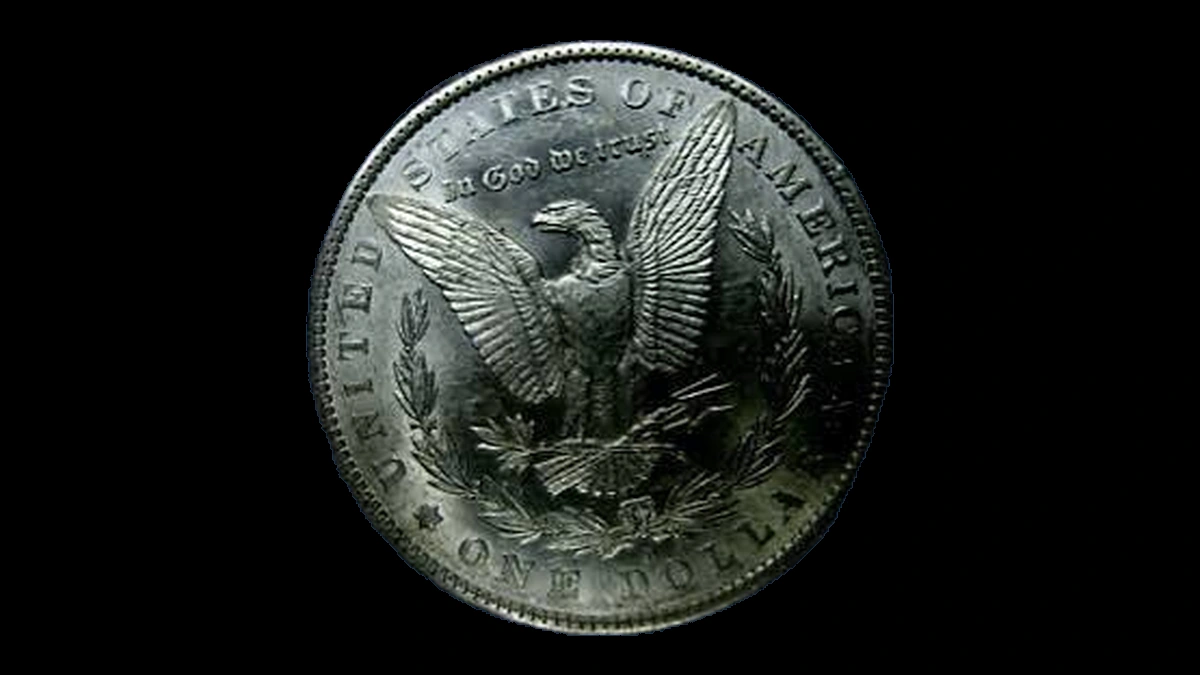
How to Identify
Choose an identified reference for the exact VAM number before interpreting a faint line. Compare connected letter strokes and nearby design rather than one isolated bar.
For VAM-22A, check the front D and O traces as additional evidence. The two reverse E patterns come from different dies and cannot be identified from one interchangeable close-up.
What It’s Worth
Matching letter-transfer varieties are estimated at $60–$500 across worn through modest unworn examples.
A recognizable fragment is more useful than an uncertain line among scratches. No specific completed sale accompanies these estimates.
5. 1883 Dollar Broad waves around the eagle: distorted reverse die Error
VAM-1C1 has uneven reverse fields associated with improper annealing, or faulty heat treatment, of the die. A tool left too soft can deform as it works.
The coin copies the altered surface. This explanation concerns the die, not a finished dollar heated later.
How to Identify
View the coin edge-on to check for bending, without attempting to flatten it. Then move a low lamp across the reverse and compare broad waves with a VAM-1C1 photograph.
Look for crushing, scraping, or heat damage around the design. Color alone cannot establish the cataloged surface shape.
What It’s Worth
Recognizable circulated through attractive lower unworn examples are estimated at $75–$600.
Original surfaces help reveal the waves clearly. A bent or heat-damaged dollar needs a different comparison, and no exact sale was supplied here.
6. 1883 Dollar The reverse leans after a straight flip: rotated die Error
New Orleans VAM-52 is reported with counterclockwise reverse rotation reaching 77 degrees. That maximum is not the angle of every example.
A rotated die turns the eagle, wreath, and surrounding words together relative to Liberty. Independently adjusted photographs can falsely suggest the same effect.
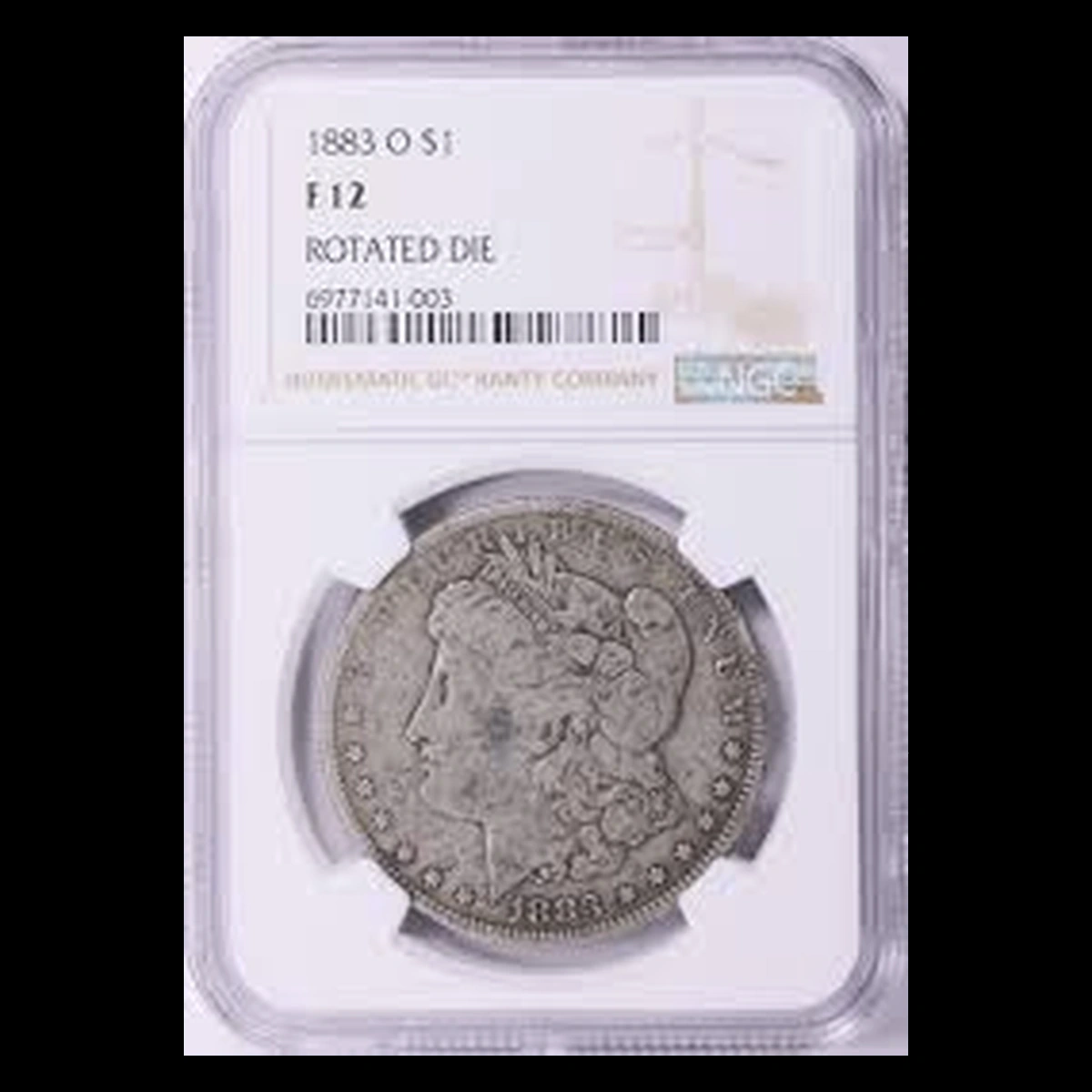
How to Identify
Align Liberty upright in a clear holder and mark the holder’s top. Flip it top to bottom without twisting; the eagle should normally finish upright.
Repeat the motion before measuring the deviation with a protractor or overlay. Preserve both images in the same holder orientation and record direction as well as angle.
What It’s Worth
Identifiable 1883-O rotations are estimated at $100–$1,000.
An 1886-O rotated dollar graded VG8 sold for $408 in September 2025. That different-year, heavily worn example does not establish VAM-52’s angle or an unworn coin’s value.
7. 1883 Dollar Edge grooves survive beside spreading silver: partial collar Error
The documented NGC MS62 1883-O retains a narrow grooved band near the reverse rim between one and three o’clock. Its border is especially wide near nine o’clock on each face.
Part of the blank entered the collar, the ring that controls diameter and forms edge grooves. The unsupported part spread outward, leaving an uneven or stepped edge.
How to Identify
Request an edge view if the coin is in a grading holder. Follow the grooved band into the area where silver spreads beyond it.
Compare the wide nine-o’clock borders on both faces. An ordinary Morgan dollar measures about 38.1 millimeters across, but extra width alone does not distinguish partial collar from other striking problems.
What It’s Worth
Comparable 1883-O partial-collar dollars have an estimated range of $200–$1,000.
The NGC MS62 specimen sold for $411.25 on June 7, 2013. Heritage titled it a broadstrike but explained that partial collar was more accurate.
8. 1883 Dollar Complete pictures inside an uneven wide border: broadstrike Error
A PCGS MS64 1883-O broadstrike has most of its extra unstruck silver above and left of Liberty. The entire intended design remains on the expanded blank.
Complete collar failure allowed outward flow and some stretched outer detail. This specimen is separate from the MS62 partial-collar dollar with surviving edge grooves.
How to Identify
Trace the date, stars, and outer words on both faces before measuring. Broadstriking preserves them even when the border is strongly uneven.
Inspect the extra silver above and left of Liberty and compare stretching in nearby border teeth and letters. Check the edge for evidence consistent with absent collar restraint.
Hammering can also enlarge a dollar, usually with crushed or damaged relief. Original spread needs to explain the shape without those later injuries.
What It’s Worth
Recognizable 1883-O broadstrikes are estimated at $600–$4,500.
Coin World reported $2,300 for the PCGS MS64 specimen at Heritage in October 2008. Its complete designs and relatively well-preserved unworn surfaces belong to that particular result.
9. 1883 Dollar Some design falls outside the blank: off-center strike Error
A displaced blank can leave an unstruck area while losing part of the intended picture. This missing design distinguishes off-center strikes from complete-design broadstrikes.
A documented NGC MS63 1883-O is described as 15% off center. Other specimens have smaller shifts and must be measured individually.
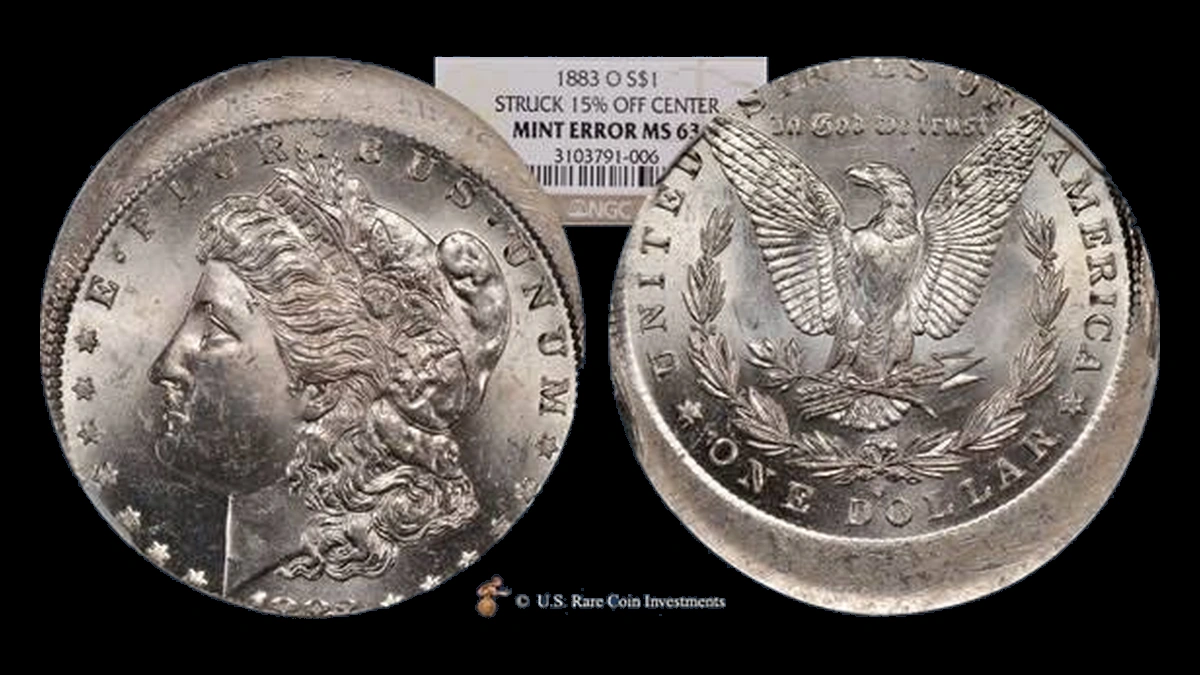
How to Identify
Locate the unstruck silver and the design missing opposite it on both faces. A shift confined to one face suggests a misaligned die instead.
Keep the date and O visible in photographs and inspect the edge for grinding or cutting. For loose coins, the normal 26.73-gram weight offers a supporting comparison with allowance for wear.
What It’s Worth
Genuine 1883-O off-center dollars have an estimated range of $1,500–$6,500.
Coin World reported a PCGS XF40 example at $2,520 in May 2024. That circulated dollar is separate from the NGC MS63 15% specimen.
An opening bid for another coin is not a completed sale. Displacement, readable identity, and preservation must accompany each price comparison.
Conclusion
Use the mint mark and complete pattern to separate small 1883 varieties. A shared date stroke or nearby line cannot replace the full star, letter, or surface comparison.
For unusual outlines, first ask whether the design is complete and then inspect the edge. Surviving collar grooves, unrestricted spread, and design missing beyond the blank identify different mechanisms, even when each produces a wide-looking dollar.