Rare 1838 Half Dollar Errors (List & Pictures)
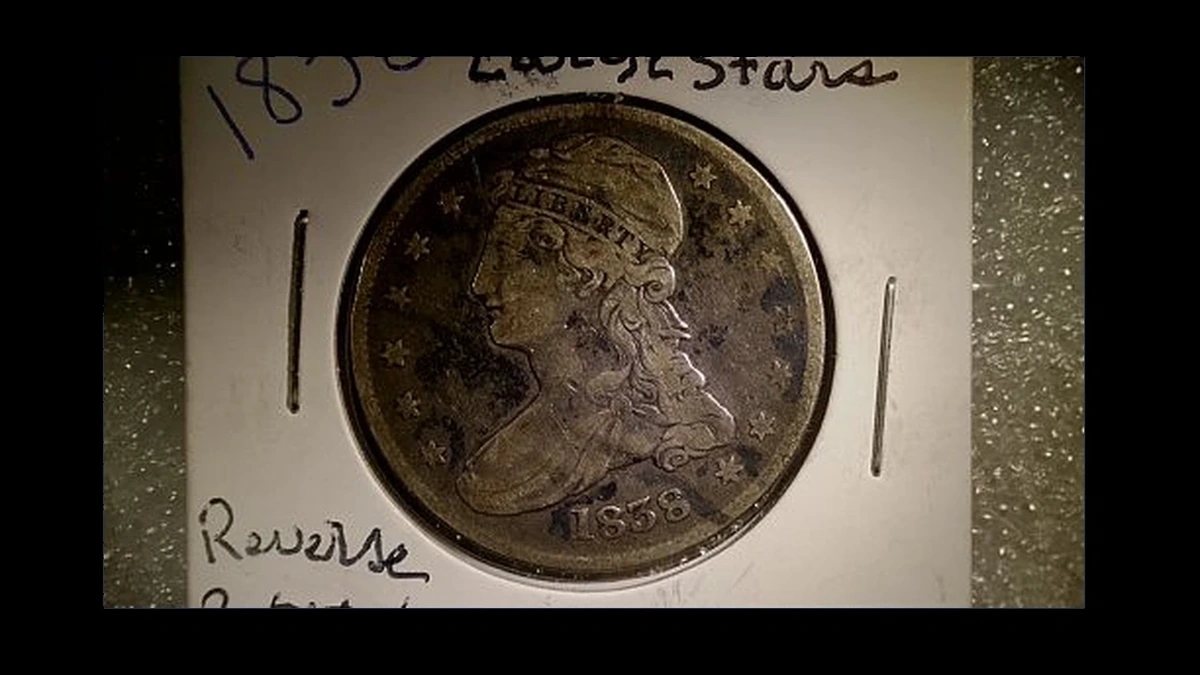
The evidence for 1838 half dollar errors includes both documented varieties and reports needing further examination. The comparison estimates below span $100–$2,500 for the Philadelphia coins discussed.
A documented GR-4 sale reached $2,350 in January 2017, valuing the complete variety and its condition. Read the denomination on the back, inspect the shield, and then test the alignment of the two faces.
| Question to check | Area | Category | Value basis |
|---|---|---|---|
| Does it say HALF DOL? | Below the eagle | Reported wrong reverse | $100–$350 ordinary-coin estimate only |
| Is there a raised line to the rim? | Shield and below HALF DOL | Die crack | $100–$2,500 |
| Does the eagle stay upright after a controlled flip? | Relationship between faces | Rotated dies | $250–$1,700 |
The 1838 type has a grooved edge and normally measures about 30 mm across, with an unworn weight of 13.36 grams. Older, larger half dollars with lettered edges have different specifications.
1. 1838 Half Dollar Unexpected Words Below the Eagle: Reported Wrong Reverse Error
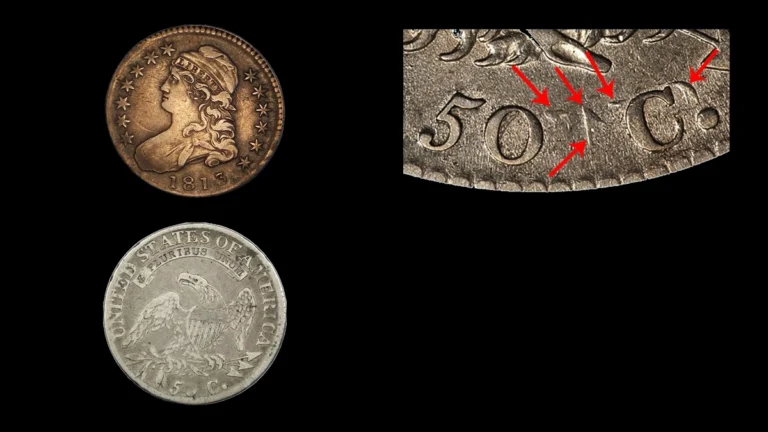
The standard reverse wording for 1838 is HALF DOL. An owner instead reported a coin dated 1838 with 50 CENTS, the denomination used on the earlier 1836–1837 reeded-edge halves.
A confirmed pairing of incompatible front and back dies would be called a mule. Here, the term describes the reported possibility; the supplied report does not establish an authenticated example.
How to Identify
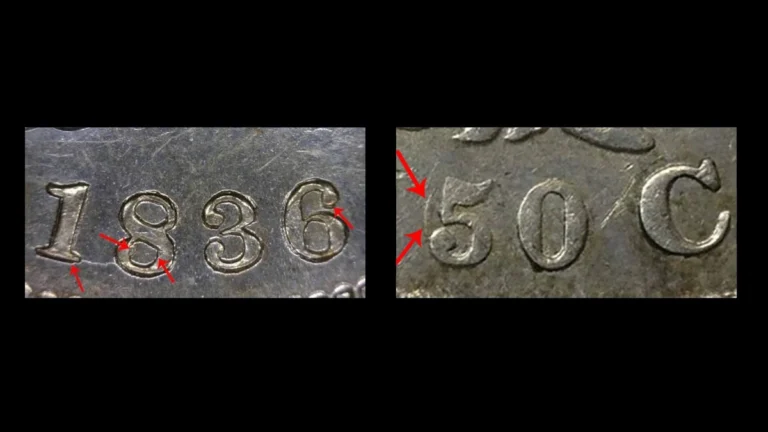
Read the last date digit carefully before drawing a conclusion from the reverse. An ordinary 1836 or 1837 with a misread date can explain the apparent mismatch.
Keep the front and back views tied to the same physical coin. Two photographs of different pieces can produce a convincing but false combination.
Examine the date for cut or added metal and inspect the edge for seams. Altered digits or joined coin parts must be ruled out before the design pairing can be accepted.
Photographs are a starting point, but a specialist should examine the date, reverse, and edge together. A convincing description alone does not resolve the reported mismatch.
What It’s Worth
Ordinary-coin estimate: $100–$350, with no added wrong-reverse premium. This is a base value for a circulated 1838, not a price for an authenticated mule.
The 1838 reference page gives normal guide figures from $98 to $330 across heavily through lightly worn grades. These figures are not auction results for the reported error.
If a genuine mismatch were established, it would require a separate valuation. The ordinary guide range cannot predict the market for an unconfirmed rarity.
2. 1838 Half Dollar A Line Across the Eagle’s Shield: Die Crack Error
With the reverse still facing you, inspect the shield and the area beneath HALF DOL. On the Philadelphia GR-4, a developed raised crack crosses the shield and continues toward the lower rim.
The stamping tool split during use, allowing silver to enter the opening. GR-4 is a catalog label for the die pairing; the raised line records a later stage in those tools’ working life.
Specialists note that developed-crack examples are more common than very early coins from this pairing. A conspicuous line therefore does not automatically mean a scarcer coin.
How to Identify
Before matching the reverse, look above the date for an O. That letter identifies New Orleans, while the Philadelphia coin in this section has no mintmark.
A crack has also been reported on a specially made 1838-O Proof. Its mint and market are different, so that example should not be used to identify or value this Philadelphia GR-4.
Trace the line across the shield toward the rim while lighting it from several directions. A ridge above the silver is consistent with a die crack; a cut below it indicates a scratch.
Compare both the raised route and the correct front design with the documented GR-4 discussion. A similar mark on another die pairing needs its own attribution.
What It’s Worth
Estimated range: $100–$2,500 for Philadelphia examples, from worn coins through selected unworn pieces. The breadth of the range reflects condition as well as the variety.
A PCGS MS63 CAC GR-4 brought $2,350 at Heritage in January 2017. MS63 describes a coin without circulation wear, although surface marks can remain.
The result is a comparison for the whole variety at that preservation level. It does not isolate an amount paid for the crack or provide a price for the rare New Orleans Proof.
3. 1838 Half Dollar The Eagle Tilts After a Flip: Rotated Dies Error
Alignment requires a different kind of inspection from reading surface details. Both designs may fit neatly within their rims while the back sits at an unexpected angle relative to the front.
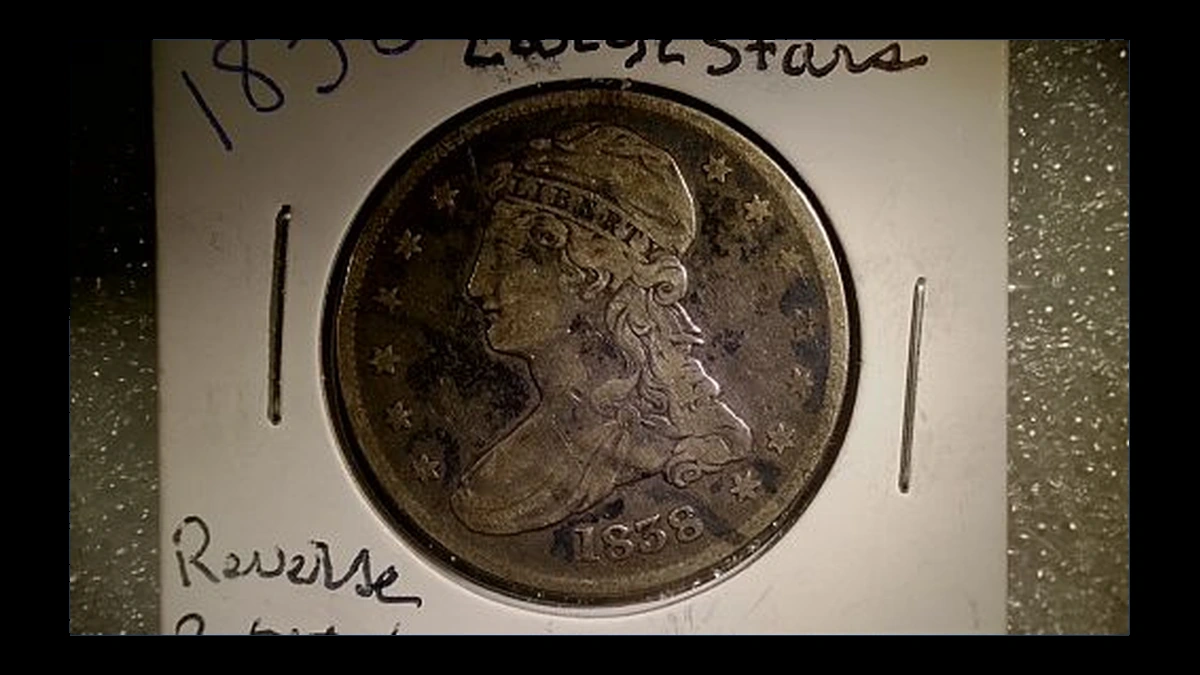
A collector described a VF25 1838 with its reverse turned to the right, without stating a measured angle. Rotation can occur when a die turns in its holder and stamps subsequent coins in that position.
How to Identify
Set Liberty upright, then flip the coin from top to bottom without adding a sideways twist. The eagle should finish upright on a normally aligned example.
Repeat the same movement to see whether the tilt is consistent. Independently rotated photographs of the two faces do not establish their actual relationship.
Measure a persistent tilt with a protractor or alignment guide and record a continuous video of the flip. The amount matters when selecting a meaningful price comparison.
Also check for an edge seam or altered date that could point to a joined or modified piece. A genuine rotational error concerns the two die positions during manufacture.
What It’s Worth
Estimated range: $250–$1,700 for a genuine circulated 1838, depending on the measured rotation and condition. The angle of the reported VF25 remains unknown.
The June 2024 E-Gobrecht records an 1839 GR-8 with 180-degree rotation sold for $1,680 in October 2023. That PCGS XF40 coin had light circulation wear.
It is a measured example from a different year. A slight tilt on an 1838 should not be valued as though it matched that complete 180-degree rotation.
Conclusion
First establish the date and reverse wording, then inspect the shield and test the flip. These checks distinguish an unconfirmed design mismatch, a recognized cracked-die variety, and a possible alignment error.
The $100–$2,500 comparison span covers the Philadelphia examples discussed. Keep the owner-reported mismatch unconfirmed until examined, measure any rotation, and reserve New Orleans Proof comparisons for coins of that specific issue.