Rare 1861 Dollar Errors (List & Pictures)
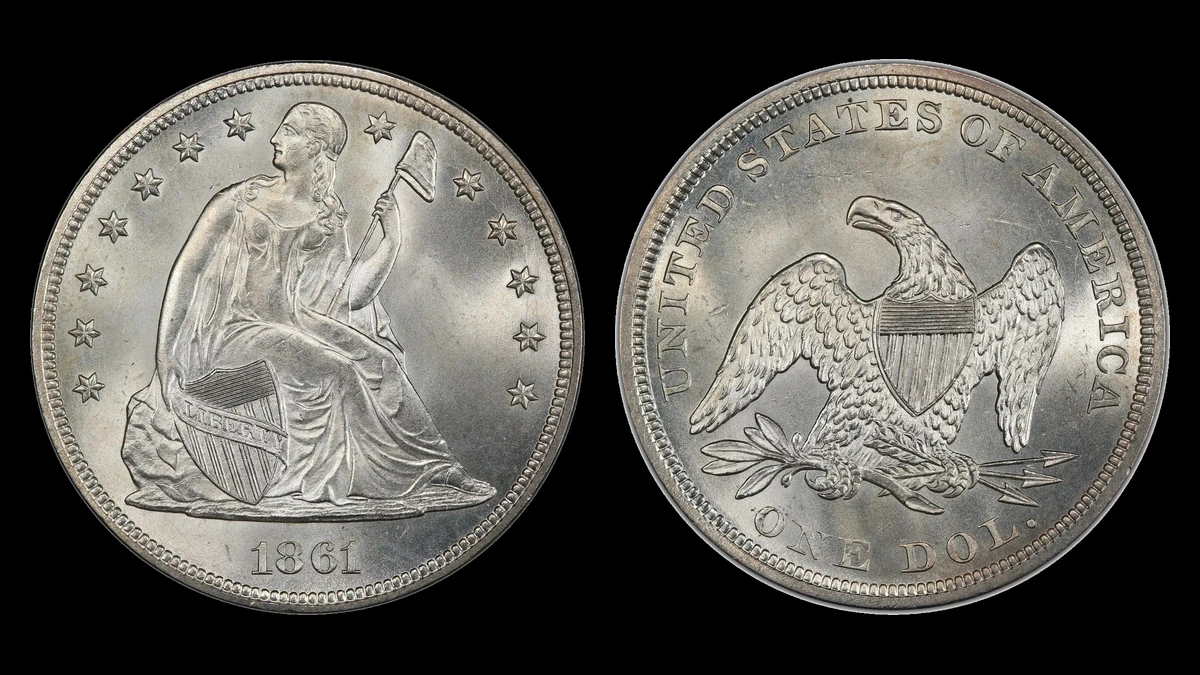
A separate ordinary 1861 dollar graded MS65 sold for $61,500 in November 2019. The 1861 Liberty Seated dollar errors discussed here concern reverse die cracks, with estimated whole-coin values of $1,000–$70,000.
Use the arrow tips, final A in AMERICA, and lower denomination letters to compare the reported routes under side lighting.
1861 Dollar Raised lines through AMERICA and the denomination: reverse die cracks Error
The arrow tips offer a clear starting landmark on this dollar. A reported crack runs from them through the second, or final, A in AMERICA.
Another route follows the bottoms of E DOL in the denomination. Together, these paths provide a more specific comparison than a general claim that the reverse has lines.
The reported example is an ordinary strike described as MS65+. That means an unworn coin of strong quality within the MS65 grade, with relatively few marks.
These cracks originated in the die, the steel tool used to stamp the design. Silver entered its narrow openings and reproduced them as raised threads on the dollar.
The coin can also carry scratches and contact marks from handling. Those marks did not necessarily come from the die and should be inspected independently.
How to Identify
Hold the eagle upright and find the arrow tips before enlarging the area. Follow the suspected raised line toward AMERICA’s final A while keeping both landmarks in view.
Move the light across the surface from opposite sides. A raised thread changes its shadow differently from a groove cut into the silver.
A deep scratch may push small ridges beside its cut, so height alone is not the whole test. The complete path should also agree with photographs of the reported die pattern.
Next examine the lower edges of E DOL in the denomination. Trace the second route without extending it through unrelated marks just to make a longer line.
Photograph the whole reverse and a closer view of each route. The full view records where the cracks sit relative to the lettering and eagle.
Compare the two paths as a group. A random line near one letter is much weaker evidence than matching routes at the arrow tips, final A, and denomination.
Leave the surface untouched during inspection. Rubbing a fine line can add damage while making the original feature harder to interpret.
What It’s Worth
Complete ordinary 1861 dollars with matching cracks have an estimated range of $1,000–$70,000 from worn through exceptional unworn examples.
PCGS records an MS65 dollar at $61,500 in November 2019. That is a general whole-coin comparison, not a stated sale of the reported MS65+ cracked specimen.
The date and preservation contribute much of the price. A crack does not create a fixed surcharge or move a worn coin into an unworn price category.
Cleaning, scratches, and other surface problems still matter even when the diagnostic lines are clear. Compare the complete dollar’s condition before applying the upper end of the estimate.
Conclusion
The reported reverse pattern can be checked through specific landmarks: arrow tips, AMERICA’s final A, and the lower denomination letters. Side lighting helps distinguish raised die evidence from cuts and nearby handling marks.
Use the $61,500 MS65 result as a preservation comparison for the issue. It neither records the identified MS65+ crack specimen’s sale nor establishes an automatic premium for any dollar with a raised line.