Rare 1863 Dollar Errors (List & Pictures)
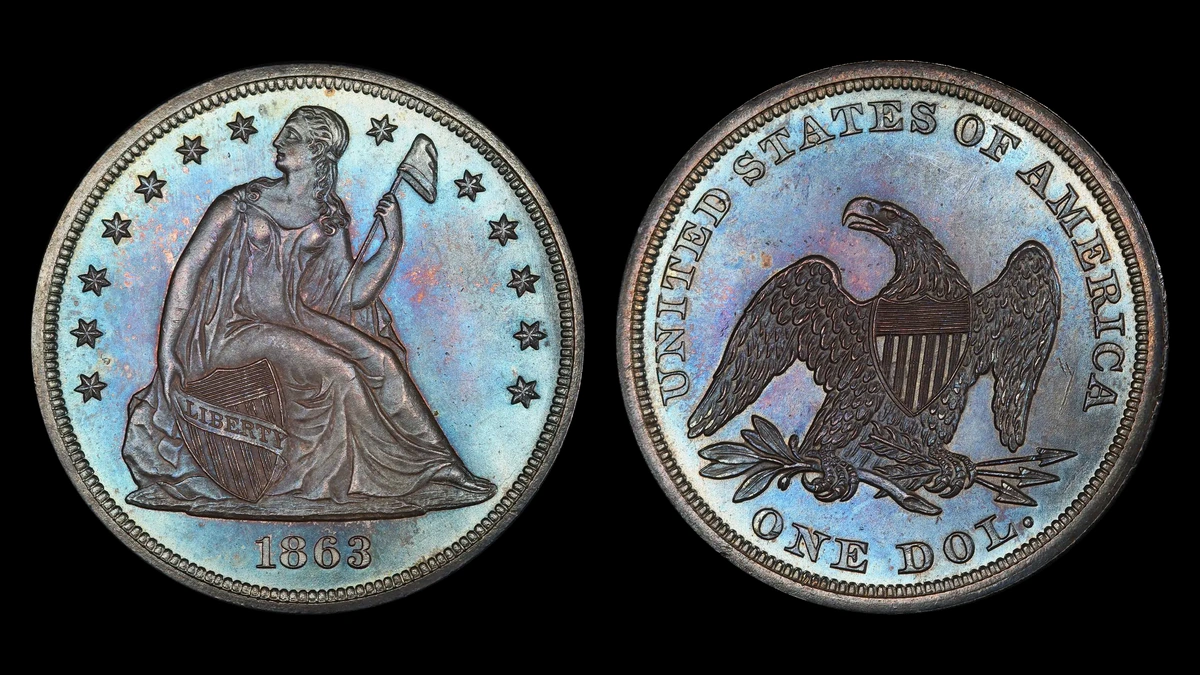
A PCGS MS66 dollar with cracks and clash marks sold for $78,000 in August 2025. This 1863 Liberty Seated dollar errors guide explains those connected observations, with estimated whole-coin values of $1,000–$85,000.
Follow the raised crack routes first, then examine extra shapes in the shield as a separate kind of die evidence.
1863 Dollar Raised lines and extra shield shapes: die cracks with clash marks Error
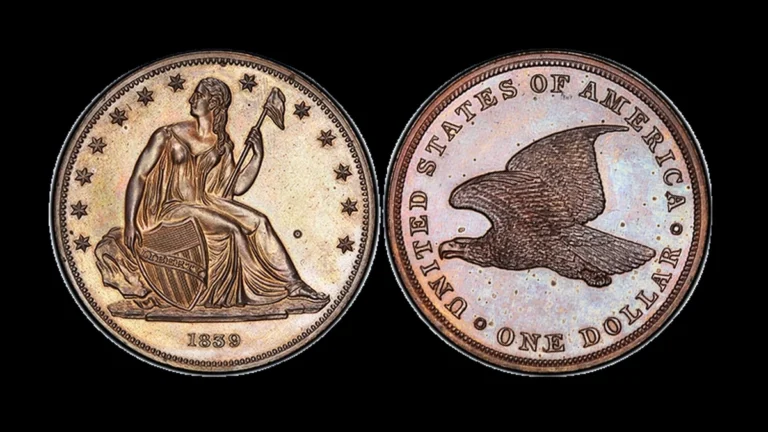
The documented OC-1 dollar offers several places to begin an inspection. Raised reverse cracks follow parts of UNITED STATES OF AMERICA, and another runs from a wingtip through an outer pair of leaves.
On the front, a crack connects the border with Liberty’s foot. These paths formed when silver entered narrow openings in the dies, the steel tools that carried the designs.
The coin also has clash marks inside the eagle’s shield and on the front. Unlike cracks, clashes begin when the dies strike each other without a blank between them.
Marks acquired in that collision can transfer to later dollars along with the normal design. Finding both features on this coin therefore describes two different events in the tools’ working lives.
How to Identify
Set the eagle upright and trace the raised lines around the outer wording. Compare where each line approaches a letter instead of identifying a crack from one isolated bright segment.
Next locate the wingtip and the outer pair of leaves on the documented OC-1 photograph. Follow the connecting route through those details to test whether the pattern agrees.
Turn to the front and inspect the border-to-foot line with light from the side. A crack’s raised silver should differ from a scratch that cuts through the struck surface.
Photograph the entire face as well as the close detail. A wider view preserves the position of the line and makes the comparison easier to repeat.
Now inspect the shield independently. Its ordinary stripes are part of the intended design and should not be counted as evidence of a clash.
Compare any extra shield shape with the opposite face and an identified photograph. A short polishing line or scratch does not become transferred design merely because it lies in the correct general area.
The front clash marks also require a matching reference. The supplied description does not establish a precise front clash map to apply to every 1863 dollar.
What It’s Worth
Examples showing the documented tool features have an estimated whole-coin range of $1,000–$85,000 from worn through exceptionally preserved unworn coins.
Heritage’s PCGS MS66 OC-1 realized $78,000 in August 2025. MS66 describes an unworn dollar with few marks, a level of preservation that contributes heavily to the result.
The transaction bought one coin with both cracks and clashes. It does not supply a separate $78,000 value for each feature or a fixed premium for any individual raised line.
Cleaning, scratches, wear, and weak detail still affect the complete dollar. A worn example with an easily seen crack is not equivalent to the exceptional auction specimen.
Conclusion
Use the reverse lettering, wingtip-to-leaves route, and front border-to-foot line to compare the documented crack pattern. Examine the shield’s extra shapes separately because a clash has a different origin from a crack.
The $78,000 result belongs to a highly preserved OC-1 dollar carrying both features. Keeping the whole coin’s condition visible prevents a useful diagnostic from becoming an unsupported price claim.