Rare 1916 Nickel Errors (List & Pictures)
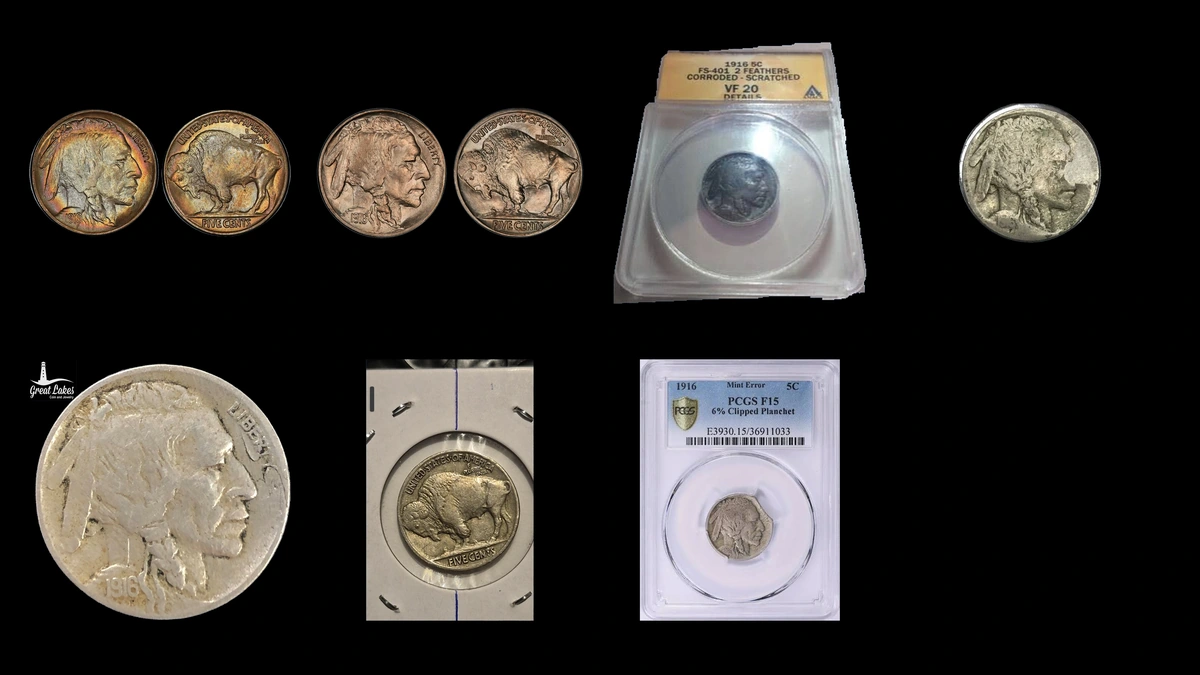
The date deserves the first look when checking 1916 nickel errors: one strongly doubled Philadelphia variety reached $281,750 in 2004. The full estimated span is $15–$300,000, with ordinary metal flaws far below that rare variety.
Compare the date and missing design details first, then inspect raised marks, metal separation, alignment, and shape.
| Visible difference | Possible identification | Estimated value |
|---|---|---|
| Bold extra date and portrait contours | Doubled die | $5,000–$300,000 |
| No F below the date | No F variety | $15–$1,800 |
| Small inner feather absent or reduced | Two Feathers variety | $50–$2,500 |
| Foremost leg partly missing | Three-and-a-Half Legs variety | $150–$3,000 |
| Raised crack or stepped rim patch | Die crack or retained cud | $25–$750 |
| Textured impression | Struck through material | $25–$900 |
| Thin separating surface strips | Lamination | $15–$200 |
| Matching broad halves | Split after striking | $400–$3,000 per pair |
| Buffalo tilted after a controlled flip | Rotated die | $30–$500 |
| Complete design within a wide outline | Broadstrike | $75–$1,000 |
| Straight gap and expanded border | Clip with broadstrike | $150–$1,200 |
| Blank crescent beside lost design | Off-center strike | $100–$2,500 |
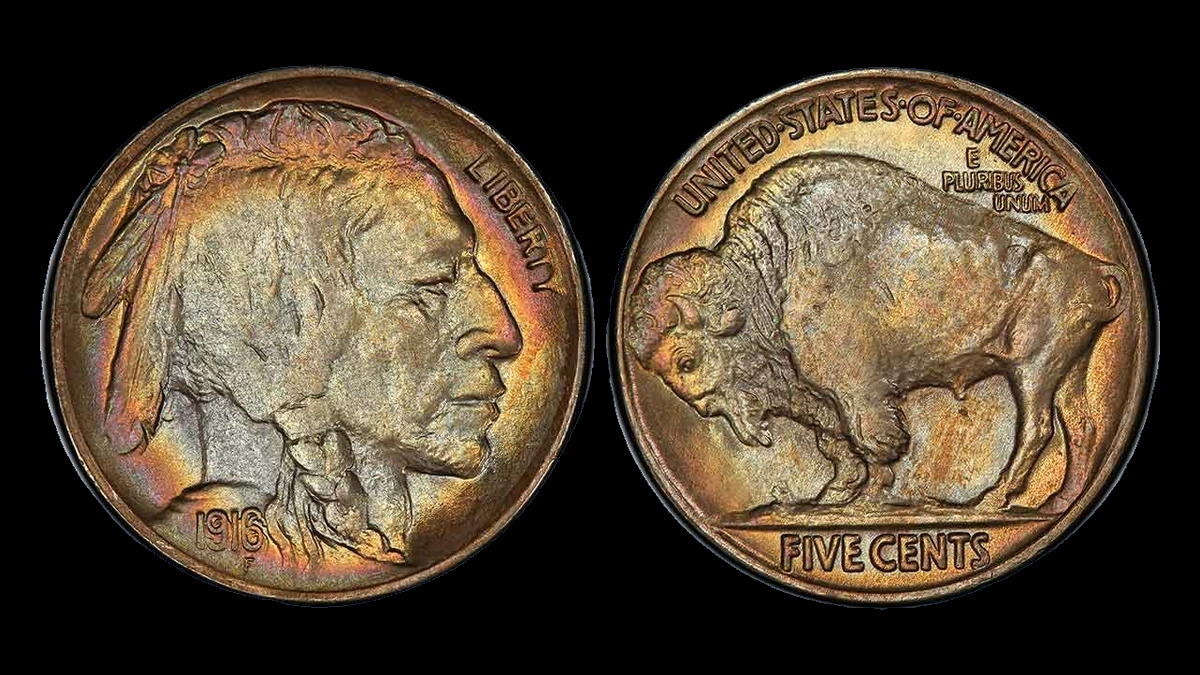
1. 1916 Nickel The Final Date Digits Have Bold Extra Outlines: Doubled Die Error
On the famous Philadelphia variety, the final 1 and 6 show strong repeated contours. Related extra detail appears below and to the right of parts of the portrait, including the lips and chin.
The die, the tool that struck the coin, contained overlapping design impressions. One blow could therefore produce the doubled design without a second strike on the nickel.
How to Identify
Trace the extra date shapes and then continue to the lips and chin. Several matching features provide stronger evidence than a single thick numeral or shallow striking shelf.
An intact area below FIVE CENTS should have no D or S for Philadelphia. A normal loose Buffalo nickel is approximately 5 grams and 21.2 mm with a plain edge, although these measurements alone cannot authenticate the variety.
Because the value is substantial, the full pattern needs professional examination for counterfeit or altered detail. A blurred or damaged date is not an adequate match.
What It’s Worth
$5,000–$50,000 is the estimate for identifiable worn examples, with roughly $50,000–$300,000 for lightly worn through exceptional unworn coins. Preservation strongly affects the comparison.
PCGS CoinFacts records $281,750 for an MS64 example at Bowers & Merena in 2004. Those figures apply to the authenticated rare variety, not to an uncertain doubled-looking date.
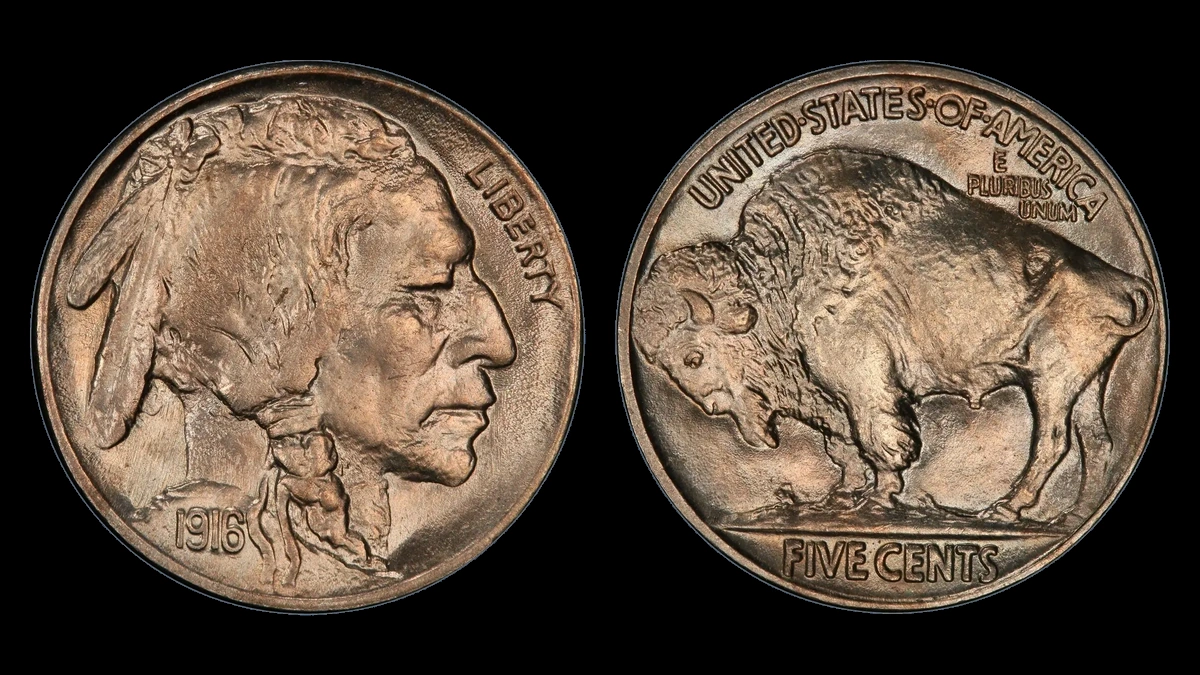
2. 1916 Nickel The Small F below the Date Is Absent: No F Variety Error
The F is the designer’s initial, while the mintmark belongs on the reverse. On the Philadelphia No F variety, die polishing removed the initial from the design transferred to the coin.
The surrounding date and portrait may remain much clearer than the absent letter. Wear or scraping can erase the same small feature on an ordinary coin.
How to Identify
Compare the expected F position with a normal 1916 nickel while keeping adjacent numerals in view. Broad wear across the area makes the absence less conclusive.
Check the intact reverse mintmark area for the Philadelphia issue and inspect the surface below the date for scratches or a locally polished patch. Altering a finished coin is different from polishing its die before striking.
What It’s Worth
$15–$150 is the estimate for worn Philadelphia No F examples, with $250–$1,800 for well-preserved unworn pieces. The year guide reports $1,675 for an MS65 in 2021.
That figure is a secondary report in the supplied material. Reliable attribution and original surrounding detail are necessary before applying the stronger range.
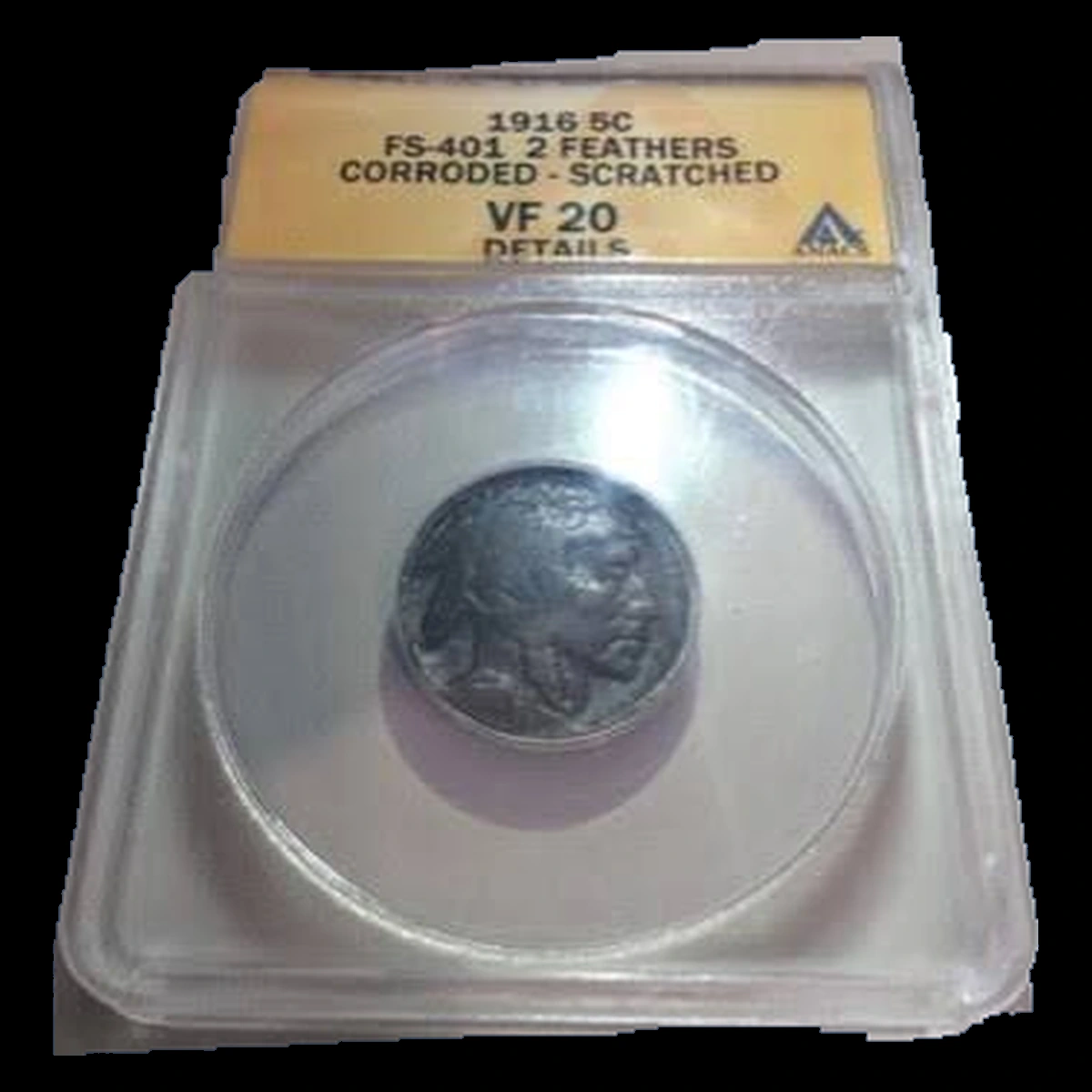
3. 1916 Nickel The Short Inner Feather Is Missing or Reduced: Two Feathers Variety Error
The Philadelphia FS-402 variety leaves two prominent long feathers while the short inner feather is absent or greatly reduced. Polishing changed what the die could reproduce in that small area.
How to Identify
Inspect the space between the neck and longer feathers rather than simply counting the two most visible ones. Any remaining trace should be compared honestly with an attributed FS-402 photograph.
Check nearby hair and neck detail for general wear and look for scraping around the missing feature. Confirm the 1916 date and Philadelphia issue before using a variety comparison.
What It’s Worth
$50–$250 is the estimate for worn examples, rising to about $300–$2,500 for unworn coins. Stack’s Bowers sales include an XF45 at $80 in January 2023 and an AU55 at $125 in July 2024.
An MS65 sold for $1,920 at Heritage in December 2018. The preservation difference helps explain why a worn, softened portrait is not equivalent to a sharp unworn example.
4. 1916 Nickel Part of the Foremost Leg Is Weak: Three-and-a-Half Legs Variety Error
This Denver variety retains three full legs and part of the fourth. Polishing weakened the lower part of the foremost leg in the die.
Some leg detail remains, which distinguishes the description from the better-known 1937-D three-legged variety. The nickname does not replace a match to the actual 1916-D pattern.
How to Identify
Confirm the D below FIVE CENTS and the date, then trace the remaining lower-leg outline. Compare the body, ground, and other legs to judge whether broad wear explains the weakness.
A scraped or polished area on the finished coin needs separate investigation. The original surviving leg detail should match the named variety rather than appear freshly removed.
What It’s Worth
$150–$500 is the estimate in more worn condition, with $600–$1,200 for lighter wear and $1,500–$3,000 for unworn examples. These ranges follow the supplied year-guide comparisons rather than an individual completed sale.
The Denver attribution, remaining leg, and natural surfaces need to agree. Prices for the separate 1937-D three-legged variety do not apply.
5. 1916 Nickel A Raised Crack Borders a Retained Patch: Die Cracks and Retained Cuds Error
A Denver MS64 example has a reverse retained cud near eleven o’clock. Part of the broken die remained in position, allowing design to survive inside the affected patch.
A separate cleaned San Francisco coin has a front crack near six to six-thirty. It is described as an earlier stage before a complete break, not as the Denver retained cud.
How to Identify
Choose the correct mint and face before following the raised boundary. On the Denver piece, retained design inside the patch helps distinguish a shifted die section from a fully missing one.
On the San Francisco piece, trace the raised line without assuming that the surrounding area is a full cud. An edge dent, added filler, or other later damage can produce misleading raised metal.
What It’s Worth
$25–$150 is the estimate for the smaller crack and $100–$750 for a clearer retained rim break. No completed sale was supplied for these individual specimens.
The Denver MS64 is unworn with some marks. Cleaning on the separate San Francisco coin can reduce its value despite a genuine die crack.
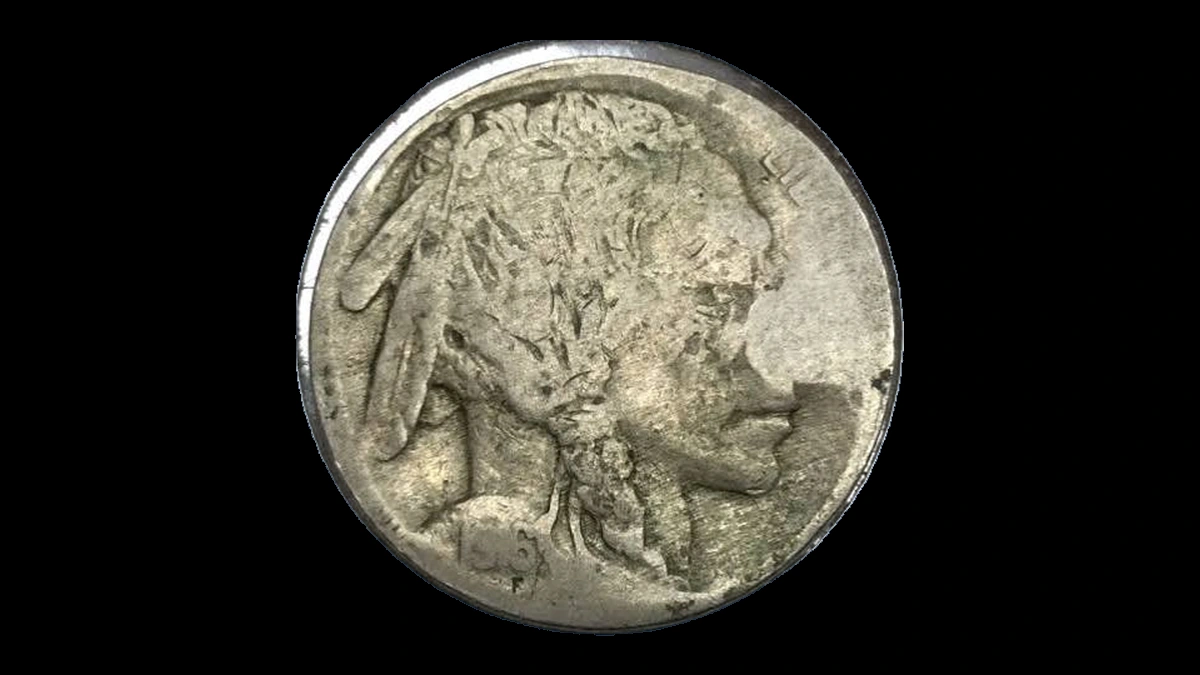
6. 1916 Nickel A Textured Impression Replaces Normal Detail: Struck Through Material Error
An obstruction between the blank and die can leave a depression where the design should form. Cloth may leave a repeating woven texture.
The year guide reports a 1916 cloth-related example without an original auction listing establishing mint or location. An impression left by fabric is also different from fabric still retained on the coin.
How to Identify
Inspect the depression for a coherent weave before naming cloth as the cause. Random roughness is not sufficient.
Follow the adjoining design for evidence of original formation rather than a pattern pressed onto a finished coin. Photograph any retained object without removing it and do not infer an unstated mint or position.
What It’s Worth
$25–$150 is the estimate for a modest genuine impression, while a larger clear fabric pattern may fall around $150–$900. The guide’s $850 example remains a secondary price report.
Original texture and undisturbed surrounding detail support the comparison. An empty impression should not acquire an additional retained-object premium.
7. 1916 Nickel Thin Strips Lift beside the Buffalo’s Back: Surface Lamination Error
A lightly worn Denver example in a Stack’s catalog has thin separating metal around the buffalo’s arched back. Weakness within the alloy allowed shallow layers to lift.
Buffalo nickels are solid copper-nickel alloy rather than modern clad coins. The defect does not expose an intentionally layered copper core.
How to Identify
Confirm the reverse D and examine the strips with the surrounding buffalo design in view. A shallow natural separation differs from a surface scratch or a broad split through the coin’s thickness.
Leave attached strips undisturbed and check their ends for prying or scraping. Retained metal can leave the coin near its normal weight.
What It’s Worth
$15–$200 is the estimate for genuine surface laminations. The Denver specimen appeared in a five-coin group, so a group result would not be its individual price.
A different-date 1929-S nickel with a lamination flap sold for $149.50 at Heritage in April 2010. Its result provides context without directly pricing the 1916-D.
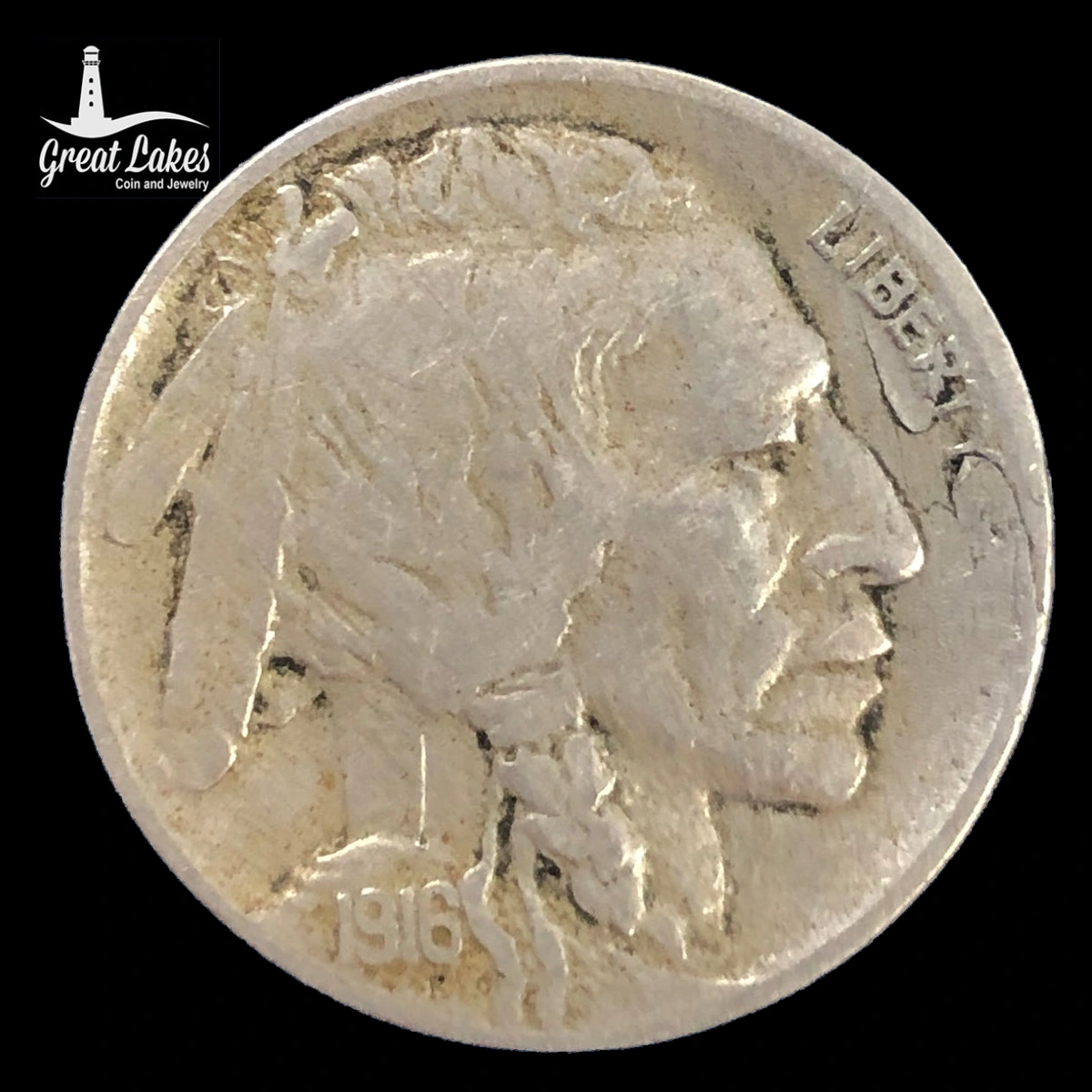
8. 1916 Nickel Two Broad Halves Preserve Opposite Faces: Split after Striking Error
A collector gallery presents two matching pieces of one Philadelphia nickel, with the portrait on one and the buffalo on the other. The coin separated through its thickness after striking.
Both pieces are described as lightly worn and retain their outer designs. They are halves of one solid-alloy coin, not two complete nickels or detached modern clad skins.
How to Identify
Photograph both inner and outer faces while keeping the halves supported and apart. Rubbing them together can damage the separation surfaces.
Compare their outlines, plain-edge sections, and internal texture for a convincing match, checking for sawing or grinding. Their combined mass can be compared with a normal 5-gram nickel, allowing for wear or small metal losses.
What It’s Worth
$400–$3,000 is the estimate for a genuine complete matching pair. No completed sale was supplied for the gallery example.
The estimate covers both halves together. Compatible internal surfaces and preserved outside designs give the pair its explanatory value.
9. 1916 Nickel The Buffalo Remains Tilted after a Flip: Rotated Die Error
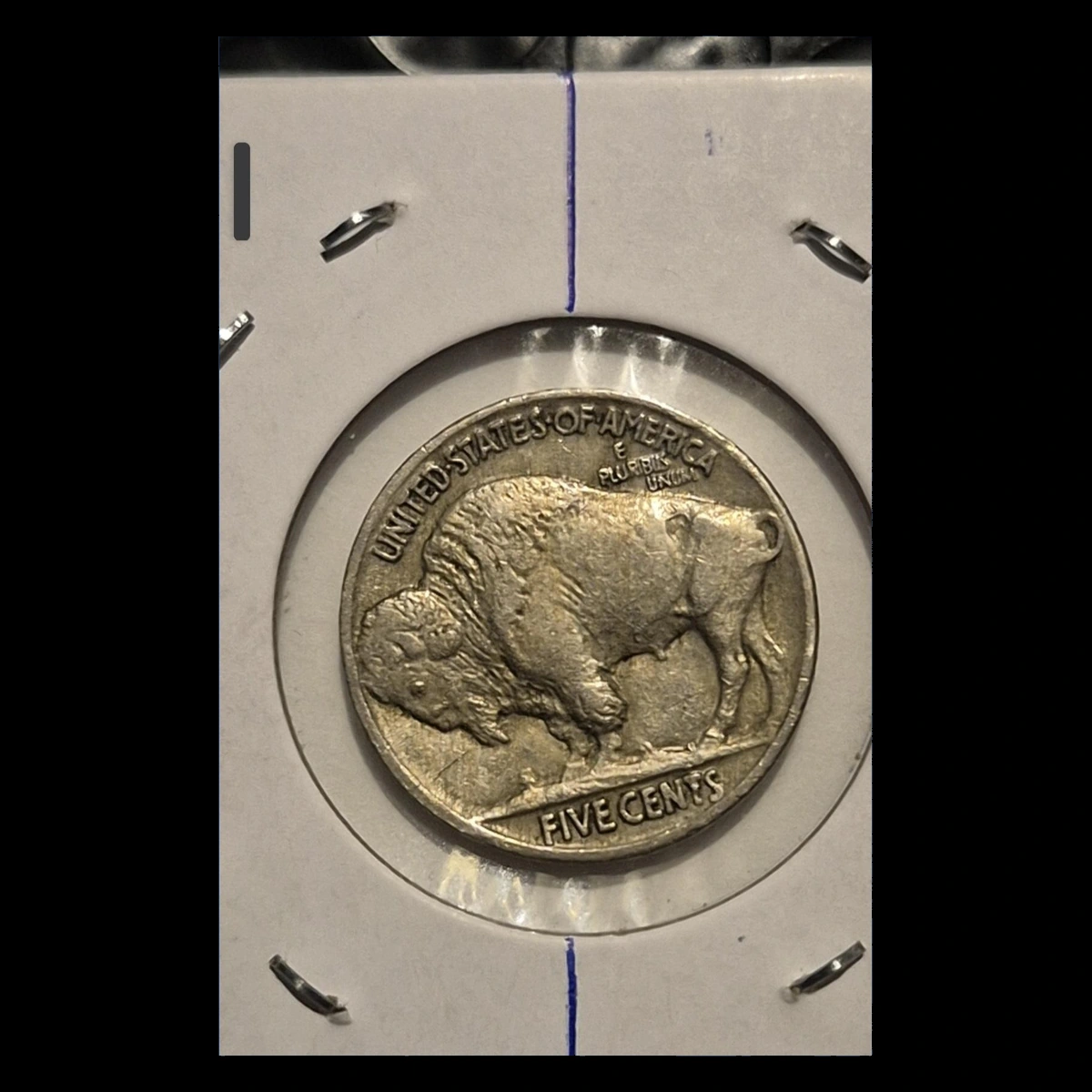
A dealer listed a worn Philadelphia 1916 nickel as having a rotated die. Its description gives no measured angle.
Rotation concerns the relationship between the front and back designs. Independently turned photographs can make a normally aligned coin appear unusual.
How to Identify
Hold the portrait upright and flip the coin top to bottom without a sideways twist. The buffalo should finish upright on a normally aligned example.
Repeat the movement or record it continuously and check whether the same tilt returns. A quarter-turn or half-turn must be demonstrated rather than inferred from the dealer’s general description.
What It’s Worth
$30–$500 is the estimate for genuine rotations of varying size and condition. No completed result or fixed angle was supplied for the worn dealer example.
A large repeatable turn can be a stronger comparison than a small tilt. Keep the readable date and surface condition visible when documenting it.
10. 1916 Nickel An Expanded Coin Retains the Complete Design: Broadstrike Error
A blank can spread when the collar fails to restrain its edge normally. The collector gallery includes separate unworn Philadelphia and Denver examples and a worn San Francisco coin.
The Denver piece has uneven borders and is described as an uncentered broadstrike. Its complete design distinguishes it from an off-center strike that loses detail beyond the blank.
How to Identify
Read the outer lettering on both sides and inspect how it fits inside the expanded border. Unequal border width does not require missing design.
Check the plain edge and high points for later crushing or grinding. Natural outward flow with intact design is stronger evidence than increased diameter alone.
What It’s Worth
$75–$1,000 is the estimate for genuine expanded strikes. No completed price was supplied for the three gallery specimens.
The worn San Francisco coin is a different condition comparison from the unworn examples. The separate straight-clipped broadstrike below must also be valued as its own combination.
11. 1916 Nickel A Straight Gap Interrupts an Expanded Outline: Clip with Broadstrike Error
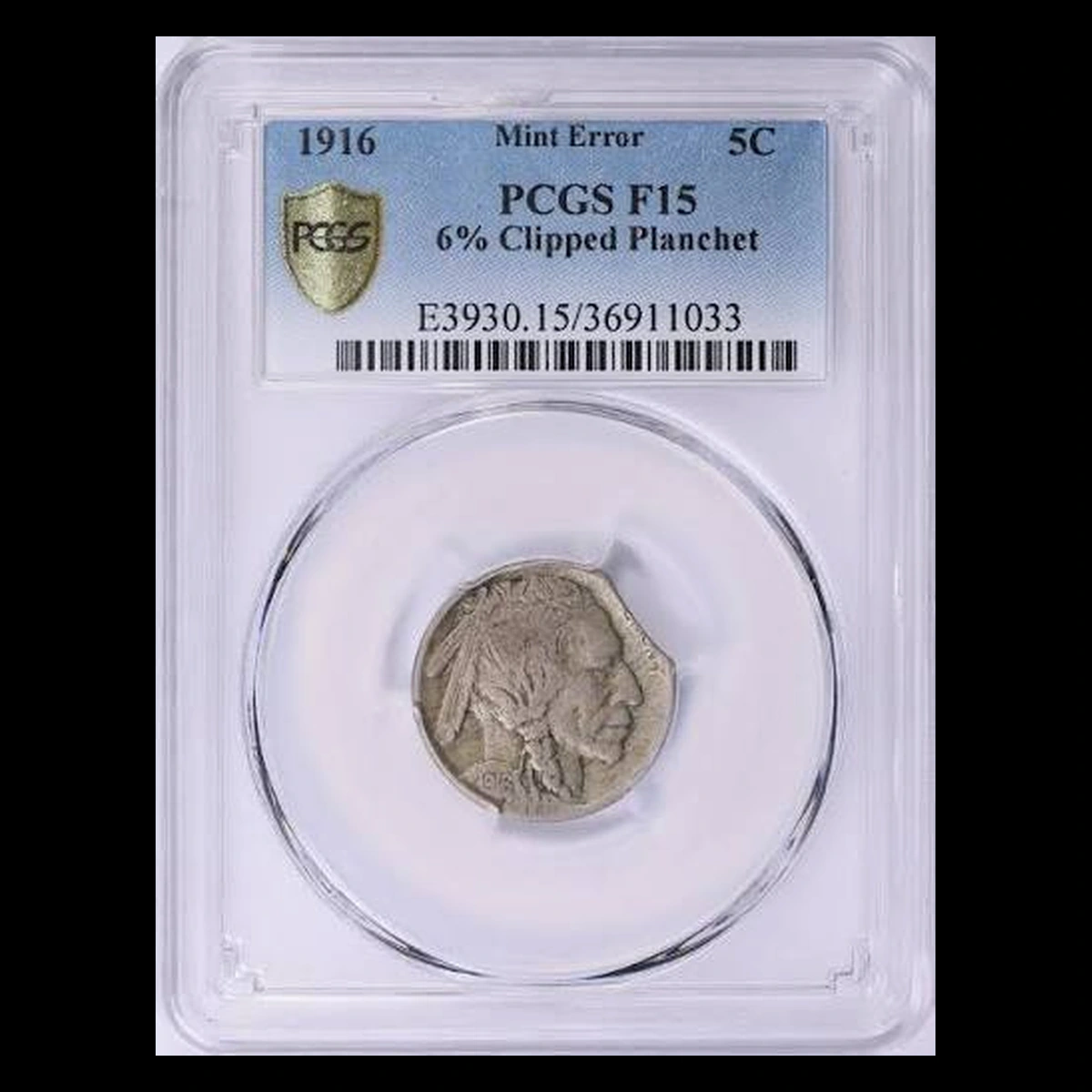
Mint Error News lists an NGC MS62 example with a 10% straight clip and broadstriking. The shortage existed before the strike, while the remaining metal spread without normal restraint.
The listing does not establish the mint or the gap’s clock position. Both features belong to the same unworn coin with noticeable marks.
How to Identify
Examine both ends of the straight gap for original metal flow and check the remaining edge for sawing or fresh shearing. Opposite-rim weakness can provide supporting evidence when visible.
The expanded border should agree with the same incomplete blank. A 10% clip description is not a measured specimen weight, and expansion does not replace the missing metal.
What It’s Worth
$150–$1,200 is the estimate for the combined clip and broadstrike. No completed sale was supplied for this MS62 listing.
Readable identity, original surfaces, and a clear pre-strike gap matter to the comparison. Adding two full standalone error prices would overstate what the listing establishes.
12. 1916 Nickel A Blank Crescent Adjoins Cropped Design: Off-Center Strike Error
The collector gallery includes a 5% off-center San Francisco example, and a Mint Error News list includes a separate unworn Denver piece. A year guide describes another example displaced 40%.
In each case, some of the design misses the blank rather than fitting within a wide border. Their amounts of displacement and mint evidence must remain separate.
How to Identify
Read the date and compare the untouched areas with the missing design on both faces. A shift mainly on one face calls for a different alignment explanation.
Inspect the intact mintmark area if it survives. If it lies beyond the struck metal, absence of D or S cannot establish Philadelphia.
What It’s Worth
$100–$600 is the estimate for smaller original shifts, with $500–$2,500 for dramatic examples retaining a date. The year guide reports more than $1,500 for the 40% example without a visible mintmark.
That is a secondary comparison with an unidentified mint, separate from the 5% San Francisco specimen. A large displacement that loses the date may appeal less to a year collector than a smaller dated error.
Conclusion
The exceptional doubled-date variety accounts for the highest 1916 nickel prices, while most metal and strike errors occupy much lower ranges. Match the full visible pattern before selecting a value comparison.
Distinguish missing design caused by die polishing from wear on the coin, and keep surface flakes separate from broad split halves. Preserve paired pieces and compare both faces whenever the strike or alignment looks unusual.