Rare 1846 Half Dollar Errors (List & Pictures)
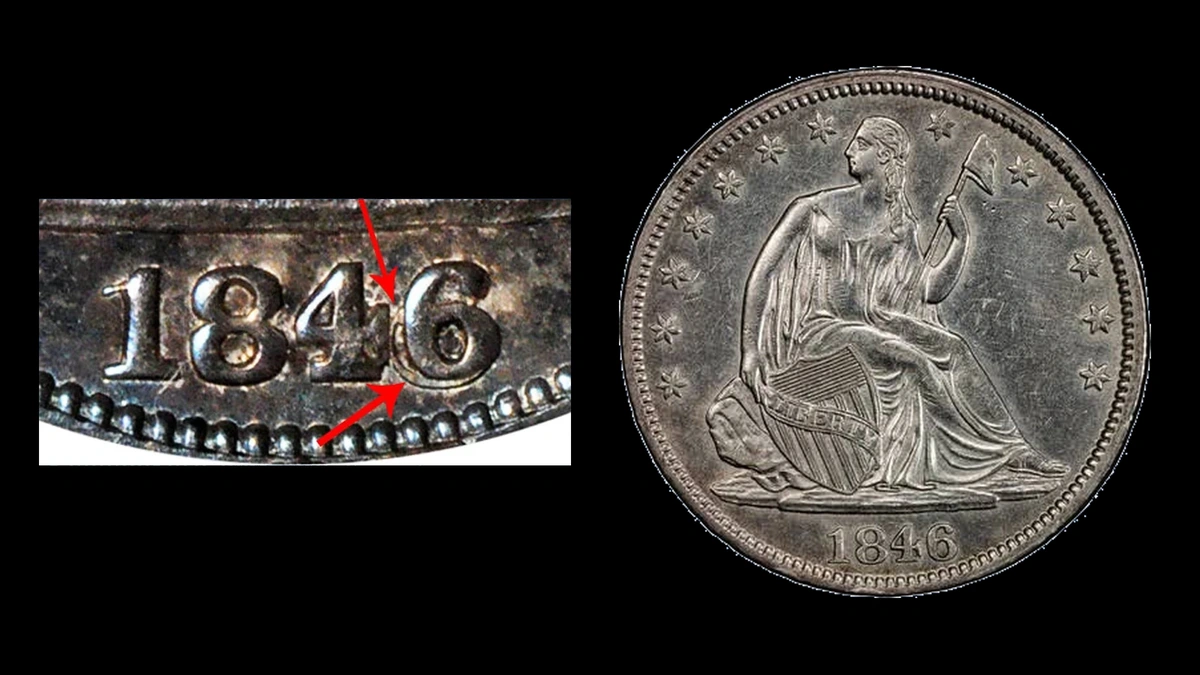
A close view of the date can miss part of the story on an 1846 half dollar: raised patches may sit just below it at the rim. Keep both areas visible when checking the 1846 half dollar errors described here.
Estimated values span $150–$16,000, with a horizontal-6 MS65 selling for $15,862.50 in October 2014. Inspect extra digit strokes first, move down to the rim, and then compare doubled front detail.
| Feature to look for | Area | Category | Estimated value |
|---|---|---|---|
| A sideways 6 or repeated digit pieces | Date | Repunched date | $150–$500 for worn New Orleans examples; $12,000–$16,000 for comparable MS65 horizontal-6 coins |
| Two raised patches touching the border | Rim below 846 | Double rim cud | $6,000–$8,500 for the combined MS62 variety |
| Repeated front design detail | Matched WB-10 obverse | Doubled die obverse | $350–$700 |
The date style and mintmark guide the comparison: Philadelphia and New Orleans reports concern different digits and varieties. An unworn 1846 half normally weighs about 13.36 grams, measures 30.6 mm, and has grooves along the edge.
1. 1846 Half Dollar A Sideways Number Beneath the 6: Repunched Date Error
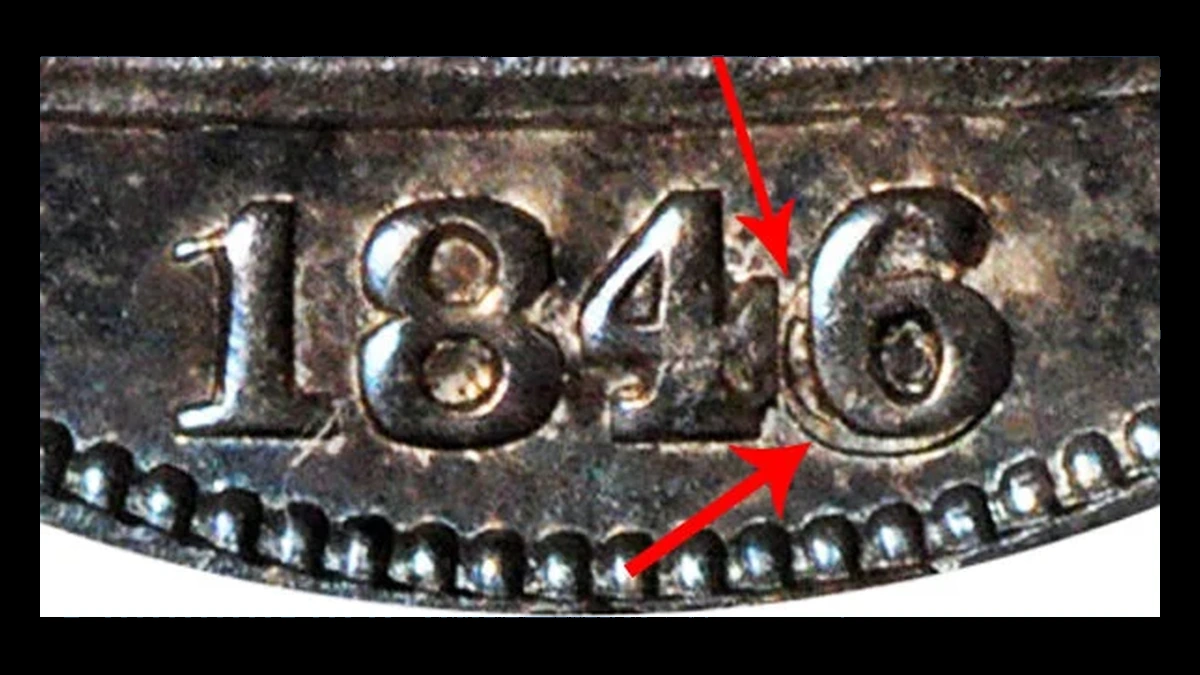
The best-known example contains parts of a 6 rotated ninety degrees clockwise beneath the final upright 6. The overlapping curves show how much of the earlier punch survived the correction.
A repunched date begins while the date is being added to the steel die. Applying a digit again in a changed position can leave pieces of both impressions for the die to reproduce on coins.
The sideways-6 variety belongs within that broad category alongside subtler reports. New Orleans Medium Date coins can show repeated portions of the 1 and 6, while Philadelphia Tall Date reports concern the 1 and 4.
How to Identify
Decide which mint and digit style you are examining before enlarging the suspicious strokes. Otherwise, a correct photograph of one variety can become a misleading guide to another.
For the horizontal 6, trace curves that make sense when the earlier numeral is turned clockwise. A broad-looking 6 without those surviving curves is not a sufficient match.
The 1846-O Medium Date repunched-6 example provides a New Orleans reference. Its O mintmark and Medium Date matter when comparing the extra strokes.
Raised fragments of a punched digit should have a recognizable shape. A flattened shelf or a random impact lip can add an apparent edge without representing an earlier number.
What It’s Worth
Estimated ranges: $150–$500 for ordinary worn New Orleans repunched-date coins, and $12,000–$16,000 for horizontal-6 examples comparable to the cited MS65. These are separate condition and variety groups.
The MS65 horizontal-6 coin brought $15,862.50 at Heritage in October 2014. MS65 describes a well-preserved coin without circulation wear, which is a major reason for its distance from the lower range.
The New Orleans reference was graded XF Details, indicating wear and a condition problem, and its sale price was not public in the supplied record. It documents the variety without providing another numeric sale comparison.
2. 1846 Half Dollar Two Patches Joining the Lower Rim: Double Rim Cud Error
Continue downward from the date and inspect beneath 846. A documented horizontal-6 coin has two raised patches that meet the rim in this area.
These features are called cuds because pieces broke away at the edge of the working die. Silver entered the missing areas during striking and formed larger raised patches instead of the intended detail.
The cuds developed after the date had been punched into the tool. Their presence on the same coin as the sideways 6 records two different changes to that die.
How to Identify
Keep a strip of the rim visible below the entire date when examining a photo. Without the rim connection, a close crop can hide the evidence needed to call a patch a cud.
Compare both outlines and their positions beneath the digits. The two-patch arrangement in the documented example is more specific than simply finding a bump at the border.
Inspect the outer edge as well. A later blow can push or flatten silver and disturb the grooves, whereas the documented cud shapes originate in the missing portions of the die.
Confirm the horizontal-6 feature separately. Correctly identifying one feature does not establish the other when photographs leave the relevant area unclear.
What It’s Worth
Estimated range: $6,000–$8,500 for an MS62 horizontal-6 half with the documented cuds. MS62 coins have no circulation wear but can show noticeable marks or other imperfections.
The June 2020 Heritage description confirms the two patches on an MS62, although its price was hidden. A separate MS62 horizontal-6 coin sold for $7,762.50 in August 2011, with no cuds specified in that price record.
The estimate therefore uses a documented feature description and a comparable grade sale with a stated limitation. It values the combined coin once; another full repunched-date value should not be added.
3. 1846 Half Dollar Repeated Detail Elsewhere on the Front: Doubled Die Obverse Error
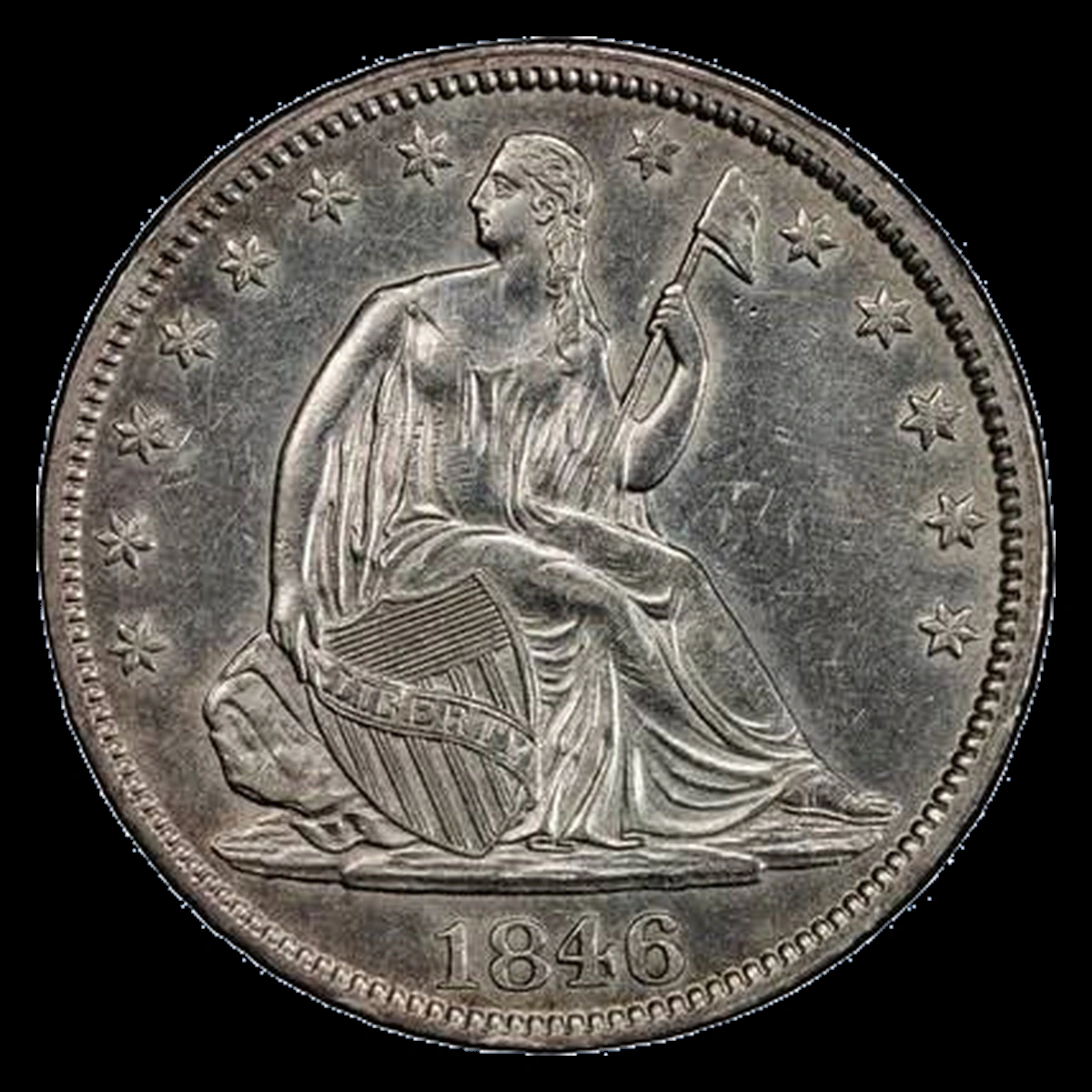
WB-10 is the PCGS catalog entry for an 1846 Medium Date doubled die obverse, meaning a doubled front design. It supplies a specific variety to investigate beyond the repunched digits discussed above.
With a doubled die, the repeated design is built into the steel tool that stamps the coin. A repeated date-punch impression has a different origin, so extra date strokes alone cannot settle a WB-10 identification.
An advertisement from 1986 also mentioned an 1846 doubled obverse. It named no particular doubled letter and does not prove that the advertised coin was WB-10.
How to Identify
Obtain a clear image of an identified WB-10 and compare the full front before concentrating on a small area. The supplied descriptions do not justify inventing a single letter as the universal diagnostic.
Use a magnifier to match the actual repeated shapes and their spacing. A flat ledge caused by movement during striking or an extra edge from an impact is not equivalent to that pattern.
Check the Philadelphia mint identity and Medium Date style as part of the match. A report involving another date style needs its own evidence even if it also uses the words “doubled obverse.”
What It’s Worth
Estimated range: $350–$700 for similarly lightly worn, identified examples. A coin in the PCGS WB-10 category graded AU55 sold for $504 in May 2022.
AU55 indicates light circulation wear with substantial detail remaining. Cleaning or other surface problems weaken the comparison, and the older advertisement supplies no basis for replacing this price with a higher figure.
Conclusion
The inspection moves only a short distance from date to rim, but it passes through different causes: repunching and broken die edges. A doubled front design requires a third, separate variety match.
Across the $150–$16,000 estimates, mint, date style, and preservation all change the appropriate comparison. When the horizontal 6 and cuds share one coin, use one whole-coin valuation.