Rare 1953 Half Dollar Errors (List & Pictures)
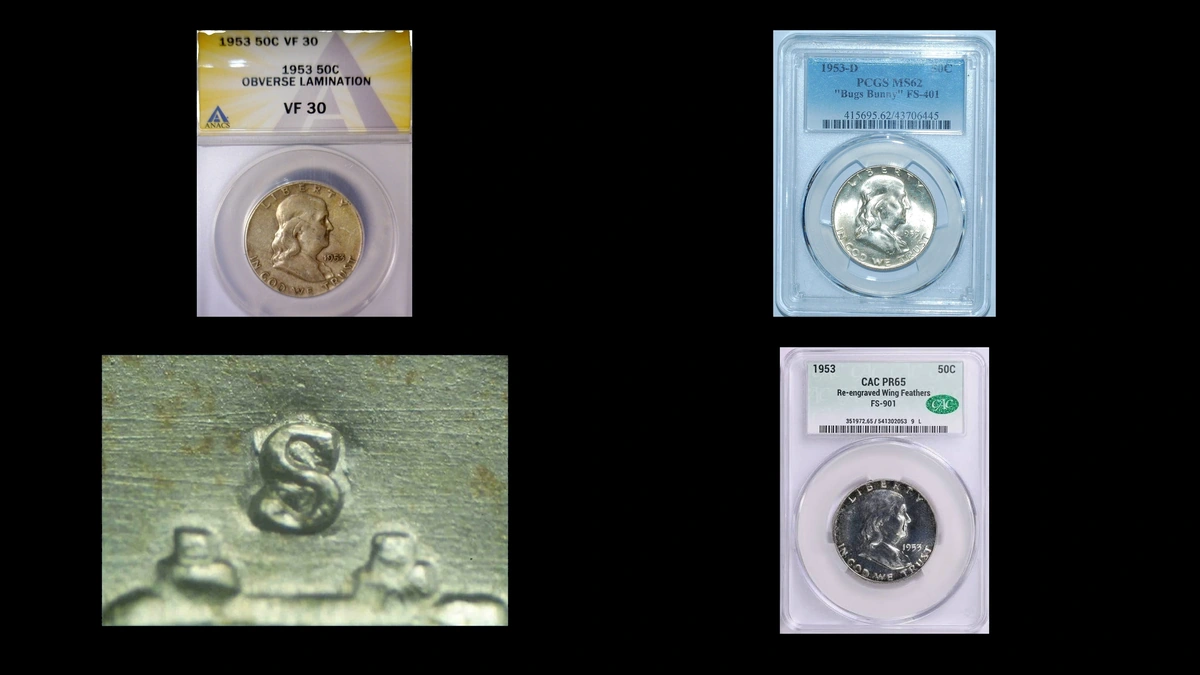
Size is the quickest way to separate the most dramatic 1953 half dollar errors from the small marks that need magnification. The seven categories below span estimated values of $40–$8,000.
A documented Denver half struck on a dime blank brought approximately $6,612 in August 2011. Examine the outline and surface first, then follow Franklin’s mouth, the mintmark, and the small eagle’s wing.
| Clue | Check first | Category | Estimated value |
|---|---|---|---|
| Very small coin with half-dollar design | Weight, date, and D | Dime planchet | $5,000–$8,000 |
| A substantial edge section missing | Gap surfaces and weight loss | Clipped planchet | $75–$250 |
| A thin layer separates | Layer boundary on S-mint coin | Lamination | $50–$175 |
| Localized impressed or weak area | Correct mint and production type | Strike-through | $50–$350 |
| Raised toothlike mouth detail | Upper lip | Die clash | $40–$400 |
| Extra part of the mint letter | Above bell | Repunched mintmark | $75–$500 |
| Coarse restored feathers | Small eagle on collector Proof | Re-engraved wing | $250–$600 around PR65–PR66 |
The normal 90% silver half dollar weighs 12.50 grams and measures approximately 30.6 mm across, with a grooved edge. D and S above the bell identify Denver and San Francisco; Philadelphia has no mintmark and also produced the collector Proofs discussed here.
1. 1953 Half Dollar A Half-Dollar Design on a Tiny Disc: Dime Planchet Error
The documented 1953-D retains its date and mintmark despite being struck on a 2.5-gram dime blank. Much of the larger half-dollar design had no metal beneath it and could not fit.
Stack’s Bowers cataloged the NGC MS63 in August 2011. The description concerns a blank, not a previously struck dime carrying an older design underneath.
How to Identify
Compare the weight with a silver dime’s 2.5 grams. Since both denominations use 90% silver, color alone does not separate them.
Measure against the dime’s usual 17.9 mm and the half’s 30.6 mm, allowing for spreading during striking. The edge should explain a smaller original blank rather than a finished half trimmed down later.
Inspect for machining and record the readable 1953 and D. Naturally formed surfaces, compatible weight, and the design running beyond the available metal work together as evidence.
What It’s Worth
Estimated range: $5,000–$8,000 for an authenticated example comparable to the MS63. Greysheet records approximately $6,612 for the August 2011 Stack’s Bowers coin.
The historical amount depends on its identity, readable date, and preservation. A small altered half dollar does not qualify for the same comparison.
2. 1953 Half Dollar A Large Section Missing From the Edge: Clipped Planchet Error
Collector Sean Reynolds estimated the missing portion of a reported 1953-D at fifteen to twenty percent of the blank. The report does not establish a specific gap shape or clock position.
A separate 1951-S in the same discussion has a larger straight clip. Its outline must not be assigned to the Denver 1953.
How to Identify
Inspect both ends of the gap and the exposed edge. Original design should fit metal that was absent before striking, rather than terminate at a recently cut or filed wall.
Check for opposite-rim weakness as supporting evidence, then compare the weight loss with the substantial missing area. An intact span can still measure the normal diameter.
Retain the date, D, and complete outline in photographs. Naturally interrupted edge grooves provide useful context alongside the gap itself.
What It’s Worth
Estimated range: $75–$250 for a substantial genuine clip across worn through ordinary unworn grades. A year guide reports $66 for another unusual Denver clip without specifying its percentage.
That figure does not identify Reynolds’ example. Missing-metal percentages cannot be converted into a fixed price per percentage point.
3. 1953 Half Dollar A Thin Sheet Lifts From the Surface: Lamination Error
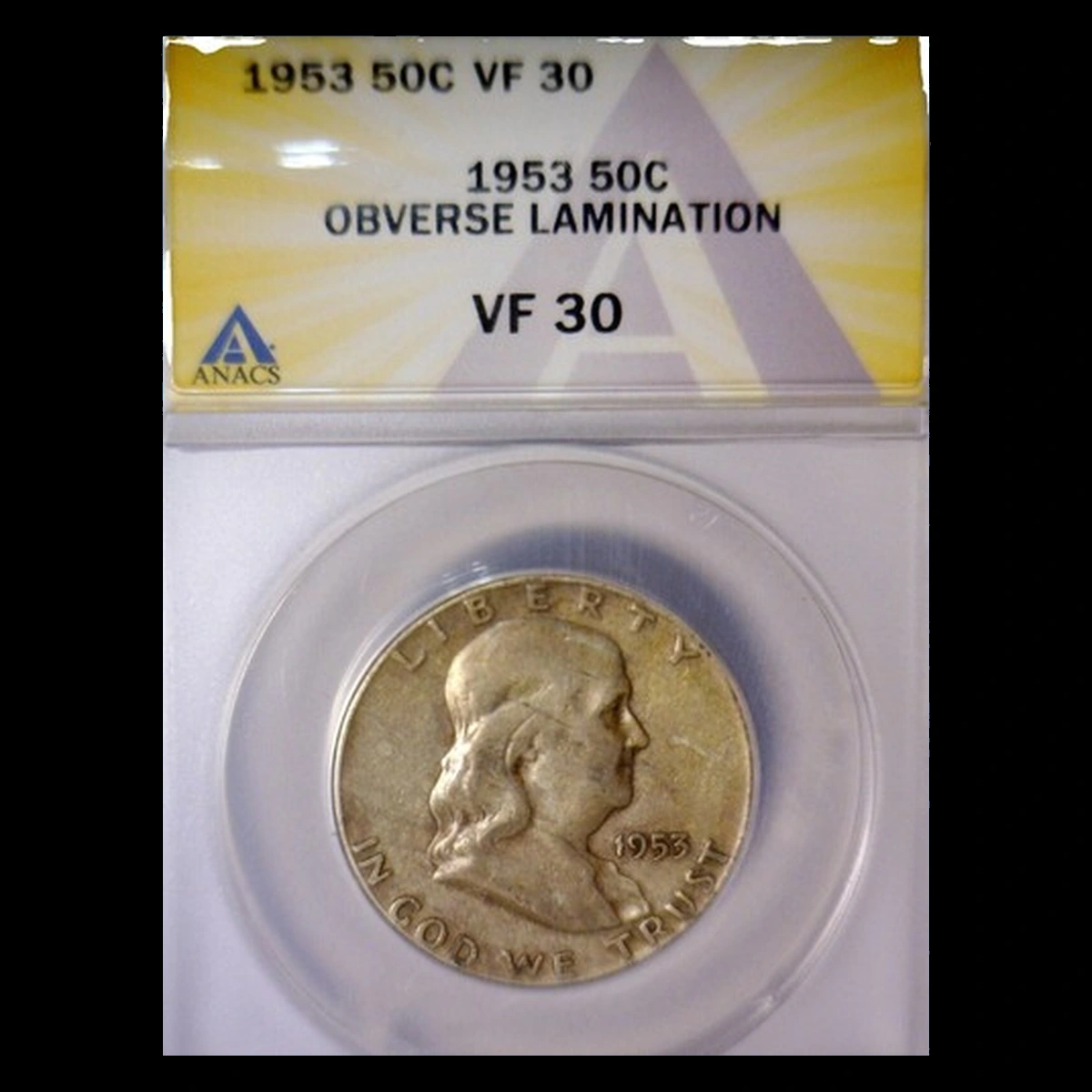
The reported 1953-S lamination involves local separation within the silver. An attached flake and the shallow area left after it falls away represent different stages of that same problem.
The report gives no exact location. Roughness or discoloration by itself cannot establish the physical layer separation.
How to Identify
Verify the S, then trace the affected boundary under low light. Look for a lifted margin or distinct thin layer continuing into the surrounding metal.
Keep loose material untouched. Corrosion pits, cutting tracks, and a gouge through solid silver need to be distinguished from the boundary of a separating sheet.
What It’s Worth
Estimated range: $50–$175 for small laminations on worn through ordinary unworn S-mint coins. Minor graded examples around $52–$55 appear in the year guide.
Those figures do not establish a sale of this specific report. A larger attached layer or substantially different surfaces would require a more suitable comparison.
4. 1953 Half Dollar A Localized Groove or Impression: Strike-Through Error
Three reports need to remain distinct: a Denver groove with fiber texture, a front-side mark on an NGC MS65 San Francisco coin, and a thread example listed as an ANACS PR66 Philadelphia Proof.
Material between die and blank can impress or block the forming design. The die is the steel stamping tool, and the broad strike-through category does not establish that all three involved string.
How to Identify
Establish the mint and whether the coin is an ordinary issue or collector Proof. Compare the Denver texture, San Francisco front mark, or Proof thread impression only with its corresponding example.
Inspect how the recess meets surrounding detail. A later scratch cuts the completed surface and may leave sharp lips, while a strike-through formed as the design was being impressed.
What It’s Worth
Estimated ranges: $50–$250 for distinct ordinary-issue examples and $175–$350 for a comparable thread-impressed Proof. The guide gives approximately $215 for a prominent MS65 and a $225 PR66 comparison.
These figures do not identify completed sales of the specific Denver or San Francisco coins. The interruption’s size, clear texture, and surrounding surface quality matter.
5. 1953 Half Dollar Raised Teeth or Other Portrait Traces: Die Clashes Error
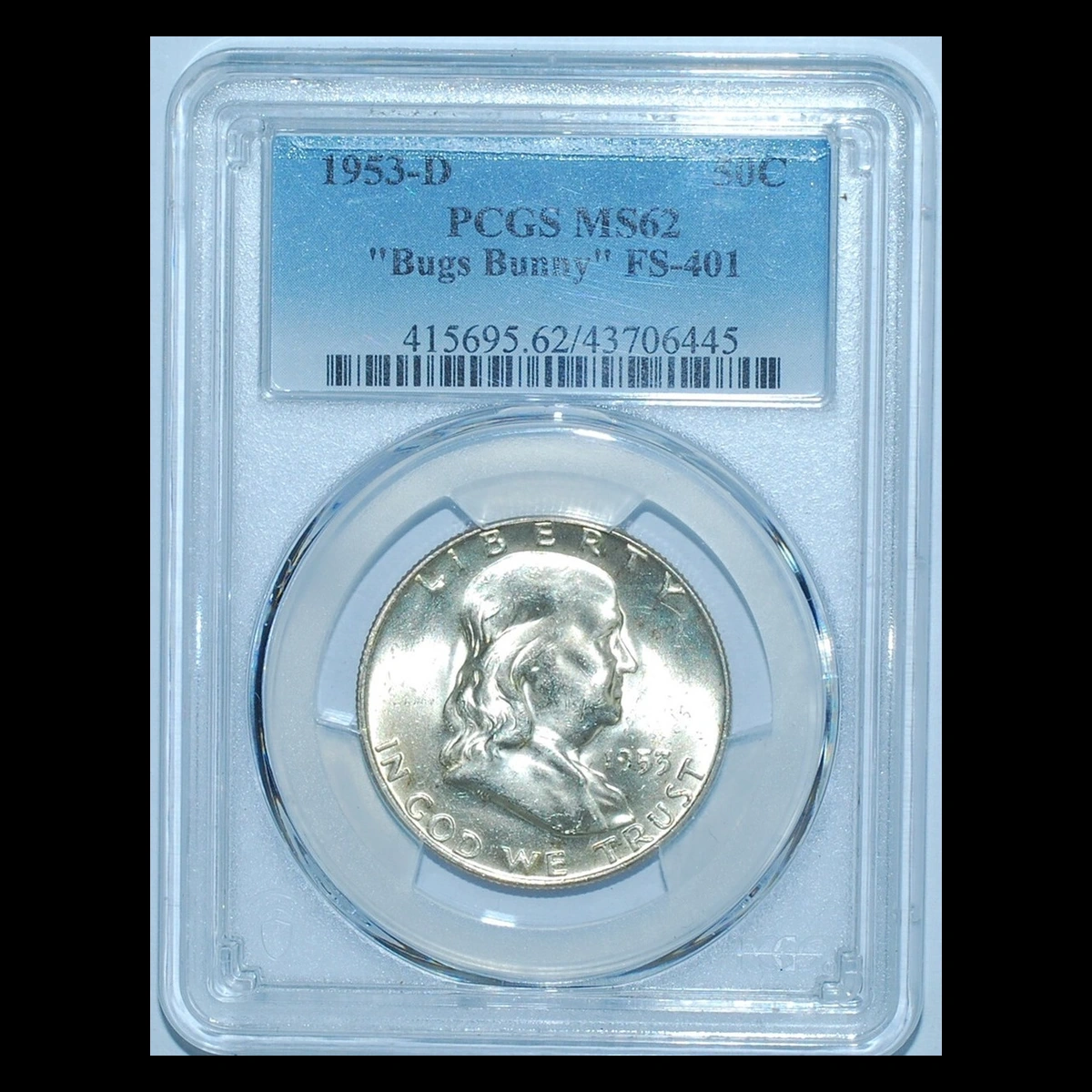
The Bugs Bunny nickname describes small projections at Franklin’s upper lip. Other transferred traces can arise without prominent teeth.
The dies first contacted one another with no blank between them, transferring design marks. Later coins copied those added shapes.
Reports cover Philadelphia, Denver, and San Francisco. Each mint’s particular pattern needs its own reference.
How to Identify
View the whole mouth before enlarging the lip. Match the original raised projection to a documented same-mint example rather than a dent, scratch, or attached speck.
Compare any supporting traces with the opposite design. Unrelated nearby lines should not be joined into an invented clash pattern.
What It’s Worth
Estimated range: $40–$400 for recognizable clashes on worn or ordinary unworn coins. A 1953-D described as SEGS MS65+ recorded $325 at Key Date Coins in August 2025.
Keep the SEGS attribution with that comparison. Bell-line clarity, surfaces, and the correctly identified pattern also affect demand.
6. 1953 Half Dollar Another Letter Beside the Mintmark: Repunched Mintmark Error
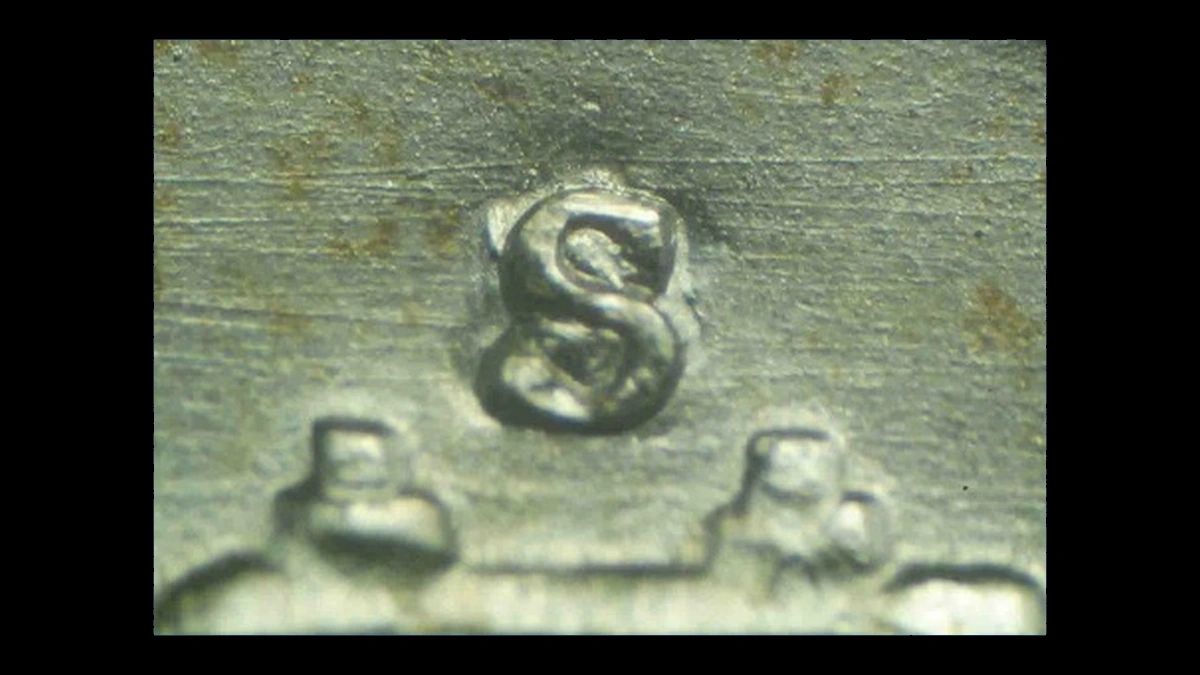
A mintmark punch applied in more than one position could leave part of the earlier letter visible. For the referenced 1953-S, that extra S lies above and left of the final S.
A separate Denver report places extra D detail below the main letter. These directions are specific to different mintmark reports.
How to Identify
Use Wexler’s S-mint reference for the upper-left curves. For Denver, compare the lower D remnants with the corresponding documented example.
A genuine remnant must resemble part of the same letter. A flat ledge, cut, or random lump beside the mintmark is insufficient even if its location seems promising.
What It’s Worth
Estimated range: $75–$500 for clearly identified unworn coins below exceptional preservation levels. A PCGS MS65 1953-S was offered at $154.99 in the year guide.
That is an asking price, not an auction realization. No separate Denver sale is supplied, so its bracket remains comparative.
7. 1953 Half Dollar Coarse Straight Feathers on the Small Eagle: Re-Engraved Wing Error
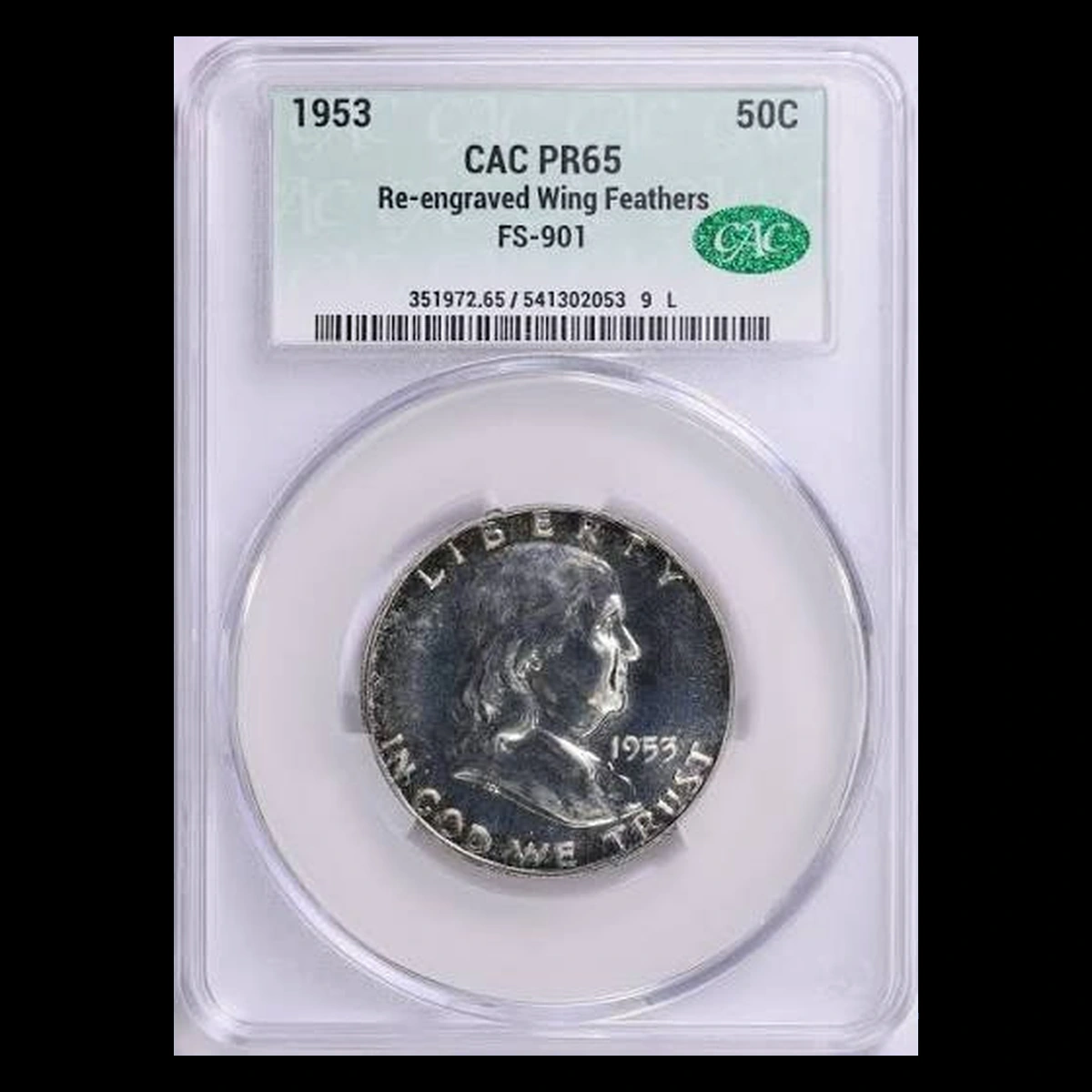
On the Philadelphia Proof variety, hand work restored detail weakened by die polishing. The affected eagle’s left wing appears on the viewer’s right and carries straighter, coarser feather lines.
The repaired lines were in the tool and became raised coin design. PCGS recognizes the Re-Engraved Wing variety as FS-901.
How to Identify
Set the bell upright, find the small eagle to its right, and inspect the wing on the viewer’s right. Compare with a normal 1953 Proof under similar lighting.
Confirm Proof manufacture rather than relying on brightness alone. Original restored lines rise with the design, whereas later engraving cuts into the finished metal.
This concerns the Franklin half’s small eagle. A similarly named Washington-quarter feather variety is a different reference.
What It’s Worth
Estimated range: $250–$600 for confirmed PR65–PR66 examples. The year guide reports PR66 offers of $330–$425, while the PCGS variety page supplies no auction record.
The figures are asking-price context. Mirror quality, fine scratches, and any contrast between frosted designs and backgrounds require appropriate comparison.
Conclusion
Record the mint and production type alongside every suspected error. A small wrong blank, a clipped edge, a separating layer, and tool-made design details tell different manufacturing stories.
The $40–$8,000 estimates depend on correct attribution and condition. Keep the three strike-through accounts separate, retain asking-price labels, and compare the dime-blank rarity only with a coin whose date, metal, weight, and edge support that identity.