Rare 1810 Half Dollar Errors (List & Pictures)
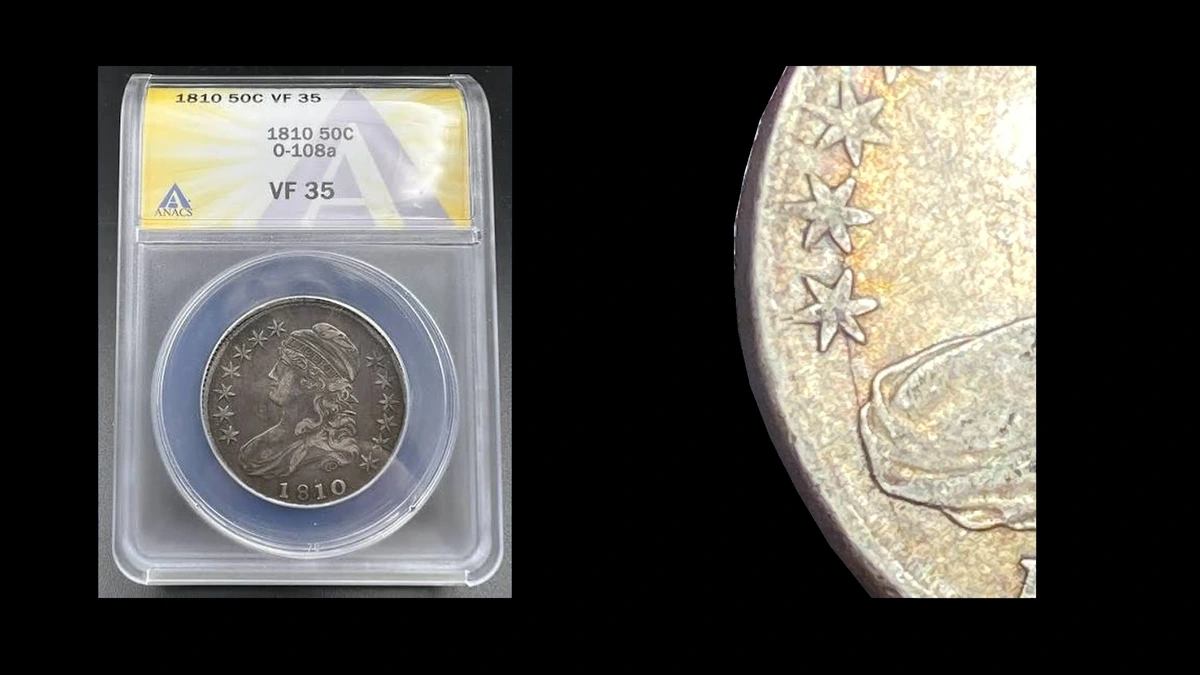
On one 1810 half dollar, nearly all of AMERICA missed the edge of the blank. The coin was heavily worn, yet its dramatic off-center strike helped it sell for $8,225 in September 2016.
Smaller 1810 Capped Bust half dollar errors require a closer look at the borders, raised lines, and surface. The estimated ranges in this guide extend from $150–$10,000.
Begin by comparing the position of both pictures, then inspect the rim and smaller marks.
| What to compare | Possible feature | Estimated whole-coin range |
|---|---|---|
| Both pictures shifted | Off-center strike | $1,500–$10,000 |
| Only the front clearly shifted | Misaligned die | $300–$900 |
| Part of the blank missing | Clip | $300–$2,500 |
| Short flat part of the rim | Reported mint-made flattening | $250–$1,800 |
| Raised branching lines | Die cracks | $150–$1,400 |
| Unwanted design traces | Die clash | $150–$1,200 |
| Long sunken reverse line | Unresolved surface or blank feature | $250–$700 |
These Philadelphia halves have no mint letter and carry lettering around the edge. Their original weight was 13.48 grams, with a diameter of roughly 32.5 mm; wear and missing metal affect comparisons with those figures.
Numbers such as O-102 identify particular pairs of stamping tools. They help you match a feature without turning every small variety into a separate error category.
1. 1810 Half Dollar Both Designs Shift beyond the Edge: Off-Center Strike Error
The blank was out of position when the dies struck it. As a result, parts of the picture landed beyond the available metal.
The well-known O-102 example is about 20% off center toward two o’clock, with almost all of AMERICA missing. A separate O-102 has a smaller 5% shift toward one o’clock.
Another example, graded AU58 for slight wear, shifts toward 10:30. Its catalog uses “partial collar” in quotation marks but explains the appearance as off-center striking.
How to Identify
Compare the full outline on both faces and follow the design that runs off the coin. On the 20% example, the loss of AMERICA is especially easy to recognize.
The AU58 coin loses small border marks at roughly nine to one o’clock on the front and five to eight on the back. Those locations belong to that coin, not every 1810 off-center half.
Inspect the lettered edge as well as the faces. These early halves used an open retaining ring, so a modern explanation about partly formed edge grooves does not automatically apply.
What It’s Worth
$6,000–$10,000 is the estimate for similarly dramatic worn examples. Milder shifts on better-preserved pieces around XF or AU have an estimated range of $1,500–$5,000.
The 20% O-102 auction coin brought $8,225 in September 2016 in Fine12 condition. Its substantial wear did not hide the striking mistake.
2. 1810 Half Dollar The Front Sits Off to One Side: Misaligned Die Error
Unequal front borders can have a different explanation when the back remains more centered. One die may have shifted rather than the entire blank.
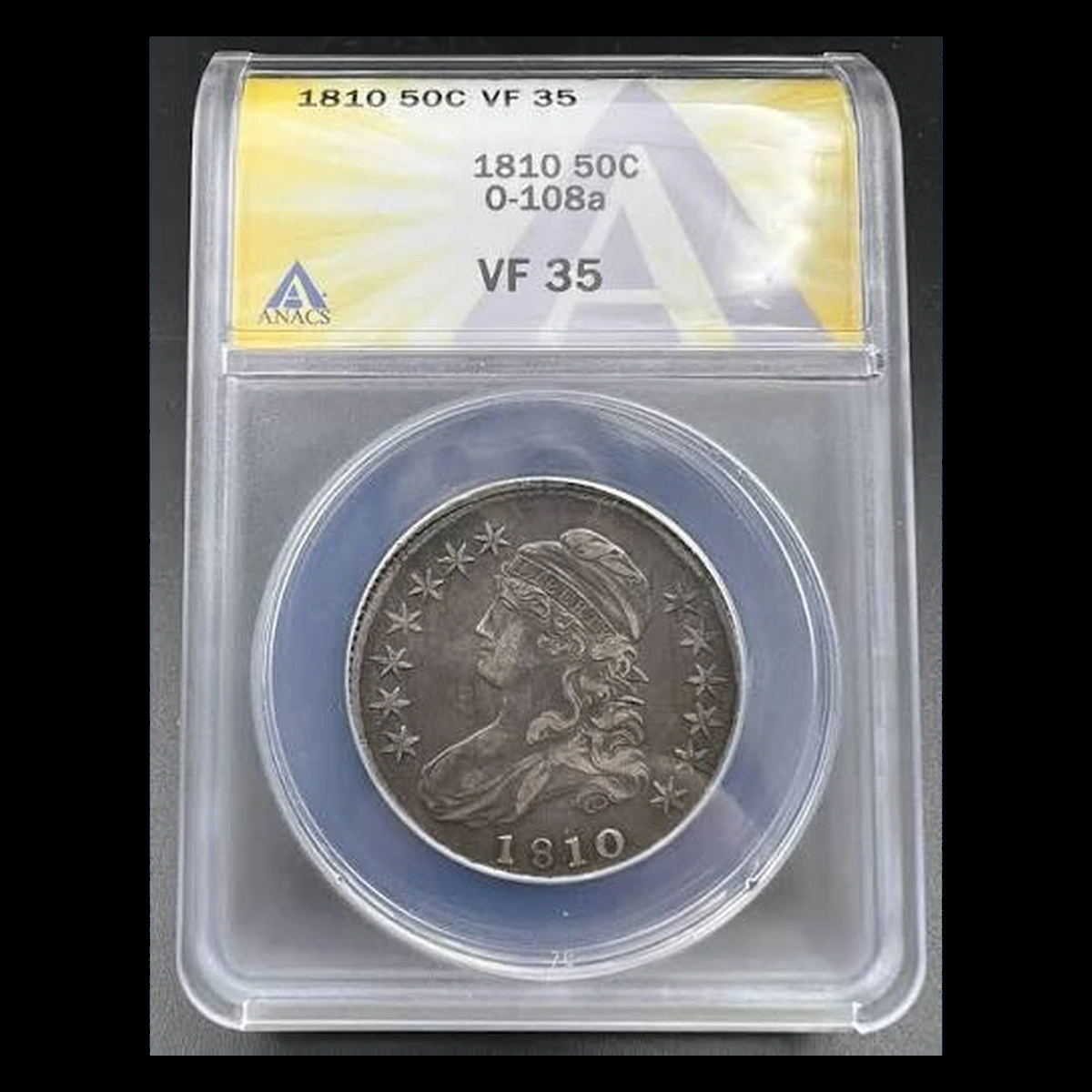
A dealer-listed O-108a graded VF35 is described this way. The same coin has a long sunken line on the back, discussed separately below.
How to Identify
Place equally sized photographs of both faces beside each other, with the entire rim visible. Compare the distance from the picture to the rim in several directions.
Look for real displacement on the front alongside a more balanced back. A tightly cropped image or worn rim can make the border seem uneven when it is not.
The reverse line does not explain the front’s position. Keep the two observations separate while examining the same coin.
What It’s Worth
$300–$900 is the estimated whole-coin range for a piece similar to the listed VF35 example. VF35 means worn, with substantial design detail remaining.
The dealer page displays $639.99 and “sold out.” That is a listed amount, not proof of the final price paid.
3. 1810 Half Dollar A Piece of the Outline Is Missing: Reported Clip Error
A collector posted an 1810 O-108 with a reported clip in December 2023. The account does not provide certification or a clock position for the missing segment.
A genuine clip starts with an incomplete blank. When that blank is struck, the remaining metal flows around a gap that already exists.
How to Identify
View the gap from both sides and edge-on. Look for natural changes in the nearby struck design, rather than a cut passing through a finished picture.
Saw marks and file lines suggest later removal. Weakness on the opposite rim can support a clip, although its strength varies.
Use the collector’s O-108 report for that example only. Other coins in the discussion do not establish the position or size of this coin’s clip.
What It’s Worth
$300–$2,500 is the estimated range for genuine worn 1810 clips, depending on size, preservation, and clear identification. No sale amount is assigned to the collector’s example.
An 1832 half with a smaller defect formed before striking brought $263.25 including fees in July 2025 in XF45 condition. That is a modest different-year comparison, not a sale of the same clip.
4. 1810 Half Dollar A Short Part of the Rim Is Flat: Reported Mint-Made Flattening Error
Some O-106a halves show a flattened rim segment beside the stars. Reported positions include star 1, gaps near stars 5–7, and the area beside stars 11–13.
These positions occur on separate coins. A researcher proposed that an object interfered with the rim during striking, but no recovered object or specific material was identified.
How to Identify
Keep the neighboring stars visible when photographing the flat section. The O-106a reference shows how the reported positions differ between examples.
Inspect the transition from normal rim to flattened area. File marks, freshly exposed metal, and metal pushed aside by a blow suggest later damage.
The adjacent design must also make sense with the proposed obstruction. A flat rim alone does not prove that the Mint caused it.
What It’s Worth
$250–$1,800 is the estimate where physical evidence supports mint-made flattening on a worn example. Better preservation and a convincing connection to the original strike support the higher end.
An 1821 half struck through a thread sold for $176.25 in January 2015. Its different obstruction provides limited context, not a sale record for the pictured O-106a pieces.
5. 1810 Half Dollar Raised Lines Branch from the Date: Die Cracks Error
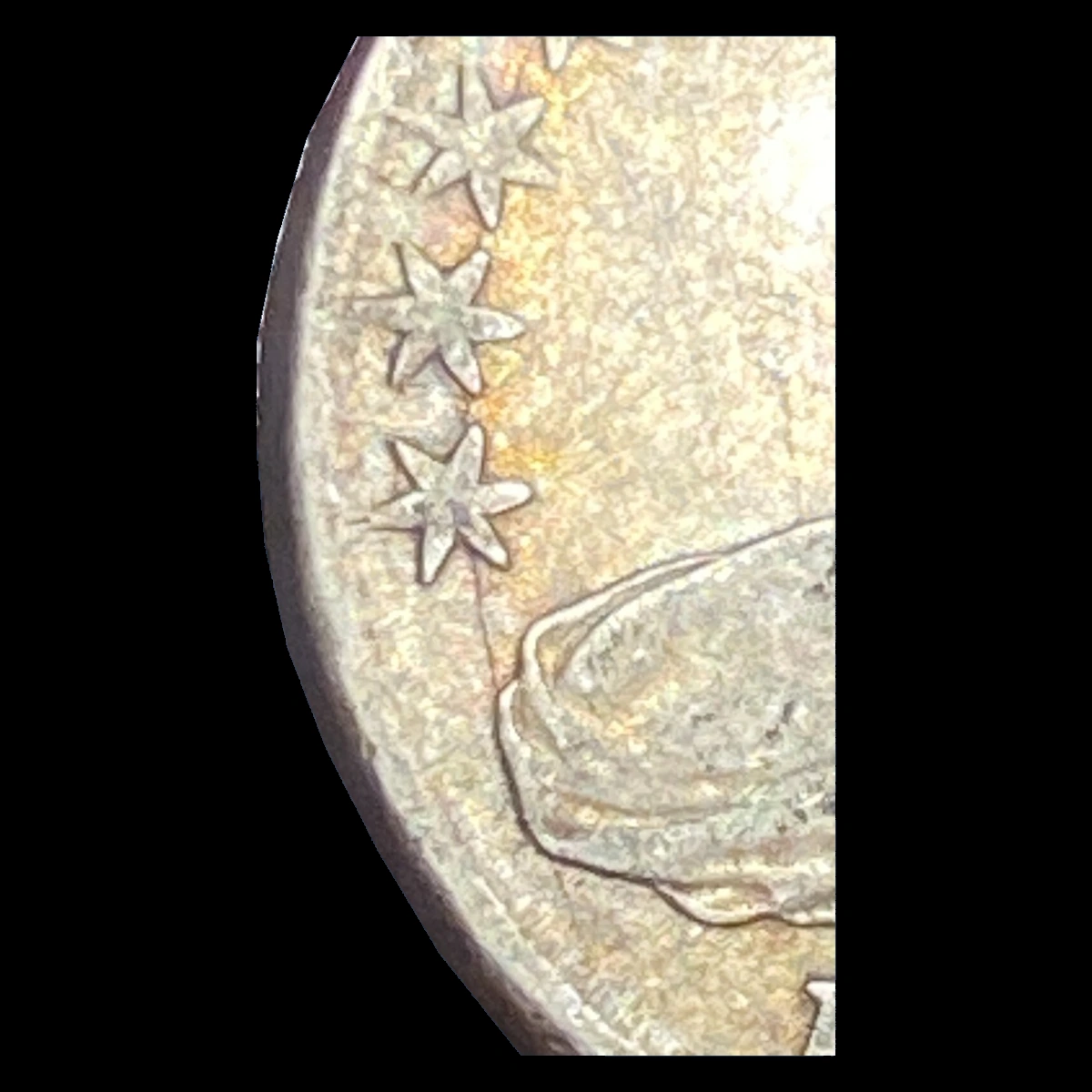
On O-103, lines extend outward from the base of the date. They formed when metal entered cracks in the die and became raised ridges on the coin.
O-101a shows other paths through the portrait and stars and around the back lettering. Use the correct tool pair’s pattern before deciding whether a line matches.
How to Identify
Start at a clear intersection, such as the date, and follow one continuous branch. A 10× magnifier and low side lighting help show whether it rises above the surface.
A scratch usually cuts down into the coin, although its edges can push upward. Do not join unrelated scratches to create the route of a known crack.
What It’s Worth
$150–$1,400 is the estimated whole-coin range for worn through slightly worn examples with clear cracks. Surface quality remains important even when the line is extensive.
An 1826 O-104 graded AU58, with cracks on both faces, sold for $1,020 in August 2025. That different-year comparison includes the value of a well-preserved early half, not just its cracks.
6. 1810 Half Dollar Parts of the Opposite Picture Appear: Die Clash Error
Shield-related traces near LIBERTY are described on O-101, along with marks below the eagle’s right wing. They reflect contact between the two dies when no blank was in the press.
Later strikes carried unwanted pieces of the opposite design. A separate O-110 was also cataloged with front clash traces in 2002.
How to Identify
Try to connect the unusual shape to a recognizable part of the other face. A random line is weaker evidence than a matching section of the shield or another design element.
Use O-110 photographs for an O-110 comparison instead of expecting every O-101 mark. Normal feathers, scratches, and shallow clash traces can look alike until their positions are compared.
What It’s Worth
$150–$1,200 is the estimate for worn 1810 halves with recognizable clash traces. Better remaining detail helps reveal shallow marks.
The $1,020 sale of the cracked 1826 AU58 half offers context for condition and the underlying coin value. It is not a clash sale and is not a separate transaction from the comparison above.
7. 1810 Half Dollar A Long Sunken Line on the Back: Unresolved Blank or Surface Feature Error
The dealer-listed VF35 O-108a has a recessed line beginning near the denomination and crossing much of the back. Its appearance has prompted several possible explanations.
Suggestions include a weakness or peeling layer in the blank, a weight-adjustment mark, die-related damage, or a later scratch. These causes are different, and the line has not been firmly assigned to one.
How to Identify
Examine the bottom and both sides of the groove under changing light. An actual peeling layer should show a seam or flake boundary, not just a smooth sunken line.
Check for cut metal or a pushed-up lip that could support a scratch. A proposed adjustment mark would involve metal removed to change the blank’s weight before striking.
The coin’s misaligned front remains a separate observation. It does not establish the cause of this reverse line.
What It’s Worth
$250–$700 is the estimated range for a worn coin with this reported combination. No separate lamination premium is added because a peeling layer has not been established.
The $639.99 dealer display belongs to the same coin discussed under misalignment. Do not add the two sections’ ranges together or count that listing as two sales.
Conclusion
A shifted picture, a missing piece, and a flattened rim can all change the outline, but they need different checks. Compare both faces and the lettered edge before choosing a category.
Smaller marks need an equally careful match: raised cracks, copied clash details, and a recessed groove tell different stories. Price the complete coin with its condition and evidence, rather than adding a separate premium for every visible feature.