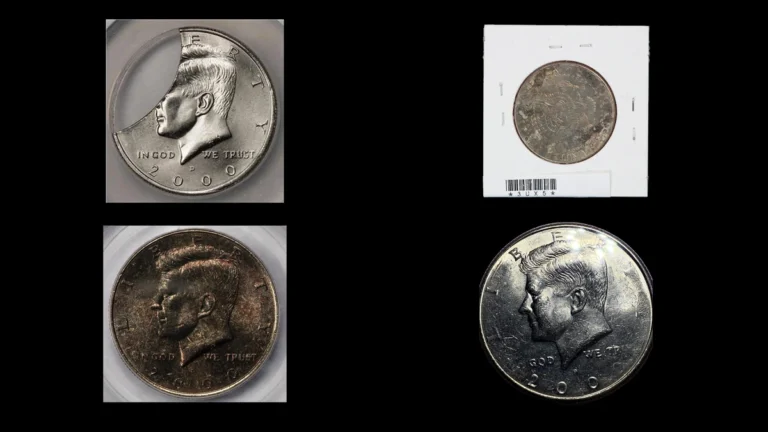
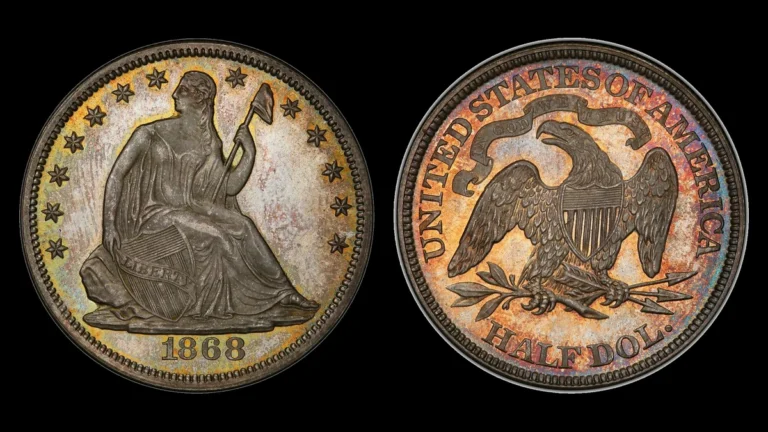
Rare 1834 Half Dollar Errors (List & Pictures)
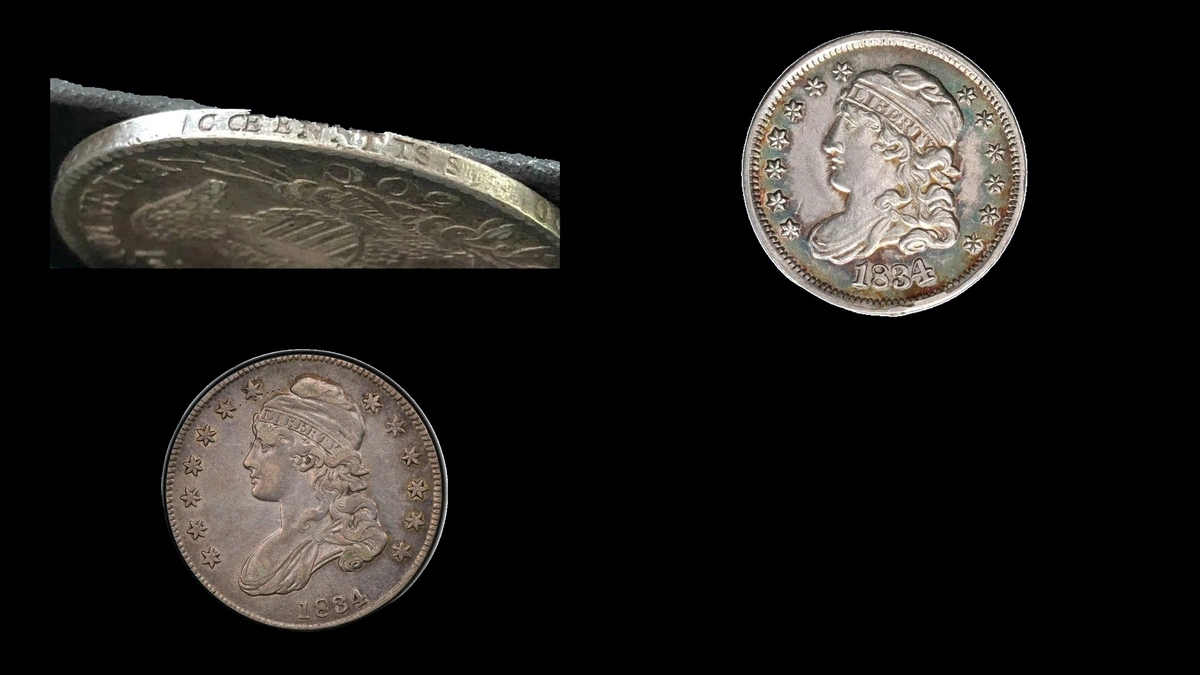
The edge of an 1834 half dollar can be as informative as Liberty’s portrait: it may carry overlapping words, a genuine clip, or an apparent gap in the lettering. Those observations require different explanations.
Estimated prices for 1834 half dollar errors run from $100 to $3,500. An ordinary unworn coin sold for $1,560 in January 2025, while a documented worn rim-clip example brought $263.25 in February 2026.
Follow the edge first, then check surface layers, raised paths, alignment, and repeated designs.
| First clue | Category | Estimated value |
|---|---|---|
| Two edge inscriptions | Overlapping edge lettering | $200–$1,000 |
| Apparently plain edge | Missing-lettering candidate | $800–$3,500 if confirmed |
| Opposing weak border areas | Incomplete edge-preparation candidate | $200–$1,200 if supported |
| Missing rim section | Rim clip | $200–$450 |
| Peeling reverse layer | Lamination | $150–$500 |
| Raised reverse route | Die crack | $100–$2,200 |
| Winglike trace near chin | Reported clash | $150–$650 |
| Reverse tilt | Rotated dies | $300–$900 |
| Earlier design remnants | Reported double strike | $1,000–$2,500 |
This Philadelphia issue has no mintmark, contains 89.24% silver, and originally weighed about 13.48 grams at roughly 32.5 millimeters across. The edge normally has words; ordinary examples can have those words facing either direction.
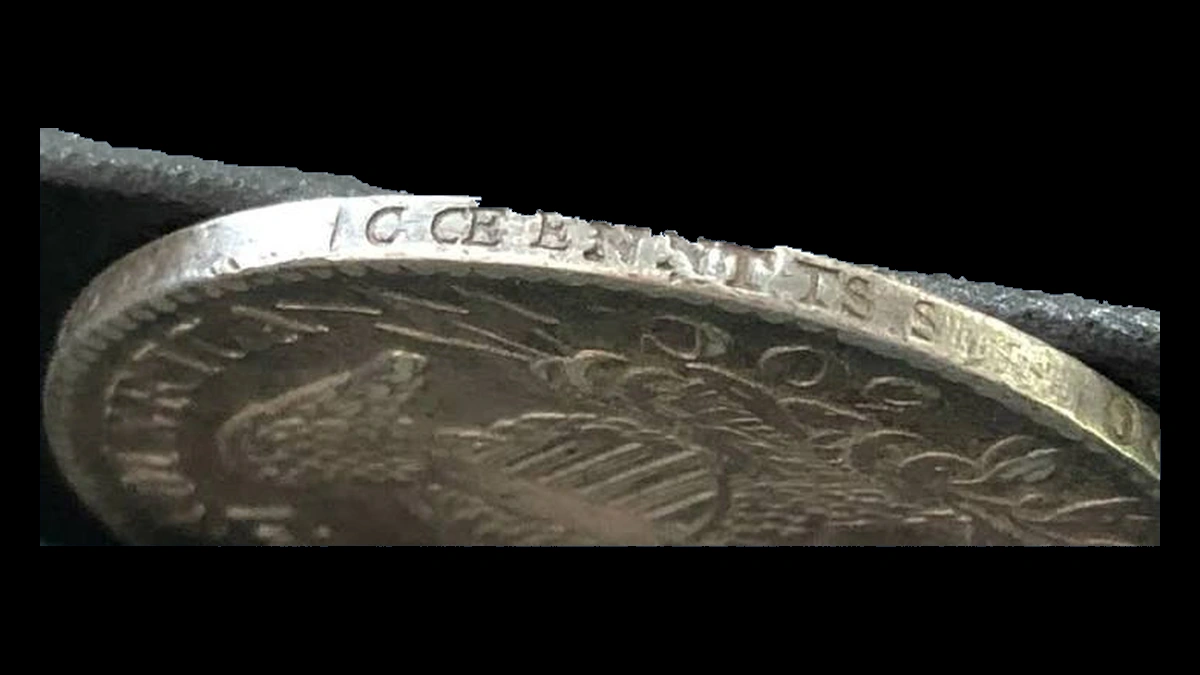
1. 1834 Half Dollar Two sequences of words cross on the edge: Overlapping Edge Lettering Error
Repeated words can record two passes through the edge-lettering equipment before the faces were struck. An 1834 in the Logan collection showed repetition around its circumference.
A separate O-116 had upside-down letters from DOLLAR crossing CENTS, indicating a changed orientation between passes. That pattern differs from two inscriptions running the same way.
How to Identify
Photograph short overlapping sections of the edge while keeping the same face toward you. Trace each sequence of letters through the crossing points instead of trying to read one confusing fragment alone.
Upside-down words by themselves are normal on this type; an additional inscription is required. A fragment that resembles OALF does not establish that the entire original word HALF was missing.
What It’s Worth
Worn examples with readable overlap have an estimated $200–$1,000 range. A more complete second inscription provides stronger evidence than one ambiguous stroke.
An O-121 with doubled edge words sold for $220 at Heritage in July 2026, graded ANACS Fine Details for cleaning. That transaction concerns neither the separate Logan example nor the cited O-116.
2. 1834 Half Dollar No words can be seen: Missing Edge Lettering Candidate Error
A holder can conceal edge lettering that is actually present. An owner reported an unworn PCGS-graded 1834 with no obvious words, but the complete edge was not shown.
Skipping the lettering step is one possible explanation, while wear, removal, and hidden lettering require consideration. The rare Crushed Lettered Edge Proofs, specially made collector coins, also need to be distinguished from an ordinary unlettered-edge error.
How to Identify
Keep a sealed holder closed and use a small mirror, magnification, and changing light where its openings allow. Record which areas remain hidden rather than treating one smooth-looking section as the whole circumference.
On an accessible coin, inspect for tool lines or the surviving bases of removed letters. Grinding can also reduce weight and diameter.
A specialist should rule out the special Proof issue before assigning the ordinary error label. Complete original edge evidence is needed to move this report beyond a candidate.
What It’s Worth
A confirmed ordinary coin with an originally unlettered edge has an estimated $800–$3,500 range across attractive worn examples and lower unworn grades. No sale of the owner’s coin is established.
The ordinary MS63 O-109’s $1,560 January 2025 result offers a condition comparison only. Crushed Lettered Edge Proofs require separate pricing, and ground-away lettering does not qualify for the error range.
3. 1834 Half Dollar Two opposite border areas spread and weaken: Incomplete Edge Preparation Candidate Error
The proposed explanation for this reported coin concerns what happened before its faces were struck. Two opposite weak, spread border sections led a collector to suggest incomplete edge preparation, informally called Guido.
The suggested test was missing edge words beside those weak sections. Requested edge photographs did not establish that relationship, so the explanation remains unconfirmed.
How to Identify
Line up each weak border section with its own edge and see whether the lettering actually stops there. Continuous words through both areas would argue against the proposed explanation.
Compare the affected sections with the undamaged border between them. Squeezing a finished coin can flatten opposite sides and push metal outward.
Document width in several directions and inspect for later pressure damage. This early manufacture should not be described as a modern broadstrike simply because the outline spreads.
What It’s Worth
A conditional estimate of $200–$1,200 applies to a moderately worn coin only if its edge supports the proposed cause. The upper end requires clear missing lettering beside the unusual borders.
The $263.25 sale of an XF40 clipped 1834 supplies a same-date minor-error comparison, although clipping is a different process. Two weak patches alone do not justify this candidate’s error estimate.
4. 1834 Half Dollar Part of the rim is missing: Rim Clip Error
A genuine clip begins with an incomplete metal blank, so the nearby design forms in relation to an already missing area. Pristine Auction documented an 1834 rim-clip example in ANACS XF40.
The listing gives no precise shape or location for its gap. A notch on another half dollar therefore cannot inherit those missing diagnostics.
How to Identify
Inspect the small border teeth and silver beside the gap for a natural response to striking around absent metal. Fresh cuts, sharp burrs, and tool marks may instead indicate a later cut.
Weakness opposite the gap can help, but its absence does not rule out an early silver clip. Compare the affected edge with undamaged sections and check whether lost weight makes sense for the missing piece.
What It’s Worth
A modest genuine clip in worn but detailed VF–XF condition has an estimated $200–$450 whole-coin range. The surviving surfaces and the missing portion’s visibility affect its appeal.
The February 2026 ANACS XF40 result was $263.25, comprising a $225 winning bid and $38.25 buyer’s fee. A notch made after minting does not qualify for that comparison.
5. 1834 Half Dollar A thin layer separates on the reverse: Lamination Error
A small reverse lamination was described on an O-103 Large Date, Large Letters coin in the March 2009 Coin Galleries catalog. O-103 identifies the variety, rather than the cause of the separating layer.
Weak bonds or impurities in the silver strip can allow a layer to lift or detach. A dark patch with no physical boundary is a different observation.
How to Identify
Use low light to distinguish a visible layer edge or its shadow from a flat color change. Do not lift a loose flap, which may break away and remove evidence.
Compare the large date and reverse letters with the cataloged O-103 description. Weight can help reveal substantial loss but cannot turn a stain into lamination.
What It’s Worth
An estimated $150–$500 covers small laminations on moderately worn collectible examples. No sale price is assigned here to the 2009 O-103.
The dated $263.25 clip sale provides limited same-year context but concerns a different error. A visible lifted layer may interest collectors, while unattractive metal loss can reduce the coin’s appeal.
6. 1834 Half Dollar A raised route crosses the eagle and words: Die Cracks Error
The illustrated O-110 has a curved reverse path beginning near the tail feathers, passing through the left wing and UNITED, then continuing above the scroll toward the right wing. Following its route helps distinguish it from an isolated dark mark.
Silver entered a crack in the die during striking and left a ridge. Wear can soften that ridge along with the ordinary design.
How to Identify
Compare the complete path with the collector’s O-110 photographs. Check that the line stands above the surface under changing light.
A scratch generally cuts downward rather than forming a continuous raised route. Match the date, lettering, and variety instead of importing crack locations from other dates.
What It’s Worth
Estimated values are $100–$700 for worn coins with readable cracks and $1,200–$2,200 for attractive examples in lower unworn grades. The fracture accounts for only part of the whole-coin comparison.
A PCGS MS63 O-109 sold for $1,560 in January 2025. That ordinary different-variety coin demonstrates the role of condition rather than establishing an O-110 crack sale.
7. 1834 Half Dollar A winglike shape appears near Liberty’s chin: Reported Die Clash Error
The cause of the discussed chin-area shape remains disputed. A die clash could transfer an outline from the eagle, but pressure-related distortion can also produce a suggestive shape.
Clashes begin when the dies touch without a blank between them, leaving traces later reproduced on coins. A year guide also reports the category without supplying an exact diagnostic location.
How to Identify
Photograph both faces at the same scale and compare the suspect mark with a mirrored outline of the opposite design. Its position and shape should fit together, rather than merely resemble a wing in isolation.
The collector discussion records disagreement. Examine whether the feature is a narrow transferred outline, a broad surface change, or a scratch before adopting a cause.
What It’s Worth
A clear clash on a moderately worn example has an estimated $150–$650 range. An unexplained winglike feature does not automatically justify that error comparison.
The $263.25 XF40 clipped-coin sale offers only limited same-date context. If the shape remains uncertain, value the actual condition and surfaces without assigning a separate clash premium.
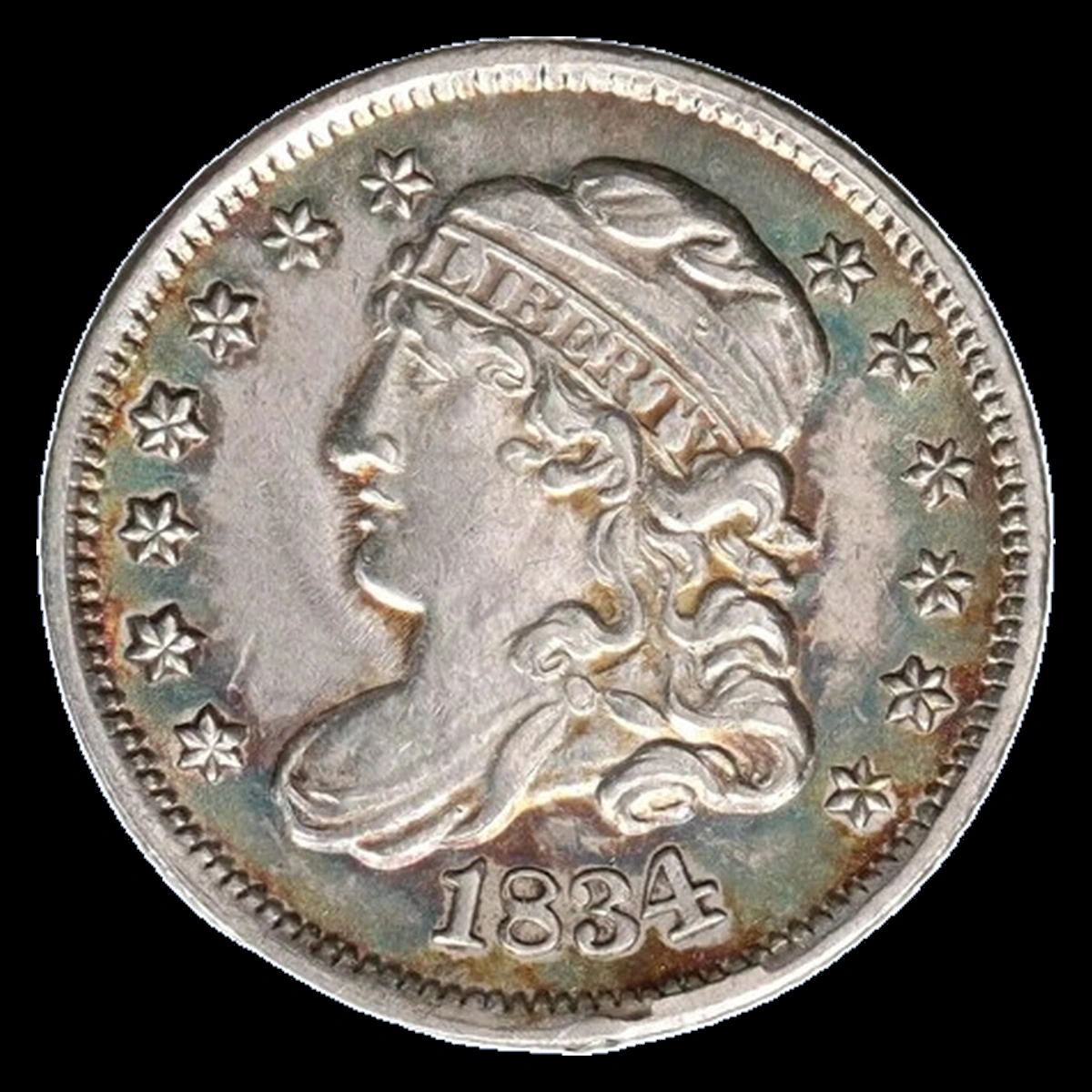
8. 1834 Half Dollar The eagle stays tilted after a careful flip: Rotated Dies Error
Heritage described some rotation on an O-121 Small Date, Small Letters coin in ANACS AU Details. No angle or direction was supplied.
Rotation concerns how the two designs align with one another, even if each is centered on the metal. Separately straightened sale photographs can hide that relationship.
How to Identify
Hold Liberty upright and flip top to bottom without twisting sideways. Repeat against a fixed reference and record whether the eagle finishes at the same angle each time.
Compare the date and reverse lettering with O-121 and inspect the edge. The Heritage description does not authorize assigning a particular degree measurement to another coin.
What It’s Worth
The estimate is $300–$900 for a modest rotation near the reported AU Details condition. AU describes nearly unworn detail, while Details indicates a problem affecting an ordinary numerical grade.
The $1,560 MS63 O-109 comparison is an unworn ordinary coin, not this rotated specimen. Both the measured tilt and the surface problem matter before using a price comparison.
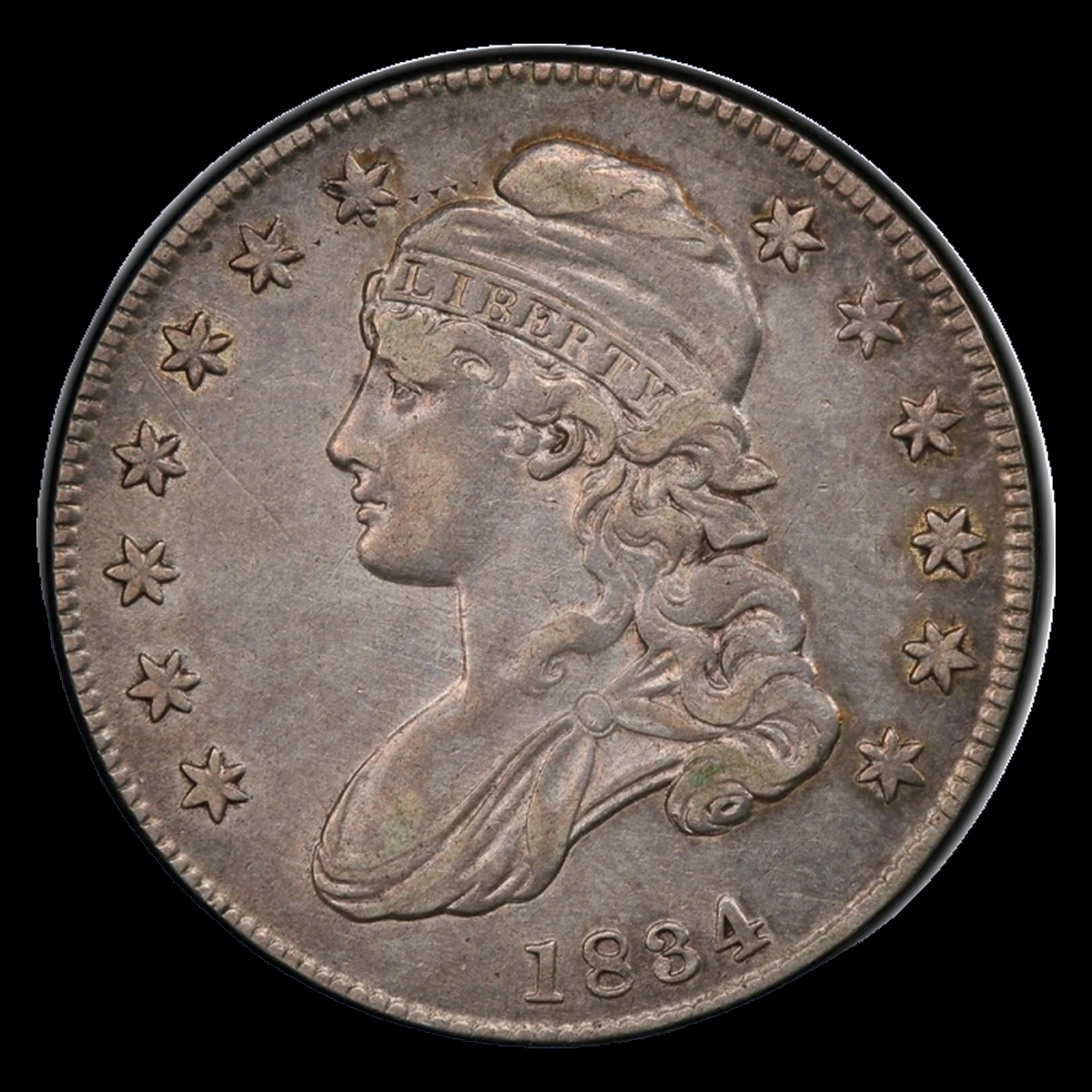
9. 1834 Half Dollar Remnants of an earlier impression survive: Reported Double Strike Error
Several related design remnants can reveal movement between two blows. A later strike may flatten much of the first while leaving enough evidence to reconstruct its earlier position.
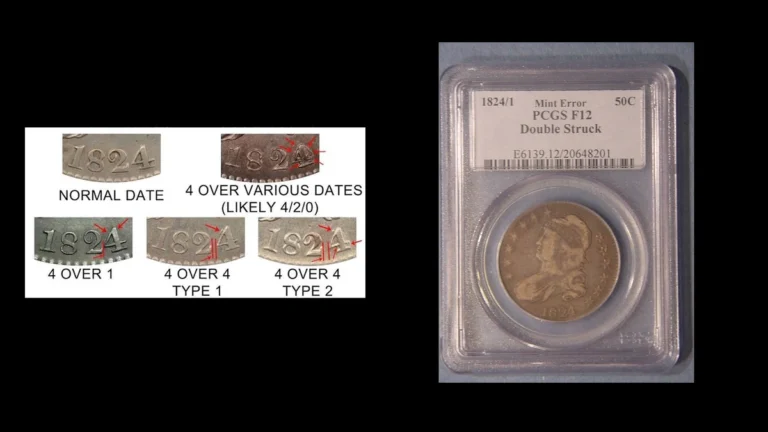
Eye Appealing Coins offered an O-111 Small Date, Small Letters 1834 as double struck, graded PCGS XF Details. The description supplies no exact remnant locations or movement direction.
How to Identify
Find more than one recognizable earlier detail and test whether they fit the same shifted position. Compare the date and lettering with O-111 without inventing a second portrait from a single line.
A thin shelf can arise during one strike, and a privately punched name does not repeat the Mint’s design. Inspect the lettered edge and the surrounding surfaces as part of the same examination.
What It’s Worth
A worn 1834 double strike with clear evidence of both impressions has an estimated $1,000–$2,500 range. Its surface problem and the visibility of the earlier design affect the useful comparison.
The dealer website asked $1,475, while a marketplace offer asked $1,625 for the same XF Details coin. Neither amount is a completed sale, and two offers do not represent two specimens.
Conclusion
Edge lettering supplies several different tests: a second inscription supports overlap, while apparently missing words require a complete view and consideration of other causes. Opposing weak borders alone leave the incomplete-preparation proposal unconfirmed.
For face details, follow a full crack route or a coherent second design rather than an isolated mark. Keep disputed observations and dealer claims distinct from the dated sales used as comparisons.