Rare 2000 Half Dollar Errors (List & Pictures)
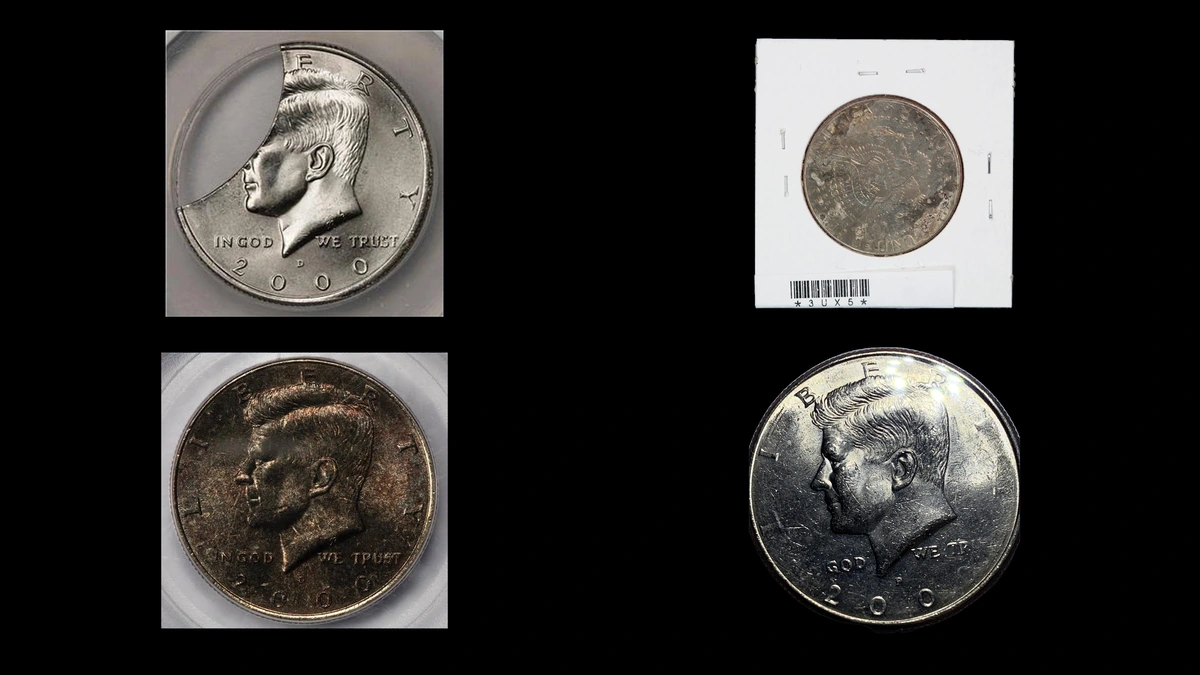
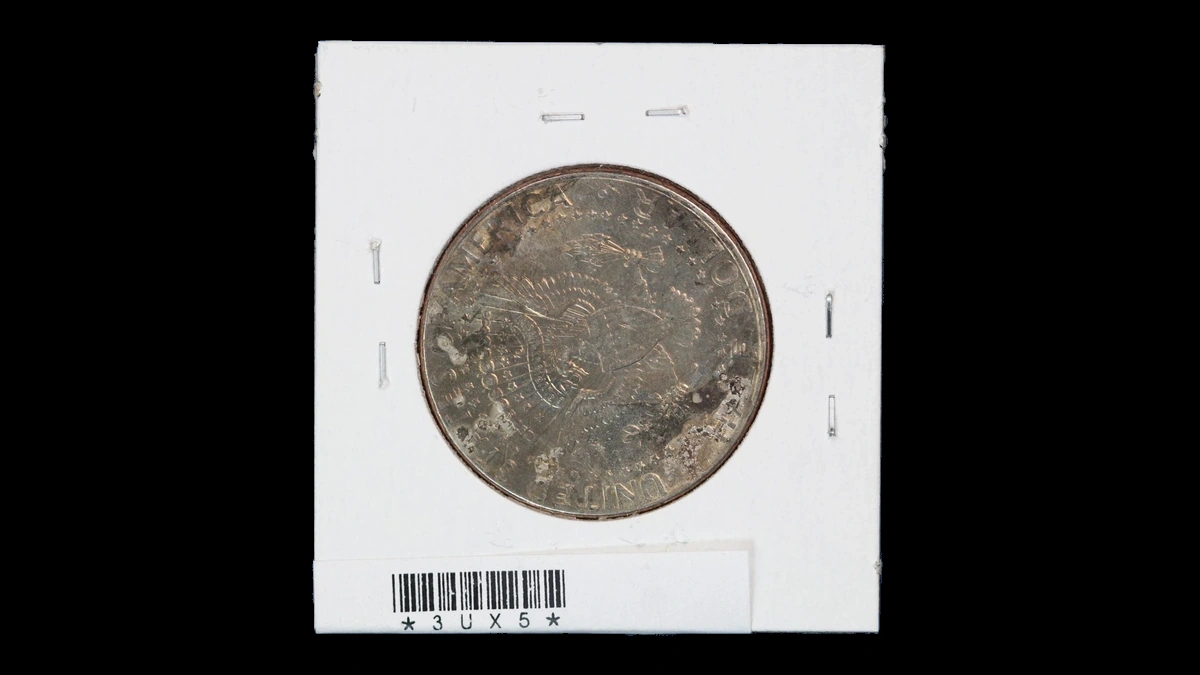
A coin can look ordinary until you turn it over: a documented 2000-P half dollar has its reverse tilted 75 degrees and sold for $79 in 2025. The larger supplied auction comparison, $114, belongs to a different-year struck-through coin.
Estimated values for 2000 half dollar errors span $5–$500 across the categories below. Start with the outline, check the alignment, then examine color and small design details.
| Where to look | Possible error | Estimated value |
|---|---|---|
| Missing curved piece | Clipped planchet | $25–$300 |
| Blank crescent and lost design | Off-center strike | $100–$400 |
| Tilting eagle after a straight flip | Rotated dies | $60–$150 |
| Copper-colored surfaces | Improper annealing | $300–$500 |
| Interrupted or missing detail | Struck through | $5–$250 |
| Extra front detail | Reported doubled die obverse | $10–$75 |
| Extra reverse detail | Reported doubled die reverse | $10–$75 |
Ordinary clad halves have a standard weight of 11.34 grams and diameter of 30.61 millimeters; 90% silver Proofs weigh 12.50 grams. The S mintmark alone does not establish silver content, and Proof means a specially made collector coin.
1. 2000 Half Dollar A curved gap in the edge: Clipped Planchet Error
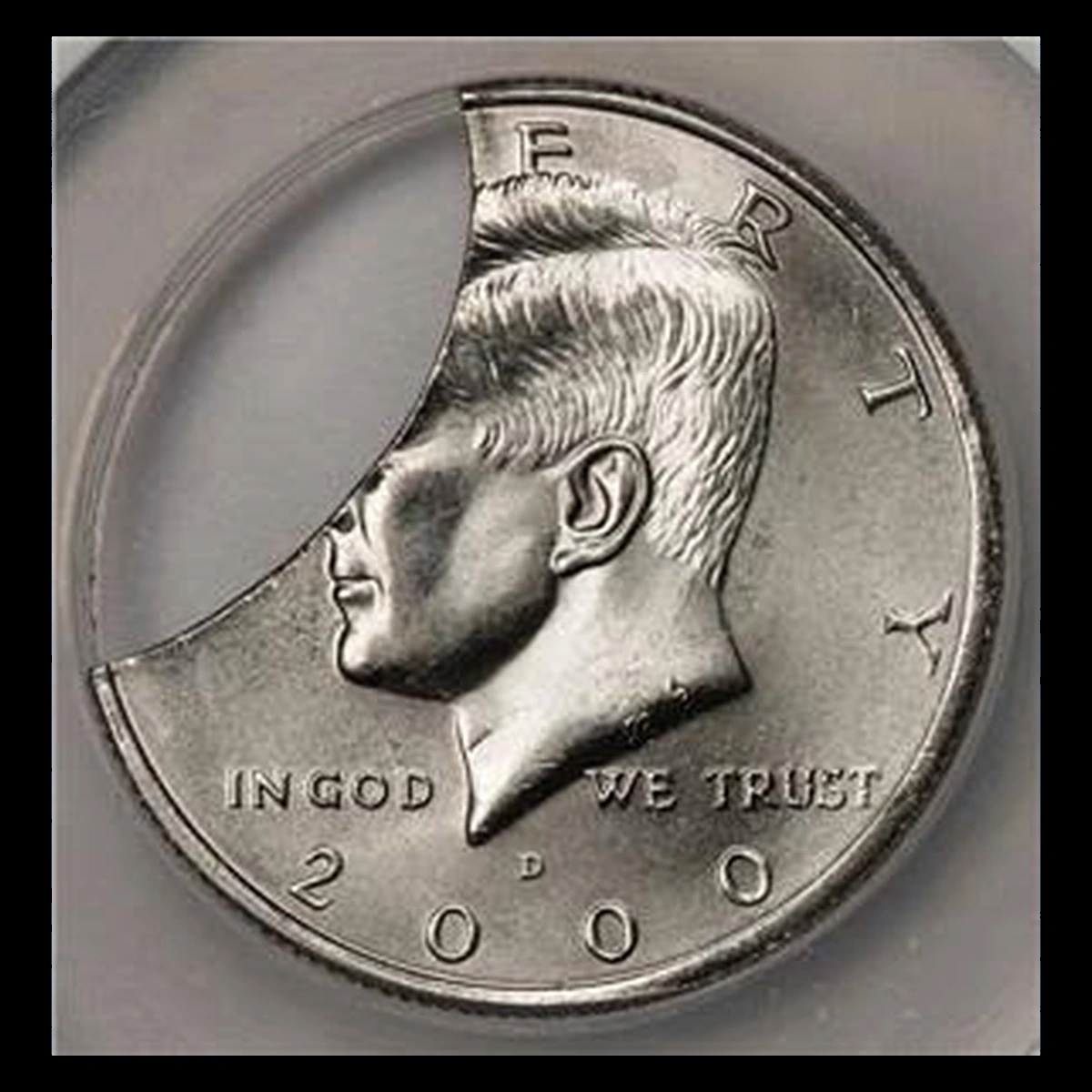
Missing metal deserves an edge inspection before any close-up of the portrait. A curved clip can begin when a blanking punch overlaps a hole left by an earlier punch, leaving an incomplete blank to be struck.
The supplied examples include a 2000-D with about 30% missing, graded NGC MS63, and a separate 2000-P with two curved clips, graded NGC MS64. Those descriptions refer to two different coins.
How to Identify
Follow the entire missing boundary and examine the neighboring rim for a shape formed during striking. Saw marks, filed surfaces, or freshly exposed cuts call for a different explanation.
Weakness in the rim opposite a clip can support the diagnosis, but it is not enough by itself. A lower weight should make sense for the missing metal, while the intact part of the coin may still span its normal diameter.
What It’s Worth
Estimated values are $25–$125 for modest curved clips and $100–$300 for conspicuous large or multiple clips in attractive condition. No completed sale accompanies the two specific 2000 examples in the supplied evidence.
MS63 and MS64 describe unworn coins with different amounts of visible marking. A damaged clipped coin should not be priced as though it matched those preserved examples.
2. 2000 Half Dollar A blank crescent beside a cut-off design: Off-Center Strike Error
A complete blank can enter the press in the wrong position. The dies then strike only part of it, leaving a blank crescent while some of the intended design falls beyond the opposite edge.
The year guide reports this category for 2000 without identifying a certified specimen, mintmark, or measured percentage. A coin being attributed to this date still needs a readable 2000.
How to Identify
Check both faces for a compatible shift and inspect the blank area for an original unstruck surface. Grinding or flattening can remove design without producing a Mint off-center strike.
If only one face looks displaced, a misaligned die may be the better explanation. An off-center coin generally retains its metal, so missing weight needs an explanation beyond the shifted design.
What It’s Worth
A provisional range is $100–$400 for a clear, dated example, depending on displacement and preservation. This is a guide estimate, not a verified 2000 auction range.
A dealer offered a 1996 half dollar with a 5% off-center strike and PCGS MS64 grade for $135 in 2016. That older, different-year asking price provides context only.
3. 2000 Half Dollar The eagle stays tilted after a straight flip: Rotated Dies Error
The two faces need not be correctly aligned even when every part of the design is present. A die turned from its intended position can leave the reverse tilted relative to the upright obverse.
How to Identify
Hold Kennedy upright, then flip the coin top to bottom without turning it sideways. Repeat against a fixed reference, or record the movement, to see whether the same tilt returns.
The documented 2000-P has a 75-degree clockwise rotation. A loose coin slipping in a holder, separately rotated photographs, or an altered edge can make the apparent alignment misleading.
What It’s Worth
Roughly $60–$150 is a useful estimate for a comparable, clearly rotated example. A slight tilt should not borrow the price of a 75-degree rotation.
The PCGS MS61 2000-P sold for $79 at Heritage on March 31, 2025. Its grade indicates an unworn coin with noticeable marks.
4. 2000 Half Dollar Copper color across both faces: Improper Annealing Error
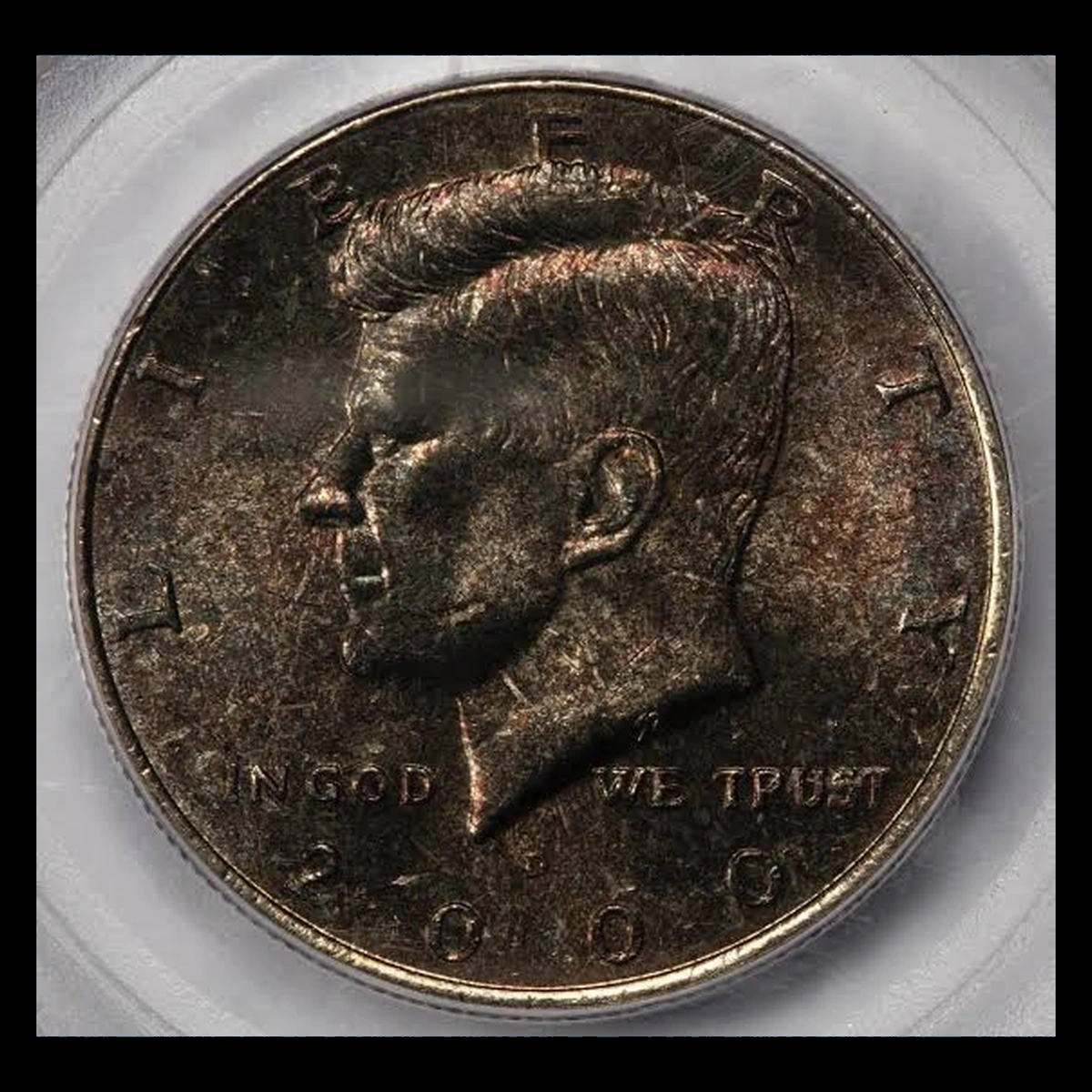
Several documented 2000-D halves have a copper-colored wash over their surfaces. Improper conditions during heating of the blanks can change their surface appearance before the designs are struck.
This error is also described as sintering or improper annealing. The recorded coins vary in color strength, so a very dark surface is not required.
How to Identify
Use neutral light to inspect fields and sheltered areas around letters, looking for how evenly the unusual color follows the original surface. Residue, added plating, and environmental color can produce confusing appearances.
Check the edge for the normal clad layers and compare the weight and diameter with an ordinary clad half dollar. A missing outer layer is a separate problem, and color alone cannot tell the two apart.
Do not heat, polish, or chemically treat the surface to test it. Such changes remove evidence needed for an informed examination.
What It’s Worth
An estimated $300–$500 applies to identified, unworn examples with a substantial copper wash. It does not extend to every discolored half dollar.
A historical Fred Weinberg inventory listed certified 2000-D examples at $375–$450, including an MS64 at $400 and MS65 coins at $375 and $450. These were asking prices, and the differing surfaces help explain why grade alone did not determine the offers.
5. 2000 Half Dollar A narrow impression or a patch of absent detail: Struck Through Error
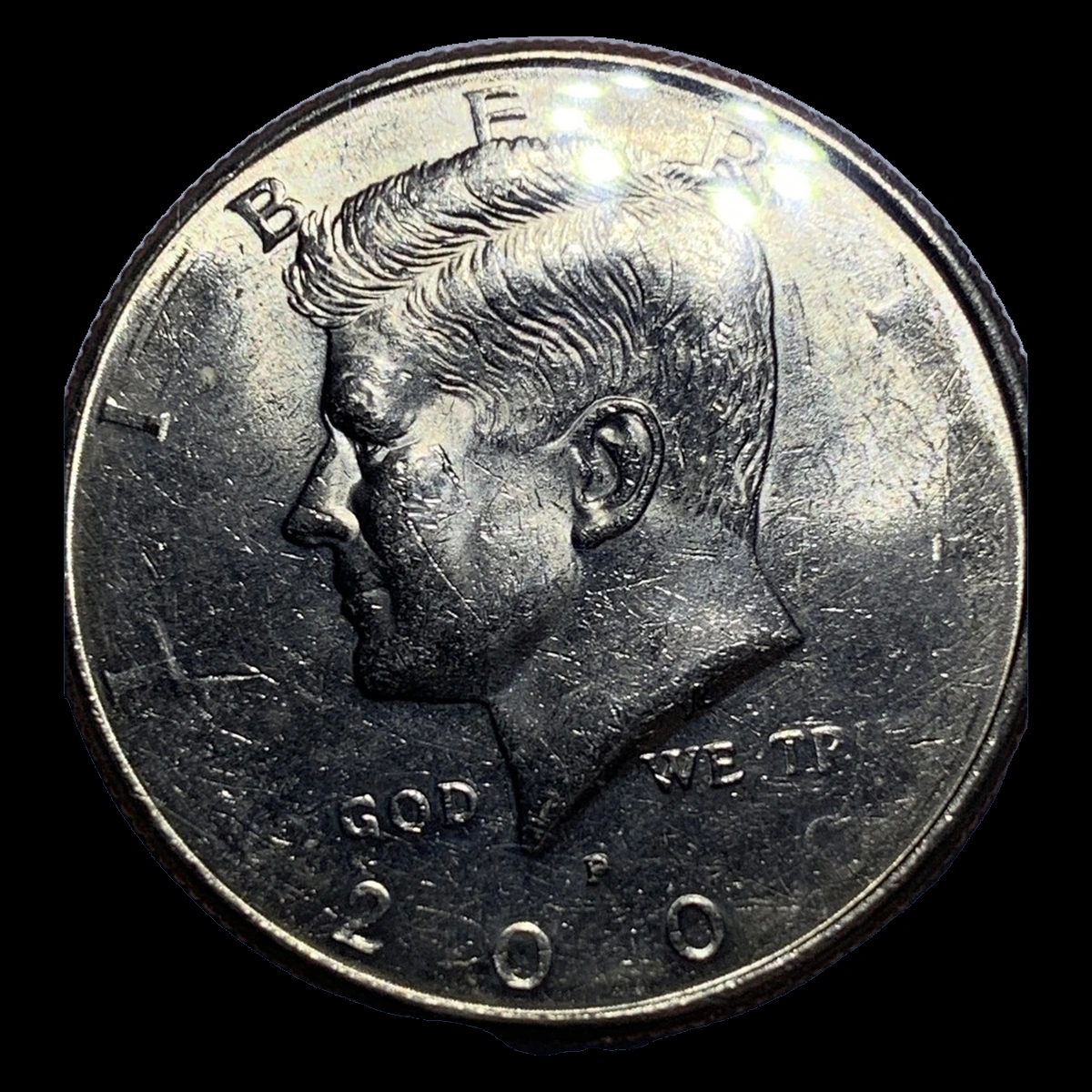
Material between a die and the coin can interrupt the design as it forms. A small solid fragment may leave a distinct impression, while grease can keep shallow details from appearing clearly.
The supplied records describe a narrow mark on a 2000-S silver Proof and grease-related weakness on a separate 2000-P. They belong to the same broad error class but should not share mintmarks, grades, or material claims.
How to Identify
Inspect the margins of a narrow impression and the way it interrupts the struck design. A later scratch can cut the finished surface and push metal up along its sides.
A thin mark does not establish that wire caused it. For suspected grease weakness, compare the missing details with nearby normal detail and consider wear or surface damage.
The owner of the silver Proof reported an ANACS PR69 Deep Cameo result. Deep Cameo describes the contrast between frosted designs and mirrorlike fields; the report is not a completed sale.
What It’s Worth
Estimated values are $75–$250 for an attractive identified Proof strike-through and $5–$40 for minor grease weakness on an ordinary 2000-P. The surface quality and visibility of the interruption matter greatly.
A 2000-P seller listing asked $7, rather than recording a sale. A different-year 1976-D struck through on both sides sold for $114 in March 2025, which is supporting context rather than a 2000 price record.
6. 2000 Half Dollar Extra raised detail on the front: Reported Doubled Die Obverse Error
Use the date, LIBERTY, and IN GOD WE TRUST as the front-side inspection areas reported by the year guide. A true doubled die carries duplicated detail before it ever strikes the coin.
The supplied description does not establish a numbered die variety or a particular direction of doubling. It therefore cannot serve as a precise diagnostic map for every 2000 half dollar.
How to Identify
Compare the same characters with a normal coin of the same mint and finish. Look for a stable extra raised shape, rather than a bright edge that disappears as the light moves.
Flat shelves from movement during striking and worn letter edges can resemble doubling. A blurry corner of one character is not enough to attribute a doubled die.
What It’s Worth
The supplied estimate is $10–$75 for modest, identified doubling on ordinary clad coins. No numbered 2000 obverse variety with a completed sale supports a tighter figure here.
A high-grade Proof needs its own comparison instead of being placed automatically at the top of that range. Identification should come before assigning a premium.
7. 2000 Half Dollar Repeated reverse detail: Reported Doubled Die Reverse Error
The eagle already contains many closely spaced design elements, making the reverse an easy place to misread ordinary detail. This reported category concerns duplication carried by the reverse die, not simply thick feathers.
How to Identify
Photograph the whole area of interest and compare it with the matching region on a normal same-mint, same-finish coin. The comparison should separate an extra raised outline from neighboring parts of the intended design.
The supplied year guide does not name a specific reverse die, letter, feather, or doubling direction. Avoid treating reflections or a flat shelf as confirmation of an unnamed variety.
What It’s Worth
A tentative $10–$75 range covers modest identified examples on ordinary clad halves. The supplied material contains no completed sale of a specifically attributed 2000 doubled reverse.
Preservation and the strength of a verified feature can influence interest, but an uncertain photograph cannot establish either an attribution or its value.
Conclusion
The strongest evidence depends on the feature: a controlled flip for rotation, an intact missing boundary for a clip, or original surfaces for unusual color. Small doubled-looking details need a documented match before they become a variety attribution.
Keep silver Proofs separate from ordinary clad coins when comparing prices. The dated auction result, historical dealer offers, and guide estimates above answer different questions and should remain clearly distinguished.