Rare 2021 Half Dollar Errors (List & Pictures)
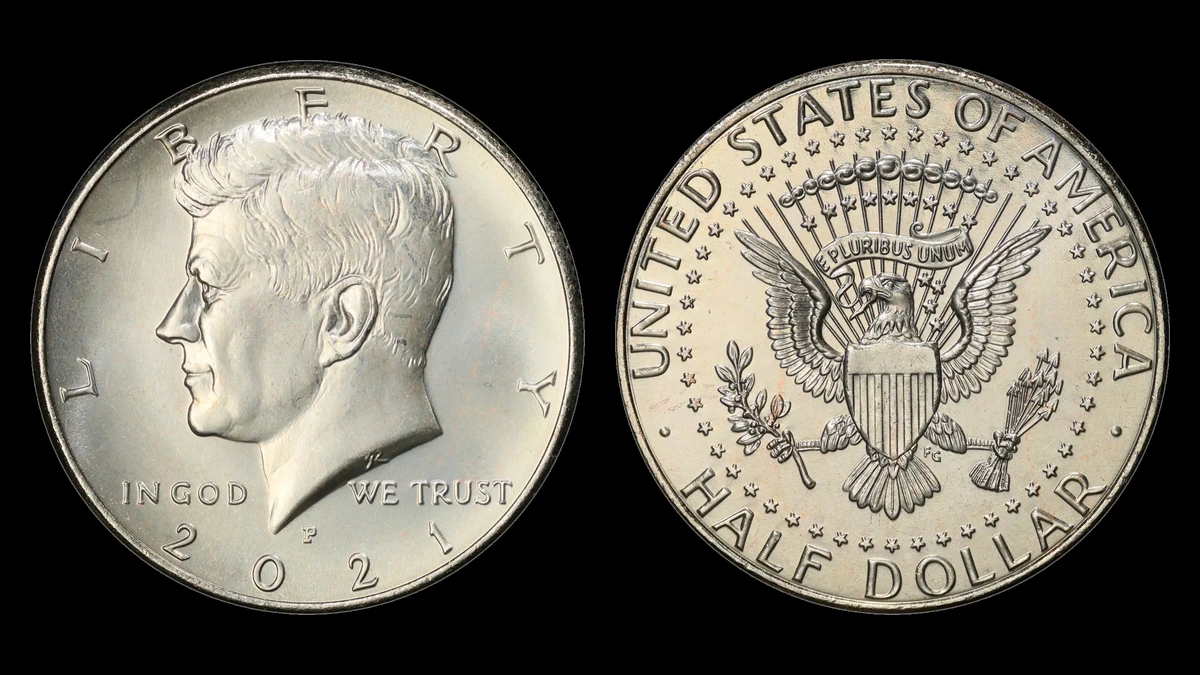
Many reported 2021 half dollar errors are small enough to need close inspection rather than a glance at the date. The supplied estimates run from $5 to $300, and a published account reports a $65 sale for a 2021-D NGC MS65 strike-through.
A different-year rotated-die half provides a documented $79 auction comparison. Start with the edge and alignment, then examine surface layers and portrait details while keeping seller offers separate from completed sales.
| Area or clue | Reported category | Estimated range |
|---|---|---|
| Missing rim section | Clip candidate | $30–$150 |
| Right-edge projection | Collar break | $15–$50 if genuine |
| T near rim and inner ring | Unresolved rim-contact report | $5–$65 |
| Eagle tilted after a straight flip | Rotated dies | $40–$200 |
| Copper-colored face | Missing clad layer | $75–$300 |
| Localized weak or impressed area | Strike-through | $5–$150 |
| Ridge across portrait | Die crack | $5–$30 |
| Raised eye and date additions | Die chips | $5–$40 |
| Extra nose or letter contours | Doubled die report | $20–$200 |
Ordinary P and D halves have copper-nickel outer layers bonded over copper, a normal weight of 11.34 grams, and a diameter of about 30.61 millimeters. Their edges are grooved; the 2021-S silver proof is a different normal product containing 99.9% silver and weighing 12.685 grams.
1. 2021 Half Dollar A curved or straight shortage of metal: Clipped-planchet candidate Error
A true clip is already present in a blank before its design is struck. The supplied 2021 discussion includes this possibility without identifying a mint or individual specimen.
How to Identify
Inspect how the rim and nearby detail formed around the missing section. A saw or file cutting through a finished coin does not create the same original transitions.
Weight loss should broadly agree with the absent area. Weakness at the opposite rim can support a genuine clip but is not equally apparent on every example.
Record the remaining date and mintmark instead of assigning an identity from the category alone. A smooth curved wall is insufficient if its adjoining borders show later cutting.
What It’s Worth
A genuine small or moderate clip on an ordinary clad half is estimated at $30–$150. A specialist dealer’s $90 offer for a 1971-D 10% clip graded PCGS MS64 is a different-year asking comparison.
That offer does not confirm a 2021 specimen or sale. Original borders, amount missing, and preservation must be established before applying the estimate.
2. 2021 Half Dollar An unusual right-hand edge shape: Reported collar break Error
The collar ring holds a blank’s edge during striking, and a break in that ring can allow metal to flow outward. The 2021-P seller report instead describes a cut or missing area, which does not by itself support its collar-break label.
How to Identify
Look for an outward projection where normal edge grooves are interrupted. A notch merely removing metal needs a different explanation.
Photograph the edge from both directions and examine for fresh cuts, folded burrs, or impact flattening. A face-on view can conceal the distinction between flowed metal and damage.
Compare widths in several directions if a projection is present. A collar break redirects metal and need not reduce weight.
What It’s Worth
A small genuine collar-related projection is estimated at $15–$50. The report’s $39 figure is a seller’s asking price for a circulated coin.
That modest feature does not borrow the prices of dramatic broadstrikes or major partial collar errors. The actual side profile must support the manufacturing explanation first.
3. 2021 Half Dollar T close to the rim with an inner ring: Unresolved rim-contact report Error
A reported 2021-P has a T in LIBERTY close to the border and an additional ring inside the main rim. Those observations do not establish a specific mint error or excessive striking pressure.
How to Identify
Compare several normal 2021-P halves at equal magnification to determine whether T truly meets the rim. Normal variation can look dramatic when a tiny area fills a photograph.
Follow the inner ring under side lighting to determine whether it is raised or incuse and whether scraping interrupts it. A rolled or squeezed rim can also change the border after minting.
The letter, ring, and edge must fit one coherent explanation. A tall-looking T alone does not prove abnormal pressure in the press.
What It’s Worth
The supplied $5–$65 estimate reaches the reported seller asking price of $65. No completed sale demonstrates that buyers accepted the proposed rim error.
A normal close letter or later contact ring may add no collector value. A repeatable mint-made feature and undamaged surfaces would be needed to support the higher comparison.
4. 2021 Half Dollar The eagle tilts after a top-to-bottom flip: Rotated dies Error
The Philadelphia report describes about 30 degrees of reverse rotation relative to Kennedy. This concerns the alignment of the dies and does not require a second strike or an abnormal rim.
How to Identify
Hold the portrait upright against a vertical reference and flip the coin top to bottom without twisting sideways. Normally the eagle then stands upright; repeat the motion to check any remaining slant.
Record the angle while preserving the same top and bottom in both photographs. Independently straightened images cannot demonstrate rotation.
Inspect the edge for seams or alterations that might join separately positioned faces. A consistent measured relationship is more useful than a single tilted photograph.
What It’s Worth
A demonstrated rotation near 30 degrees is estimated at $40–$200, depending on condition. The reported 2021-P was advertised as high as $192, which is an asking price.
A 2000-P PCGS MS61 with 75 degrees clockwise rotation sold for $79 at Heritage in March 2025. That stronger, different-year rotation shows why a high advertisement is not automatically market value.
5. 2021 Half Dollar One copper-colored face opposite a normal side: Missing clad layer Error
The reported 2021-P has a copper-colored face that may expose the core beneath a lost outer layer. No measured weight is supplied for that particular example.
How to Identify
Weigh the coin and inspect its layer boundaries before relying on color. Actual outer-layer loss should reduce the normal clad weight, while staining or plating can change appearance without the same loss.
Check the exposed face for intact struck design and the edge for filing or chemical damage. A normal opposite face can help establish which layer was affected.
The normal silver proof has neither the clad construction nor the light weight this explanation requires. It must not be classified as a missing-layer error simply because its metal differs from circulating halves.
What It’s Worth
A genuine missing-layer example is estimated at $75–$300. The reported $150 seller offer is an asking price rather than a completed transaction.
Amount missing and preservation of the struck surface influence the comparison. Brown toning or later plating does not qualify for the same range.
6. 2021 Half Dollar A local impression or patch of soft detail: Strike-through, including grease Error
The reported Denver NGC MS65 has affected areas at Kennedy’s cheek, neck, and rear head. A separate Philadelphia example and grease-related weakness also appear in the supplied account.
Material blocking the die can leave an impression, while grease filling design recesses may prevent detail from forming clearly. These effects need not share the same sharp boundary.
How to Identify
Compare the localized interruption with nearby details of similar height. Uniform wear across the portrait raises a different question from soft detail surrounded by crisp struck features.
Inspect for impact or abrasion cutting across the completed design. Keep the Denver MS65 grade attached to its own specimen rather than assigning it to the Philadelphia or grease reports.
What It’s Worth
Clear impressions are estimated at $20–$150, with grease-related weakness at $5–$100. The published year account reports a $65 sale for the Denver NGC MS65.
The cited $95 grease-example figure is an asking price. A recognizable shape and clean surrounding surfaces can improve appeal, but a faint weak patch does not earn a fixed premium.
7. 2021 Half Dollar A ridge from the L/I gap toward Y: Die crack Error
The reported 2021-D line begins between L and I in LIBERTY and travels across Kennedy’s portrait toward Y. Metal entering a fracture in the die would leave that route raised on the coin.
How to Identify
Follow the path through field and portrait under side lighting. Its center should rise rather than form a groove, since a scratch may push up metal only along its sides.
Do not scratch the line or test it with a fingernail. Another reverse line would need its own diagnosis and would not automatically disprove a genuine obverse crack.
What It’s Worth
Similar small cracks are estimated at $5–$30. The year list reports a $10 marketplace sale for the circulated example, not a certified auction record.
A long portrait-crossing ridge can be easier to recognize than a short rim line. Length alone does not place an ordinary circulated half in the price range of major striking errors.
8. 2021 Half Dollar Added metal at the eye and date’s 1: “Snake Eyes” die chips Error
The reported 2021-D combines an eye-area lump with another raised addition changing the outline of the date’s 1. The Snake Eyes name describes the appearance of the first feature.
Small pieces missing from a die can leave recesses that fill with metal during striking. They produce localized chips rather than the long ridge of a crack or a broad rim-connected break.
How to Identify
Compare both eye and date with a normal 2021-D and check how the extra metal joins the original surface. Stuck-on material, a folded burr, or metal displaced by impact can imitate a bump.
Keep the full portrait and date in the record so the two locations remain linked. A date chip alone is not necessarily the same appearance as the reported combined example.
What It’s Worth
Ordinary collectible examples with the reported eye and date features are estimated at $5–$40. The supplied account gives a $29 marketplace sale.
The eye location makes a small chip distinctive, but the nickname is neither a grading-service designation nor evidence of rarity. Compare the actual shapes and preservation before using the higher end.
9. 2021 Half Dollar Repeated contours near the nose, date, or letters: Doubled die report Error
The 2021-P report names extra outlines in the nose, lettering, and date areas. A doubled die carries repeated design details in the tool, allowing a consistent pattern to recur on later coins.
How to Identify
Look for rounded raised contours that persist as the light changes. Reflections move with the light, while a flat shelf alongside a reduced letter often reflects movement during striking.
Match the full arrangement with a properly identified example rather than expecting every letter to show equal separation. Small areas of modern doubling can be meaningful, but unrelated thick spots do not establish one die pattern.
What It’s Worth
Clearly identified minor through more visible obverse doubling is estimated at $20–$200. The source reports a $60 marketplace sale for its Philadelphia example.
The wider range is based on modern Kennedy comparisons, not a certified $200 sale for this exact die. Persistent matching metal contours are needed before an apparent second edge supports that estimate.
Conclusion
On a 2021 half, let the physical feature choose the test: an edge projection needs a side view, rotation needs a controlled flip, and a missing layer needs a weight check. Small portrait additions need an undisturbed close-up.
Several reports rely on marketplace descriptions, and the proposed collar break and T-to-rim contact remain especially dependent on better evidence. Keep those limits visible when comparing asking prices with actual reported sales.