Rare 1974 Half Dollar Errors (List & Pictures)
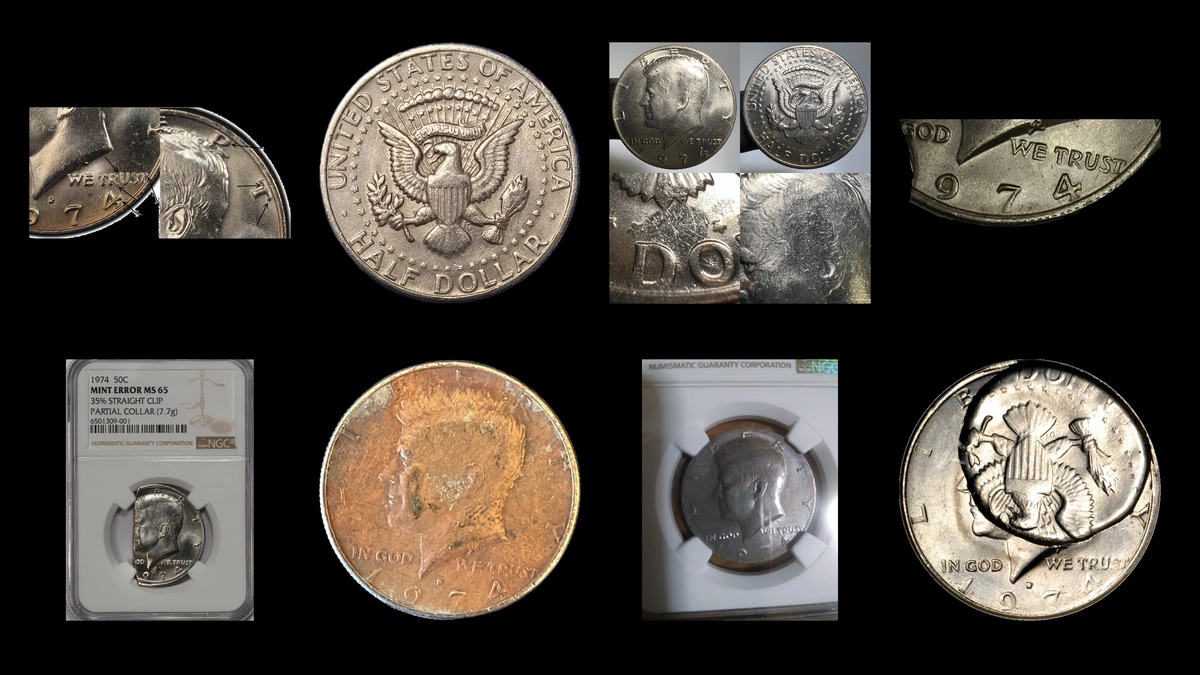
Small mintmark defects and dramatically wrong blanks both appear among 1974 half dollar errors, with estimated values from $5 to $5,000. A half struck on a Taiwan five-dollar blank sold for $2,880 in September 2023.
Work from the mintmark and lettering to the surfaces and edge, then compare the coin’s size and surviving designs to the examples below.
| Where to look | Clue | Estimated range |
|---|---|---|
| Mintmark and lettering | Filled D, repunching, doubling, missing FG | $5–$1,000 |
| Fields and devices | Raised cracks, clash traces, strike-throughs | $10–$800 |
| Edge and outline | Collar cuds, broadstrike, clips, off-center strike | $40–$700 |
| Metal and overlapping designs | Missing layer, indent, multiple strike, wrong blank, brockage | $75–$5,000 |
Normal 1974 Kennedy halves are copper-nickel clad, including the San Francisco Proofs, and weigh about 11.34 grams at 30.6 millimeters across. Philadelphia coins have no mintmark; D identifies Denver and S identifies San Francisco.
1. 1974 Half Dollar A Solid-Looking Mintmark: Filled D Report Error
A reported Denver mintmark appears to have its center filled with raised metal. A small die chip could produce that result by opening a cavity into which the coin’s metal flowed.
How to Identify
Inspect the center under angled light to distinguish raised coin metal from dirt or a flattened letter. Grease can weaken a letter’s impression, but it does not explain a raised lump filling the D in the same way a chipped die can.
What It’s Worth
The suggested range is $10–$75 for a convincing mint-made defect. No certified auction result accompanies the supplied report, and an obscured D alone does not establish an error.
2. 1974 Half Dollar A Second Mintmark Outline: Repunched Mintmark Reports Error
Another reported mintmark problem involves an extra impression of D or S. A repunched mintmark originated when a mintmark was entered into the die more than once in slightly different positions.
How to Identify
Look for a recognizable portion of the same letter alongside the main mintmark. The supplied reports do not establish a particular direction or catalog number, so a flat shelf or stray lump should not receive a specific variety attribution.
What It’s Worth
Professionally identified examples are provisionally estimated at $25–$200. No confirmed sale is supplied for an exact 1974 repunched-mintmark variety.
3. 1974 Half Dollar Divided Letters in TRUST: Doubled Die Error
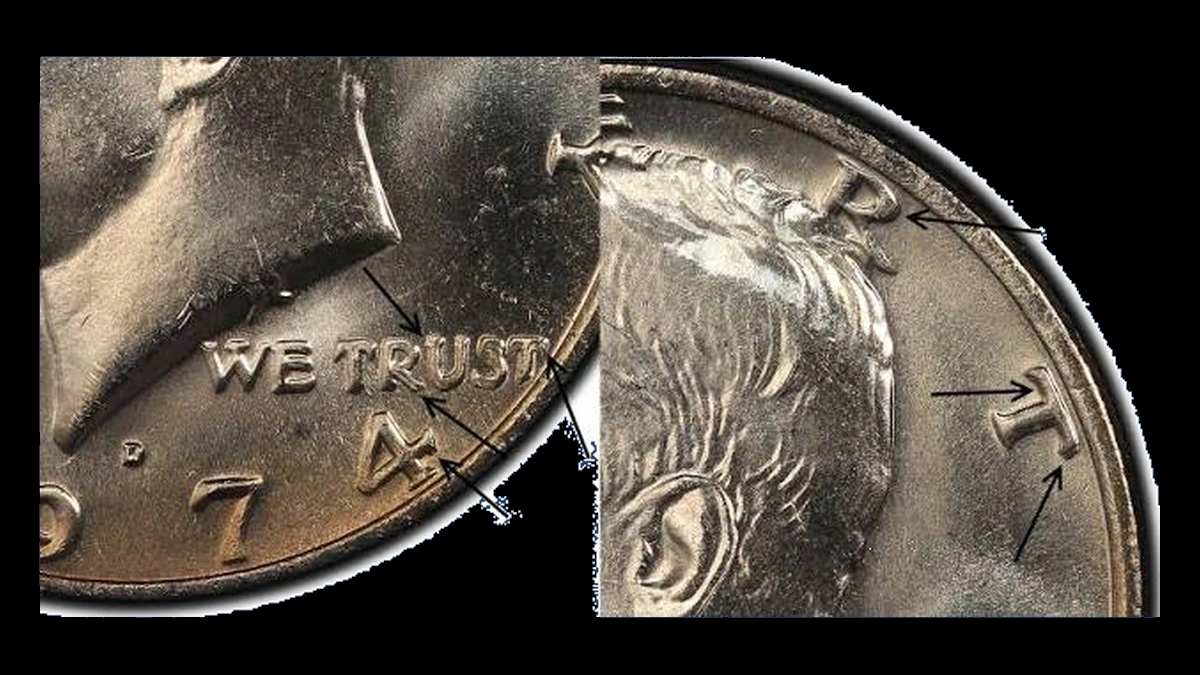
The Denver FS-101 variety shows strong counterclockwise separation in TRUST, with additional doubling in LIBERTY, the motto, and the date. The extra design was already in the die before it struck the coin.
A second Denver obverse variety, WDDO-002, has a different pattern. Reports also include Denver reverse doubling in DOLLAR, AMERICA, and stars, plus subtler WE TRUST doubling on San Francisco Proofs.
How to Identify
Match several letters to the same attributed variety, rather than choosing a name from one unusual edge. Flat, shelf-like doubling may appear even on a genuine doubled-die coin, but the shelf itself is not evidence of the variety.
What It’s Worth
The supplied varieties span roughly $20–$1,000 according to strength, attribution, and condition. An MS66 example of the 1974-D FS-101 doubled die sold for $575 in September 2005.
4. 1974 Half Dollar Faint or Absent Designer Initials: No FG Report Error
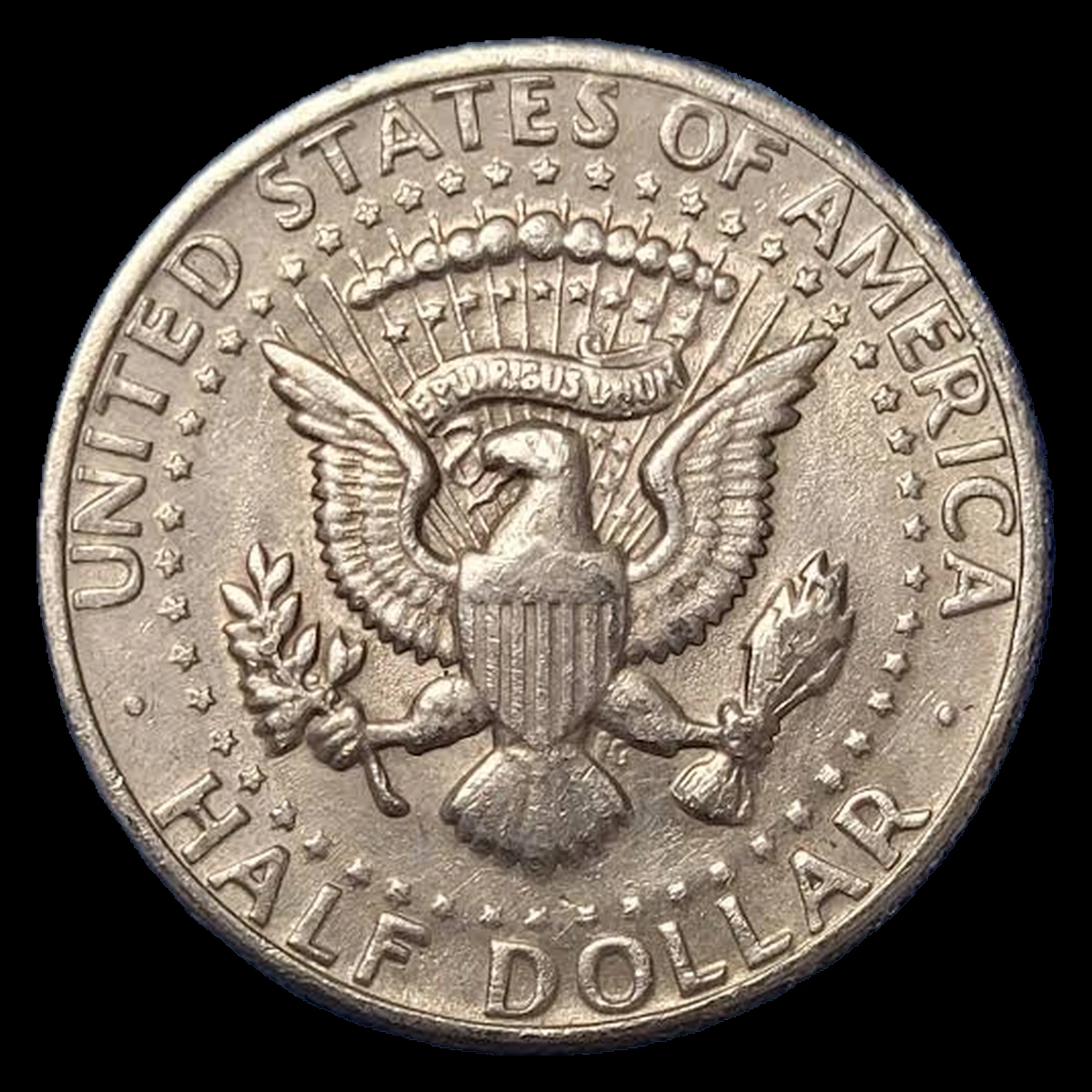
The small FG initials belong to reverse designer Frank Gasparro. They sit above and to the right of the eagle’s tail, below the leg on the viewer’s right.
Reports of weak or missing 1974 initials suggest die polishing as one possible cause. Some described examples retain part of an initial, so they should not all be called completely absent FG.
How to Identify
Turn the area through several lighting angles and look for any surviving F or G. Wear, localized blockage during striking, and later smoothing can also reduce the initials, and each needs to be distinguished from a recognized die variety.
What It’s Worth
Weak examples are estimated at $5–$30; convincingly absent initials may fall around $50–$250. A 1972-D FS-901 MS64 sold for $900 in December 2022, but that established different-year variety does not authenticate or price a 1974 report.
5. 1974 Half Dollar A Raised Line among the Stars: Die Crack or Small Break Error
Raised lines or lumps among the stars below UNITED have been reported on 1974 halves. A crack or localized break in the die allows the blank’s metal to enter the opening and form a raised feature.
How to Identify
Follow the feature beyond the normal boundaries of the stars, checking that it rises above the field. An internal break is not automatically a rim cud, and the supplied report does not establish one fixed path for every mint or finish.
What It’s Worth
A practical estimate is $10–$150, with size and visibility doing much of the work. No auction result is supplied for a specifically mapped 1974 crack.
6. 1974 Half Dollar Faint Traces of the Opposite Design: Die Clash Error
A die clash can leave fragments of the eagle near the portrait side or portrait-related traces on the reverse. The dies first struck each other without a blank, then carried those marks into later coins.
How to Identify
Compare the suspicious shape with the opposite design and ask whether its position fits die-to-die contact. Random scratches, flat doubling, and a coin pressed against another after minting do not demonstrate a die clash.
What It’s Worth
Regular-strike examples are estimated at $20–$300. A strong 1973-S Proof clash graded PR68 Deep Cameo sold for $720 in October 2022, a different-year Proof comparison rather than a typical 1974 price.
7. 1974 Half Dollar Parallel Grooves in a Depression: Struck Through a Reeded Fragment Error
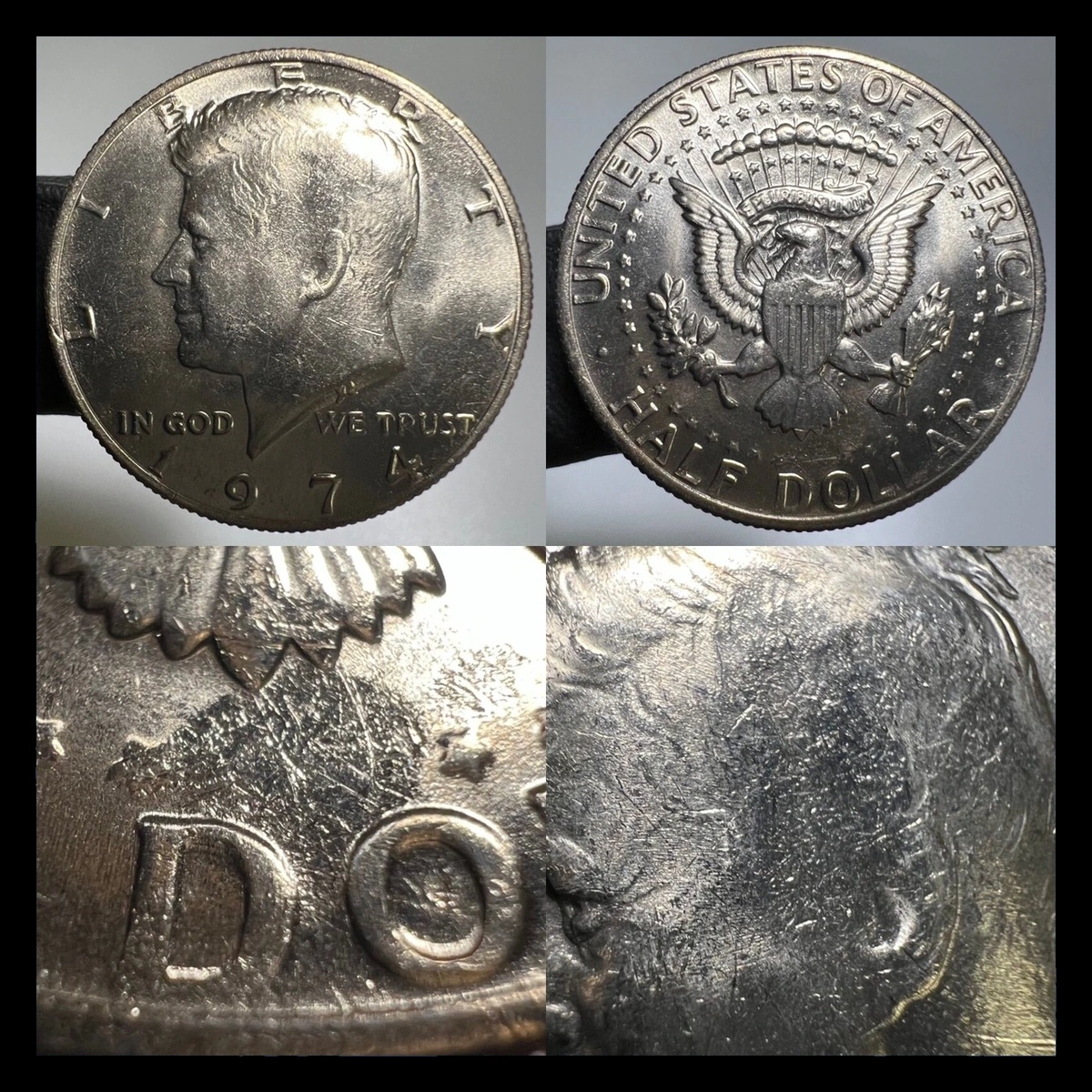
A Denver MS64 was reported struck through a fragment bearing edge grooves. The obstruction interrupted the half-dollar design and impressed its own ridged surface into the coin.
How to Identify
Look inside the depressed area for repeated parallel marks, rather than confusing them with the coin’s normal edge grooves. The description does not establish that the fragment remained attached, or specify another object beyond the reeded fragment.
What It’s Worth
Estimated value is $40–$800, varying with the clarity and extent of the impression. A 1992-D MS64 of this general class sold for $336 in July 2021; no exact sale is supplied for the 1974-D.
8. 1974 Half Dollar Metal Sticking Out from the Edge: Collar Cuds Error
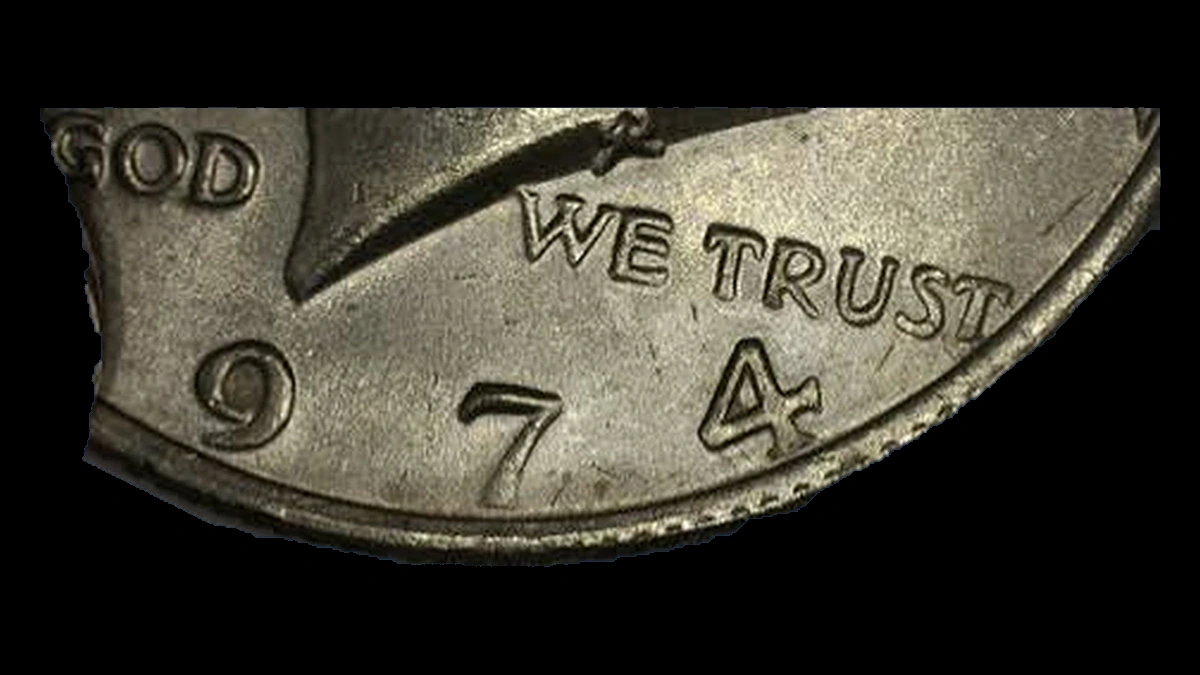
One documented 1974 half has two edge projections near 4 and 11 o’clock. These collar cuds formed when metal flowed sideways into damaged portions of the ring surrounding the blank.
How to Identify
Inspect the projections from the side and locate the interruption in the normal edge grooves. Solder, an impact bulge, or a folded rim can create an outward lump without a broken collar.
What It’s Worth
The estimated range is $40–$350. Ken Potter’s 2014 observations of about $40 for a single collar cud and $100 for a double were value guidance, not auction sales; a separate ANACS MS64 shows a different pattern.
9. 1974 Half Dollar A Wide Coin with Full Designs: Broadstrike Error
The ICG MS60 broadstrike retains the complete design while spreading beyond the normal boundary. Without full collar restraint, the blank could expand during the strike.
How to Identify
Check that the expanded outline and surface flow belong to the original strike. Uneven spreading is possible, but later flattening or edge alteration does not create an authentic broadstrike.
What It’s Worth
A $75–$450 range covers ordinary examples in varying condition. The reported ICG MS60 sold for $126.50 in February 2009 and should be kept separate from the multiple-struck broadstrike discussed below.
10. 1974 Half Dollar A Missing Arc or an Unfinished Cut: Clipped Planchet Error
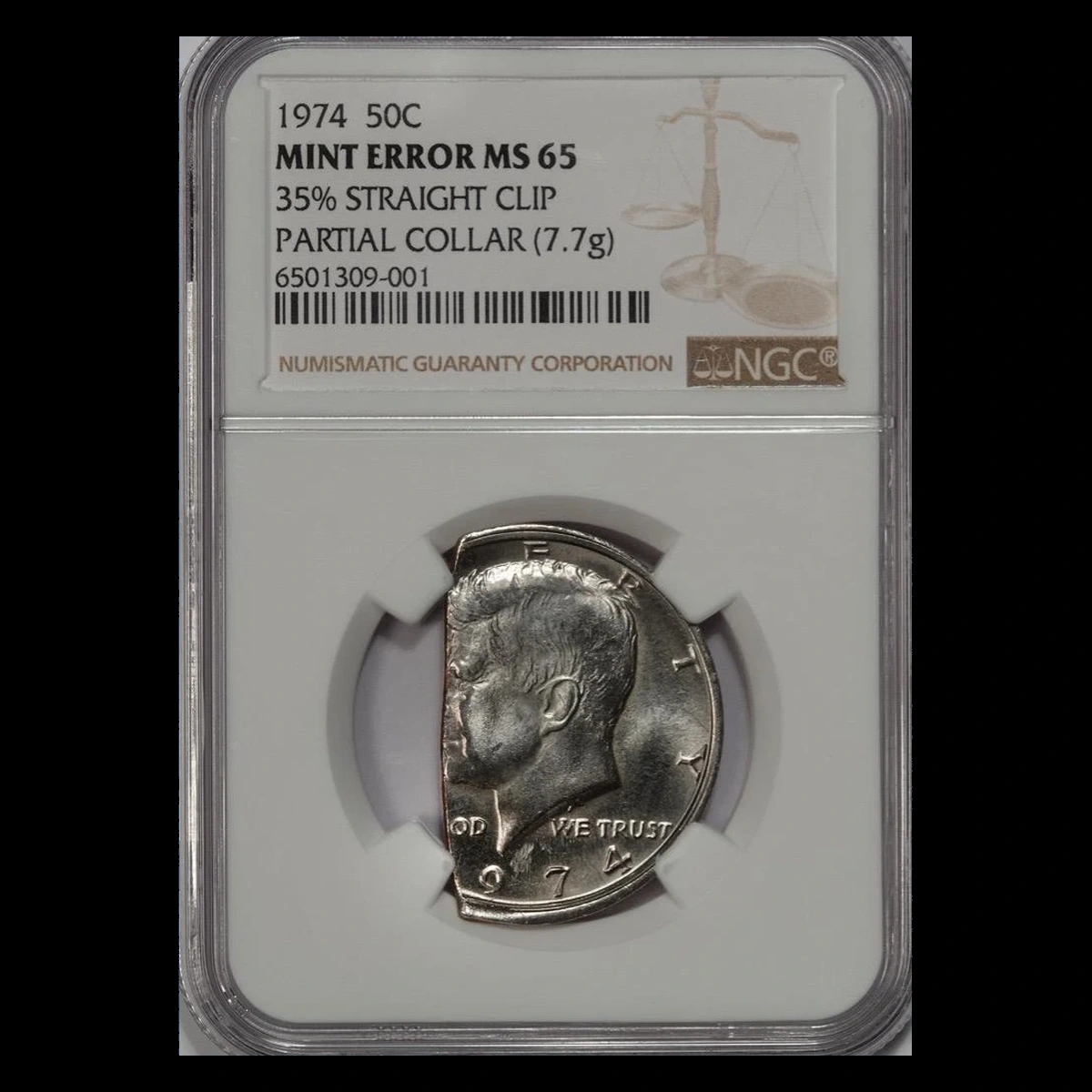
A Philadelphia AU58 has a large curved clip described as 34%. Other reports include a straight clip and an MS64 with an incomplete cut that left the metal attached.
How to Identify
Study how the original rim and design meet the boundary, checking for evidence that it existed before striking. An incomplete clip may retain nearly normal weight because the cut segment never separated; do not bend it to test the cut.
What It’s Worth
Estimated values run from $40–$600, depending on size, completeness, and condition. The incomplete-clip MS64 sold for $384 in July 2021; no sale is supplied for the separate 34% curved clip.
11. 1974 Half Dollar An Untouched Crescent at One Side: Off-Center Strike Error
The reported ANACS AU58 Details coin was struck about 10% off center toward 4:30. Its blank was displaced between the dies, leaving part of the surface outside the design.
How to Identify
Compare both faces for corresponding displacement and an original unstruck crescent. The scratches recorded on this example are later damage, not part of the off-center minting event.
What It’s Worth
A broad estimate is $50–$700, with modest displacement and damaged surfaces toward the lower end. A much stronger 1999-D 65% off-center MS66 sold for $552 in March 2023 and is not a direct equivalent to the scratched 1974 coin.
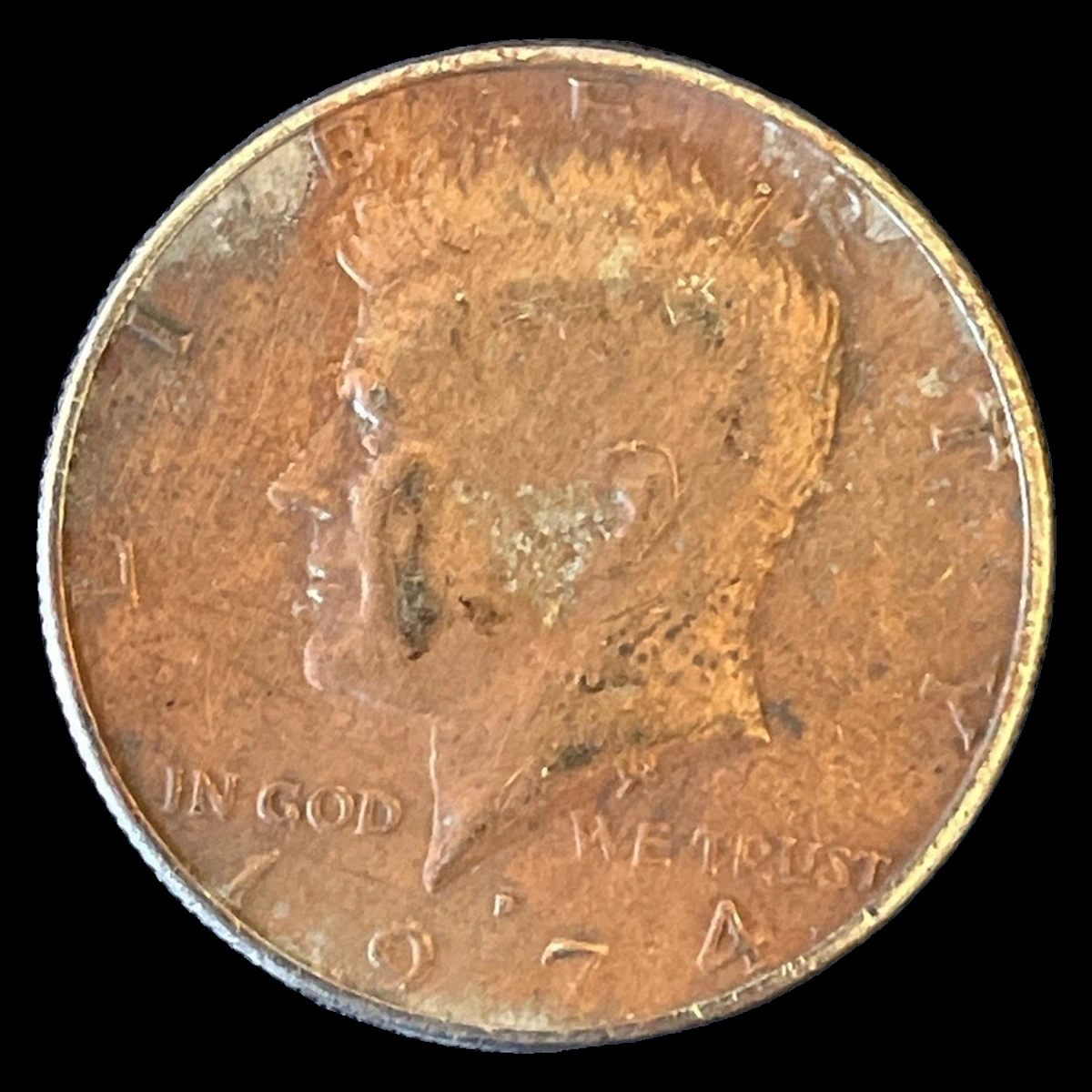
12. 1974 Half Dollar An Exposed Copper Area: Missing Clad Layer Report Error
A missing outer layer can expose the copper inside a clad half dollar. The supplied 1974 report does not identify the affected face, amount missing, or measured weight.
How to Identify
Examine the layer boundary and determine whether the exposed copper received the original strike. Chemical stripping, later peeling, and added plating can change a coin’s color without creating a mint error.
What It’s Worth
A provisional $100–$1,500 range reflects how differently partial and extensive layer loss can present. The supplied comparison is a 1998-P MS63 with a defective obverse layer at $149 in March 2023, not a sale of a fully missing 1974 layer.
13. 1974 Half Dollar A Large Blocked Area on the Front: Indent Error
An NGC MS64 listed as “(1974)” has an obverse indent made by an object between the die and blank. Parentheses indicate an attributed date rather than a fully readable date on the coin.
How to Identify
Follow the depressed boundary and the design interrupted by it, looking for a striking event rather than a later impact. The supplied record does not identify the obstruction’s denomination or metal; a transferred backward design would require considering brockage instead.
What It’s Worth
The estimated range is $150–$2,000. No completed sale is supplied for this particular indent, and naming an unproven obstruction would not justify a higher estimate.
14. 1974 Half Dollar More than One Design Position: Multiple Strike Error
A second strike 85% displaced from the first left the reported MS64 with separated design impressions. Another coin combines multiple striking with a broadstrike and has an Uncirculated Details designation.
How to Identify
Find recognizable sections of an additional design and trace the outline produced by each strike. Counting-wheel marks on both faces of the Details coin are later damage and should not be counted as extra mint impressions.
What It’s Worth
A broad $75–$2,000 estimate allows for very different combinations and surface quality. The MS64 with the 85% displaced second strike sold for $79 in December 2020; no sale is supplied for the separate Details broadstrike combination.
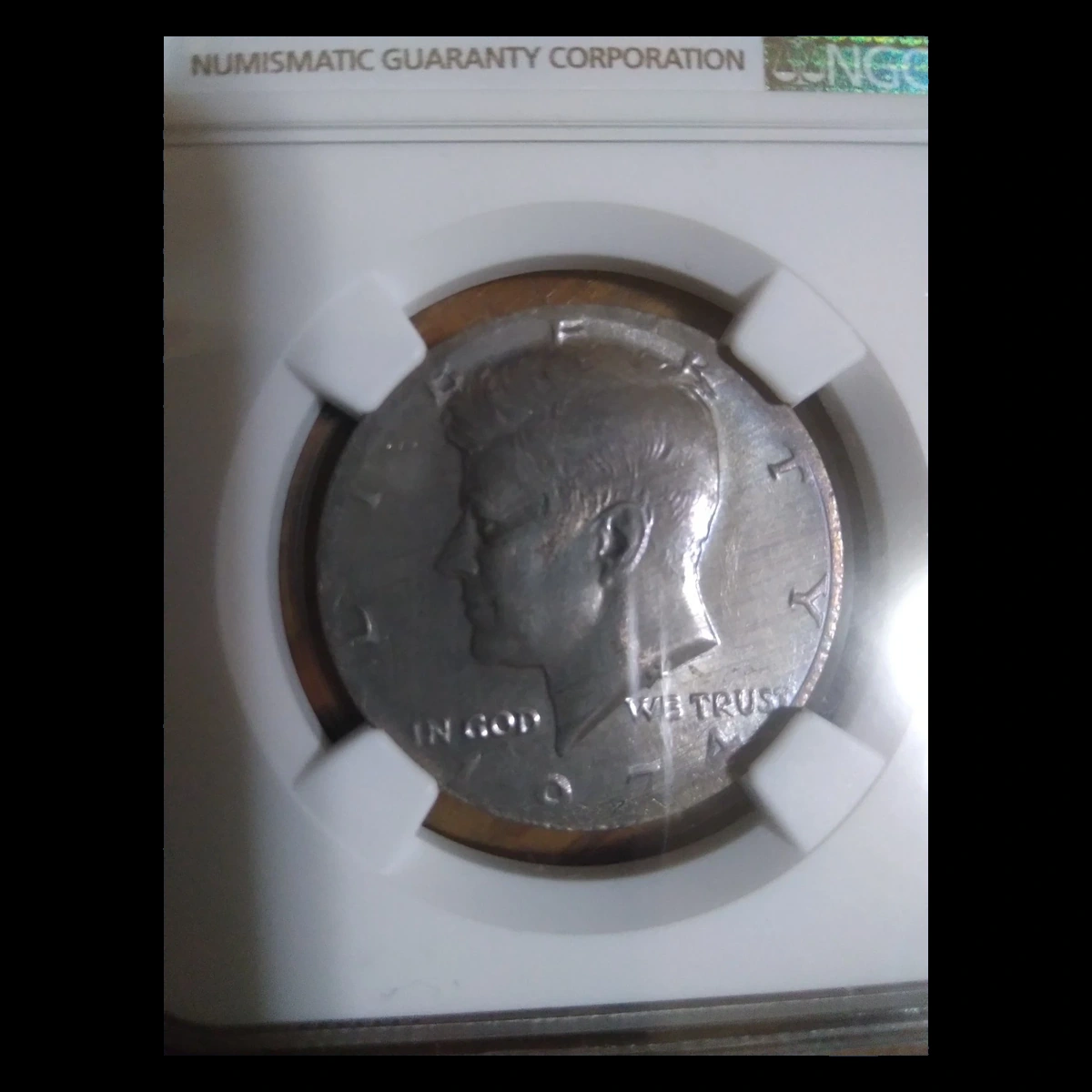
15. 1974 Half Dollar Cropped Designs on a Lighter Coin: Wrong Planchet Error
Reported 1974 halves were struck on Taiwan five-dollar blanks and on a United States quarter blank. These are unused blanks intended for another coin, so an earlier denomination’s design need not appear beneath Kennedy.
How to Identify
Compare the weight, composition, and natural outline with the proposed blank, rather than relying on cropped lettering alone. The recorded MS62 quarter-blank example weighs 5.71 grams, close to the quarter’s normal 5.67-gram standard, while a separate MS64 Taiwan-blank piece is recorded at 9.6 grams.
What It’s Worth
Estimated value is $400–$3,500. Supplied Heritage records include a Taiwan-blank AU55 at $2,880 in September 2023, the separate 9.6-gram MS64 at $660 in September 2019, and the quarter-blank MS62 at $630 in August 2022.
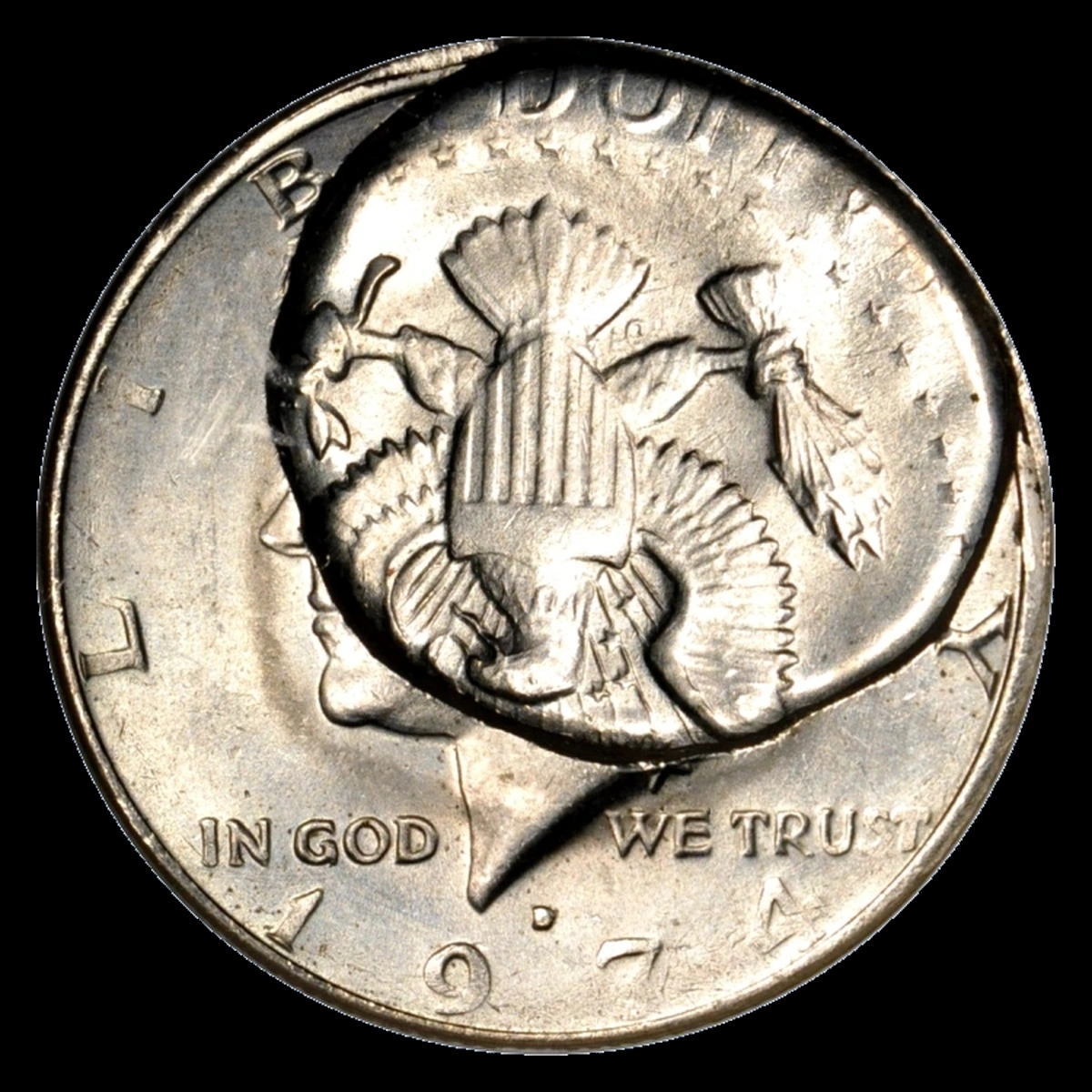
16. 1974 Half Dollar A Backward Recessed Design: Brockage Error
The unusual Denver MS62 brockage was made on a normal-sized half by a smaller coin that already carried a half-dollar design struck on a cent blank. The receiving half itself was not struck on cent metal.
A separate AU58 has an obverse brockage combined with a partial-collar edge step. These are different striking events, not two descriptions of the same coin.
How to Identify
Brockage should contain a recognizable design impressed backward and below the surface, unlike a plain indent. The reported Denver combination requires careful attention to which coin supplied the impression and which received it.
What It’s Worth
Ordinary examples of the supplied type are estimated at $100–$600, while the unusual Denver combination has a tentative $1,500–$5,000 range. The separate AU58 brockage with partial collar sold for $125 in June 2024; no sale is supplied for the Denver MS62.
Conclusion
A clear description of a 1974 error begins with its location and shape: a raised line, missing layer, displaced design, or backward impression each points to a different event. Match varieties to their exact lettering patterns and keep reported possibilities separate from established attributions.
When a coin combines errors, identify every feature before comparing prices, including any later scratches or other damage that affects its condition.