Rare 1827 Dime Errors (List & Pictures)
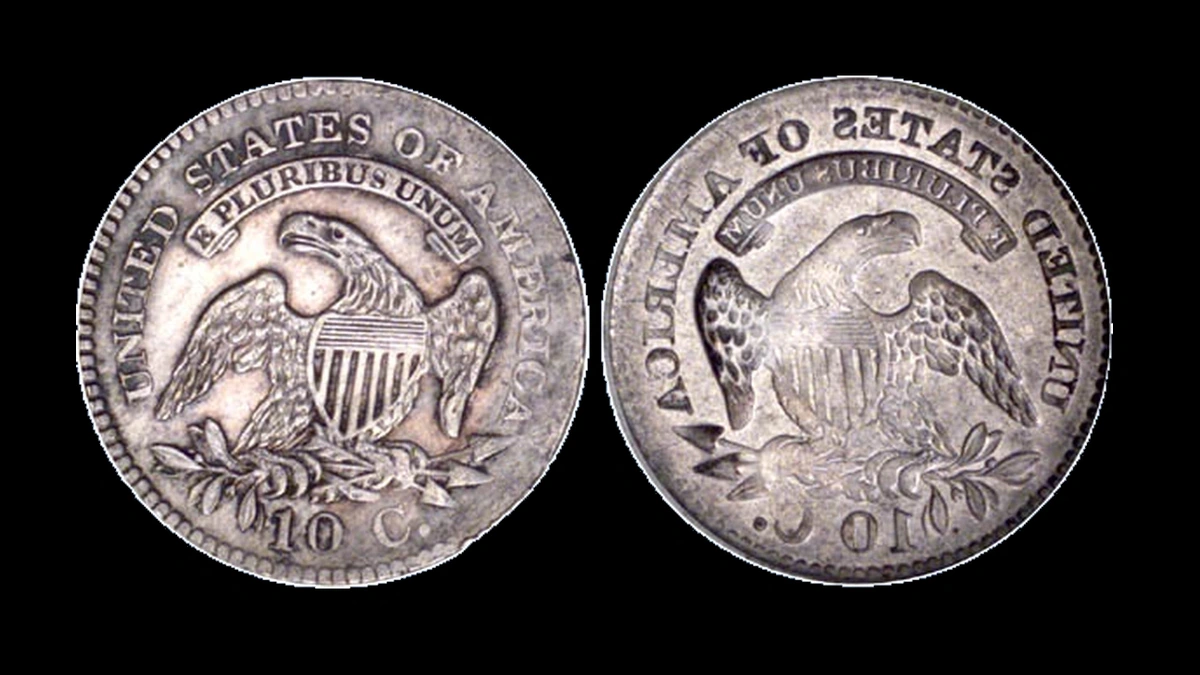
An extra 7 in the date and a backward eagle point to very different 1827 Capped Bust Dime errors. A rare Specimen-65 with a reverse die crack brought $40,800 in August 2019, but that price depends on its special production category.
Whole-coin estimates span $100–$60,000 across the three groups. Begin with the date, then use the reverse details to understand the special specimen and the undated brockage assigned to 1827.
1. 1827 Dime Another 7 Shows beside the Final Digit: Repunched Date Error
The JR-1 variety preserves part of an earlier 7 beside the final numeral. Its old 1827/5 nickname came from a different reading of that same shape.
The accepted explanation is a 7 punched again into the die in a slightly different position. Coins then copied both surviving outlines from the tool.
How to Identify
Compare the entire last digit with a clear JR-1 image and trace the extra raised outline. It should fit another placement of a 7, rather than a 5 suggested by the older name.
Check the full date and surrounding portrait so one damaged corner does not drive the match. Fresh cuts or a nearby scratch do not establish repunching.
A normal dime of this type began near 2.70 grams and 19 mm in roughly 89.2% silver alloy. Measurements and a look at the grooved edge support examination of the whole coin, with wear taken into account.
What It’s Worth
$100–$2,000 is a working whole-coin estimate for worn JR-1 examples with readable repunching. Remaining detail and original surfaces help determine where a coin fits.
PCGS records an exceptional MS66 at $15,525 in October 2000. That unworn, very well-preserved example belongs to a different condition group from the circulated range.
The old 1827/5 name does not create a second rarity. It should not add another premium to the same repeated-7 variety.
2. 1827 Dime A Fine Ridge Crosses the Eagle’s Head: JR-10 Specimen Die Crack Error
The documented line starts at F in OF, passes through the S of PLURIBUS, and crosses the eagle’s head. It ends toward the upper right wing below the beak.
Silver filled a crack in the die and reproduced it as a ridge. The catalog proposes stress from tool reworking and reheating, but that explanation is separate from the visible path.
This JR-10 is classified Specimen-65, a special production category. An ordinary circulation dime does not gain that classification merely by having a similar line.
How to Identify
Follow the whole route from F through the motto and head to the wing. An isolated scratch near an endpoint is not enough to identify the pattern.
Use low lighting to distinguish a raised ridge from a cut. Then verify the complete coin’s JR-10 attribution and specimen classification against its grading record.
A photograph of the line cannot prove the proposed reheating history. Keep the observed crack and the suggested manufacturing cause separate.
What It’s Worth
$20,000–$60,000 is an estimate for comparable coins in this exceptional category. The PCGS Specimen-65 JR-10 sold for $40,800 in August 2019.
The rare production type, variety, and preservation contribute to the whole price. The thin crack is not a $40,800 bonus that can be transferred to an ordinary 1827 dime.
3. 1827 Dime A Backward Eagle Replaces the Dated Face: Brockage Attributed to 1827 Error
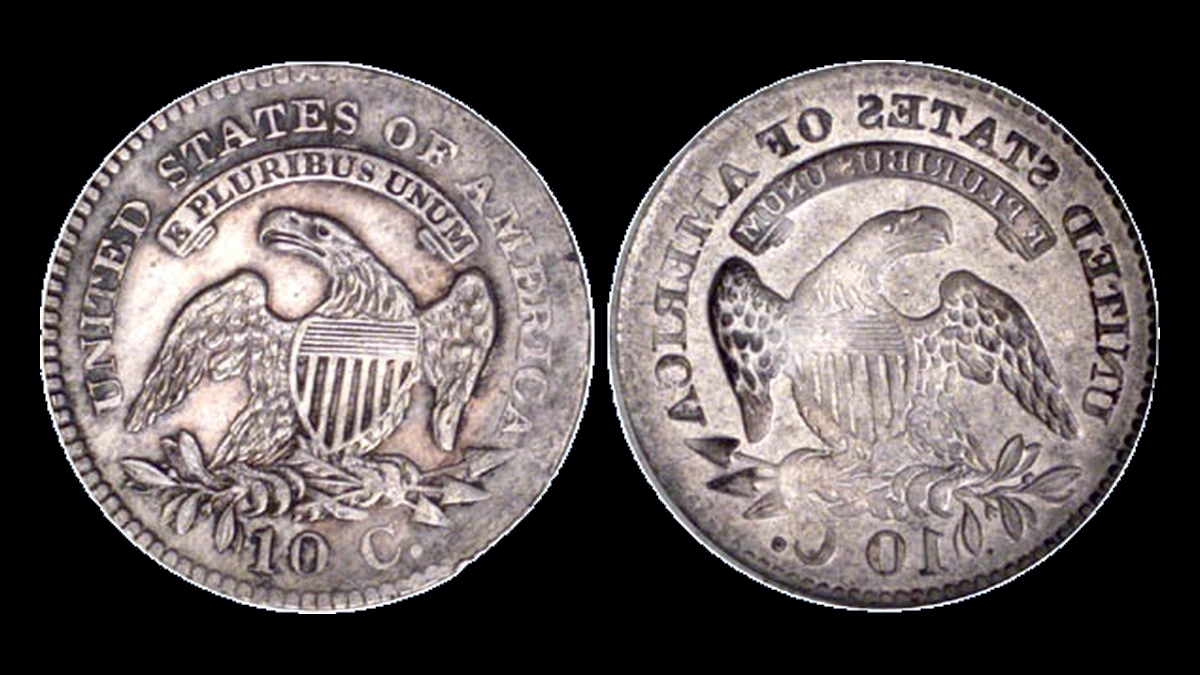
The undated example has a normal raised eagle on one face and a backward eagle pressed into the other. A previously struck coin acted against the blank during striking and transferred that sunken copy, called a brockage.
No normal dated face formed to prove 1827 directly. The year assignment comes from the crack pattern on the normal eagle die, which had also served in 1824 and 1825.
How to Identify
Compare the normal eagle side first, including its stronger later cracks. The collection description explains why those marks support the tool’s 1827 use.
Then check the opposite eagle for a backward image sunk into the surface. Later squeezing, crushed rims, or joined pieces can create lookalikes that require close inspection.
Keep “undated, attributed to 1827” with the specimen. A similar backward eagle on another dime cannot inherit the same year without the matching die evidence.
What It’s Worth
$2,000–$10,000 is an estimated range for an authenticated brockage with the documented year assignment. No completed sale is supplied for this undated specimen.
A related 1828 dime with a reverse brockage sold for $5,750 in February 2009 in heavily worn AG3 condition. Its different transferred design and receiving face make it a broad comparison, not proof of the undated coin’s year or exact value.
Conclusion
For JR-1, trace a second 7 rather than following an outdated 5 label. For the JR-10, match the full raised crack and verify the special specimen category separately.
The backward-eagle coin needs its undated status preserved alongside the evidence assigning it to 1827. Those distinctions explain why a small date feature, a rare specimen, and a brockage have such different price ranges.