Rare 1896 Dime Errors (List & Pictures)
A hidden numeral near the rim is a very different clue from a blank crescent beside Liberty. The 1896 dime errors below have estimated whole-coin values of $50–$2,000, while an ordinary Philadelphia MS65 sold for $960 in June 2025, illustrating the importance of condition even without an attributed error.
Look below and within the date, then examine interrupted surfaces and the full outline before choosing a comparison.
| Clue | Category | Estimated range |
|---|---|---|
| Top of a 6 under the 9 | Misplaced date | $50–$1,500 |
| Extra strokes near the main numbers | Repunched date | $50–$1,500 |
| Several blocked areas on an S-mint dime | Reported strike-throughs | $150–$1,500 |
| Blank margin and missing outer design | Off-center strike | $200–$2,000 |
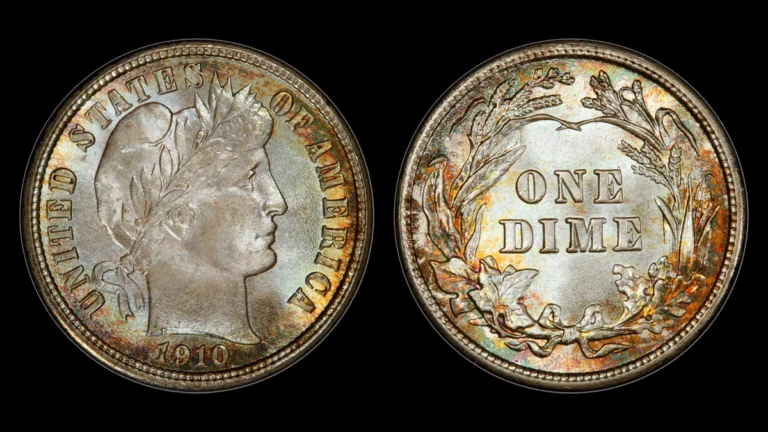
A normal 1896 dime contains 90% silver and starts near 2.50 grams at 17.9 millimeters across, with a grooved edge. Check the mintmark and condition independently of the error, allowing for ordinary wear when using measurements.
1. 1896 Dime A Number Top among the Rim Teeth: Misplaced Date Error
Directly below the normal date’s 9, part of an extra 6 appears among the rim teeth. The date punch landed too low during preparation of the die, leaving this remnant below the correctly placed numerals.
The Philadelphia variety is called MPD-001 in the Barber dime guide. That catalog label must stay with its denomination; the same letters and number on an Indian cent would identify a different coin.
How to Identify
Include the entire date and lower rim in a close-up, then compare the curved top beneath 9 with printed page 49 of Flynn’s Barber dime guide. A damaged rim tooth or shapeless bump is not enough.
Confirm the absence of a reverse mint letter before applying this Philadelphia reference. The extra curved piece should occupy the documented position rather than simply look numeral-like somewhere near the rim.
What It’s Worth
Matching examples are estimated at $50–$1,500 from worn condition through lower unworn grades. The $960 June 2025 sale belongs to an ordinary Philadelphia PCGS MS65, not to the misplaced-date variety.
That result provides context for preservation, while an undamaged rim and legible extra 6 make attribution easier. It does not establish an error premium of the same amount.
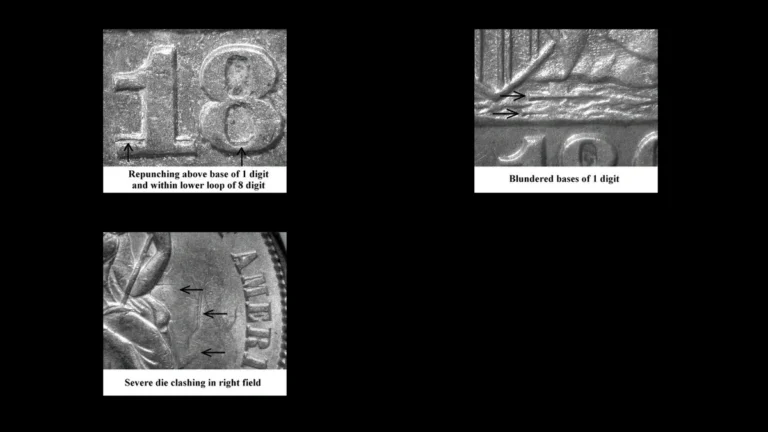
2. 1896 Dime Overlapping Pieces around 896: Repunched Date Error
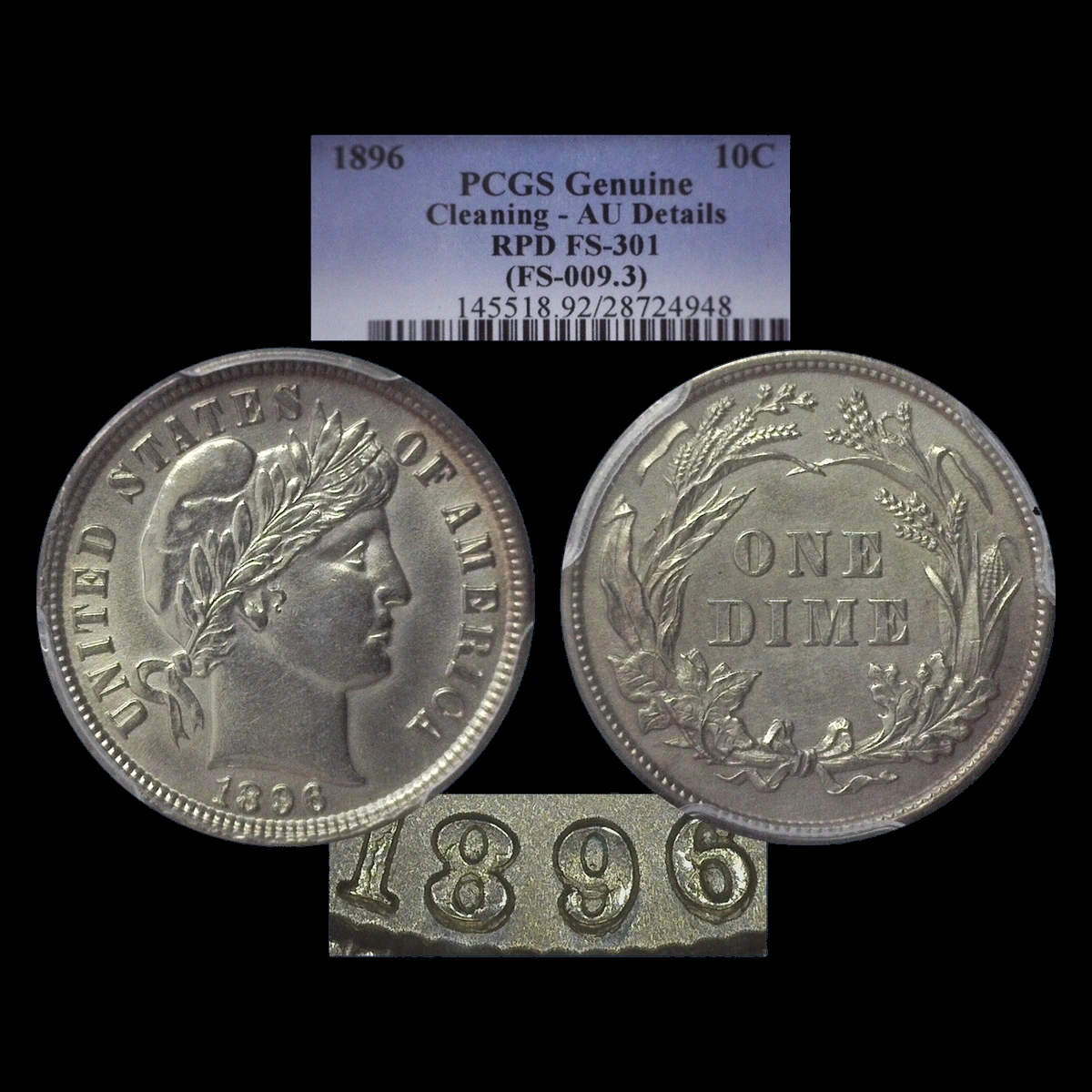
The notation 1896/896 describes repeated date work, not a proven 1896 date over 1895. An earlier entry of the same date left pieces within or beside the final numerals.
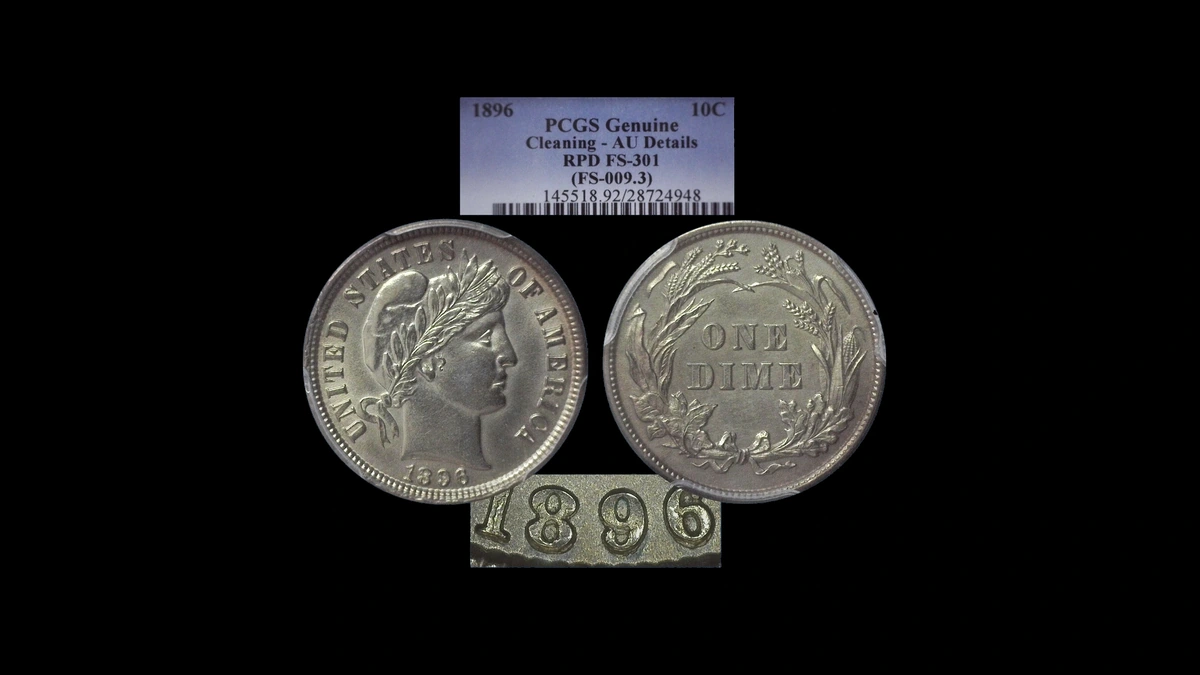
NGC lists FS-301 for Philadelphia regular strikes. A separate guide entry called RPD-001 shows lower impressions at the foot of 1, through 89, and on 6, without establishing that the two catalog entries describe one die.
How to Identify
Use an FS-301 photograph for an FS-301 candidate and the RPD-001 pattern for that separate entry. Compare the full arrangement of extra strokes rather than equating varieties from one similar curve.
Raised fragments should fit recognizable numeral shapes. Flat strike-related shelves and cuts into the surface require different explanations.
What It’s Worth
The estimated whole-coin range is $50–$1,500 for identified examples of these Philadelphia repunched dates. The ordinary MS65 at $960 is a condition reference, not a recorded sale of either variety.
Multiple catalog descriptions do not create multiple premiums to add together. Preservation and the clarity of the actual matched pattern remain central.
3. 1896 Dime Several Shallow Interruptions: Reported Multiple Strike-Throughs Error
A seller described an 1896-S as having multiple strike-throughs without supplying a grading-service attribution or exact map of the marks. The claimed mechanism is material blocking portions of the design between the die and blank.
The report names no obstruction, so it cannot establish wire, fabric, or grease specifically. Each depressed or weak area needs its own examination.
How to Identify
Verify 1896 and the S mintmark, then follow where intact design meets each alleged obstruction mark. Look for design interrupted during striking rather than a completed surface subsequently cut or crushed.
Corrosion can eat pits, an impact can displace metal, and a detached flake can leave a rough hollow. Similar depth alone does not separate those effects from a genuine strike-through.
What It’s Worth
Genuine examples are provisionally estimated at $150–$1,500 from circulated through lightly worn condition. The seller’s $300 figure was an asking price, with no completed sale established here.
A separate ordinary PCGS VF30 with CAC approval sold for $600 in January 2026. That graded coin’s condition and sale cannot be assigned to the ungraded reported error.
4. 1896 Dime Untouched Metal beside Cropped Design: Off-Center Strike Error
An off-center blank receives a partial design, leaving a crescent untouched while the opposite part of the design falls beyond the metal. This changes placement without cutting a piece from the blank.
The year guide lists the category without establishing a particular specimen’s mint or displacement. Those details must come from an actual readable coin.
How to Identify
Compare both faces at the same scale and check that displacement explains the blank area and missing outer design together. A shift confined to one face can involve a misaligned die instead.
A broadstrike spreads metal while retaining the whole design, which is a different pattern. Also inspect for grinding around an apparently blank area and confirm enough of the date survives to support 1896.
What It’s Worth
Genuine readable-date examples are estimated at $200–$2,000. A 1902 Barber dime struck off center and graded ANACS AU50 sold for $561.20 in June 2026, providing a different-year same-design comparison.
A clearer or larger shift can attract interest, but damage and incomplete identity affect the result. That auction does not confirm a sale of an 1896 specimen.
Conclusion
Locate the feature before naming it: the misplaced 6 sits near the rim, while a repunched date leaves repeated strokes close to the main numerals. Larger depressions and outline changes need evidence from their boundaries and both faces.
Keep seller reports provisional where attribution is missing, and separate ordinary condition comparisons from actual error sales when estimating the complete dime’s value.