Rare 1924 Dime Errors (List & Pictures)
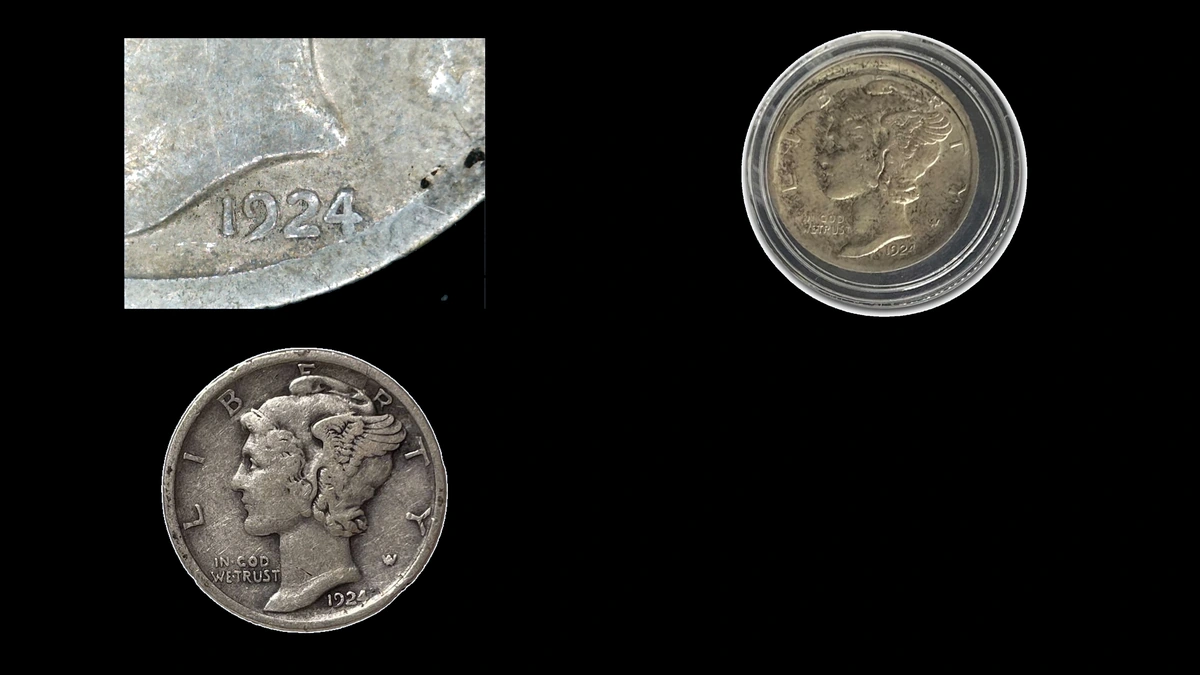
A complete design inside an uneven, expanded outline identifies one of the more visible 1924 dime errors. A San Francisco broadstrike sold for $840 in 2018; a different-year 1945 example brought $3,416 in September 2026, above this guide’s $30–$3,000 working range.
Begin with the date and mintmark details, then compare missing metal, attached separation, and design completeness around the outline.
| What to examine | Category | Estimated range |
|---|---|---|
| Repeated front contour | Reported doubled die | $100–$700 |
| Extra D or S fragment | Repunched mintmark | $30–$1,200 |
| Original missing edge section | Clip | $30–$600 |
| Separated metal still attached | Lamination or retained split | $40–$900 |
| Blank margin and cropped design | Off-center strike | $100–$1,800 |
| Expanded margin with all design present | Uncentered broadstrike | $400–$3,000 |
A normal Mercury dime starts at 2.50 grams and measures about 17.90 millimeters, with a grooved edge. Full Bands describes clear separation of the central bands on the reverse bundle, not the presence or cause of an error.
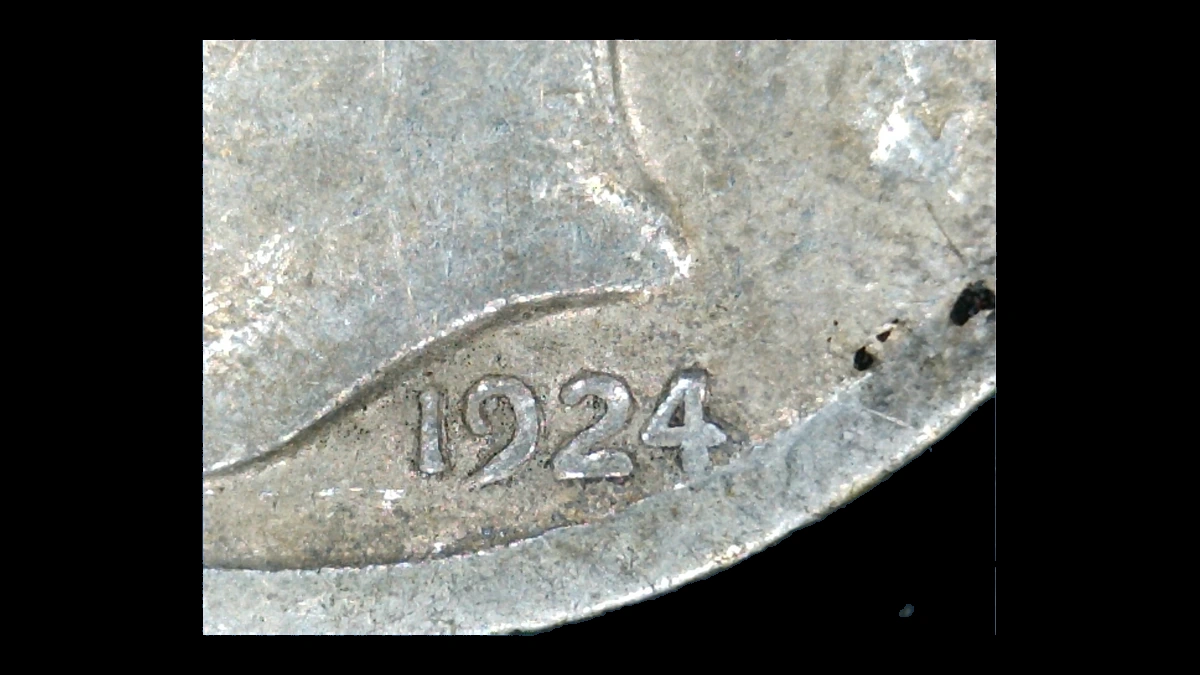
1. 1924 Dime A Rounded Repeated Front Shape: Reported Doubled Die Error
The year guide suggests examining LIBERTY and the date for doubled-die evidence. It reports the category without specifying one confirmed pattern that every suspect letter must share.
A doubled design in the die can transfer an extra contour with one strike. A flat shelf produced by movement during striking has a different origin.
How to Identify
Compare several suspected features with a normal dime under the same light, looking for stable rounded separation. Reflections and dark borders can imitate an additional edge in a single photograph.
LIBERTY and the date are search locations, not an attribution by themselves. The generic report does not justify borrowing an exact diagnostic from another year.
What It’s Worth
Clearly identified examples are provisionally estimated at $100–$700. This follows guide estimates from roughly a hundred to several hundred dollars and is not a completed sale for a named variety.
2. 1924 Dime An Extra D or S Curve: Repunched Mintmark Error
An earlier mintmark impression can remain when the punch moved between entries into the die. The 1924 guide reports both Denver and San Francisco examples.
Each letter needs a matching reference for its direction and shape. The feature concerns the mintmark area rather than doubling of the entire reverse.
How to Identify
Find the small letter low on the reverse beside the bundle, near E in ONE. Inspect its top and bottom together to decide whether the extra piece fits another D or S.
Corrosion dots, added material, or metal moved by a nick need different explanations. An unrelated year’s familiar pattern cannot establish this year’s variety.
What It’s Worth
Estimated whole-coin values span $30–$1,200 from worn through lower unworn examples. No fixed premium applies to every odd-looking mintmark, and Full Bands preservation can affect the base coin’s value independently of repunching.
3. 1924 Dime A Missing Section near 4 O’Clock: Clipped Planchet Error
The Philadelphia Teich Collection dime has a clip near 4 o’clock with the obverse upright. The blank was incomplete before the dies impressed the remaining metal.
Its MS66 Full Bands designation combines high preservation with sharp central reverse bands. Those bands do not explain the missing edge or represent an additional error.
How to Identify
Study how the rim and design approach both ends of the gap. Natural formation around the shortage differs from abrupt cuts, tool lines, or pushed metal on a finished coin.
Opposite-rim weakness may support a clip but varies between specimens. Compare intact spans of the outline and surviving edge grooves while keeping wear and any missing metal in mind.
What It’s Worth
Estimated values are $30–$600. The MS66 Full Bands example sold for $305.50 in June 2013.
A separate 1942 clip graded MS66 brought $192 in March 2025. Both demonstrate that a clear clip can remain moderately priced despite strong preservation.
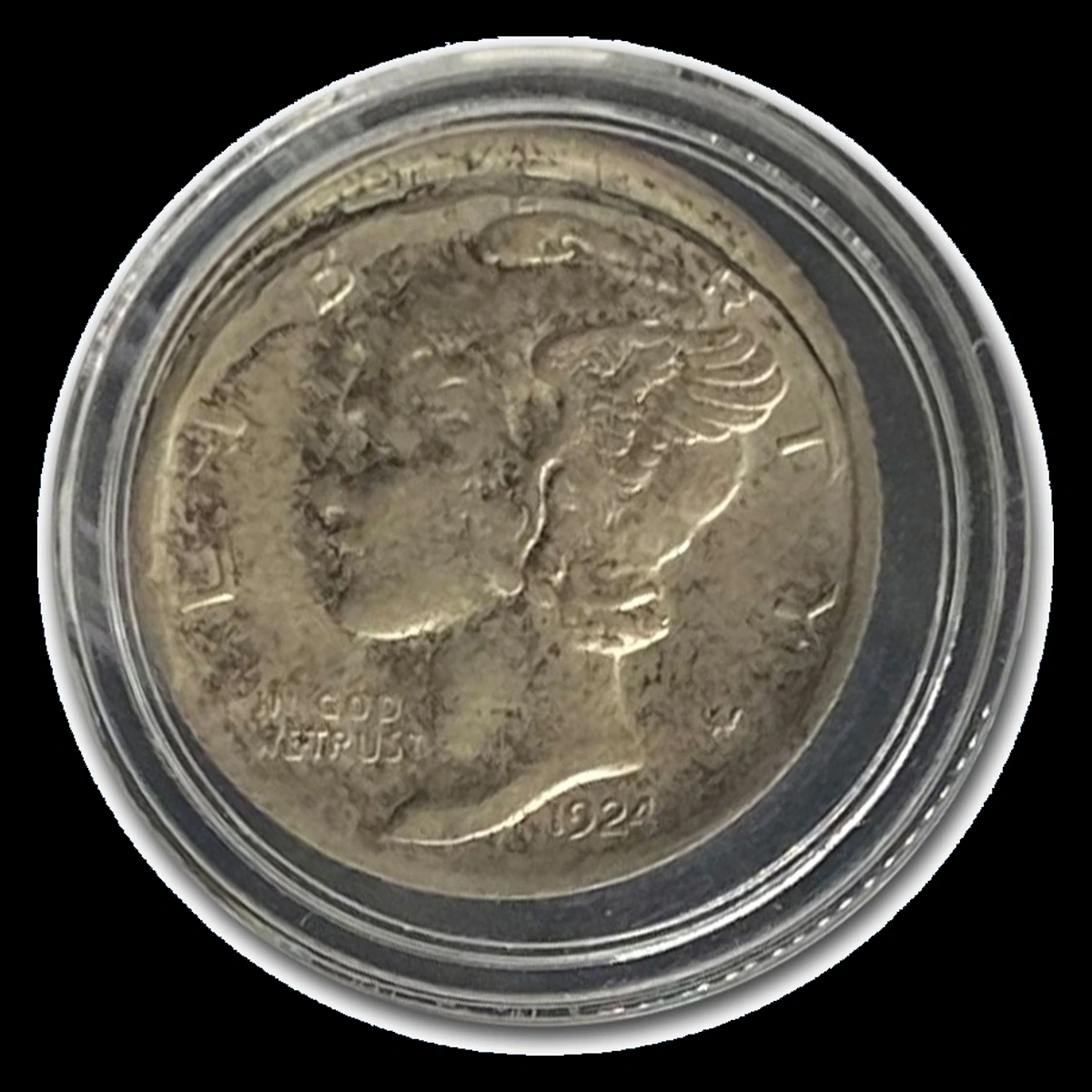
4. 1924 Dime A Separated Sheet Still Joined to the Coin: Retained Split and Lamination Error
The Denver AU58 listed by APMEX has an attached split in its silver-copper alloy. “Retained” means the separated metal remains connected instead of becoming a detached fragment.
This belongs to the broad family of metal separations that includes smaller laminations. An extensive split can involve considerably more metal than a surface flake.
How to Identify
Begin at the edge and follow the physical connection between the separated sheet and the coin’s body. A deposit of glue or residue lies on top of intact metal and does not show the same structure.
Compare the listed retained-split example without lifting the flap. Nearly normal weight is possible when all the separated metal is still attached.
What It’s Worth
Genuine laminations and retained splits are estimated at $40–$900. No price is supplied for the AU58 listing; a 1921-D reverse lamination graded VG8 sold for $74 in 2013.
The comparison’s heavier wear and different year limit its use. The extent of separation and the Denver coin’s own condition must be assessed together.
5. 1924 Dime Part of the Design Falls beyond the Metal: Off-Center Strike Error
An off-center strike pairs an untouched margin with design missing at the opposite side. The blank was misplaced when the dies closed.
The generic 1924 report does not establish an individual percentage or mint. It should not be confused with the documented San Francisco broadstrike, whose full design remains present.
How to Identify
Trace the outer design on both faces and locate where it actually disappears beyond the blank. If all details fit inside expanded metal, consider a broadstrike instead.
Inspect original blank texture beside the struck area and rule out grinding or cutting. Displacement itself need not remove any metal, and a shift limited to one face can involve a moved die.
What It’s Worth
Readable-date examples are estimated at $100–$1,800. A 1944 dime struck 10% off center and graded PCGS AU58 sold for $360 in December 2025, a later-year Mercury comparison rather than a 1924 result.
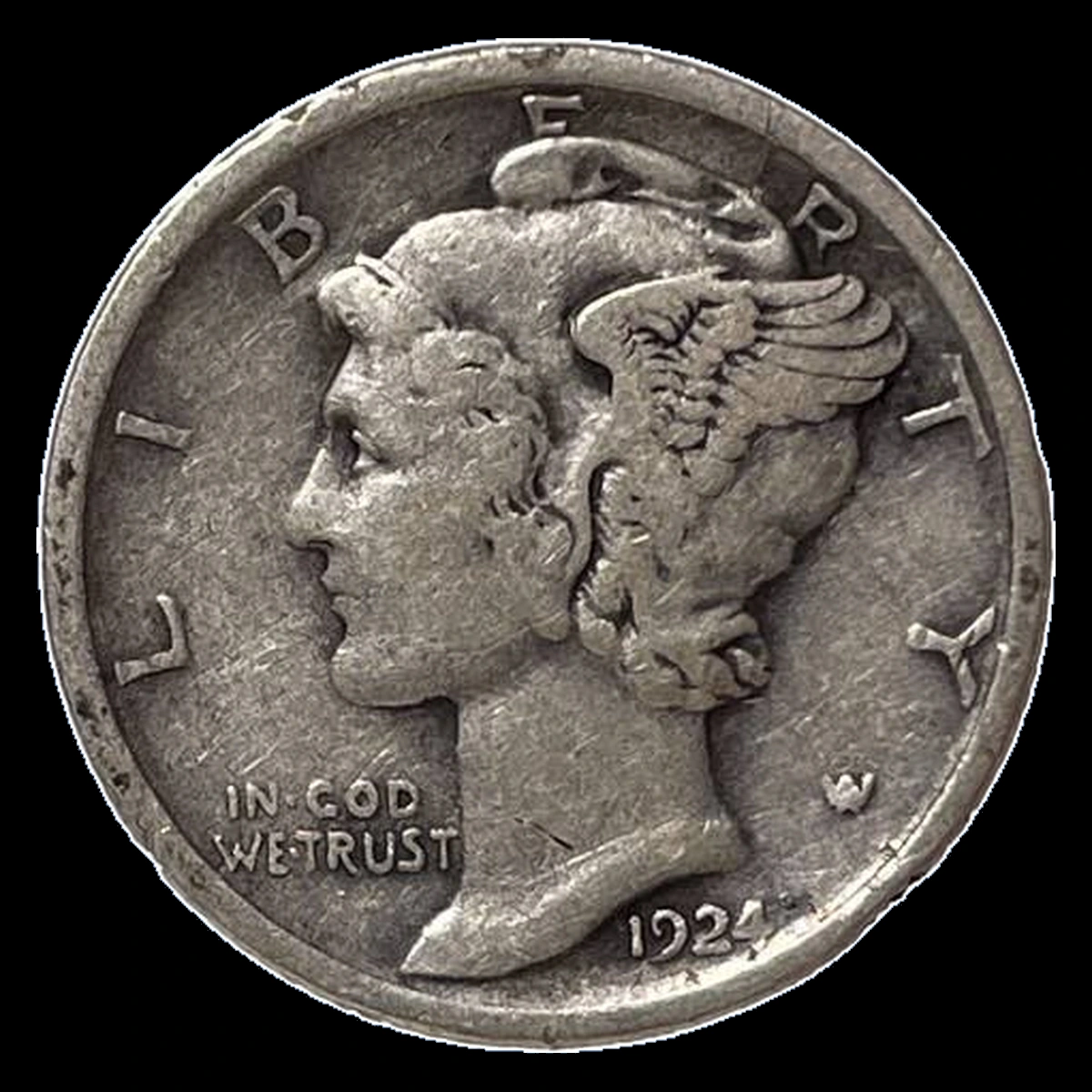
6. 1924 Dime Uneven Expansion with Complete Designs: Uncentered Broadstrike Error
The cataloged San Francisco MS64 Full Bands has extra spread near 6:30 with the front upright. Its blank was uncentered and lacked normal collar support, allowing outward expansion while preserving the complete designs.
The collar is the ring that usually controls width and forms the edge grooves. Loss of that restraint explains the expanded outline without requiring missing design.
How to Identify
Follow every outer letter and the reverse design before judging the uneven margin. Completeness of the design is the decisive contrast with a true off-center strike.
Compare the expansion near 6:30 with the cataloged specimen, then inspect the edge for incomplete grooves and original outward flow. Later hammering can widen a dime but also disturbs its struck details.
What It’s Worth
San Francisco uncentered broadstrikes are estimated at $400–$3,000. A PCGS MS64 Full Bands sold for $840 at Heritage on April 29, 2018.
A different-year 1945 broadstrike graded NGC MS66 Full Bands brought $3,416 in September 2026. Its higher preservation helps explain why that comparison lies beyond the working range and does not set a price for every 1924-S.
Conclusion
A missing segment, an attached split, and outward spread describe different changes to the coin’s metal. Check the entire design before naming a wide, uneven coin off center, and use specific references for smaller mintmark or doubled-die candidates.
Full Bands and numerical grade describe strike quality and preservation; they should stay separate from the evidence explaining the minting error and its contribution to one whole-coin price.