Rare 1920 Dime Errors (List & Pictures)
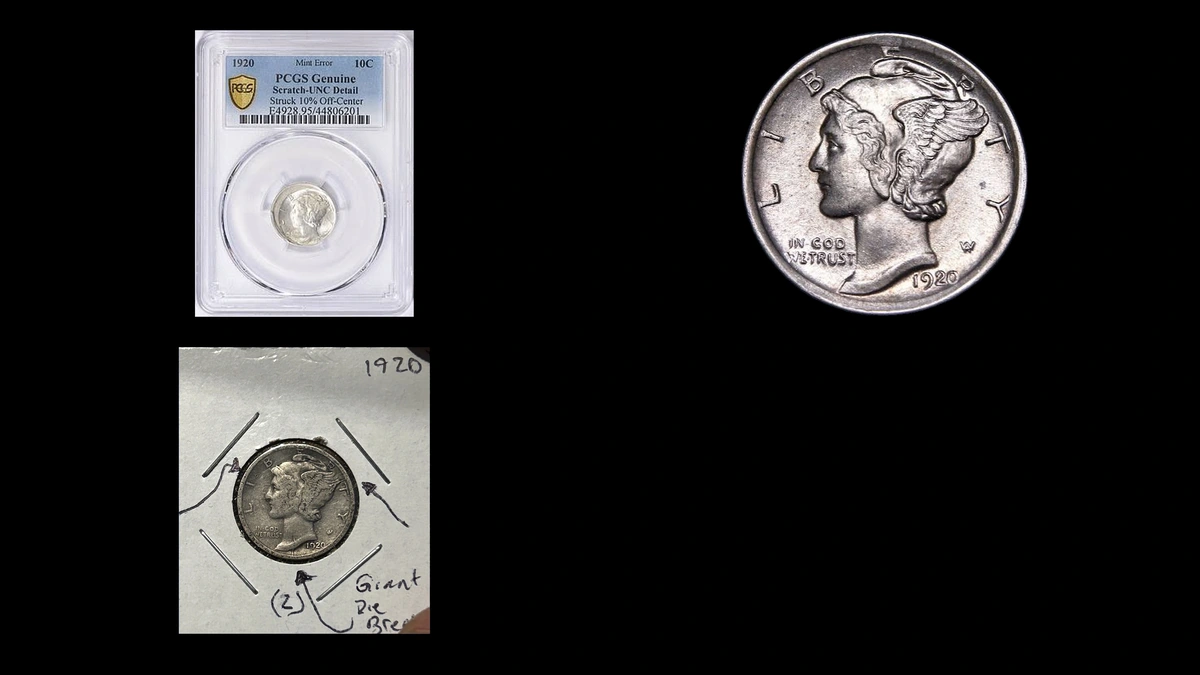
Estimated whole-coin values for 1920 dime errors span $10–$3,000, with a 1920-S off-center example selling for $1,860 in 2020. The highest supplied comparison, $3,416 in September 2026, concerns a different-year 1945 broadstrike in a higher grade.
Use the outline to separate missing metal, expansion, and displacement before magnifying smaller features.
| What stands out | Feature | Estimated value |
|---|---|---|
| A section is missing | Clipped planchet | $40–$450 |
| A wide coin keeps its full design | 1920-S broadstrike | $250–$1,500 |
| Incomplete design borders unused metal | Off-center strike | $100–$3,000 |
| LIBERTY or the date looks doubled | Reported obverse doubling | $10–$300 |
| A raised feature runs behind the neck | 1920-D die cracks and breaks | $10–$600 |
| Extra strokes appear beside D or S | Reported repunched mintmark | $20–$750 |
1. 1920 Dime A gap interrupts the coin’s outline: Clipped Planchet Error
A planchet is the blank prepared for striking. It can already lack a section if the cutting punch overlaps an earlier hole or extends beyond the metal strip’s edge.
The incomplete blank then receives its design, allowing the rim and nearby detail to form around the gap. The general 1920 report does not establish a particular mint.
How to Identify
Inspect the gap’s endpoints and nearby rim on both faces. A genuine pre-strike absence can affect metal flow, while a later cut removes an already finished edge.
Look under a 10× magnifier for saw marks, crushed metal, or fresh cuts. Weakness opposite a curved clip can support the diagnosis, though it is not required on every genuine example.
An ordinary Mercury dime started at 2.50 grams and 17.90 millimeters, with a grooved edge. For an accessible coin, compare weight allowing for missing metal and wear, and measure across an unaffected portion.
Low weight by itself does not establish a clip. The rim’s response around the opening supplies more specific evidence about when the section went missing.
What It’s Worth
The whole-coin estimate is $40–$450, from modest worn clips to larger clear examples in better condition. Mint and surfaces still affect the comparison.
A 1942 clipped dime graded PCGS MS66 sold for $192 in March 2025. Its high unworn grade and different date belong to that comparison, not to an unspecified 1920 report.
2. 1920 Dime The full design remains on a wider coin: Broadstrike Error
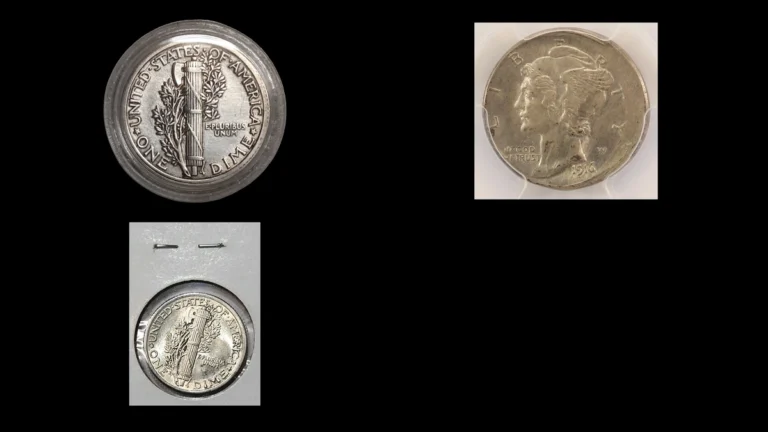
A broadstrike forms when the collar fails to restrain the blank normally. This ring controls diameter and usually forms the edge grooves, so its failure can affect both width and edge appearance.
The silver spreads outward while the entire design remains, even if unevenly positioned within the expanded outline. Northeast Numismatics lists a specific 1920-S example graded NGC AU58.
How to Identify
Confirm that both faces retain all their design before measuring the increased width. If part of the picture is missing, consider an off-center strike instead.
Examine the edge for incomplete grooves or other evidence of abnormal collar contact. A completely ordinary edge on a reportedly expanded coin calls for closer investigation.
Outward flow need not remove silver, so weight can stay near the original amount after wear. Later hammering can also widen a dime but often crushes its existing details.
What It’s Worth
The estimate is $250–$1,500 for worn through lower-grade unworn 1920-S broadstrikes. The NGC AU58 dealer example is offered at $725.
AU58 means only slight wear, and $725 is an asking price rather than a completed sale. Expansion, remaining design, and surface quality help determine how useful that offering is as a comparison.
A 1945 broadstrike graded NGC MS66 Full Bands sold for $3,416 in September 2026. Its different date and much higher grade keep it outside a direct AU58 price comparison.
3. 1920 Dime A blank crescent sits beside the displaced design: Off-Center Strike Error
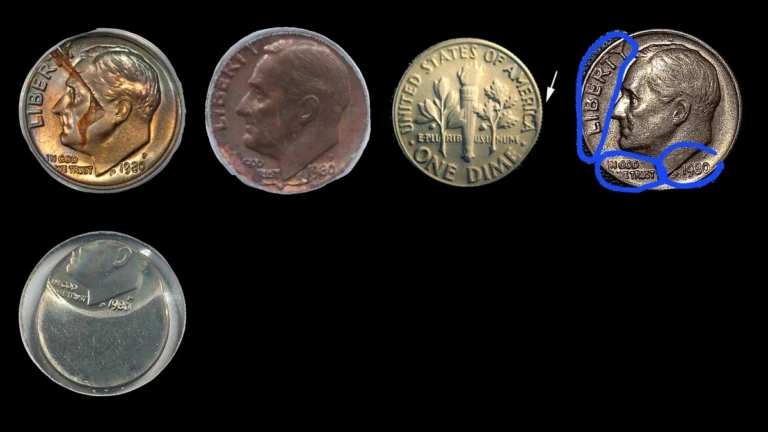
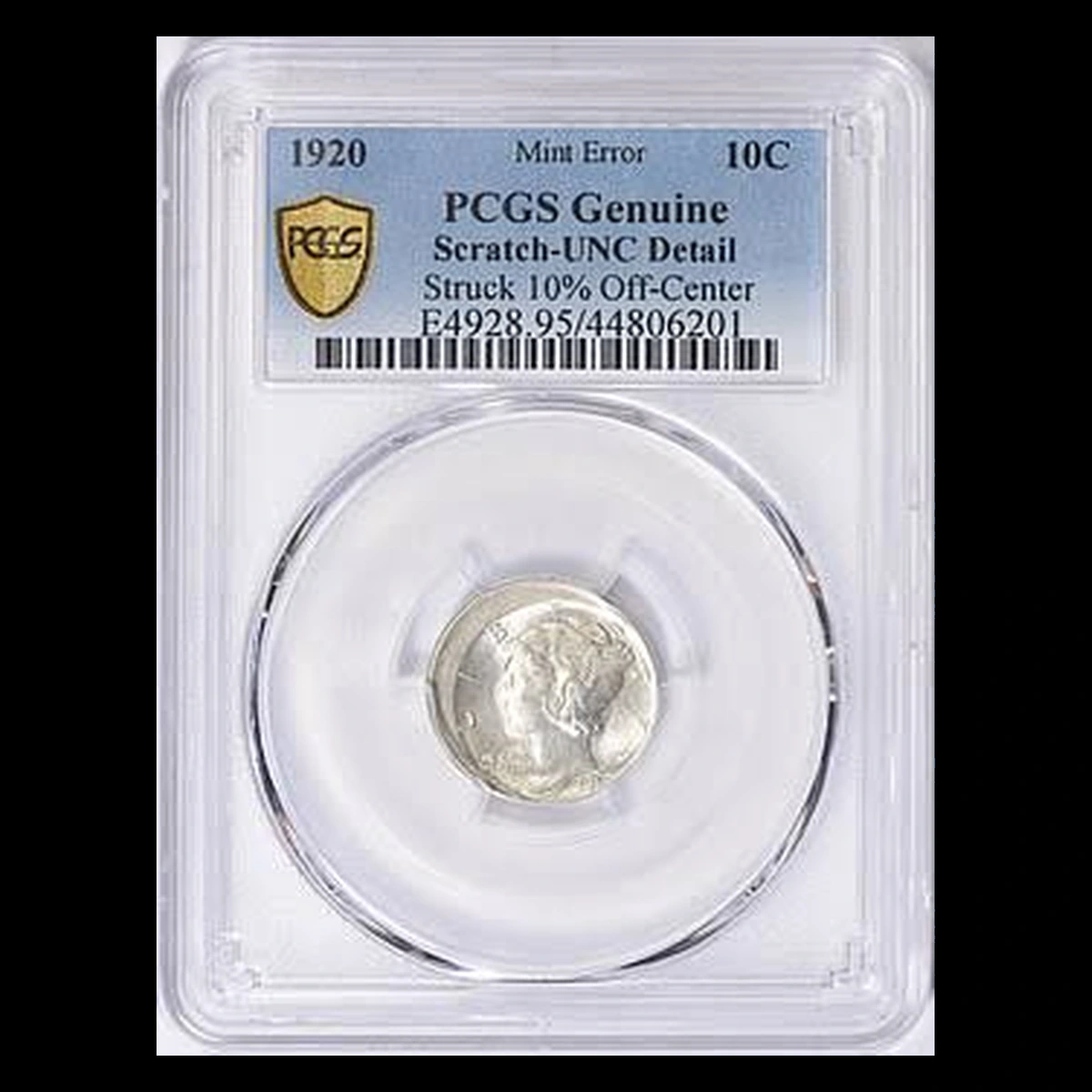
The Philadelphia PCGS MS63 report describes a 40% off-center dime. A separate 1920-S graded PCGS MS64 Full Bands is described as 20% off center.
In each case, the blank was outside its intended position, leaving some design beyond the available metal and some silver untouched. The two percentages describe different coins.
Full Bands means clear separation in the horizontal bands on the reverse bundle. It measures a surviving design detail, not the amount of displacement or an additional error.
How to Identify
Photograph the entire blank crescent with the readable date and compare both faces. Their designs should be displaced consistently within the same outline.
A single shifted border can result from a misaligned die without the blank being off center. Check the actual missing design and unstruck metal rather than relying on a percentage in a description.
Inspect the boundary and remaining edge for trimming or grinding. Preserve the visible mintmark when identifying a San Francisco example.
What It’s Worth
The supplied whole-coin estimate is $100–$3,000. A readable date, original surfaces, and an appealing visible shift support stronger comparisons.
The 1920-S PCGS MS64 Full Bands struck 20% off center sold for $1,860 in October 2020. That is a completed same-year sale of a specific unworn example.
The 40% Philadelphia coin does not inherit that result or its Full Bands designation. Minor worn offsets can cost much less despite belonging to the same error class.
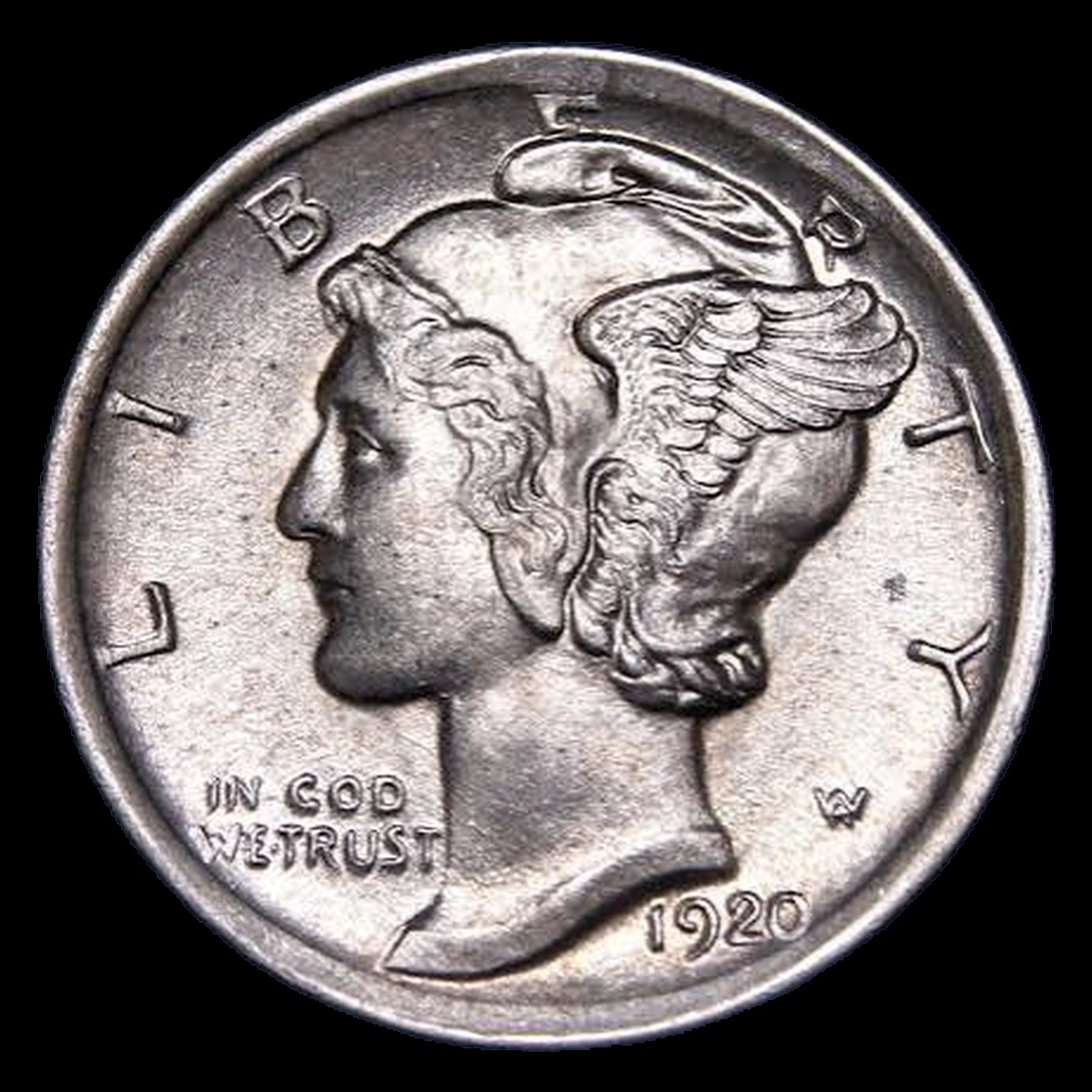
4. 1920 Dime LIBERTY or the date has an extra edge: Reported Obverse Doubling Error
The 1920 report uses both doubled-die and mechanical-doubling terminology. These refer to different mechanisms, so a doubled-looking edge requires examination before choosing either label.
A doubled die carries repeated design within the stamping tool itself. Movement during the strike can instead flatten an edge into a low shelf that reduces the original raised detail.
How to Identify
Inspect LIBERTY and the date under consistent magnification and lighting. Compare the apparent second edge with the rounded main stroke and with a normal 1920 dime.
A low flat shelf narrowing the original letter favors a striking-movement explanation. A blurred outline or moving reflection cannot establish a true doubled die.
Do not scrape dirt away to reveal the edge. The famous 1919 doubled-die variety is a different year and does not identify a 1920 coin.
What It’s Worth
The estimated range is $10–$300 for worn through lower-grade unworn Philadelphia coins with the reported appearance. Mechanical doubling generally adds little value.
An ordinary NGC MS64 Full Bands sold for $192 in July 2025. Its unworn condition and separated reverse bands provide context, not a documented doubled-die premium.
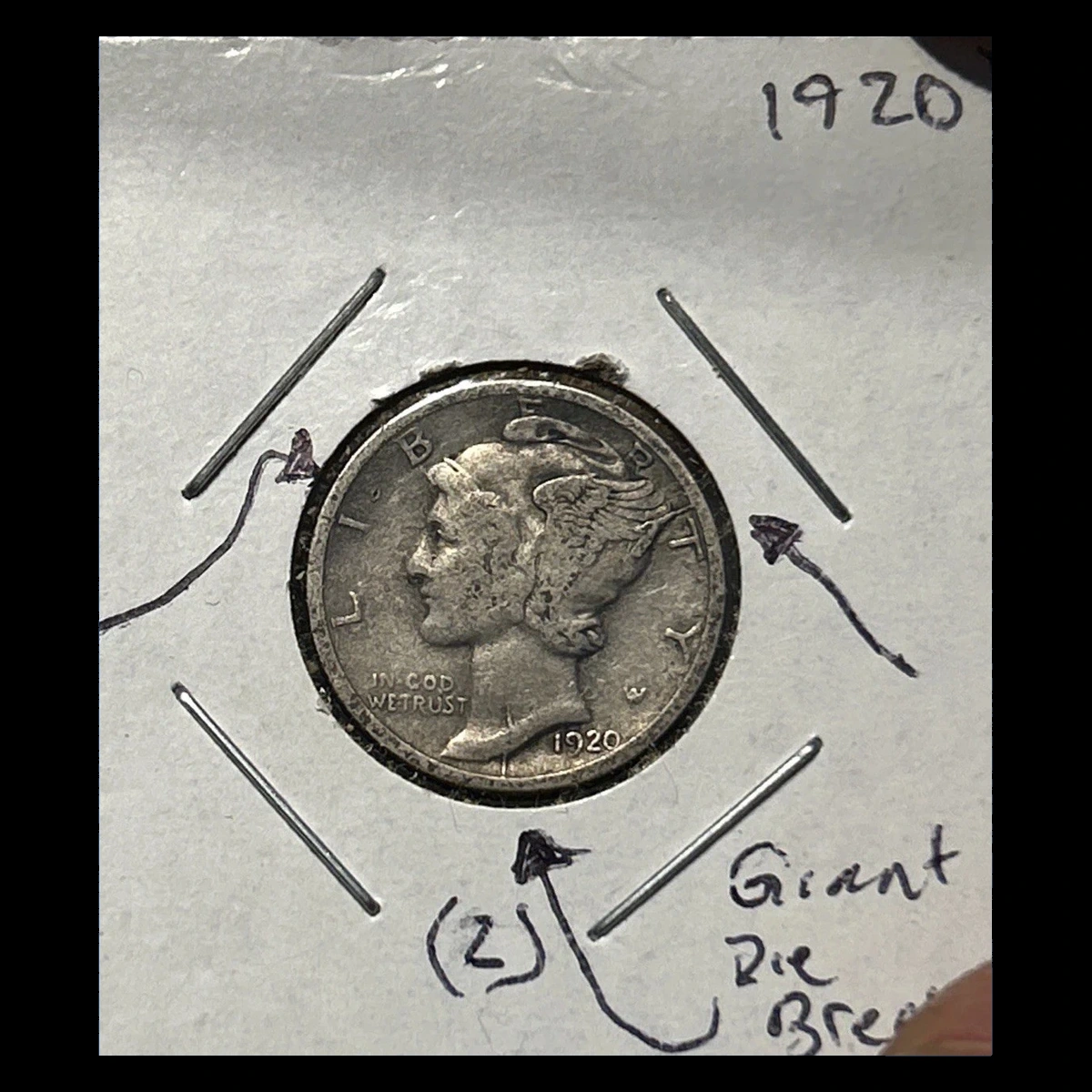
5. 1920 Dime A raised break runs behind Liberty’s neck: Die Cracks and Breaks Error
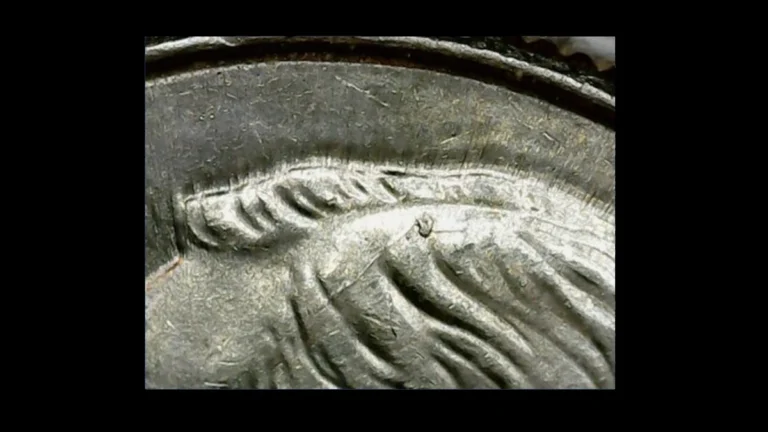
A reported heavily worn 1920-D retains a raised feature behind the neck toward the date. Its Good condition description shows that a mint feature can survive after much surrounding portrait detail is lost.
Metal entered an opening in a damaged die and formed a ridge or thicker patch. That process differs from a circulation scratch cut into the finished coin.
How to Identify
Confirm the D on the reverse, then follow the neck-to-date feature under low light. It should rise above the surface rather than appear as brightness inside a groove.
Keep both faces in the record so the break and Denver attribution remain connected. Do not assign the same route to every dime dated 1920.
A faint shape resembling part of the opposite design may have another cause. Match the raised break itself rather than grouping every unusual trace into one crack.
What It’s Worth
The estimate is $10–$600 for worn through lower-grade unworn Denver whole coins with visible cracks. Small lines usually add only modest interest.
Ordinary 1920-D examples sold for $154 at PCGS AU55 in March 2025 and $564 at MS65 that June. The first had slight wear; the second was unworn with relatively few marks.
Those are not confirmed crack sales. A visible break and preserved neighboring design still need assessment on the coin being valued.
6. 1920 Dime A smaller D or S segment borders the mintmark: Repunched Mintmark Error
Mint letters were punched by hand into the dies. An incompletely overlapping second entry could leave portions of the earlier D or S alongside the final impression.
The year-specific reports mention both Denver and San Francisco without a reliable shared catalog identification. Each mint needs its own comparison, including the shape and direction of the extra stroke.
How to Identify
Locate the mintmark beside the lower reverse bundle and identify the main letter first. Follow any extra curve or straight segment at 10× magnification, retaining the surrounding surface.
Compare nearby lettering for similar flat shelves that might reflect movement during striking. A repunched mintmark should preserve part of another letter in a matching documented position.
Inspect the base for added metal or disturbance. An unclear photograph should not be used to assign an unsupported direction to either mint’s reported feature.
What It’s Worth
The whole-coin estimate is $20–$750, from worn examples with visible remnants to attractive lower-grade unworn coins. The mint and condition explain much of the spread.
The ordinary Denver sales at $154 and $564 in 2025 do not establish an extra payment for repunching. A stronger estimate needs a recognizable matching letter remnant, not simply a thick D or S.
Conclusion
Missing blank metal, outward expansion, and design displacement produce different outline evidence. For smaller features, the shape of the raised edge and the correct mint comparison matter more than a broad error label.
The $10–$3,000 estimates concern complete 1920 coins. Keep the $725 offering distinct from the $1,860 sale, and treat the higher-grade 1945 broadstrike as a different-year comparison.