Rare 1827 Penny Errors (List & Pictures)
A different-year comparison leads the supplied records for 1827 penny errors: an 1811 double strike brought $16,200 in September 2025. A documented 1827 retained-break coin sold for $264 including the buyer’s fee in May 2025.
Estimated whole-coin ranges span $25–$20,000. Check missing metal and strike placement before examining flakes, raised breaks, and reported lettering.
A normal copper Coronet cent weighs 10.89 grams and measures roughly 28 mm, with a plain edge. Later damage can coexist with a genuine mint-made feature.
1. 1827 Penny A Gap Interrupts the Original Border: Clipped Planchet Error
The reported circulated clip has Very Good to Fine detail, but no specimen-specific percentage or position is supplied. Its missing section needs to be evaluated from the actual coin.
A planchet is the prepared metal disc before striking. When it starts with a missing section, the rim and design form around that gap.
How to Identify
Follow the struck rim into both endpoints and look for natural transitions. Sharp cuts through a finished border or parallel filing marks suggest later removal.
Opposite-rim weakness can support a clip, although wear can also erase border teeth. Reduced weight alone cannot distinguish a clipped blank from a coin cut after minting.
What It’s Worth
The estimated range is $60–$1,000 for genuine examples. Missing area, surviving detail, and copper surface quality all matter.
A 1939 clipped cent graded unworn MS64 Brown brought $180 in January 2023. That much later small cent offers broad context, not a measured or priced match for the reported 1827 piece.
2. 1827 Penny One Design Shifts—or Two Designs Overlap: Off-Center and Repeated Strikes Error
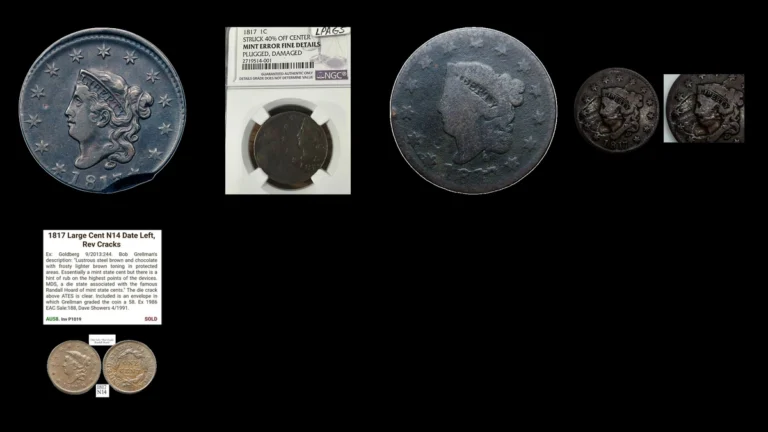
The recorded N-3 cent is about 30% off center, leaving original copper unstamped. Another 1827 coin was struck twice, with one impression about 50% off center at 1 o’clock.
The repeated-strike coin has an ANACS label noting cleaning and Fine detail. Cleaning affects its surfaces but does not explain its two design positions.
How to Identify
Find a recognizable second portrait or group of letters before calling the coin double struck. A single misplaced strike has one design position beside its unused metal.
Read the date and inspect both faces where design meets the unstruck area. Keep the N-3’s 30% displacement separate from the double strike’s 50% and 1 o’clock description.
What It’s Worth
Estimated ranges are $400–$6,000 for readable-date off-center pieces and $500–$20,000 for clear repeated strikes. A coin combining displacement with another strike receives one whole-coin value.
An 1854 off-center large cent sold for $1,527.50 in 2016, and an 1811 double strike brought $16,200 in September 2025. Neither different-year result is a realized price for the two 1827 specimens.
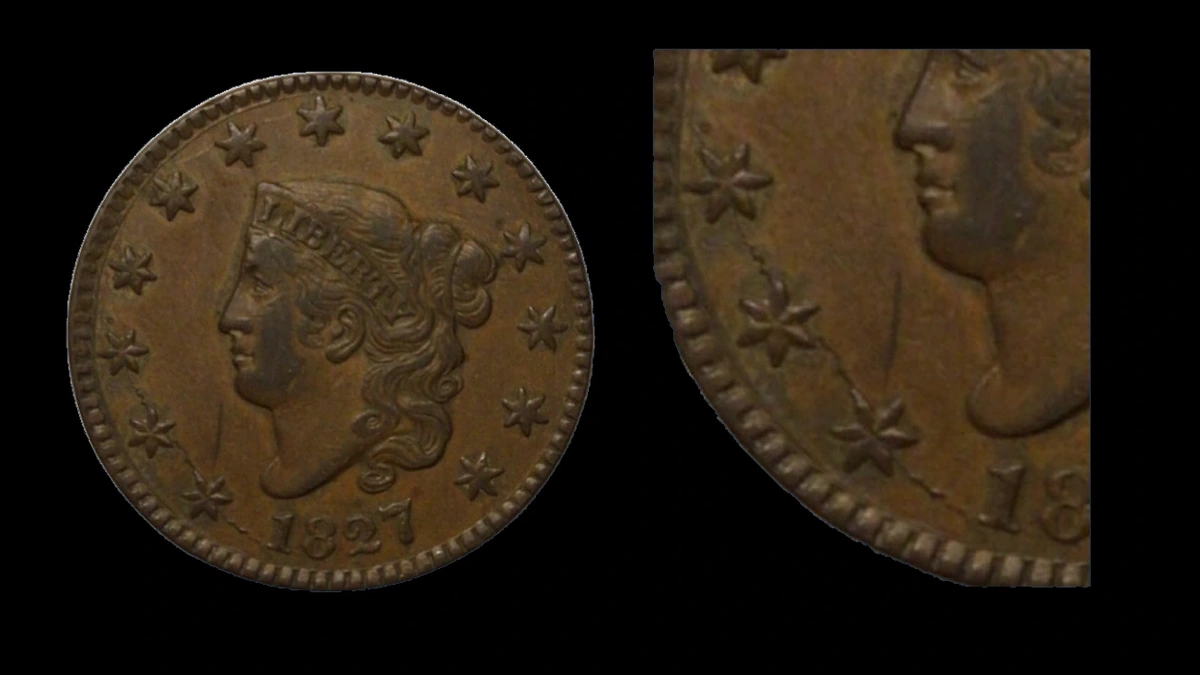
3. 1827 Penny A Shallow Copper Flake Is Missing beside Star Seven: Planchet Flaw Error
The documented N-2 example has a shallow missing flake near the teeth to the right of star seven. Fine pin scratches appear within that area and below star eight.
The original missing flake and the later scratches have different causes. ANACS described EF40 detail with “Fields Tooled,” indicating subsequent alteration of the surface around the design.
How to Identify
Locate star seven and trace the shallow opening separately from the fine lines cut across it. The similar scratches below star eight show that the later damage extends beyond the original defect.
Keep measuring tools away from the opening and inspect the edge for further alteration. A small flake may cause little measurable weight loss.
What It’s Worth
The estimated range is $25–$1,500 for genuine flake defects across differing conditions. A tooled coin needs a lower comparison than an otherwise similar example with original surfaces.
An 1842 large cent with a small border-layer flaw brought $750 in September 2021. That neighboring-year result does not cancel the effect of tooling and scratches on the recorded 1827 N-2.
4. 1827 Penny Raised Lines or a Retained Patch Begin near the Date: Die Cracks and Cuds Error
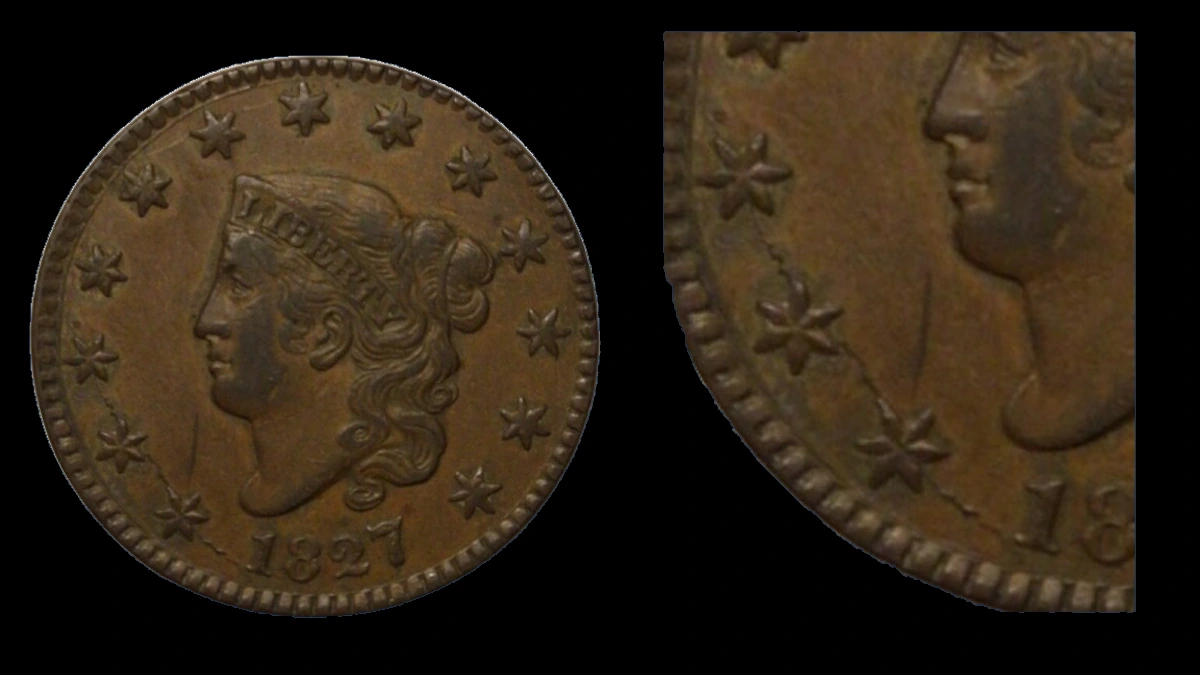
On N-12, a crack rises between the date’s 1 and 8 toward the ear and can extend farther across the front at stronger stages. Not every N-12 coin shows the fully developed path.
N-6 instead has a retained cud below the date: a fractured section of the die stayed in place and shifted. The recorded coin also has a separate later dent at ED in UNITED.
How to Identify
Choose the correct starting location, then distinguish a raised crack from a scratched groove. A retained break may keep design inside its boundary, so it need not be a smooth blank lump.
Inspect the rim and follow the entire below-date section on N-6. Do not identify the dent at ED as another cud or require the N-12 crack on that separate variety.
What It’s Worth
The estimated range is $30–$2,000 across cracks and retained breaks. The stage’s scarcity and the coin’s preservation can matter as much as the size of a raised area.
The N-6 example described as VG8 sold for $264 including the buyer’s fee in May 2025. Its retained break and later rim dent both belong in that whole-coin comparison.
5. 1827 Penny LIBERTY Has Reported Extra Outlines: Repeated-Letter Variety Error
N-4 and N-5 share the same front die, so their different reverses do not create two independent front-doubling types. The reported extra outlines occur in LIBERTY on that shared front.
The report uses the term doubled die, meaning repeated design already in the stamping tool. For these early letters, hand reworking of the die and flat edges created during striking must also be distinguished.
How to Identify
Use an identified N-4 or N-5 front photograph and compare the extra shape on each affected letter. A damaged letter, rough lump, or flat shelf is insufficient by itself.
Check the surfaces and edge for alteration, then look for the same pattern in the same positions on the reference. Merely identifying an ordinary N-4 or N-5 does not establish a doubling premium.
What It’s Worth
An authenticated repeated-letter variety has an estimated range of $40–$1,200. Wear and the clarity of the repetition control the usefulness of a comparison.
An 1887 Indian cent doubled die graded PCGS MS63 Brown sold for $1,380 in June 2025. That later, better-defined variety does not establish the cause of the 1827 letter outlines.
Conclusion
A coin can preserve both a genuine production flaw and later damage, as the N-2 flake and N-6 retained break demonstrate. Record the original feature separately from tooling, scratches, cleaning, or dents before comparing values.
For striking errors, determine whether one displaced image or two overlapping impressions are present. For LIBERTY, retain the limits of the reported identification and compare the shared front carefully rather than assuming every N-4 or N-5 earns a premium.